Poker Combinatorics: How to Count Opponent's Combos
Knowledge of math is a key skill for a poker player, and combinatorics is the most important topic for beginners. Let's discuss how to count combinations in an opponent's range.

One of our first coaches: on the team since the very founding of the project. He prioritizes simple and practical training with an emphasis on real game situations and decision-making over the long run. Val doesn't just "beat the games" as a player, but also instills a systematic approach to the game and discipline in his students.
Casual observers see poker as just another gambling game. They see no difference between poker, roulette, blackjack, or slots. Experienced players hold the opposite view: over the long run, results are determined by skill. Knowledge of math is a key skill for a poker player, and combinatorics is one of the most important topics for beginners. Let's discuss how to count combinations in an opponent's range.
Key information about combinatorics in poker
Combinatorics lets you count the number of combinations in an opponent's range.
Calculations bring clarity to a hand. A player doesn't guess the opponent's hand — instead, they split the opponent's range into groups and assign a mathematical probability to each.
The total number of starting combinations in No-Limit Texas Hold'em is 1,326.
Any pocket pair includes 6 combinations, an offsuit unpaired hand — 12, a suited one — 4.
The number of combinations when describing a hand is often denoted by the # symbol.
A blocker is a card known to the player that reduces the number of combinations in the opponent's range.
Combinatorics develops range-based thinking. It's convenient to hone this skill in poker calculators like Flopzilla Pro or Power-Equilab.

New breakdowns in your inbox
Subscribe to the FunFarm newsletter: fresh Poker ABC articles and material that helps you grow as a player.
Why count combinations
In 1990, two-time WSOP ME winner Stu Ungar played heads-up against reigning WSOP champion Mansour Matloubi. In one hand, Stu opened T9o and got a call from Mansour's 45o. The flop came 3-3-7. Ungar made an overbet on the flop, and Matloubi called. On the turn, a K arrived and the players checked. The dealer put a Q on the river, and Mansour went all-in. Ungar thought for a few seconds and said: "You have 45 or 56. Call!" The legendary player exposed his opponent's T-high call and made one of the most memorable hero calls in history.

Thanks to combinatorics and experience, the best players in the world can figure out an opponent's hand in a matter of seconds
To read opponents at Stu Ungar's level, you need talent and colossal experience. However, the starting point for brilliant calls is knowledge of combinatorics. The ability to quickly count combinations moves a player from the level of "he probably has aces, kings, and queens in his range" to "he has 6 combinations each of AA, KK, and QQ." It brings the most benefit when combined with poker math. Let's demonstrate with an example.
Suppose Kristen raised 3 BB preflop. Alex called. There are 7.5 BB in the pot. The board didn't improve Kristen's hand, but she's considering a 4 BB continuation bet. If Alex folds at least 35% of the time, Kristen's action won't be a loss. A higher fold rate will bring Kristen profit. Combinatorics will help figure out how often the opponent will fold to the c-bet. Kristen needs to:
picture Alex's preflop range;
calculate the ratio of made and unmade combinations on the flop;
calculate the percentage of hands with which Alex will fold to the c-bet.
Calculating fold equity and combination counts is a basic minimum for a player. As skill level grows, a poker player starts factoring in other elements, such as range balancing. However, you can move on to more complex concepts only once you've fully understood the simple ones.
Basic combinations in poker
No-Limit Texas Hold'em is played with a 52-card deck. It allows for a two-card combination to be formed in 1,326 ways. That's an impressive number of combinations, but not compared to Omaha. A starting hand of four cards can be formed in 270,725 ways.
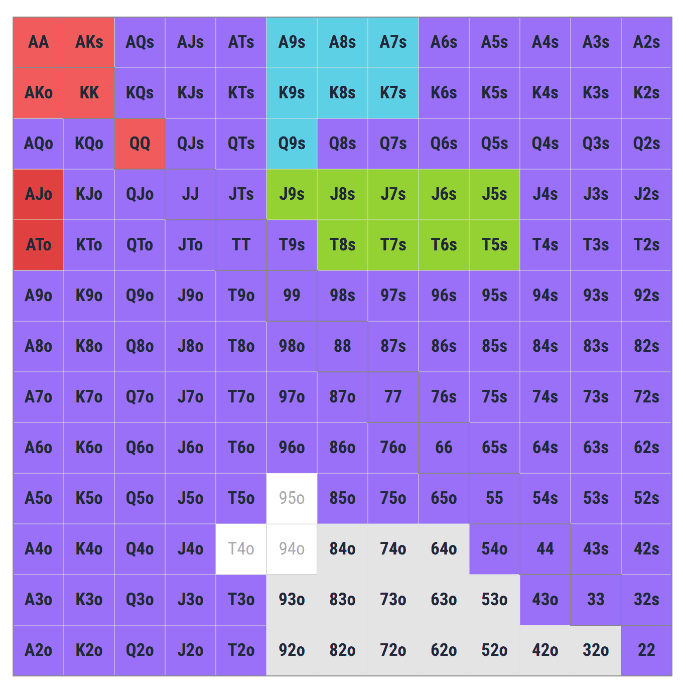
The starting hand matrix clearly shows all NL Hold'em combinations
Let's go through the main hand groups:
Pocket pair. Six combinations. For example: A♠️A♥️, A♣️A♥️, A♠️A♣️, A♦️A♥️, A♣️A♦️, A♦️A♠️. There's no other way to make a pair of aces. In No-Limit Texas Hold'em, that's #78 pocket pairs.
Offsuit hands. Can be formed in 12 combinations. Example: K♠️Q♥️. The largest group of combinations.
Broadway. Includes all hands with cards from T to A. For example: A♠️T♥️ or Q♥️J♣️. Broadway usually includes both offsuit and suited combinations. That's why each broadway hand is counted as #16.
Suited connectors. Four combinations. Example: 9♠️8♠️, 9♥️8♥️, 9♣️8♣️, 9♦️8♦️.
Suited aces. This category includes any suited hand with an ace. For example, A♣️7♣️. Each combination gives #4.
Some hands fall into several groups at once. For example, J♠️T♠️ is classified as both broadway and a suited connector.
Learning at FunFarm, from any level
How blockers reduce the number of combinations
Blockers play a significant role in reading hands. A blocker is a card in the hand or on the board that reduces the number of probable combinations for the opponent. Let's explain with an example. Suppose Liv raised preflop with A♠️A♥️ and got a 3-bet from Igor. She knows her opponent only 3-bets 2% of his range. It includes: AA, KK, QQ, AK. In a vacuum, Igor would have #32. However, Liv knows her own hand, so she can calculate her opponent's exact number of combinations. Among Igor's possible hands:
A♦️A♣️. The only combination — Liv's hand blocks the rest.
#6 KK and #6 QQ each. Liv's aces don't reduce the number of kings and queens combinations.
A♦️K♦️, A♣️K♣️, A♦️K♣️, A♦️K♠️, A♦️K♥️, A♣️K♥️, A♣️K♠️, A♣️K♦️. A total of #8 AK.
Thanks to blockers, Liv narrowed Igor's range from #32 to #21.
This blocker concept is also applied postflop. Suppose Kristen opens the betting from CO with A♣️K♣️.

Blockers reduce the number of combinations for the opponent but don't eliminate them entirely. That's why pushes with AK sometimes run into AA-KK
Alex calls on the BTN. From tracker stats and notes, Kristen knows her opponent 3-bets 5% of his range. It includes: TT-AA, AK, A2s-A5s and 87s. Alex calls with 10% of his hands. His calling range includes: most of broadway and pocket pairs. On the flop, the dealer puts down A♦️7♥️2♠️.
Let's count Alex's made hands on the flop. Let's go from strongest to weakest:
Sets of 777 and 222. A total of #6.
Two pair A2. A total of #2.
Top pair aces. A total of #24.
Underpairs. A total of #48.
Another 36 broadway combinations missed the flop entirely. With statistics, experience, and combinatorics skills, Kristen can put together an effective plan for the hand.
In a real hand, applying the blocker concept is more difficult. Working against the player are:
Time. Online, a poker player must make a decision within a few dozen seconds. Otherwise, their hand goes to an automatic fold. Live play allows more time, but within reasonable limits.
Lack of information. In the Kristen vs. Alex matchup, we set up ideal conditions with narrow and precise ranges. In a real game, there's less data on the opponent.
Psychological pressure. In real conditions, a player's decisions are influenced by the money in the pot, fatigue, and other factors.
Combinatorics on the flop
Counting combinations brings the most benefit postflop. It lets you assess how well the board fits the opponent and choose the most profitable line to play. Let's demonstrate with an example.
Suppose a player from UTG who raised a 15% range flops A♠️K♥️7♦️. Let's break down how it connects with the board and what combinations it produces.
Raising range. The top 15% of a range usually includes pocket pairs and broadway. The proportion depends on the player's preferences. Some players open all pairs and most of broadway. Others cut low combinations, like 22-55, but add QTo, JTo.
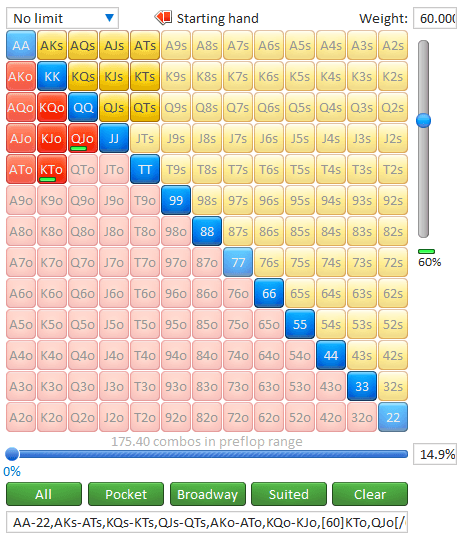
The same range percentage can include different combinations
Combinations on the flop. The high cards on the board connect well with the UTG player, since they raised a lot of broadway hands. At the same time, pocket pairs found themselves in a vulnerable spot. Let's count the number of combinations:
AA, KK, 77 flopped a set. A total of #9.
AK makes two pair. A total of #9.
AQ, AJ, AT hit top pair. A total of #36.
KQ, KJ, KT make second pair. A total of #32.
QQ-88 and 66-22 make underpair. A total of #60.
QJ, QT flopped a gutshot. A total of #15.
Situation analysis. The range can be split into 3 groups. The first includes strong hands. Players bet these for value. It includes: sets, two pair, and top pairs. The second includes vulnerable made hands: second pairs and underpairs QQ-88. It's not worth value-betting these, but they're good for catching bluffs via check-call. The third group includes 66-22. You can't bet these for value, and a check-call plan rarely works either.
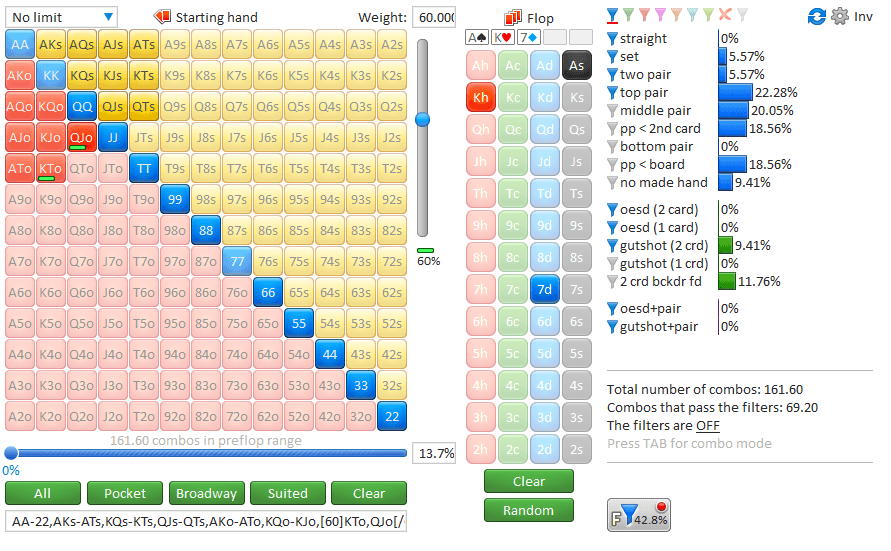
Working in a calculator teaches you to quickly count combinations and visualize an opponent's range
Note the gutshots on QJ and QT. These can make for a good semi-bluff. Sometimes opponents will fold to the continuation bet. Sometimes we'll hit our straight, and sometimes we'll run into a coincidence and take the pot from pocket pairs, like TT, 99, 88.

What software is more convenient for counting combinations
An equity calculator will help develop range-based thinking. The poker software industry offers several options:
Flopzilla Pro. The best product in terms of price-to-quality ratio. Lets you save ranges and analyze hands. Allows you to break down not only one-on-one situations but also multiway pots. Additional tools, like Hotness, are also a plus. The developer offers a 7-day trial version. A lifetime license costs $25.
Power-Equilab. An advanced version of the free Equilab. Lets you create ranges, group and color-code hands, and analyze hands. Beginners will appreciate the convenient equity calculator and Heatmap. The developer offers a 14-day trial. A monthly subscription costs $5.
Oranges Calculator. Lets you visualize opponents' ranges, create your own ranges for any situation, and calculate the probability of hitting a made hand or a draw. The tool includes: a built-in pot odds calculator, a Range vs Range function for calculating range equity, and a Preflop All-in Helper for assessing EV in push/fold situations. Oranges Calculator has a free 7-day version. A lifetime license for the calculator costs $17.
A poker player also can't do without statistical software. Hand2Note 4 or PokerTracker 4 save information about every hand played.
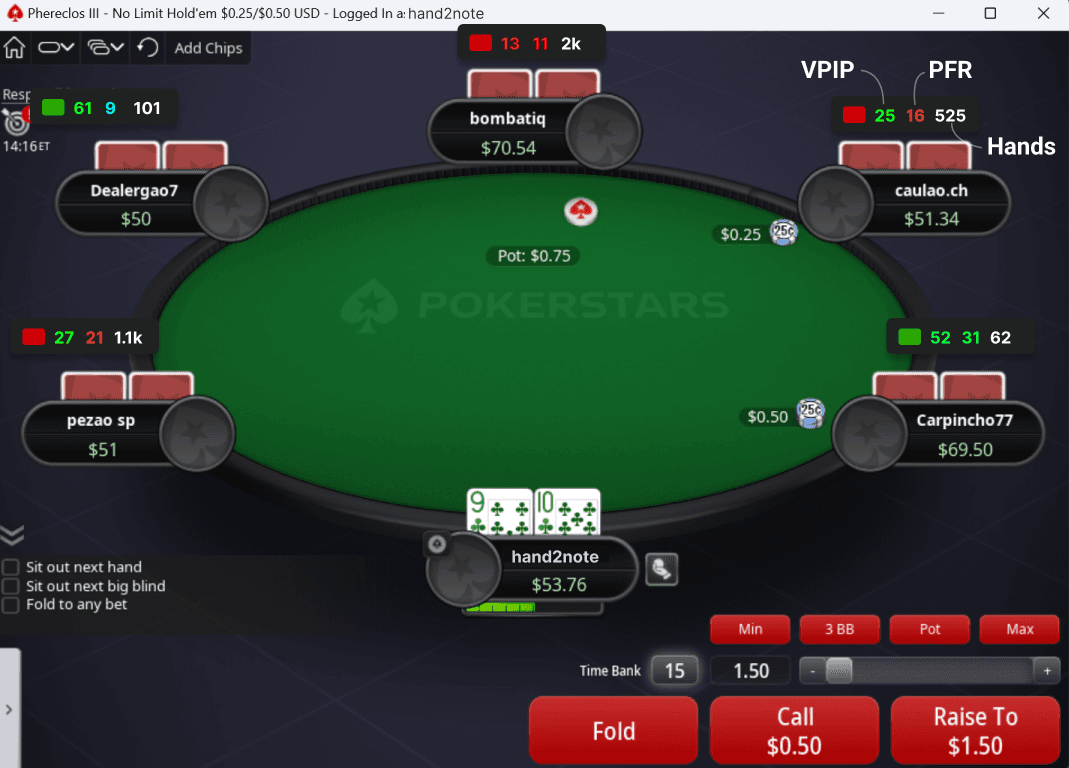
A tracker provides basic information about the opponent. Stats help identify their type, range, and postflop tendencies
Over time, a player will accumulate enough data to make assumptions about an opponent's range. VPIP, PFR, and other stats will help count combinations more accurately and put together a better plan for the hand. We covered trackers and other tools in more detail in "The Complete Guide to Poker Software."
How to learn to count combinations
To know how many combinations an opponent has, you need to constantly analyze hands in a calculator. We recommend first counting the number of combinations on your own, then checking the results in the software. With practice, a deeper understanding of ranges will come, and the speed of complex calculations will rise to a few seconds. It's a good idea to choose a room that allows playing with stats. Information from Hand2Note or Holdem Manager 3 will increase the accuracy of your analysis.

FunFarm poker school gives you the opportunity to go from micro stakes all the way to the WSOP Main Event
Knowledge of combinatorics is just one building block of poker mastery. To reach a high level of play, you need a comprehensive approach. FunFarm school provides that. The FF Start course is a good fit for beginners. Over 30 lessons, a beginner will learn the basic concepts of poker. The training ends with an exam. Graduates of the program are accepted into FF Player Path. At the advanced tier, students break through micro stakes and reach a monthly income starting from $1,200. Want to become a professional — join FunFarm.

Free course · FF Start
Poker math without complex formulas
Learn to quickly estimate probabilities, the price of a call and the expected result of a decision.