Poker Variance Calculator
In 2003, a modest accountant from Tennessee won the WSOP Main Event. His victory sparked the online poker boom. If he had lost an online satellite on PokerStars and never made it to the WSOP, the history of poker would have taken a different path. Let's discuss variance — the poker equivalent of luck.


One of our first coaches: on the team since the very founding of the project. He prioritizes simple and practical training with an emphasis on real game situations and decision-making over the long run. Val doesn't just "beat the games" as a player, but also instills a systematic approach to the game and discipline in his students.
Key facts about variance
Variance is a mathematical indicator that shows the difference between the expected and actual result. In most situations, variance and luck mean the same thing.
The variance calculator works out the relationship between a player's skill level and the length of a losing streak. The higher a poker player's skill level, the easier it is for them to survive a negative swing of variance.
Understanding variance helps you choose an appropriate bankroll management strategy.
In the worst-case scenario, a winning player can hit a downswing of 100 buy-ins.
To withstand variance, you need to constantly improve your skill level. An increase in winrate offsets the effect of a losing streak.

New breakdowns in your inbox
Subscribe to the FunFarm newsletter: fresh Poker ABC articles and material that helps you grow as a player.
What variance is in poker
Variance in poker is the deviation of a player's actual results from what's expected mathematically. It shows the difference between how much you should have won according to probability theory and the actual state of affairs. Let's illustrate with an example. Liv went all-in preflop with 22, and Igor called the push with AA. The holder of the aces is the favourite in the hand and will win 80% of the time. However, a deuce comes on the board, and Liv takes the money. Over a distance of 100 all-ins, the maths will win out and Igor will make up for the loss, but in this particular hand luck sided with Liv.
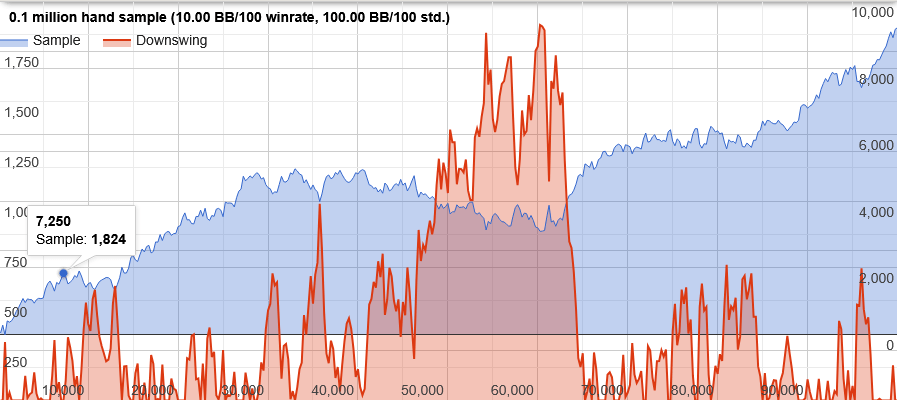
Variance isn't just bad luck or a losing streak — it's a mathematical reality. Sooner or later, every player experiences its effects. A deviation from the norm doesn't always lead to a series of losses. A weak player winning a major tournament is the result of a positive swing of variance.
Variance has a colossal effect on a player's career. It can turn a profitable month into a losing one and vice versa. To react calmly to setbacks, poker players need a deep understanding of the nature of variance. Otherwise, they risk catching a severe tilt.
It's especially important for tournament players to know everything about variance. Huge fields increase the role of chance in the final result. Sometimes poker players hit losing streaks lasting several weeks or months. When a player knows that a downswing can last hundreds of tournaments, they act more disciplined and cope with losses more calmly. Understanding variance encourages players to follow conservative bankroll management. A cash reserve and moving down in stakes in time protect a player from going broke.
What a variance calculator is and how it works
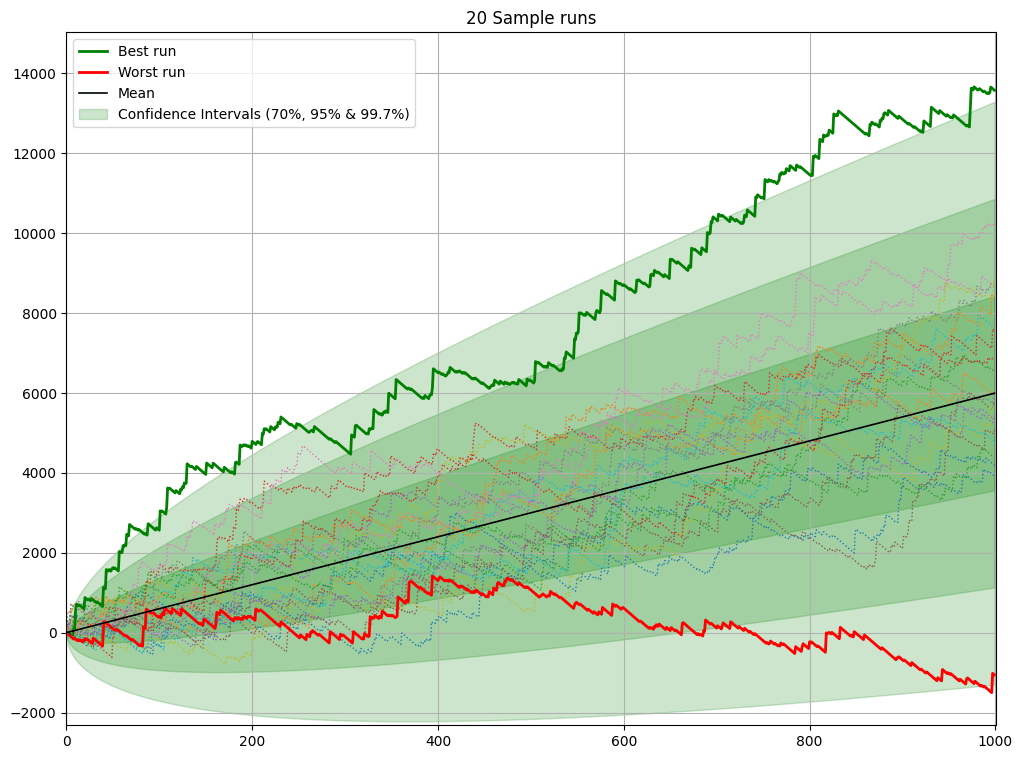
A variance calculator is a tool for simulating millions of possible outcomes based on given parameters. It shows thousands of alternative versions of the same distance — from the luckiest to the most catastrophic. The engine behind these calculators uses the "Monte Carlo" simulation method. The program repeatedly "replays" the entered data, letting chance determine each result.
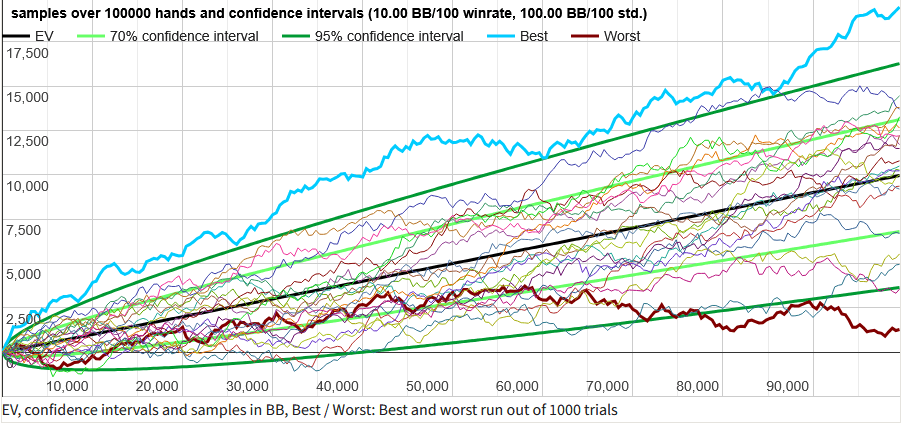
Here's how the method works in poker: the calculator doesn't analyse every single hand, but instead "replays" your distance thousands of times. In each variant, it randomly decides whether the poker player wins or loses. When analysing tournaments, it takes into account ROI and the payout structure. At the end of the simulation, it shows:
which results occurred most often,
where the deepest downswings were,
what the spread of final winnings looks like,
what bankroll will protect the player from going broke.
The main advantage of Monte Carlo: the method replaces complex maths with a repeated random experiment that delivers highly accurate results.
To calculate variance in cash games, you need to know 3 parameters: winrate (EV bb/100), standard deviation (bb/100) and the number of hands. All this information can be found in Hand2Note or another poker tracker.
A variance calculator for tournaments requires more data:
the number of MTT entrants;
the number of paid places;
the buy-in size;
rake as a percentage of the buy-in;
the player's ROI;
the total distance.
As output, the calculator provides: the range of possible results, the depth of downswings, the probability of going broke and the minimum bankroll for a given level of risk.
Learning at FunFarm, from any level
Variance in cash games
To gauge the strength of variance in cash games, let's take a player with a good winrate of 10 EV bb/100. The calculator shows that in the worst-case scenario, over 100,000 hands the poker player will go 20.5 stacks into the red. With 5 EV bb/100 over the same distance, they risk losing 56 stacks. The difference between the expected win and the actual outcome can amount to as much as 126 stacks. Many professionals regularly go through painful losing streaks.
Downswings are a popular topic on poker forums. Many professionals love to post tearful complaints along with dramatic graphs. For example, one NL500 player tracked all their bad luck over 260 hours. After two months, they ended up $6,000 in the red. By EV, they should have won over $8,000. They regularly ran into coolers and lost hands where they had a 90% chance to win. The difference between reality and EV amounted to 26 buy-ins.
Players face even more impressive drawdowns at Omaha tables. On the 2+2 forum, users tell horror stories about downswings of 100 buy-ins. For many regulars, a prolonged losing streak knocked them off balance for a long time. Some players even quit poker altogether.

Even poker stars have run into downswings. In 2008, Tom “Durrrr” Dwan lost around $2,000,000 over 4 months. Tom's aggressive playing style and high variance regularly caused him problems. In 2009, Dwan went $7,000,000 into the red following clashes with Phil Ivey, Ilari Sahamies, and Viktor Blom.
Variance in MTT poker
Variance doesn't spare tournament players either. In MTTs, a poker player with a 30% ROI can play more than 200 tournaments without any major successes. Let's take, as an example, a player with an ABI of $20 and a 20% ROI. Suppose they played 1,000 tournaments with 500 entrants each. The calculator says that in the worst-case scenario, the poker player will end up several thousand dollars in the red. Some players have experienced variance this severe firsthand.

The most impressive losing streak was endured by Andy “Bowie” Wilson. In one of his podcasts, he talked about a drawdown of 1,000 buy-ins. In monetary terms, he lost over $200,000. The prolonged losing streak didn't break Andy — he continues to play successfully both online and offline. His biggest achievement is winning a World Poker Tour stop in Florida. For first place, he received $785,800.
Even regular players fall under the steamroller of variance. For example, an experienced MTT regular with an ABI of $100 and a 35% ROI mentioned a downswing of 240 buy-ins. Many professionals note that they've lost 200 buy-ins several times over the course of their careers.
How to use the variance calculator for bankroll management
The variance calculator clearly shows the relationship between a player's skill level and the chance of going broke. Beyond the main simulation, the tool offers a Bankroll Requirements Calculator. It lets you find out the bankroll size that will protect a player from ruin. The final amount depends on the poker player's winrate. For example, with 3 EV bb/100 at NL10, a player needs a bankroll of $410. But if a regular shows solid poker with 15 EV bb/100, $90 will be enough.
When working with the Bankroll Requirements Calculator, it's important to remember the risk tolerance parameter. By default, the calculator is set to 5%. This means: 1 out of 20 poker players with the same bankroll and similar stats will lose all their money. If you want a more conservative recommendation, lower the risk tolerance to 1%. Then a player with 3 EV bb/100 at NL10 will be advised to build up $630.
The calculator will help you pick the right bankroll size for moving up to the next stake level. Many training videos and materials offer an approximate plan for progressing through the stakes. For example, here are our recommendations for cash game players from the article “How to Beat Microstakes”:
Limit | Bankroll | Move up | Move down |
NL2 | $50 or 25 buy-ins | $150 | — |
NL5 | $150 or 30 buy-ins | $400 | $75 |
NL10 | $400 or 40 buy-ins | $1,250 | $250 |
NL25 | $1,250 or 50 buy-ins | $3,000 | $875 |
NL50 | $3,000 or 60 buy-ins | $7,000 | $2,250 |
These figures suit most players, but they don't account for a particular poker player's skill level. If a regular is beating NL10 with an EV winrate of 15 bb/100 and doesn't tilt, there's no need for them to waste time saving up 50 buy-ins for the next limit. Let's imagine that at NL25 the player's winrate drops to 5 EV bb/100. The poker calculator says they can still try to establish themselves with a bankroll starting from $650.
Many players forget about the rake factor. The size of the commission often determines a poker player's standing. Let's illustrate with an example. Take a player with a "clean" winrate of 5 EV bb/100. On a platform with an 8 EV bb/100 rake, a winning player would end up playing at -3 EV bb/100. Excessive rake also hurts tournament players' ROI. When choosing a room, study its rake structure. As of July 2026, the smallest cash game commissions were charged by:
WPT Global — 3.06%.
CoinPoker — 3.65%.
PokerStars — 3.65%.
It's also worth remembering rakeback. Most online poker rooms return a share of the commission to players. Rakeback partly offsets losses from the rake.

Common mistakes in interpreting results
A player's skill level is usually measured using bb/100 and ROI. Many poker players make mistakes when assessing their results. Let's look at the most common ones.
Analysing a small sample. Taking a sample of a few thousand hands and extrapolating the results is one of the most serious mistakes. Over a short sample, much depends on variance rather than skill. Take a microstakes MTT player. Say they played 100 tournaments at $5 with a 100% ROI and decided to move up. In the more expensive MTTs, their run of luck came to an end and they lost their bankroll. Long-term conclusions about skill shouldn't be drawn from a small sample.
Working poorly with filters. Let's consider the example of a tournament regular. Over a month, they played 500 MTTs and broke even. To improve their results, the player: reviews hands, drills push/fold, discusses strategy with colleagues. They have no idea about a simpler way to turn a profit. The regular's key problem can be found in the filters. Their main mistake is playing tournaments of different formats. The player shows a high ROI in deep-stacked MTTs, while the bulk of the losses come from fast-structure tournaments. They should reconsider their schedule in favour of Deepstack, and things will start to improve.
Ignoring rake and rakeback. Many players focus only on their "clean" winrate. They don't account for commission and rakeback. Remember indirect income and expenses. Without them, a player risks reaching mistaken conclusions about the quality and results of their play.
Comparing winrates across different limits. A steady 5 EV bb/100 at NL1000 is considered an outstanding result. The same winrate at NL25 can be called a decent figure, but nothing more. To adequately assess your own level, compare your stats with the best players at your limit.
How to improve your chances against variance
The most effective way to fight variance is training. If a poker player systematically raises their level of play, their winrate grows too. Constant progress doesn't compensate for losses during a downswing, but it softens its impact. An additional benefit of training is that the player focuses attention on reinforcing skills rather than on frustration from a bad beat or a cooler.

A systematic training programme is offered by the FunFarm school. The FF Start course is a good fit for new players. It introduces beginners to the basic concepts of poker. The starting stage of training ends with an exam. Graduates are accepted to the advanced level — FF Player Path. The course's goal is to prepare a poker player for a professional career. Over 8 months of training, players reach an average income of $1,200.

Free course · FF Start
Poker math without complex formulas
Learn to quickly estimate probabilities, the price of a call and the expected result of a decision.