VPIP and PFR: How to Read These Poker Stats
In online poker, the information vacuum is filled by statistical software — trackers. They save data on players' actions and help interpret it. Let's discuss the key stats — VPIP and PFR.


One of our first coaches: on the team since the very founding of the project. He prioritizes simple and practical training with an emphasis on real game situations and decision-making over the long run. Val doesn't just "beat the games" as a player, but also instills a systematic approach to the game and discipline in his students.
In live poker, observation lets you “read” an opponent. Gestures, manner of speech, and tone of voice can hint at the right decision at the table. Online, you can't spot an opponent's hand by their eyes or shaking hands. In online poker, statistical software — trackers — fills that information vacuum. They store data on players' actions and help interpret it. Let's discuss the key stats — VPIP and PFR.

New breakdowns in your inbox
Subscribe to the FunFarm newsletter: fresh Poker ABC articles and material that helps you grow as a player.
VPIP and PFR in brief
VPIP stands for Voluntarily Put Money In Pot. It shows the percentage of hands where a player voluntarily put money into the pot. Voluntary actions include: raises, calls, 3-bets, squeezes, limps, all-ins. It's a basic stat in any poker tracker.
PFR stands for PreFlop Raise. It shows the percentage of hands where a player raised before the flop. We take "raise" broadly — including 3-bets, 4-bets, and all-ins.
The VPIP/PFR ratio lets you form a first impression of an opponent's playing style. It's often cited in hand descriptions.
The higher the VPIP and PFR, the wider the range of hands the opponent plays.
To form a reliable impression of an opponent, remember about sample size. For VPIP and PFR, you need at least 200 hands on an opponent. 15-20 hands only allow rough conclusions about the opponent's type.
What VPIP means in poker
VPIP in poker is a basic tracker stat. It indicates the percentage of situations where a player voluntarily invested money in the pot.

VPIP stands for Voluntarily Put Money In Pot. To calculate VPIP, divide the number of hands where the player voluntarily invested money in the pot by the total number of hands and multiply by 100
Voluntary actions include: raise, 3-bet, 4-bet, all-in, call, limp. Forced small and big blind bets are not included in VPIP. Let's look at an example. Liv is on the BTN and raises. Igor is on the BB and folds. The tracker will count Liv's action as VPIP. It won't count Igor's forced blind.
VPIP in poker indicates how wide an opponent's range is. For example, an opponent with a VPIP of 50 plays 50% of all starting hands. A stat of 15-25 suggests we're facing a tight-aggressive player with a strong range and high discipline. VPIP of 40+ signals we're up against an amateur.
Against players with a wide range, it's profitable to bet c-bets on the flop and aggressively barrel with strong hands. An opponent with a low VPIP folds a lot preflop, so it's profitable to steal their blinds.
What PFR means
PFR in poker indicates the percentage of hands where a player entered the pot with an aggressive action. PFR stats include: raises, 3-bets, squeezes, 4-bets, all-ins. The tracker doesn't include in PFR: forced blind bets, calls, and limps. Let's look at an example. Say Liv raises from the CO. Igor calls on the BTN. Opponents on the SB and BB fold. Liv's action will count toward PFR, Igor's won't. The tracker will count Igor's call toward VPIP. Blind folds count toward neither VPIP nor PFR.
PFR helps you understand an opponent's aggression level. The bigger the gap between VPIP and PFR, the more passive the opponent. PFR is always lower than VPIP: any raise implies voluntarily investing money in the pot. If a player shows aggression, their action counts toward both stats. When a player calls or limps, only VPIP grows.
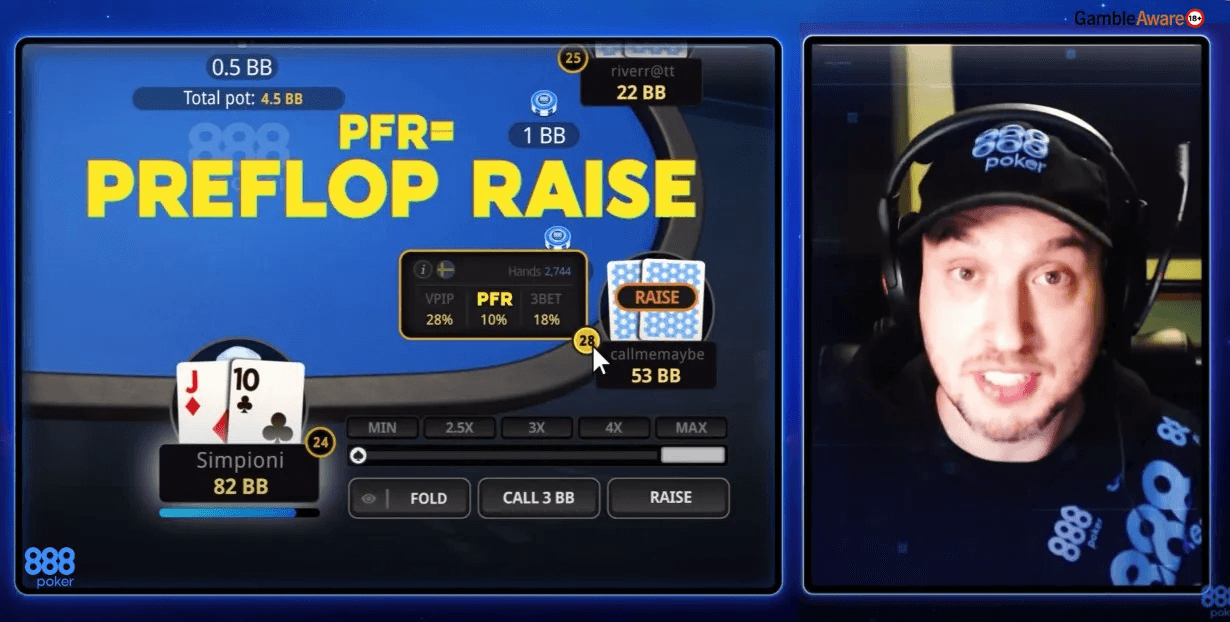
PFR in poker is one of the key stats. It helps determine a player's type and raising range
Let's examine the connection between styles and stats using players with 35/3 and 23/22 as examples. The first player likes to see flops but prefers passive lines preflop. Their range includes many medium-strength hands. Against a passive opponent, it's profitable to increase the size of value bets with strong hands. An opponent with 23/22 is harder to outplay, because they constantly bet and raise. To counter them, you need to widen your 3-bet range preflop.
Learning at FunFarm, from any level
Types of players by VPIP and PFR
Hand2Note, PokerTracker 4, and other statistical software store and process a huge amount of information. Users get thousands of stats. Studying all the stats would take more than a week. However, beginners can already benefit from VPIP and PFR in their first days playing with a tracker. Combining these stats lets you sort opponents into types.
To draw conclusions about an opponent's strategy, accumulate enough hands. Don't make expensive decisions based on 5-10 hands
Let's discuss them in more detail.
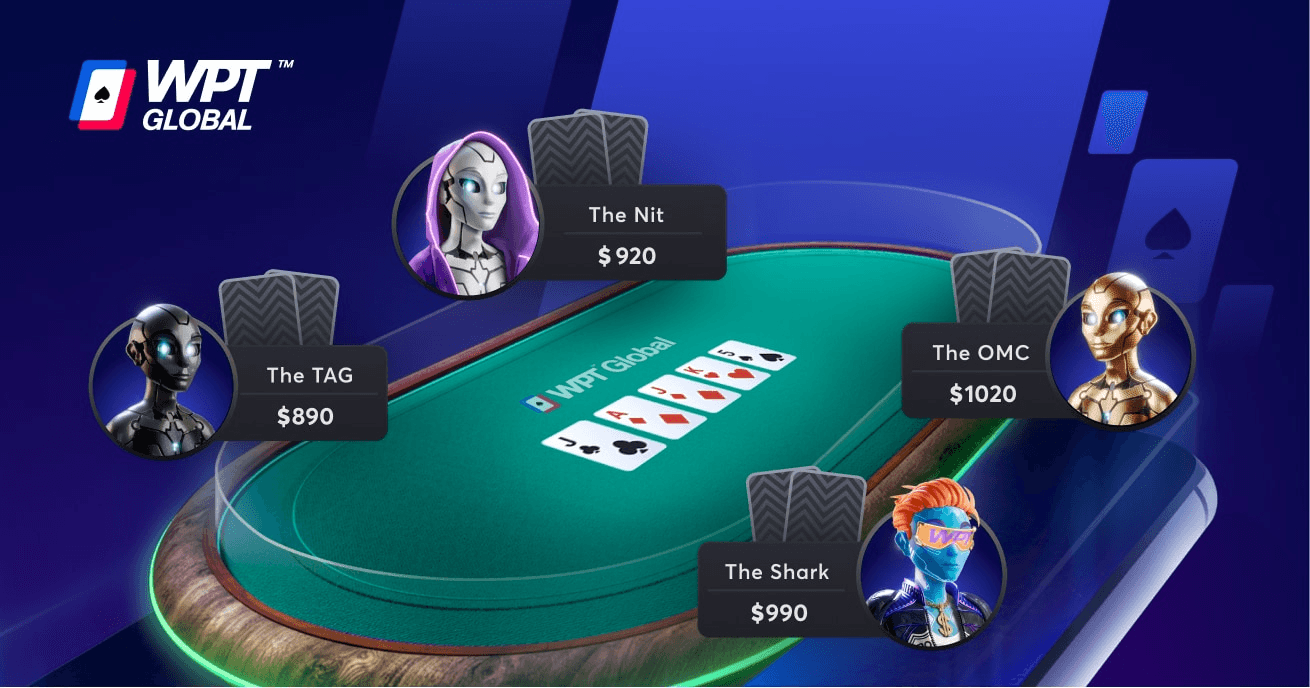
TAG. Tight-aggressive player. Plays a strong range. Prefers to enter pots with raises. Avoids calls. Never enters a hand with a limp. A TAG's approximate stats look like this: VPIP — 28-32, PFR — 24-26. Tight-aggressive players show solid poker with a minimal number of mistakes and expensive bluffs. Most strong players fall into the TAG category.
LAG. Loose-aggressive player. Plays a wide range with a lot of marginal hands. Constantly raises and 3-bets. Barely uses calls and limps. Basic LAG stats: VPIP — 34-40, PFR — 27-32. It's difficult to counter the constant bets and raises of a loose-aggressive player. Try to keep your emotional balance and play carefully postflop.
Nit. Plays a very narrow range. Doesn't bluff beyond a c-bet. Stats give a nit away. Their VPIP is in the range of 10 to 16. PFR often doesn't exceed 10. When facing a nit, follow two rules: 1) fold to their raises and 3-bets; 2) steal their blinds with any two cards. Bluffs work poorly against tight opponents: a nit waited too long for a good hand to fold it.
Fish (calling station). Loose-passive player. Likes to see community cards cheaply. Ready to call big bets with any draw. Approximate stats look like this: VPIP — 40+, PFR — 5-15. Loose-passive players stand out due to a large gap between the two stats. Sometimes it reaches 30-40 points. For example, in MTTs you might encounter an opponent with stats of 42/7. To outplay calling stations, widen your value betting range and increase bet sizes. We don't recommend bluffing against loose-passive players: they rarely find a fold.
Maniac. An exaggerated version of a loose-aggressive player. Loves to keep constant pressure on opponents. Plays with VPIP and PFR of 40+. Whereas a LAG applies aggression appropriately and knows when to slow down in a dangerous spot, a maniac goes all the way. To outplay them, widen your calling ranges. Against aggressive players, even mediocre hands often win at showdown. Sometimes use a slowplay.

Profiling opponents makes decision-making easier. However, every player has unique traits. Take them into account and avoid "autopilot"
VPIP and PFR give a basic understanding of an opponent's playing style. As your skill level grows, pay attention to other parameters too: 3-bets, 4-bets, steals, aggression, c-bets. Don't forget about strategy differences across positions. The same player might open 10% of hands on UTG and 60% on the BTN. An averaged VPIP will distort the opponent's real range. Given enough hands, choose a specialized stat. For more on opponent types and strategies against them, check out our separate article.
How to analyze your own VPIP/PFR stats
Stats not only help you find gaps in your opponents' strategies but also help analyze your own game. Studying VPIP and PFR won't turn a player into the world's leading poker pro, but it will highlight major mistakes.
Widen your range carefully. Match specific hands to your skill level
For example, stats of 12/9 over a large sample indicate that a player is excessively tight. To earn more, you need to increase your VPIP and PFR. Other common problems:
VPIP>30. A high VPIP indicates a wide player range. The player often reaches postflop with weak hands and loses to better ones. Another source of losses — opponents' 3-bets. Remove the weakest hands from your range. Aim for a VPIP of 22 to 28. Poker trackers will offer valuable recommendations on which extra hand combos to drop.
VPIP>20, PFR<10. A large gap between VPIP and PFR indicates a player's love of calling. Passive lines lead to losses in modern poker. In most cases it's more profitable to 3-bet or fold a hand. Reduce your calling range to a minimum. Move the best combos to 3-bet, the weakest to fold. Try to bring VPIP and PFR closer together.
VPIP<15, PFR<10. Modest VPIP and PFR numbers indicate excessive caution. A nitty style is bad for several reasons: 1) the player gives away a lot of money by folding preflop; 2) opponents easily figure out when the player has caught a strong hand. To fix this, widen your raising and calling ranges. Studying the topic of "free money" spots will also help. With new knowledge, the player will start defending their blinds more often.
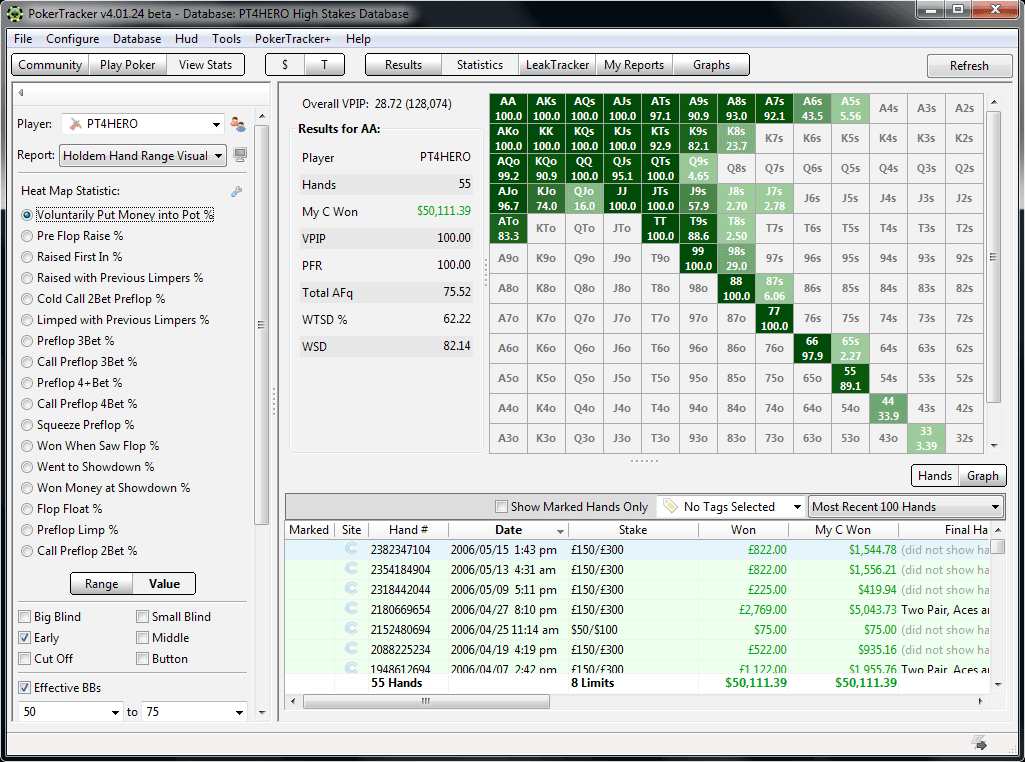
Adjust your strategy gradually. A sharp jump from 13/11 to 24/22 will lead to increased losses and loss of playing style. Widen your range gradually. Start with late positions. Having the last word postflop provides more comfortable conditions to experiment with weaker hand combos. A tracker will help you track progress. All statistical software displays a matrix of starting hands with information about their long-term profitability. A combo in the green zone — move on; in the red zone — don't add new hands yet.

How to choose a poker tracker
Trackers pay off from day one. Statistical software points out opponents' mistakes and lets you review your own hands. That's why beginners are advised to get a poker tracker as early as possible. The current market of poker software offers several options: PokerTracker 4, Holdem Manager 3, Hand2Note 4, and DriveHUD 2. We've gathered brief info in the table below:
Tracker | Price | Trial available |
PokerTracker 4 | $65 for Small Stakes | 14 days |
Holdem Manager 3 | $65 for Small Stakes | 15 days |
Hand2Note 4 | $192 for an annual H2N4 Learner subscription | 14 days |
DriveHUD 2 | $26 for an annual Microstakes subscription | 30 days |
PokerTracker 4. Released in 2011, but stays relevant thanks to regular updates. Provides a wide range of tools for game review. Detailed reports and graphs help find hidden strategy gaps. The Small Stakes version costs $65 and supports tournaments up to $22. The developer offers a 14-day free trial of PT4.
Holdem Manager 3. An updated version of the classic tracker was released in 2019. Combines high performance and an advanced toolset. The Holdem Manager 3 interface has been translated into 14 languages. The entry-level version of the tracker costs $65 and works in MTTs with buy-ins up to $22. The developer offers a free 15-day trial.
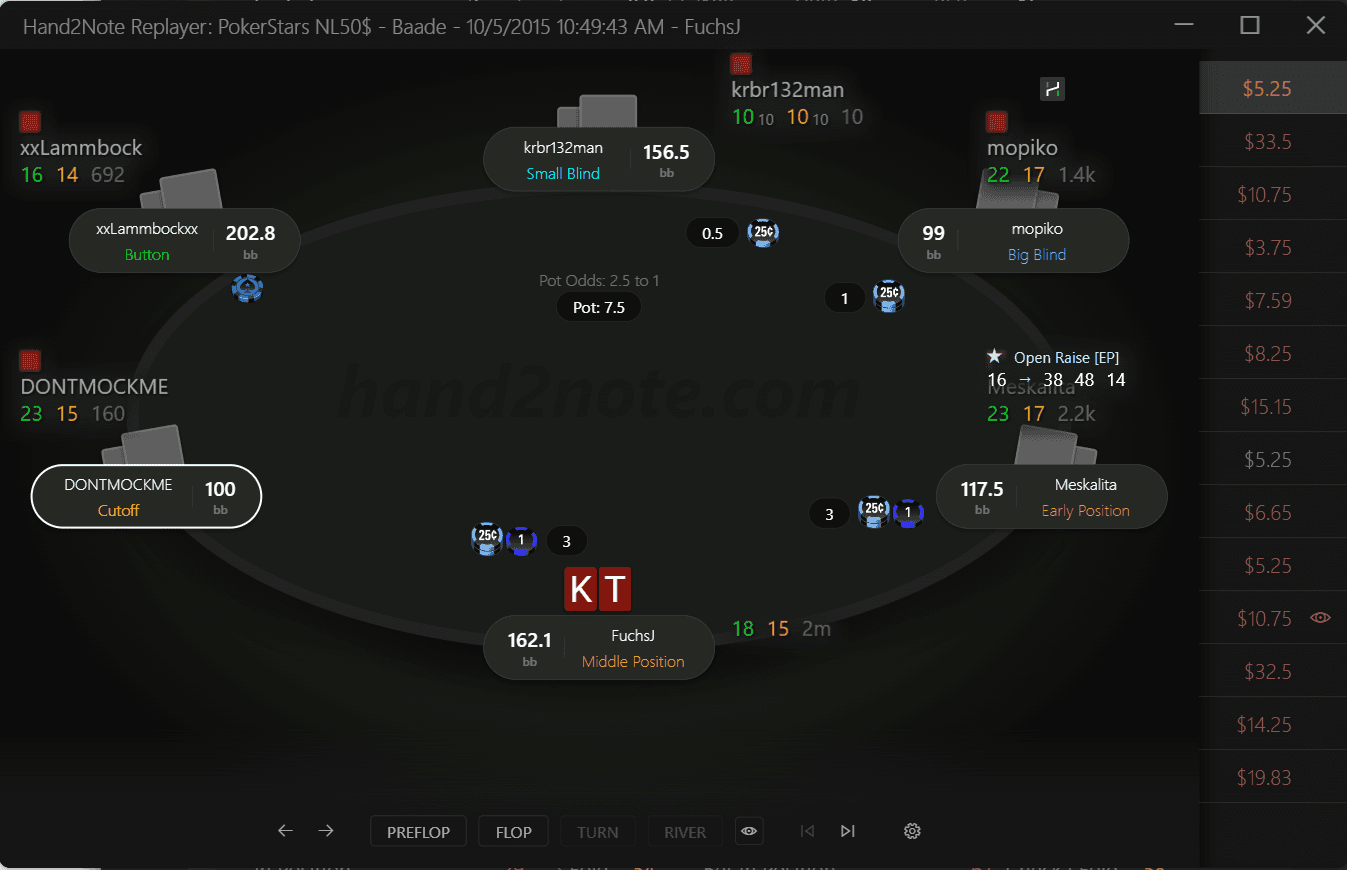
Hand2Note 4. The most technologically advanced software on the market. The updated H2N4 was released in 2025. A dynamic HUD, deep reporting system, high performance, and support for over 50 rooms are the main arguments in favor of Hand2Note 4. The tracker outperforms competitors in everything except price. An annual H2N4 Learner subscription costs $192. The developer offers a free trial of H2N4. The trial lasts 14 days.
DriveHUD 2. Released in 2021. A powerful and affordable tracker supporting around 30 rooms and mobile apps. DriveHUD 2's advantages include: an advanced HUD, a hand replayer, and detailed reports. Based on the reports, the tracker can generate self-test quizzes. An annual DriveHUD 2 subscription for microstakes costs $26. You can try the statistical software for free for 30 days.
Hand2Note 4 outperforms competitors both in features and in price
All the trackers on this list cover a beginner's needs: they display a HUD and import hands into a database. To choose the most suitable tool, use the free trials. Try each software, evaluate the interface and advanced features. The most budget-friendly option on the list is DriveHUD 2. Its functionality is more than enough to beat microstakes. The top solution on the market is Hand2Note 4. However, this tracker also costs more than the others.
Before buying software, check on 2 things: 1) whether the tracker supports the room you play on; 2) whether the room allows playing with stats. Some online poker brands restrict the ability to display a HUD. Stats are supported by: PokerStars, Winamax Poker, RedStar Poker, PokerKing, 888Poker, TigerGaming. Stats are banned on: POKEROK, Pokerdom, partypoker, Unibet.
How to learn to play poker
Information from a poker tracker gives you an edge over opponents. However, only high-level players use stats effectively. Hand2Note 4 won't bring a beginner much benefit. To turn scattered data into a real advantage, you need to study the stats and learn to interpret them. It's hard to solve this problem on your own, because modern trackers offer users thousands of stats. Without outside help and a systematic approach, the work will "eat up" months of your life.

We provide students of advanced courses with bankroll for playing at higher stakes and free software
FunFarm's training programs will help speed up your progress. We recommend beginners take the FF Start course. It consists of 30 lessons and lets you build a foundation for further growth. Adapting to different opponent types is one of the main topics of the program. We invite FF Start graduates to the next step — FF Player Path. Many lessons in the advanced course teach how to work with trackers and interpret stats. Join FF to reach a new level of skill and income.

Free course · FF Start
Count on decisions, not luck
Equity, outs, pot odds and bankroll — in plain language, with practical examples.