Call, 3-bet or fold after a raise: how to make decisions
An opponent opens with a raise, and we find ourselves holding a hand that looks too strong for an automatic fold, but not obvious enough to raise. In this situation, a call is often perceived as the safe decision: we don't inflate the pot and keep the chance to see a flop. However, in poker, far from everything is determined by the "safety of the action".

One of our first coaches: on the team since the very founding of the project. He prioritizes simple and practical training with an emphasis on real game situations and decision-making over the long run. Val doesn't just "beat the games" as a player, but also instills a systematic approach to the game and discipline in his students.

The opponent opens with a raise, and we find ourselves holding a hand that looks too strong for an automatic fold but not obvious enough for a raise. In such a situation, a call often feels like the safe decision: we don't blow up the pot and we keep the chance to see the flop. However, poker is far from being all about the "safety" of an action.
After calling, we'll have to play the hand on the following streets. Without position, we'll be making decisions before the opponent, our dominated cards may run into a stronger part of their range, and if we let other opponents into the hand, decisions become far less obvious. That's why a formally cautious call sometimes causes more damage than a well-timed fold or a precisely calculated 3-bet.
In this article, we'll break down how to choose between a call, a 3-bet and a fold after the opponent's preflop raise. We'll take into account not only our hole cards, but also positions, the opponent's range, bet sizing, the effective stack and the players still to act behind us. This approach will help us understand the logic behind decisions rather than simply memorise ready-made lists of hands.

New breakdowns in your inbox
Subscribe to the FunFarm newsletter: fresh Poker ABC articles and material that helps you grow as a player.
What factors determine the decision after a raise
Regardless of the strength of our hand, it's useful to follow one consistent sequence for assessing the situation. Before choosing an action, we answer a few questions:
How wide is the opponent's opening range?
How does our hand interact with this range?
Can we realise our equity given our position and the effective stack?
What happens if we make a 3-bet: which hands will fold, and which will continue?
Is there a chance of a squeeze or involvement from players still to act behind us?
If a hand can't profitably continue, we fold. If it realises equity well but doesn't gain a sufficient advantage from raising, we choose to call. If weaker hands are willing to continue, or the opponent folds often enough to a raise, we consider a 3-bet.
This algorithm helps us make decisions consistently, rather than relying solely on the name of the starting hand.
1. The raiser's position
The earlier the opponent's position, the stronger their opening range tends to be on average. A player in an early position has to account for almost the entire table, so they usually open fewer hands. The BTN, on the other hand, acts after most participants and can raise significantly wider.
This means that, for example, AJo against UTG and AJo against BTN are two completely different situations. In the first case, the hand more often runs into AQ, AK and strong pocket pairs. In the second, it's ahead of a significant part of the opening range and can lay claim to a more aggressive line.
2. Our position
Position determines how effectively we'll be able to realise our equity after the flop. After calling on the BTN, we act last on every street. This lets us control the pot size more precisely, gather additional information and make more effective use of both made hands and draws.
Without position, the situation becomes more complicated. We have to act first, so some of the hands that comfortably call in position turn into 3-bets or get folded altogether.
We covered positions in poker in more detail in this article. Follow the link and check it out.
3. The opening range
It's important to assess not the opponent's specific hand, but the range with which they're raising.
Against a wide range:
more hands gain value from a 3-bet
the defending range expands
the number of suitable bluff-raises increases.
Against a narrow range, the situation changes. Dominated high cards lose some of their value, the value 3-betting range narrows, and many hands that would continue against the BTN turn into a fold.
4. Raise size
The size of the opening affects the price of our continuation. The bigger the raise, the less profitable calling becomes. This is especially noticeable in the BB, where part of the mandatory bet is already in the pot.
At the same time, sizing on its own doesn't determine the strength of the opponent's range. It only changes the cost of a mistake and affects the number of hands we can profitably continue with.
5. Effective stack
The effective stack is the smallest stack among the players involved in the hand. With shallow depth, some strong hands quickly approach an all-in decision, and the value of calling with speculative hands decreases.
With deeper stacks, the importance of postflop play increases. Suited hands and pocket pairs gain more potential value, but at the same time, the cost of mistakes after the flop increases.
6. Players behind us
After our call, the hand doesn't always move straight to the flop. Players who haven't yet made a decision can call or squeeze. In the first case, we'll be forced to play a multiway pot, and in the second, we might have to fold hands that would otherwise be quite suitable for postflop play.
That's why calling from a middle position requires more caution than calling on the BTN. The more players remain behind us, the higher the chance that our original plan will change before the flop is even dealt.
When folding is the best decision

Folding is often seen as giving up the fight, but that's not the case at all. We choose to fold when the hand can't continue profitably against the assumed opening range. Usually, several factors lead to this at once:
the hand is often dominated
the raiser's range is too strong
we'll be playing out of position
aggressive players remain behind us
the cost of the call is too high
the hand realises its equity poorly after the flop
A good example is A8o against an open from an early position. If we were the ones opening first from a late position, this would be a hundred-percent open against a wide range of opponents behind us. But the situation is different here: most of UTG's range consists of hands that are stronger than ours. If we hit an ace, we often end up with a worse kicker. If we miss the flop, we're often forced to give up right on the continuation bet.
As a result, the hand rarely wins big pots, but it can lose expensively when the hand develops in an outwardly favourable way. In this kind of situation, a timely fold brings more EV than a formally cautious call.
When to call a raise
A call shouldn't be seen as an intermediate option between a fold and a 3-bet. We choose it when the hand stands up well enough against the opening range, is able to realise its equity after the flop, and doesn't gain any extra benefit from raising.
As a rule, a call becomes more attractive if we'll be playing in position, the hand has good postflop playability, a 3-bet would force the opponent to continue only with the strong part of their range, and the effective stack allows us to realise our potential odds.
1. Calling in position
Position significantly increases the value of a call. We get extra information before every decision we make, can control the size of the pot, and realise our equity more often.
Good candidates are often suited broadway hands, some pocket pairs, suited aces, and some suited connectors.
For example, 98s on the BTN against a UTG open has good playability. The hand can make strong pairs, straights and flushes, and position allows us to effectively realise this advantage.
If we choose to play through a 3-bet, we can often run into reverse aggression, because the opponent's range will more often consist of strong hands. In that case, we won't be able to realise the hand's equity postflop.
2. Calling in the BB
The BB defends wider than any other position. That's because part of the bet is already in the pot, and after our decision, the preflop betting often ends.
However, good pot odds don't mean we should defend every hand. We still take into account the size of the open, the raiser's range, the effective stack, and our own postflop playability.
We covered how to properly defend your hands from the blinds in this article. Go check it out.
3. Calling in the SB
Out of position, the calling range gets narrower. The clearest example is the SB position. After calling, we'll have to play out of position, and the BB hasn't made a decision yet and might call third. That's why many hands that are comfortably called on the BTN turn into either a 3-bet or a fold on the SB. This doesn't mean the SB strategy consists purely of 3-betting and folding. However, every call must compensate for several positional disadvantages at once.
Learning at FunFarm, from any level
When to 3-bet for value
This bet has a specific purpose — to get continued action from a sufficient number of weaker hands. That's exactly why the strength of our hand alone doesn't determine whether we need to raise.
With AA, this condition is met almost always. With TT, AQs or AJs, the situation already depends on the opponent's opening range and position.
If the BTN opens wide, we can play a 3-bet more actively, both as a bluff and for value. Against a narrow UTG open, the situation changes.
*Value (from the English "value") is the profit you extract from your strong hand due to the fact that your opponent calls your bet with a weaker hand.
After our raise, the opponent more often continues only with the top part of their range. That's why some hands that confidently belong in a value 3-bet against the BTN may be played as a call against an early position.
That's precisely why the value 3-bet range is always built relative to the opponent's opening range, rather than existing separately from it.
We covered 3-bet spots in poker in more detail in this article. If the topic interests you, we recommend reading it and familiarising yourself with it.
Linear and polarized 3-bet range
Once we've decided that raising is more profitable than calling, it remains to determine what our 3-bet range should be.
In practice, two main approaches are used: linear and polarized. The choice between them depends not only on your own cards, but also on how the opponent reacts to a raise.
1. Linear range
This range is built from the top part of our spectrum without a gap between strong and medium hands.
We start with premium combinations and gradually add the next strongest hands, as long as the 3-bet remains more profitable than calling and folding.
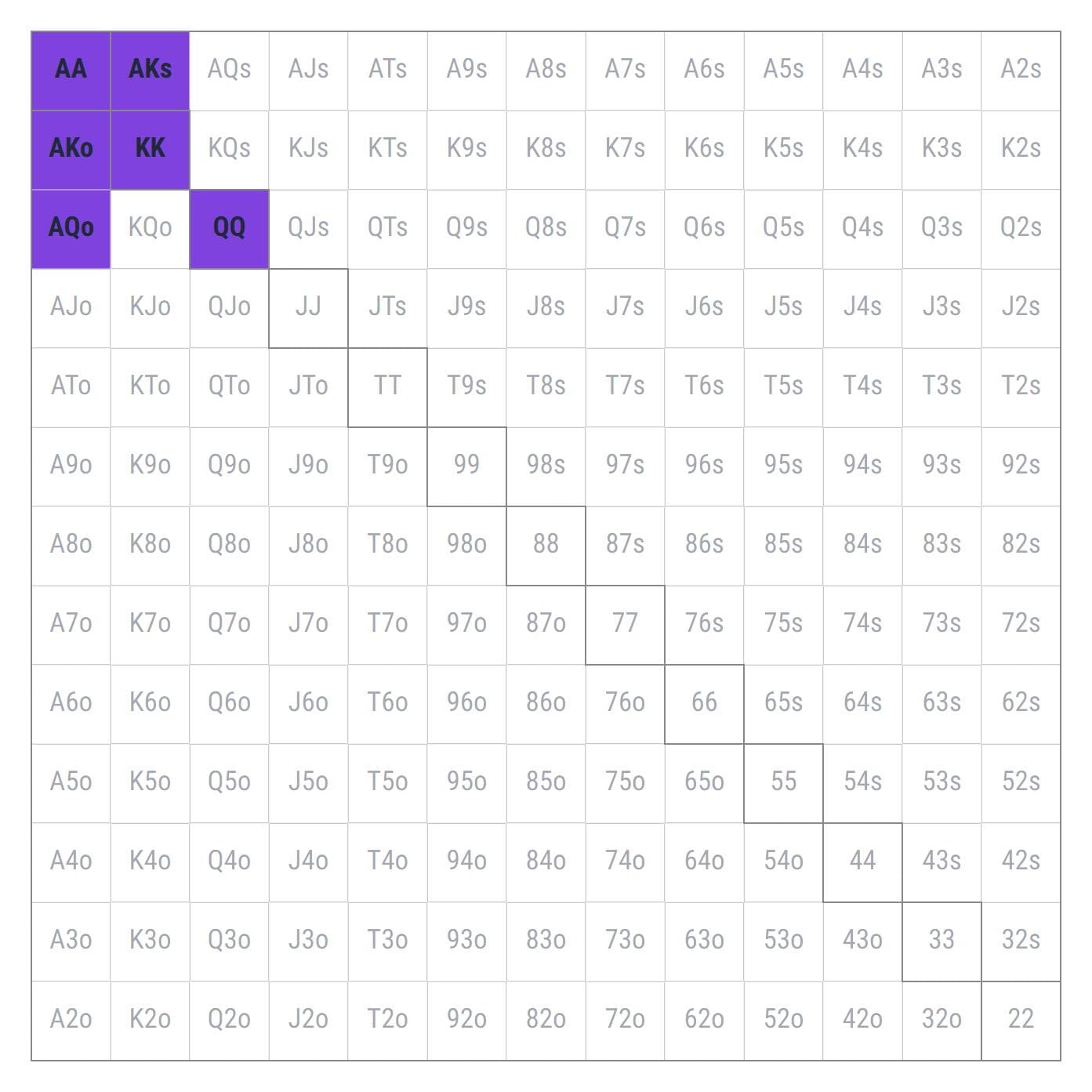
To help you understand the difference, we'll show a value range against an opening from an early position and from a late position.
For example, if our opponent opens from UTG, and we're playing against them from UTG+1, MP or HJ, our value 3-bet range will be this narrow:
But if we're on the BTN and a player on the CO raises against us, the value 3-bet range expands significantly.
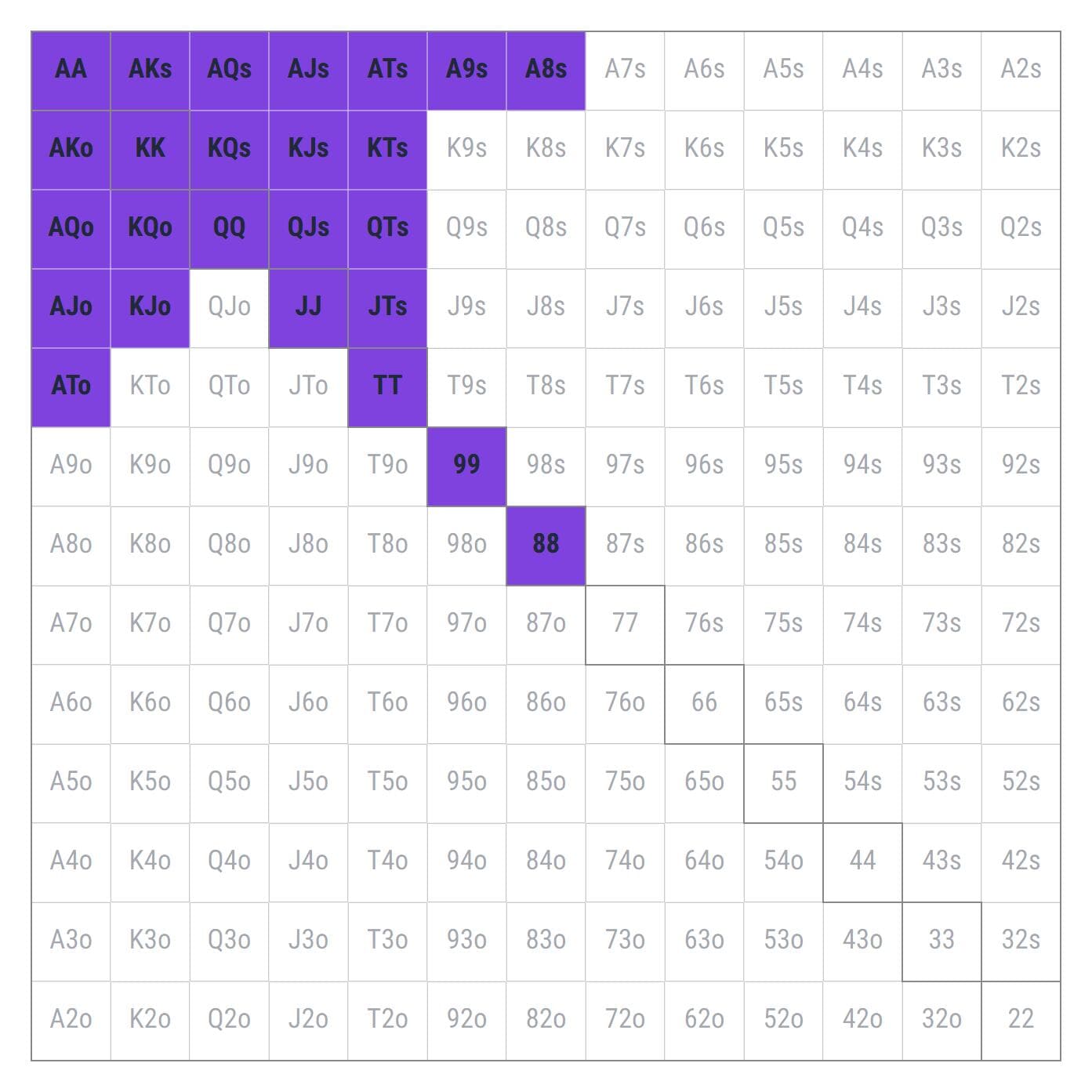
In both cases, we play these hands aggressively, and over the long run they will bring us +EV, but they're different hands.
2. Polarized range
A polarized range consists of two parts:
strong hands for value
bluffing combinations
The middle part of the range, meanwhile, remains in the calling range. This approach is used against opponents who fold to a 3-bet fairly often.
The value part consists of hands ready to play a big pot. For the bluffing part, combinations with additional advantages are selected.
Most often these are suited aces, some suited connectors, and hands with good blockers.
For example, A5s often turns out to be a better candidate for a bluff 3-bet than A9o. The reason: the ace as a blocker (the opponent theoretically has fewer Ax hands in their range) + potential for equity realisation (the possibility of making a flush or a straight).
That's why, when choosing hands for a polarized range, we're interested not only in the absolute strength of the combination, but also in how comfortably it plays out if the opponent withstands our bet and continues in the hand.
How to choose hands for a bluff 3-bet
Here it's important to take into account the concept known as the blocker effect. Having an ace or a king reduces the number of strong combinations the opponent can have.
For example, if we're playing on the BB and get raised by a player on the BTN, the value part of our range will consist of the hands we specified in the example above, and the bluff part should contain blockers — to aces and kings.
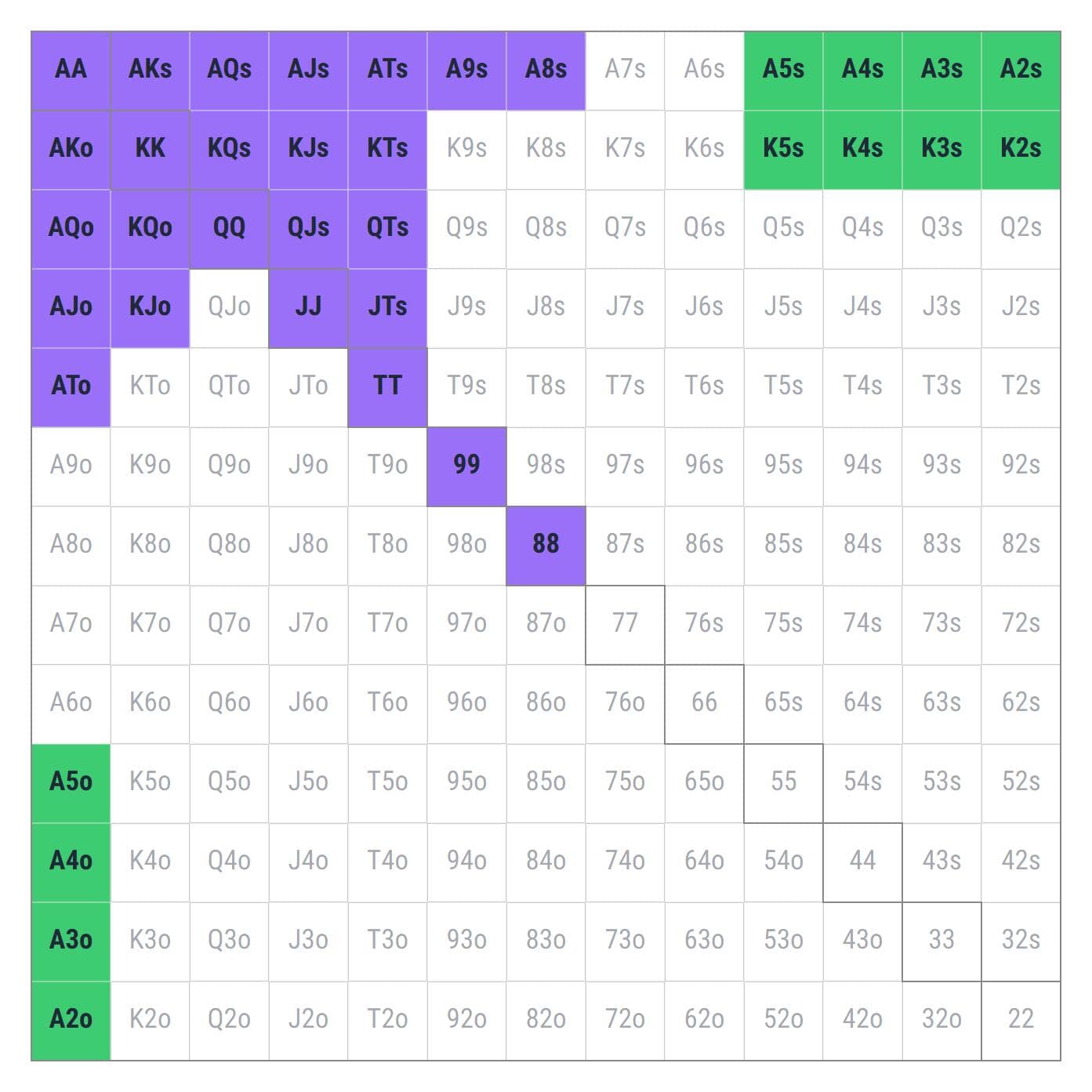
This doesn't mean that we must always play low offsuit aces and low suited aces and kings exactly this way. We only want to demonstrate the logic of how you can select hands for a polarized range.
A bluff 3-bet should have a clear plan. If, after a 4-bet, the hand becomes too strong to fold but not strong enough to continue, we create a difficult situation for ourselves. That's why combinations that are easy to fold against repeated aggression are more often chosen for bluffing.
Important: when choosing a line of play, we take into account the factor of a suitable opponent. Even a well-chosen hand won't bring profit if the opponent almost never folds to a 3-bet. In such a situation, we're only increasing the pot with the weak part of the range.

How position changes the choice
The same cards can play out completely differently depending on the arrangement of players at the table.
1. BTN vs CO
CO opens fairly wide, and the BTN has position after the flop. That's why the continuing range becomes the most diverse. Some hands are profitable to call, some are used in a linear 3-bet, and some suited aces are suitable for a polarized raise. It's precisely having position that allows flexible choice among several profitable lines.
2. BB vs BTN
The BTN opens a wide range, and the BB gets good pot odds. Because of this, the defending range becomes wider than at any other position. But playing out of position isn't easy. That's why we only continue with hands that are able to realise equity well enough postflop.
3. SB vs BTN
The situation is different on the SB. We're playing out of position and, at the same time, we don't get the same benefit as on the BB. In addition, there's still another player left to act behind us. That's why the continuing range becomes more cautious. Many hands that the BTN comfortably calls against the CO more often turn into a 3-bet or a fold on the SB.
Common mistakes made by beginner players
1. Choosing automatic decisions
There is no hand that is always a call or always a 3-bet. Every combination is evaluated relative to the opponent's opening range.
2. Using the same range against all positions
The BTN and UTG open completely differently. Consequently, the continuing range against them should also differ.
3. Making a bluff 3-bet against a player who almost never folds
If the opponent rarely folds, the main advantage of bluffing disappears. In this situation, it's more profitable to expand the value part of the range rather than the number of bluffs.
4. Calling just because the hand is «too good to fold»
A call by itself is not a safe action. If the hand realises equity poorly postflop, folding may bring more profit in the long run.
5. Using charts without accounting for the situation
Charts help you study the basic structure of ranges, but they don't replace analysis of position, sizing, effective stack, and the opponent's characteristics.
If you still don't understand what charts are and how to work with them, we suggest following the link to our article on this topic.
Conclusion
In practice, a profitable poker strategy is built not only around ranges, but also around understanding how to work with them. Before every action, we assess the position, the assumed opening range, the effective stack, the raise size, and the players who haven't yet made their decision.
It's exactly this approach that allows you to make consistent decisions and gradually increase your expected winnings in the long run. Apply to FunFarm to start earning through poker.

Free course · FF Start
Fix costly beginner mistakes
Learn when to bet, call or fold — and when putting pressure on an opponent pays off.