Playing from an early position: UTG and UTG+1 in poker
Range, sizing and typical mistakes beginners make in early position.

One of our first coaches: on the team since the very founding of the project. He prioritizes simple and practical training with an emphasis on real game situations and decision-making over the long run. Val doesn't just "beat the games" as a player, but also instills a systematic approach to the game and discipline in his students.
One of the most common mistakes made by beginner players is evaluating the strength of a starting hand separately from position. For example, a player is dealt A8o or QTo and automatically considers these cards worth opening from anywhere. But the same combination can be profitable on the button and unprofitable from an early position. The reason lies not in the cards themselves, but in how many opponents get to act after us.
*The button (from the English word "button") in poker is both a special chip marking the current dealer and the name of the most advantageous position at the table.
Playing from early positions requires far more discipline than playing from the cutoff or the button. In this article, we'll break down how to play correctly from early positions and why they're considered the toughest positions at the poker table.

New breakdowns in your inbox
Subscribe to the FunFarm newsletter: fresh Poker ABC articles and material that helps you grow as a player.
Key facts about early positions in poker
Early positions (Early Position, EP) are the first positions from which betting on the preflop begins. In the classic 9-max format, these include UTG and UTG+1, while in 6-max only UTG is considered early.
The main feature of these positions is that the player has to act first, without any information about their opponents' actions.
Most profitable strategies call for playing only strong starting hands, since after opening, there are still many players left to act, any of whom could find a hand strong enough to call or 3-bet.
What early positions in poker are
Early positions are the seats at the table from which a player begins betting before most opponents have had a chance to act. In the classic 9-max format, early positions include UTG (Under the Gun) and UTG+1.
At a 6-max table, there's only one early position left — UTG.
The name "Under the Gun" reflects the idea of being "in the firing line". Historically, the name comes from the fact that in the next hand, the player will be forced to post money into the pot from the big blind. Moreover, the name accurately reflects the player's position: they're the one who has to make the first decision with virtually no information about the intentions of the other participants in the hand.
Unlike late positions, where you can assess the actions of most opponents before acting yourself, the player on UTG has to set the tone for the entire hand on their own. That's exactly why opening ranges here are the tightest.
It's important to understand that early position is determined not by the player's seat at the table, but by the location of the button. After each hand, the dealer button moves one seat clockwise, so every participant regularly finds themselves in both early and late positions.
Why early positions are considered the toughest
Playing from early positions isn't easy even for experienced players. The reason lies in several strategic factors at once.
1. We act first
The main difficulty lies in the complete lack of information. When a player opens from the button, they already know that most opponents have folded out of the hand. On UTG, there's no such information. After our raise, there's still a large number of players left to act, any of whom could fold, call, make a 3-bet, or squeeze after a few calls.
Read also:
What a squeeze in poker is
Because of this, we have to build an opening range that lets us feel comfortable against a wide variety of scenarios.
2. Many opponents are left to act behind us
Every additional player increases the likelihood of running into a strong hand. For example, when opening from the button, we leave only two opponents behind us. From UTG at a standard table, there could be six or seven.
Even if the probability of any individual player having a premium hand is low, the combined chance of running into resistance increases significantly. That's exactly why many medium-strength hands that are comfortably opened from late positions get folded on UTG.
3. We often end up out of position
Even if our raise only gets called by one player, most of the postflop play will take place without a positional advantage.
Postflop — all the betting rounds that happen after the flop (the flop, turn, and river).
The player who is in position always acts last. This allows them to see their opponent's actions and realise their hand's equity more effectively.
Equity — our share of the pot corresponding to our chances of winning at a given moment.
In early positions, the situation is the opposite. After the flop, it's usually us who has to act first, meaning we have to make decisions with less information. This significantly complicates playing even strong combinations.
Learning at FunFarm, from any level
Opening ranges from early positions
There is no universal chart that works equally well for every game. Ranges always depend on stack depth, opponents' skill level, table format, and the stage of the tournament.
However, there are basic guidelines to start building your own strategy from. Here is what a standard opening range from the UTG and UTG+1 positions typically looks like. As a rule, this is roughly 15–18% of all starting hands.
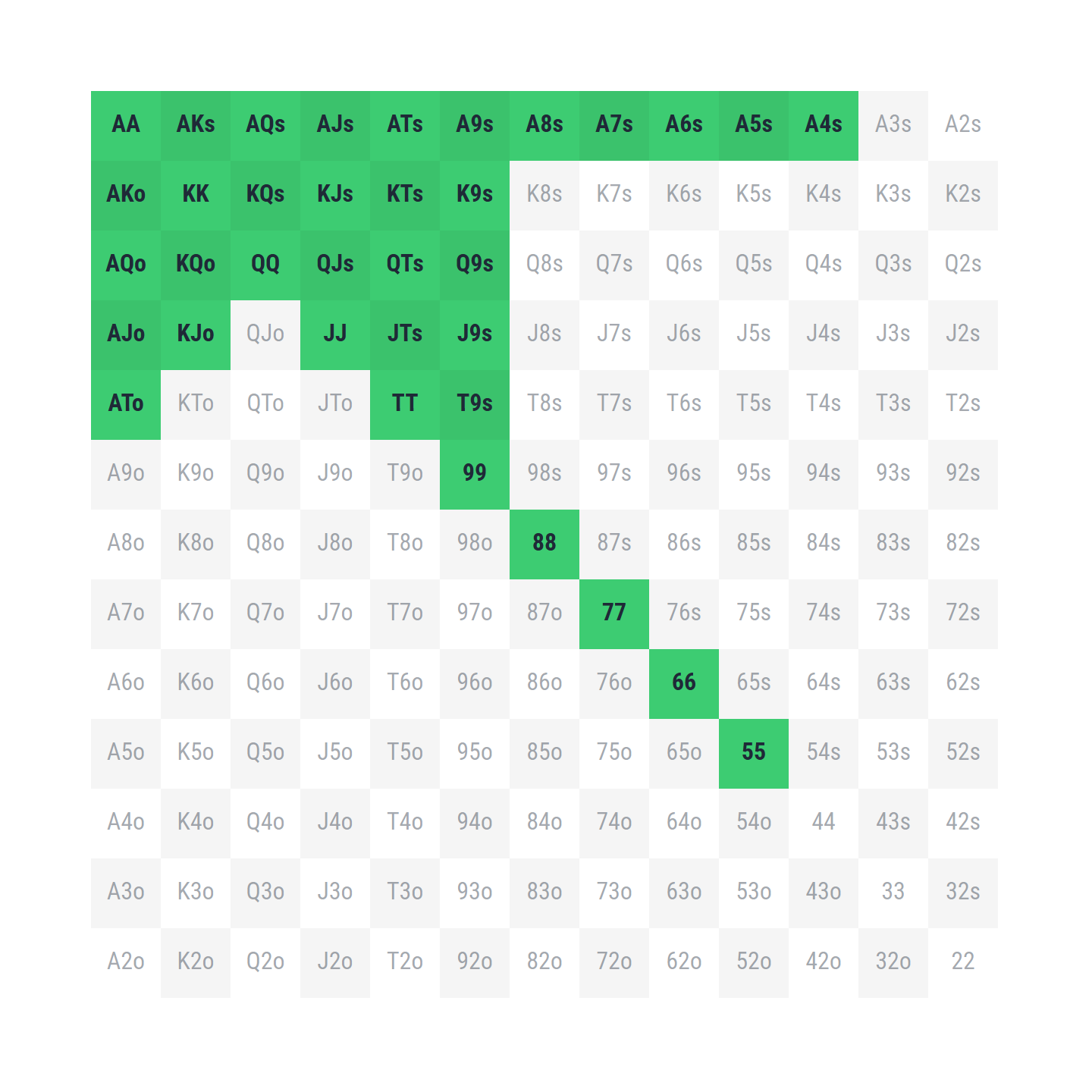
Opening from the UTG position
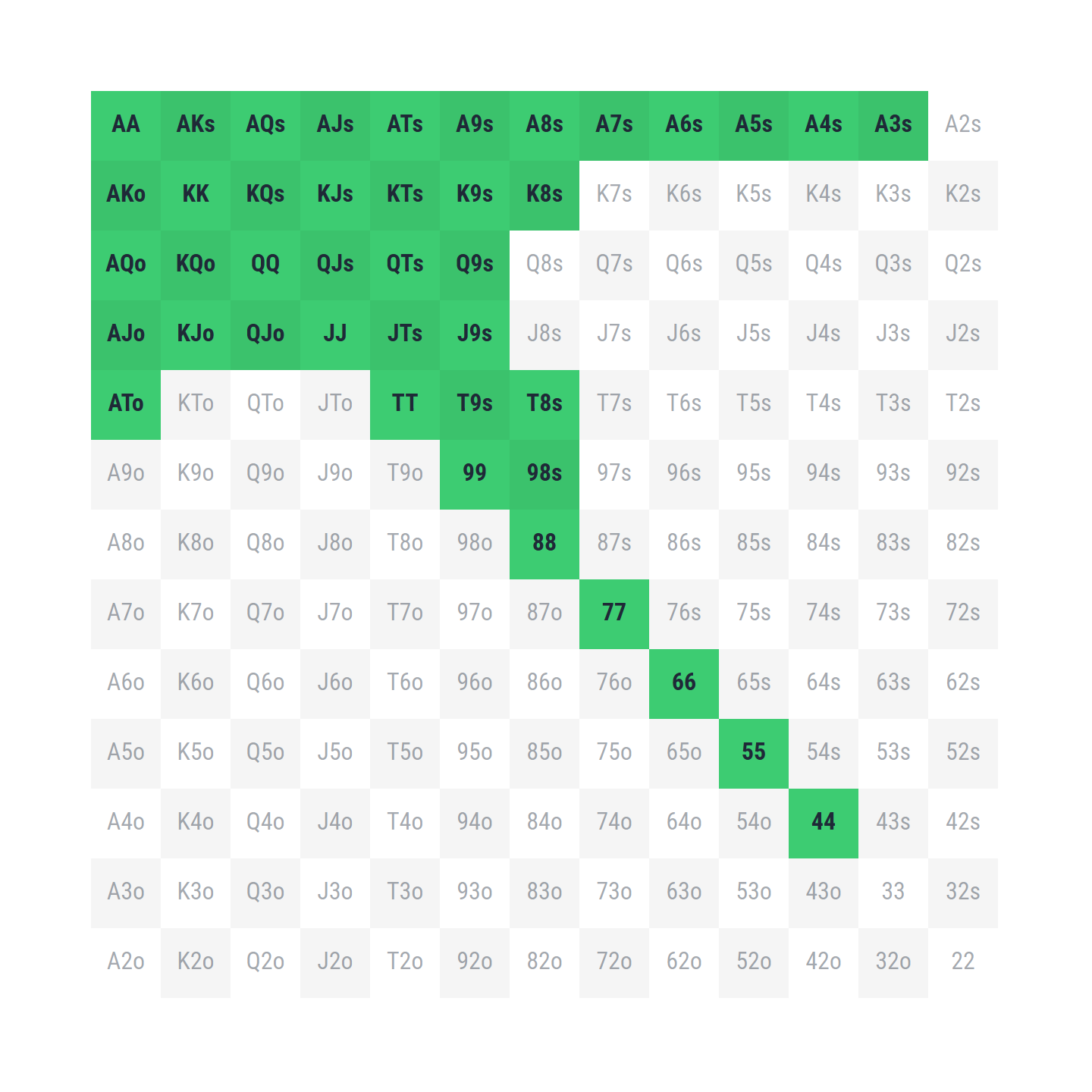
Opening from the UTG+1 position
This strategy might seem overly cautious, especially to beginner players. However, it's precisely this approach that helps avoid a large number of tough hands out of position against multiple opponents.
How to play postflop from an early position
Many players believe that the main difficulty of early positions lies in choosing starting hands. In practice, the most costly mistakes often happen after the flop comes out. The main reason for this is the lack of position.
After our opening raise, opponents typically get to act last. This gives them extra information and lets them play their ranges more efficiently. That's why playing postflop from an early position requires greater caution.
One feature of playing from early positions is that our range itself contains a large number of strong hands. This lets us apply pressure more often on favourable boards, even if a specific hand hasn't improved. Sound postflop play isn't built around wanting to win every pot, but around understanding which range has the edge on a particular texture.
How to play against a 3-bet
Getting 3-bet after opening from an early position is a completely normal situation. There are many players still to act behind us, so the chance of running into a re-raise is significantly higher than when opening from the button.
The main mistake beginners make is thinking that since the UTG range is strong, they need to continue fighting with almost every hand they opened with. In practice, this isn't the case at all: our range looks narrow to our opponent, so they won't 3-bet as boldly.
First — don't be afraid to fold hands that seem good enough to call. Folding against a 3-bet is part of the strategy, not a sign of weak play. For example, against a tight opponent, many hands like AJo, KQo, or low pocket pairs can safely be folded.
Even if these hands looked strong enough to open, against a narrow 3-betting range their equity ends up being insufficient.
Second — take your opponent's style into account. The decision always depends on exactly who made the re-raise. If a player almost never uses bluff 3-bets, you should only continue with your strongest hands.
If your opponent actively re-raises and applies pressure to early positions, you can gradually widen your defending range. That's exactly why statistics and observations of opponents play a huge role in making these kinds of decisions.

Typical mistakes when playing from early positions

Even when understanding the basic strategic principles, many players regularly make the same mistakes.
1. Too wide an opening range
The desire to play more hands leads to opening hands like K9o, QTo, or weak offsuit aces. From late positions, such hands can be profitable. From UTG, they much more often create difficult out-of-position situations against opponents' strong ranges.
2. Limping instead of raising
Some players try to enter the pot by limping, hoping to simply see the flop even with a hand that isn't particularly strong. In practice, something else happens — the player lets several opponents see the flop cheaply and loses equity.
Also read:
How to punish limpers in poker
3. Unwillingness to fold against aggression
After opening from an early position, beginner players find it psychologically hard to give up chips they've already committed. Because of this, they keep fighting against big 3-bets even when it's clearly unprofitable to do so. Knowing when to fold in time is one of the most important skills for profitable play — not just from an early position, but in general.
4. Trying to compensate for lack of position with aggression
Some players start betting on almost every street simply because they were the preflop aggressor. This leads to bloating the pot with medium-strength hands and costly decisions on the turn and river. It's far more effective to build a strategy around the strength of your own range and the board texture, playing aggressively in a well-reasoned way rather than around a desire to keep the initiative at any cost.
How to improve your game from early positions
Learning the basic opening ranges is only the first step. As you gain more experience, it becomes clear that profitable play from early positions isn't built on mechanically following charts, but on constantly adapting to the table composition and analysing your own decisions.
1. Analyse your hands
One of the most effective ways to progress is to regularly review hands played from early positions. If you use a poker tracker, try filtering only hands played from UTG and UTG+1.
This kind of analysis lets you quickly spot recurring mistakes. Even a few such reviews can significantly improve the quality of your play.
Pay attention to a few questions:
Which hands most often turn out to be losing ones?
Are you opening too wide?
How often do your continuation bets win?
Are you calling large 3-bets too often and losing?
2. Adapt to your opponents
If you're facing several very aggressive regulars who frequently 3-bet, it makes sense to tighten your opening range slightly. This will help you avoid difficult out-of-position spots more often.
The opposite situation arises at recreational tables. If most players play passively and rarely apply pressure, you can gradually widen your range. The key is to widen the range deliberately, not just because you "want to play more hands."
3. Don't forget about discipline
Early positions demand discipline far more than any other seat at the table. Sometimes the best decision really is to fold — even if you haven't played a hand in several rounds. Remember that profit in poker comes not from the number of pots played, but from the quality of decisions made.
Conclusion
If you want to understand which hands to open not only from early positions, but also from middle and late ones — and generally want to understand the game well enough to beat most of your opponents — apply to FunFarm. We've been successfully teaching people to make money playing poker for over ten years.
Free course · FF Start
Stop playing by guesswork
Get to grips with positions, bet sizing, bluffs and decisions against different opponents.