MTT Final Table Strategy: How to Play to Win
In this article, we'll break down how ICM works at the final table, what adjustments need to be made to your strategy with different stack sizes, how the game changes as the number of participants shrinks, and what principles help you more often turn final table appearances into a fight for the highest places.


One of our first coaches: on the team since the very founding of the project. He prioritizes simple and practical training with an emphasis on real game situations and decision-making over the long run. Val doesn't just "beat the games" as a player, but also instills a systematic approach to the game and discipline in his students.
Making the final table is the goal of any tournament player. This is where the bulk of the prize pool is played for, and every decision made begins to cost significantly more than at previous stages of the tournament. The difference between ninth and first place can amount to dozens of buy-ins, so even a small mistake can substantially affect the final result.
*Buy-in — the amount of money required to enter a tournament. Example usage: "The buy-in for this tournament is $100." Find even more poker definitions in our glossary.

Many players believe that after reaching the final table, it's enough to keep using a late-stage tournament strategy. In practice, this doesn't always work. As payouts grow, the value of chips changes, the influence of ICM intensifies, and stack sizes start to play a role no less important than the strength of the starting hand. Decisions that were profitable a few levels ago can now turn into serious mistakes.
At the final table, it's important to consider not just your own stack, but also the distribution of chips among opponents, the presence of short stacks, the size of upcoming pay jumps, and opponents' ability to adapt to payout pressure. That's why strong tournament players treat the final table as a separate stage of the tournament with its own strategic patterns.
In this article, we'll break down how ICM works at the final table, what adjustments need to be made to strategy with different stack sizes, how the game changes as the number of participants shrinks, and what principles help turn final table appearances into a fight for the top spots more often.

New breakdowns in your inbox
Subscribe to the FunFarm newsletter: fresh Poker ABC articles and material that helps you grow as a player.
What is a final table in MTT
The final table usually consists of seven, eight, or nine players depending on the tournament format. The main feature of the final table is the payout ladder. Each subsequent elimination increases the monetary expectation of the remaining participants. Because of this, many decisions that were profitable at the middle or late stage of the tournament can turn into mistakes.
That's why at the final table, players start to evaluate the situation not only through the number of chips, but also through their monetary value.
ICM at the final table and the pressure formula
At the final table, the concept of ICM reaches its maximum significance — this is a model that allows you to assess the value of chips through the expected share of the prize pool. It shows that the value of tournament chips is not linear.
At an early stage, doubling your stack is almost always an excellent result. At the final table, the situation changes. Additional chips help you fight for higher places, but each additional chip brings less benefit than the previous one. At the same time, losing a large part of your stack can sharply reduce your expected winnings.
That's why at the final table we can no longer evaluate decisions purely through the number of chips. It's much more important to understand how a specific action affects the value of our stack in terms of the prize pool.
You can read more about how the ICM concept works in this article. Go check it out and build up your game understanding skills.
This is exactly where we come back to the concept of the bubble factor.
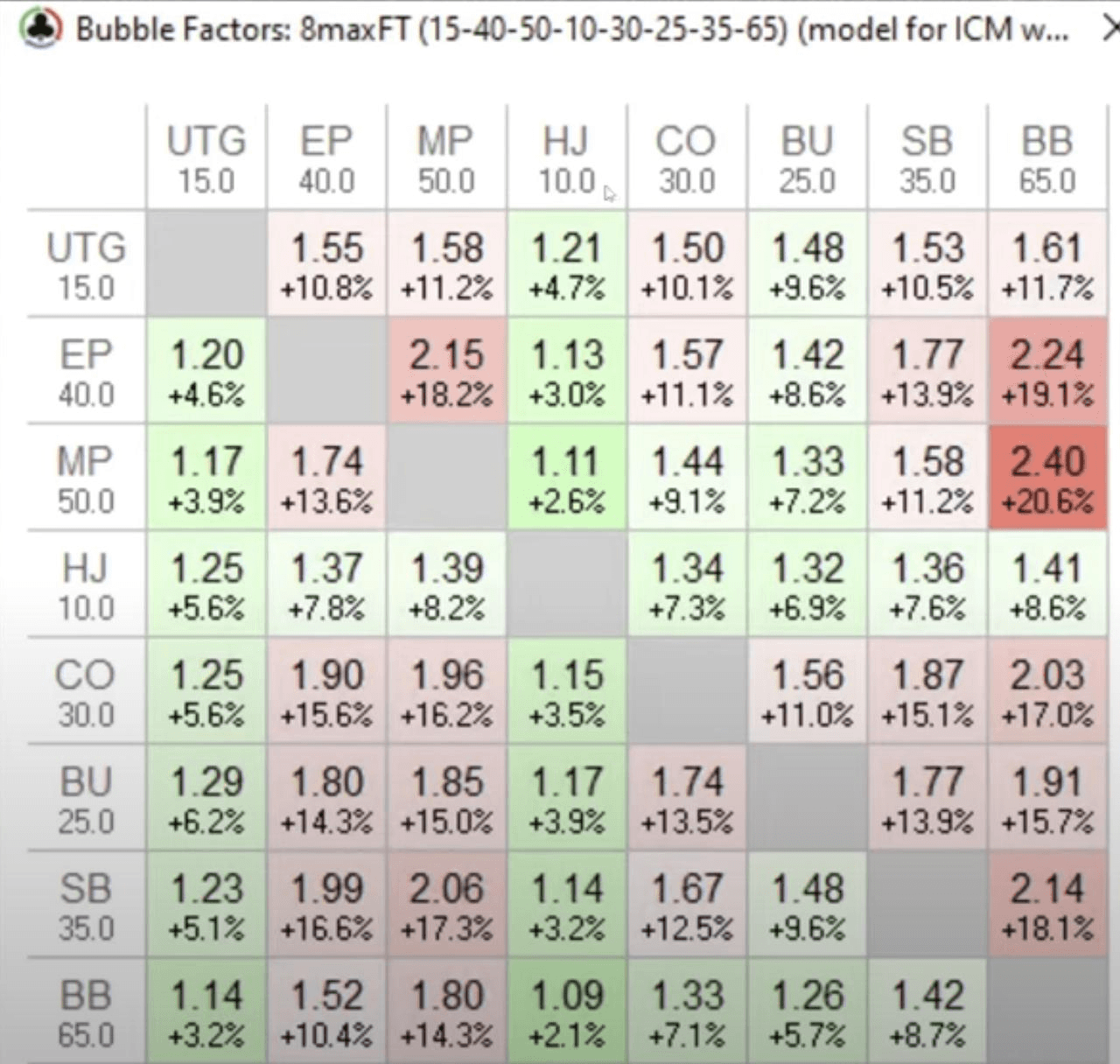
The image above shows an example of calculating the bubble factor for a final table with different stack sizes.
The number in the cell shows the ratio of the value of lost chips to won chips, and the percentage below it is the so-called risk premium. It shows what additional equity margin a player needs to participate in large pots.
Let's look at an example. What does the situation look like for a player in the MP position with a 50 BB stack? When facing the chip leader, their bubble factor is 2.40 — one of the highest values at the table. This means that losing chips is 2.4 times more painful for them than winning them.
At first glance, it may seem illogical that the pressure is stronger on the larger stack. However, from an ICM perspective, it's entirely explainable. Losing a large pot can sharply worsen a player's position in the tournament hierarchy, while winning a similarly sized pot doesn't always significantly increase their share of the prize pool.
For this reason, clashes between the two biggest stacks at the final table are usually significantly more costly than confrontations with short stacks.
How the bubble factor affects the required equity
The practical value of the bubble factor is that it shows how much stronger our hand needs to be to call or commit a large amount of chips.
For example, for the player with a 50 BB stack from the previous example, the risk premium is 20.6%. In a normal situation, when we evaluate a decision purely through the number of chips, having just over 50% equity against the opponent's range is enough to make the commitment profitable. However, under the influence of ICM, this is no longer sufficient.
If the risk premium is 20.6%, then for the same decision the player will already need about 70.6% equity to compensate for the consequences of a possible loss and justify the risk to their tournament life. That's why many calls that are mandatory at the early or middle stage of a tournament turn into obvious folds at the final table.
The formula is as follows:
The higher the bubble factor, the stronger a hand we need to have to continue in the pot.
How the bubble factor turns into equity requirements
In practice, a player rarely has to work directly with the bubble factor value itself. It's much more important to understand how it affects the minimum equity needed to continue in the hand.
Each bubble factor value corresponds to a certain risk premium. It shows what additional equity margin is needed to compensate for tournament risk.
For example, if the bubble factor equals 1.2, it's no longer enough for the player to have the standard 50% equity against the opponent's range. A profitable decision will require about 54.5% equity. The additional 4.5% is the risk premium.
As the bubble factor grows, the requirements become significantly stricter:
Bubble factor | Required equity | Risk premium |
1.1 | 52.4% | +2.4% |
1.3 | 56.5% | +6.5% |
1.5 | 60.0% | +10.0% |
1.7 | 63.0% | +13.0% |
2.0 | 66.7% | +16.7% |
The table shows that even a relatively small increase in the bubble factor noticeably affects strategy.
Imagine a player with an average stack at the final table facing an all-in from the chip leader. In a normal situation, they would need only about 50% equity against the opponent's range. However, with a bubble factor of 1.7, they will now need about 63% equity.
This means that many hands that are a mandatory call in the ChipEV model turn into a fold under ICM pressure.
*Chip EV — is the mathematical expectation of the number of chips a player expects to gain as a result of a certain action (a call, raise, all-in). In simple terms, it shows how much your stack will increase or decrease on average as a result of that hand.
That's why at the final table, players much more often fold strong but marginal hands. From the outside, such decisions may look too tight, but in reality they account not only for the probability of winning the pot, but also for the cost of a possible elimination.
The higher the bubble factor, the more cautious calls become and the more aggressively the player applying pressure can act. It's precisely this difference between the value of won and lost chips that underlies most strategic adjustments at the final table.
The bubble factor shows how much more painful losing chips is compared to winning them in terms of monetary expectation.
Imagine this situation: we have a 15 BB stack, and our opponent has 5 BB. At first glance, it may seem that shoving against a short stack is always profitable. However, ICM forces us to look at the situation differently.
Suppose that before the hand, the value of our stack is a nominal $100 of tournament equity. If we win the all-in, our stack grows, but its value only rises to $120. We gained additional chips, but their impact on the prize pool distribution is limited.
If, on the other hand, we lose the shove, the situation changes much more dramatically. Our stack shrinks to the level of a short stack, and its value drops to $75.
It turns out that:
a win brings us $20 of expected value
a loss costs us $25 of expected value
The ratio of loss to win is: 25 / 20 = 1.25
This is the bubble factor in this situation. This example clearly shows the main property of ICM — losing chips at the final table is almost always more painful than winning the same amount of chips.
That's why many decisions that are profitable in terms of chip count can turn out to be unprofitable in terms of monetary expectation. The higher the bubble factor, the greater the equity margin a player needs for a call, value bet, or shove.
*Value bet — a bet a player makes with a strong hand in order to get a call from the opponent's weaker hands and thereby increase the pot won.
For this reason, calling ranges at the final table typically become significantly narrower than aggression ranges. The player applying pressure gains an additional advantage from the risk their opponent takes on in case of losing the pot.
Learning at FunFarm, from any level
8-max at the final table
The initial stage of the final table largely resembles the late bubble. Before every important decision, four factors must be assessed:
stack sizes
upcoming payouts
position relative to the chip leader
the presence of short stacks
If there is one or more players at the table with a stack of less than 10 BB, their influence on strategy becomes enormous.
Imagine this situation: we have 28 BB, while two opponents have 6 BB left. Under such conditions, clashes with players of a similar stack size often become less attractive. Losing our stack could cost us several payout jumps, whereas one of the short stacks busting automatically increases our monetary expectation.
In such a situation, chip leaders get the opportunity to actively apply pressure and attack medium stacks. Players with medium stacks are forced to act more cautiously. Their main task is to avoid marginal shoves against opponents who could knock them out of the tournament.
Short stacks are in the opposite situation. Their stack keeps losing value due to rising blinds, so waiting for the perfect hand is often a more costly mistake than a timely push. That's why play with a 5–10 BB stack is usually built around a push/fold strategy, taking into account ICM's influence and the size of the remaining stacks.
*Short stack — a situation where a player has a relatively small number of chips compared to their opponents at the table.
*Push — a bet of a player's entire stack. This action is also called an all-in or shove.
6-max: the shift to more aggressive play
After several eliminations, the tournament's dynamics start to change noticeably. There are fewer players, and the blinds keep rising. Now every orbit costs significantly more. While at a full table you can wait relatively long for a suitable spot, in a 6-max format the cost of inaction increases. For this reason, opening ranges start to widen.
Many hands that were folded at the 9-max stage become profitable opens. This is especially true for late positions. Defending the BB also gains additional importance. Since the number of players has decreased, opening ranges become wider, which means the big blind must be defended more often. However, ICM's influence doesn't disappear entirely.
If there's an aggressive chip leader to your left who can regularly apply pressure through 3-bets, opening ranges need to be adjusted. In such a situation, excessive aggression can lead to costly mistakes. That's why successful play in the 6-max format is built on a balance between accumulating chips and preserving tournament life.
You can learn more about how to use 3-bets in this article.
Playing 3-max
When three players remain in the tournament, the payout structure starts to influence decisions less. At this stage, it's especially important to correctly define your role.
If we are the chip leader, our task is to use our stack advantage as effectively as possible. A big stack allows us to regularly apply pressure on opponents and force them to make difficult decisions.
If we have a medium stack, the strategy becomes more selective. It's usually more advantageous to avoid conflicts with the leader and direct pressure toward the short stack.
If we are the shortest stack, our main task is to look for profitable spots to double up. Waiting for the next payout jump matters, but excessive passivity quickly leads to a loss of fold equity, and in this situation it's important for us to use the fold equity factor to keep our stack in a playable state and aim to build up our chips.
*Fold Equity — the probability that an opponent will fold in response to a bet, raise, or all-in. We've talked in more detail about how this concept works in the game in this article.
At this stage, players are already gradually shifting to heads-up principles. Many decisions against each opponent are treated as a separate confrontation.

Heads-up — the end of the tournament

When two players remain in the tournament, ICM's influence disappears. Now each participant has already guaranteed themselves second place, and the main battle is for the difference between the first and second prize.
Strategy becomes significantly more aggressive. Most hands gain playable value. Opening ranges widen so much that many players start playing virtually any starting hand.
While in the early stages of a tournament many medium hands could comfortably go to showdown, in heads-up play opponents pay off bets with marginal combinations much more often.
That's why the ability to extract extra value becomes one of the key factors for success.
Should you agree to a deal
At the final table, many sites allow players to split the prize money before the game is finished. Two options are most common.
The first is a chip-count split. The prize pool is distributed proportionally to the number of chips.
The second is an ICM split. In this case, stack sizes and the structure of the remaining payouts are taken into account.
There's no universal answer as to whether a deal is worthwhile. If a player considers themselves stronger than the remaining opponents, it's often more advantageous for them to keep playing. If, however, the stacks of the participants are close and the skill gap is small, a deal allows you to reduce variance and guarantee a significant part of the prize money. Therefore, the decision about a deal should always take into account not only stack sizes but also the skill advantage.
*Variance — a measure of the spread of game results around the average value, that is, the deviation of actual results from mathematical expectation over short samples. We talked about this topic in more detail in this article.
Conclusion
In the long run, it's precisely the ability to make the right decisions in expensive tournament situations that allows you to consistently turn final table appearances into a fight for first place.
If you want to reach final tables in tournaments consistently and feel confident making the most expensive decisions in the game, apply to FunFarm.

Free course · FF Start
Break the game down street by street
Learn to plan a hand from preflop to river and understand the purpose of every action.