What are exploits in poker and why use them?
Complete guide to exploits for micro-stakes MTTs. We break down how to steal blinds, make big value bets, and punish limpers to maximize your profit.

One of our first coaches: on the team since the very founding of the project. He prioritizes simple and practical training with an emphasis on real game situations and decision-making over the long run. Val doesn't just "beat the games" as a player, but also instills a systematic approach to the game and discipline in his students.
In poker there are two main approaches to the game: a strategy built on GTO theory (Game Theory Optimal) and exploitative play. While the first involves balanced decisions against a perfect opponent, the second, on the contrary, is based on exploiting opponents' weaknesses.
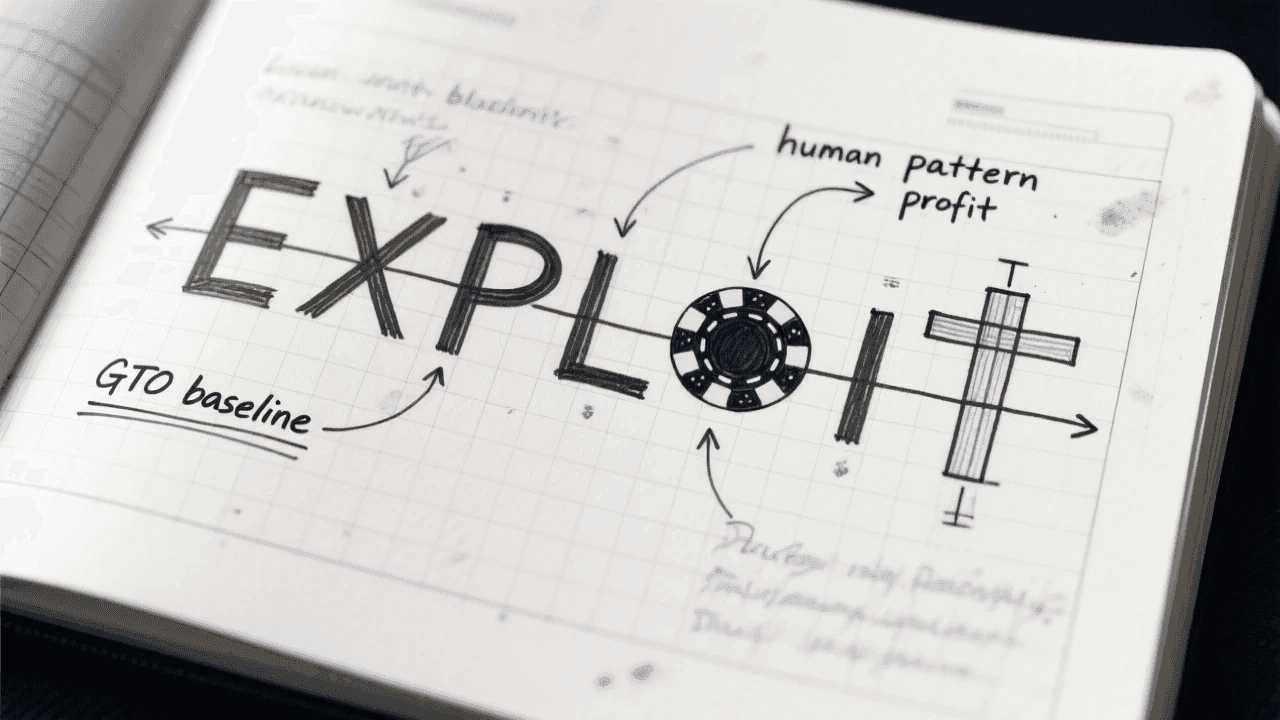
Exploit (from the English word "Exploit") is a deliberate deviation from theoretically optimal play in order to gain an advantage against a certain type of player. Simply put, you adjust your strategy to your opponents' mistakes in order to earn more.
In this article we'll look at exploits applicable in tournament poker (MTT) and specifically at micro-stakes, that is, in tournaments with a buy-in of up to 10 dollars. It's precisely at these stakes that the proportion of players making systematic mistakes is greatest, which means the opportunities for exploiting are maximal.
Applying exploits allows you to increase the profitability of your game, build your bankroll faster, and use your advantages against weak opponents more effectively. Let's look at the most profitable ones.

New breakdowns in your inbox
Subscribe to the FunFarm newsletter: fresh Poker ABC articles and material that helps you grow as a player.
Get greedy
At micro-stakes most players tend to call far too often. They don't like to fold and quite often make decisions out of simple curiosity - they want to "see it through to the end," all the community cards up to the river, even when their hand is clearly not strong enough.
This trait makes a balanced strategy less effective. Instead of maintaining a balance between bluffs and value bets, it's far more profitable to simply bet a lot and often when you have a good combination.
If you have an edge - bet big. Against players who rarely fold, every bet with a strong hand brings additional profit. Remember that you're playing no-limit hold'em, so bet size is not limited. With the nuts, that is, the best possible combination, you can shove all in on the river and will often get paid.
This approach allows you to significantly increase the overall expected value (EV) of your game: thanks to frequent and large bets, the enlarged pots add up to a steady increase in profit over the long run.
Bluff if you have no chance of winning at showdown
At micro-stakes players often tend to overestimate the strength of river bets. For all their desire to see all the community cards on the board, for many the mere fact of aggression on the last street seems like a convincing signal of a strong hand. This can and should be used.
If you understand that your hand has no chance of winning the pot at showdown, the optimal decision is often a bluff bet. In such situations a check leads to a guaranteed loss, while a bet creates scenarios in which the opponent will sometimes fold his cards. Thus, bluffing in hopeless situations allows you to recover part of your losses and turns desperate spots into potentially profitable ones.
Learning at FunFarm, from any level
Steal the blinds from late position
At micro-stakes most players don't defend their blinds enough. They call preflop too rarely in response to a raise and almost never use 3-bets (a raise of a raise). This creates an opportunity to systematically take the blinds without resistance, especially from late position: from the cutoff (CO) and the button (BTN).
Since in these positions you act almost last and have the advantage of position, you can enter the pot with a raise, when everyone before you has folded, with a very wide range of hands.
The recommended opening range from the button includes:
any two suited cards, for example 38 suited;
any pocket pair, for example 22;
any ace or king, for example K2 offsuit;
all Broadway combinations (two "picture" cards), for example JQ offsuit.
If the blinds are occupied by opponents with a passive playing style (so-called "nits"), the range can be widened even further - up to any two cards. We covered opponent types in another article (link), check it out to use other players' weaknesses even more effectively.
Regularly stealing the blinds allows you to steadily increase your stack without taking the hand to the flop. Over the long run this gives a tangible advantage and lets you resist the constant rise of blind levels in the tournament.
Always make a continuation bet in position
If you were the aggressor preflop and you're in position, a continuation bet, that is, a c-bet, should be your standard action. This is one of the basic strategies that brings steady profit at micro-stakes.
The reason is simple: most players miss the flop. The probability that the opponent has a strong hit is extremely low, so even a small bet puts pressure on him.
The optimal c-bet size: 25-33% of the pot. Such a bet is big enough to force the opponent to fold weak hands, but optimal for maintaining a good risk-to-reward ratio.
Regular use of a c-bet in position allows you to:
take pots without a showdown;
maintain initiative in the hand;
build the image of an active player, which helps you later extract profit from strong hands.
However, it's important not to c-bet automatically. Before making a decision, assess the flop texture and the type of opponent. On boards with many possible draws and against players not inclined to fold, such a bet may be less effective.

Isolate limpers
A limp is calling the big blind before the flop. The word limp itself means "feeble" or "weak," and that accurately describes the nature of such an action.
At micro-stakes a limp almost always indicates a weak starting hand or a passive playing style, while also marking the limper as an amateur. Such players want to see the flop cheaply, without risking a significant part of their chips. Sometimes cunning opponents use a limp with a strong hand to lure an aggressive player into a trap, but such situations are rare.
The most effective response to a limp is an isolation raise (or "isolate"). With our raise we aim either to take all the chips already preflop, or to be left heads-up in the pot with the amateur, since it becomes expensive for the other players to take part in the hand. For these purposes, use a bet of 3.5 big blinds plus one big blind for each additional limper.
Players who limp tend to defend poorly against pressure. Even if they call the isolation raise, a c-bet on the flop will often decide the hand in your favor. Most passive opponents simply aren't ready to withstand consistent aggression across several streets.
However, keep in mind: if after your isolate the limper makes a re-raise (3-bet), this almost always means a strong hand. In such cases the optimal decision is to fold and wait for a more profitable situation.
Conclusion
We've covered the five most profitable exploits at micro-stakes, but the foundation for building an exploitative strategy is understanding opponent types. The more precisely you identify a player's behavior pattern, the easier it is to find and use his vulnerabilities. Someone folds too often, someone doesn't know when to stop and bluffs a lot, someone overestimates the strength of their combinations. Your task is to notice this and adapt your game to the specific opponent. It's exactly this skill that distinguishes a strong and experienced player. An article about opponent types can help you. Use the tendencies of micro-stakes play correctly, add an understanding of opponent types to that - and your game will become significantly better.

Free course · FF Start
Strong play starts before the flop
Master starting hands, position, bet sizes and the core preflop scenarios.