Variance and Downswings: How to Stay Motivated
Poker is a game where mathematical strategy and chance go hand in hand. Even a perfectly played hand sometimes ends in defeat, while a win can come at a moment when the odds were minimal. This is exactly how variance manifests — the deviation of your actual result from what you expect over the long run. Understanding variance helps you avoid tilt, stay motivated, and make decisions with a clear head. In this article, we'll break down in simple terms what variance and a downswing are, why they happen even to professional players, and what to do so that a losing streak doesn't throw you off balance.


Ilya is a Liga 2 player with six years of experience in online MTTs. He graduated from the Faculty of Journalism at RSUH and writes about poker for beginners, explaining complex things in simple, clear language. In his texts, Ilya combines his personal playing experience with his professional journalism skills to help newcomers confidently get into the game.
What variance is in simple terms
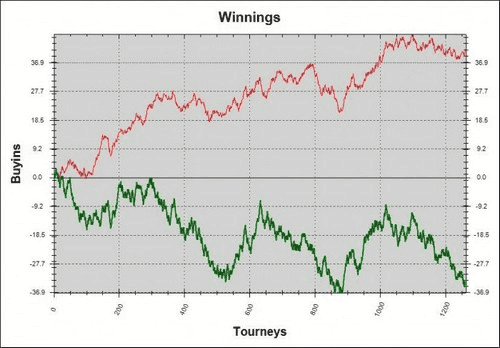
Variance is the difference between what we expect to get over the long run and what is happening right now. In poker this factor is especially strong, because every hand is the result of the interaction between strategy and chance.
Even the weakest hand, for example 72o, wins about 11% of hands against pocket aces. This seems like a paradox, but it's precisely thanks to such "bad beats" that weak players keep playing, which makes poker a profitable game for those who understand the math and the long run.
If you treat variance correctly, you'll be able to avoid tilt, maintain your A-game, and make quality decisions regardless of your current results.
What a downswing is and why it isn't the same as bad play

A downswing is a period when you make the right decisions but get bad results. It's not a strategy mistake and not an indicator of a player's level — it's part of the game.
Even professionals go through long unlucky streaks. The difference is that they don't draw emotional conclusions — one lost tournament or a series of unsuccessful sessions doesn't cancel out the expected value over the long run.
The main mistake of a beginning player is starting to perceive a downswing as a sign of "I play badly" or "nothing will ever work out for me." The professional approach is to look at the situation through the lens of the long run and analysis.
You can learn even more about the difference between the professional and the amateur approach to poker in our Telegram channel. Follow the link to the post and stay up to date with all the fund's latest news.
Learning at FunFarm, from any level
What the frequency and depth of downswings depend on
1. Level of play
The higher the quality of the decisions you make, the less deep and less prolonged your dips will be. A strategy oriented toward expected value smooths out the long run.
2. Player psychology
Emotions directly affect decisions. If you sit down at the table tired or irritated, a dip rarely stays limited to one hand — it intensifies and leads to a string of wrong decisions that can carry over from session to session and worsen your expectation in the long term.
3. The long run
Downswings aren't infinite. The more hands you play, the faster your actual profit will converge with your expected value.
How to survive a downswing: practical recommendations

1. Stop and assess the situation soberly
The first mistake is trying to "catch up to the long run." When a player hits a dip and starts increasing their volume, the quality of their decisions drops while losses grow.
The professional move is to take a break, restore your psychological state, and look at your game from the outside.
2. Look at your game's graph
The graph is an objective source of information. It helps distinguish a problem with your game from a problem with your mood.
If the yellow line — which represents expected value — heads down for a long time, the player is most likely making suboptimal decisions and deviating from profitable strategies.
If the graph was stable or rising and the dip appeared suddenly, that's a manifestation of variance, and you need to ride it out.
3. Work on your mistakes
Reviewing sessions is the best way to regain confidence. In this case professional players use software, rewatch session recordings, record key situations, and analyze hands.
This reduces emotional pressure, helps identify error patterns faster, and increases understanding of exactly what affects results.
4. Reduce the number of tables
During a dip, the desire to "play more" leads to the opposite — your attention gets scattered. Reducing the number of tables increases concentration, and therefore the quality of your decisions.
5. Move down a limit
This reduces emotional pressure and the risk of big losses. Playing at lower stakes helps restore confidence and the quality of your play without straining your mental state.
6. Take intervals between sessions
If a player feels the urge to "win it back," the best decision is to take a break. A day, a week, a month — as long as it takes.
Playing on emotions is the worst thing you can come up with during a dip. After resting, a player returns to the tables with a clear head and confidence in their abilities.
7. Use the downswing as a window for learning
Paradoxically, it's precisely during a dip that players learn best. When everything goes perfectly, it seems like there's nothing to change. When a player is losing, it becomes clear where the weak spots are — and that's the ideal moment for growth.
How not to lose motivation during a downswing
The most important piece of advice is to shift your focus from the result to the process. Variance becomes painful when a player judges themselves by the financial result of every session.
It's far more useful to track:
the quality of your decisions
execution of your plan
your state during play.
Conclusion
Variance isn't a system error, but an inseparable part of it. Downswings happen to every player, regardless of skill level.
If you perceive them as a temporary phase rather than a diagnosis, keep a systematic approach, and work on your game — your motivation will stay stable, and your long-term results will only improve.
If you want to learn to weather variance steadily, maintain high-quality decisions, and build a professional game over the long run — submit an application to FunFarm and develop together with our team.
Free course · FF Start
Poker math without complex formulas
Learn to quickly estimate probabilities, the price of a call and the expected result of a decision.
Frequently asked questions
Read next

Poker Variance Calculator
What is winrate in poker and what counts as a good one

A, B, C game: how to stop giving away blinds to your own inner monkey