MTT Bubble Strategy: Pressure, ICM, Stack Play
In this article, we'll break down what the bubble is in poker, why it's so important for the final result in a tournament, how ICM pressure works, what adjustments need to be made to your strategy, and how to play correctly with different stack sizes.

One of our first coaches: on the team since the very founding of the project. He prioritizes simple and practical training with an emphasis on real game situations and decision-making over the long run. Val doesn't just "beat the games" as a player, but also instills a systematic approach to the game and discipline in his students.
For every tournament poker player, the main goal is to make the money. That's exactly why the stage before the payouts begin causes the most tension. Some players start playing too cautiously and practically stop fighting for pots. Others, on the contrary, try to double up as quickly as possible and make costly mistakes, risking their tournament life in situations that don't require it.

However, the bubble isn't just the moment before reaching the money. It's a special stage of the tournament where the usual value of chips changes, and many standard decisions stop working. Players start taking into account not only the strength of their hand, but also the stack sizes of their opponents, the payout structure, the risk of elimination, and the influence of the ICM model.
*ICM (Independent Chip Model) is a mathematical model used in poker tournaments to estimate the monetary value of a player's stack.
That's exactly why strong tournament regulars view the bubble not as a period of waiting for the prizes, but as an opportunity to use this stage of play based on their goals. While most participants think about survival, experienced players use their opponents' fear and build up a stack without needing to constantly go to showdown.
In this article, we'll break down what the bubble in poker is, why it's so important for the final result in a tournament, how ICM pressure works, what adjustments need to be made to strategy, and how to act correctly with different stack sizes.

New breakdowns in your inbox
Subscribe to the FunFarm newsletter: fresh Poker ABC articles and material that helps you grow as a player.
What is the bubble in poker
The bubble is the stage of the tournament right before the payouts begin. It's the moment when only a few eliminations, or even just one player, remain before reaching the prize zone.
For example, if a tournament pays out 100 places, the bubble stage begins roughly when 101–105 players remain in the game. The exact duration depends on the tournament structure, stack sizes, and the pace of eliminations.
The main feature of this stage is that the next elimination determines the line between players who get paid and those who leave with nothing. That's exactly why decisions that looked standard at earlier stages start requiring a completely different approach on the bubble.
In the early stages of a tournament, most players think about accumulating chips. On the bubble, another factor is added to the game — the cost of survival. In some situations, preserving your stack turns out to be more important than trying to win an extra pot. Because of this, the field's behavior changes noticeably. Many participants start avoiding risky showdowns, defend their blinds less often, and become significantly tighter. For an attentive player, this creates additional opportunities for pressure.
*Tight is a playing style in which a player plays a very narrow and strong range of hands.
Who is the bubble boy
There's a separate term for the player who busts last right before the payouts begin. Such a player is called the bubble boy.
If a tournament pays 100 places, the player who finishes 101st becomes the bubble boy. Despite having made it almost all the way to the prize zone, he doesn't receive a payout.
That's exactly why busting on the bubble is considered one of the most unpleasant results in tournament poker. Many players start subconsciously avoiding such situations, which directly affects their strategy.
What's the main difference in playing on the bubble
In the early stages of a tournament, most decisions are made based on expected value in chips. If a play is profitable over the long run, it's considered correct. On the bubble, this approach is no longer enough.
*Expected Value (EV) is the average result of a specific action over the long run. It shows how profitable or losing a bet or decision in a hand will be on average.
Let's imagine two players. One has a stack of 40 BB, the other has 10 BB. If both double up, their stack becomes twice as large. However, their monetary expectation doesn't increase by anywhere near double. Tournament payouts are distributed unevenly. Each additional chip brings less and less additional value, while losing a large part of the stack becomes increasingly painful. That's exactly why the independent chip value model, better known as ICM, comes into play on the bubble.
From an ICM perspective, losing part of a stack is often significantly more costly than gaining the same amount. A player who risks busting before the money may pass up even a profitable showdown if the risk of losing their tournament life is too high.
Because of this, important changes occur:
players call all-ins significantly less often
blind-defense ranges narrow noticeably
the value of aggression increases if the player is the chip leader
big stacks gain the ability to apply pressure on almost the entire table.
*A chip leader (chipleader) is the player in a poker tournament who, at a given moment, holds the largest number of chips among all participants.
In essence, the bubble turns into a battle not only of cards, but of tournament circumstances as well.
Learning at FunFarm, from any level
What is the bubble factor
To assess the real ICM pressure at the table, special bubble factor calculations are used. They show how much more painful losing chips is compared to winning them for each individual player.
It's important to understand the main principle:
Chips lost at the final table are almost always worth more than chips won.
The reason is that losing a stack directly affects tournament life and the chance of finishing in a higher place, while winning the same amount of chips doesn't always lead to a comparable increase in monetary expectation.
The practical value of the bubble factor is that it shows how much stronger our hand needs to be for a call or a large chip commitment.
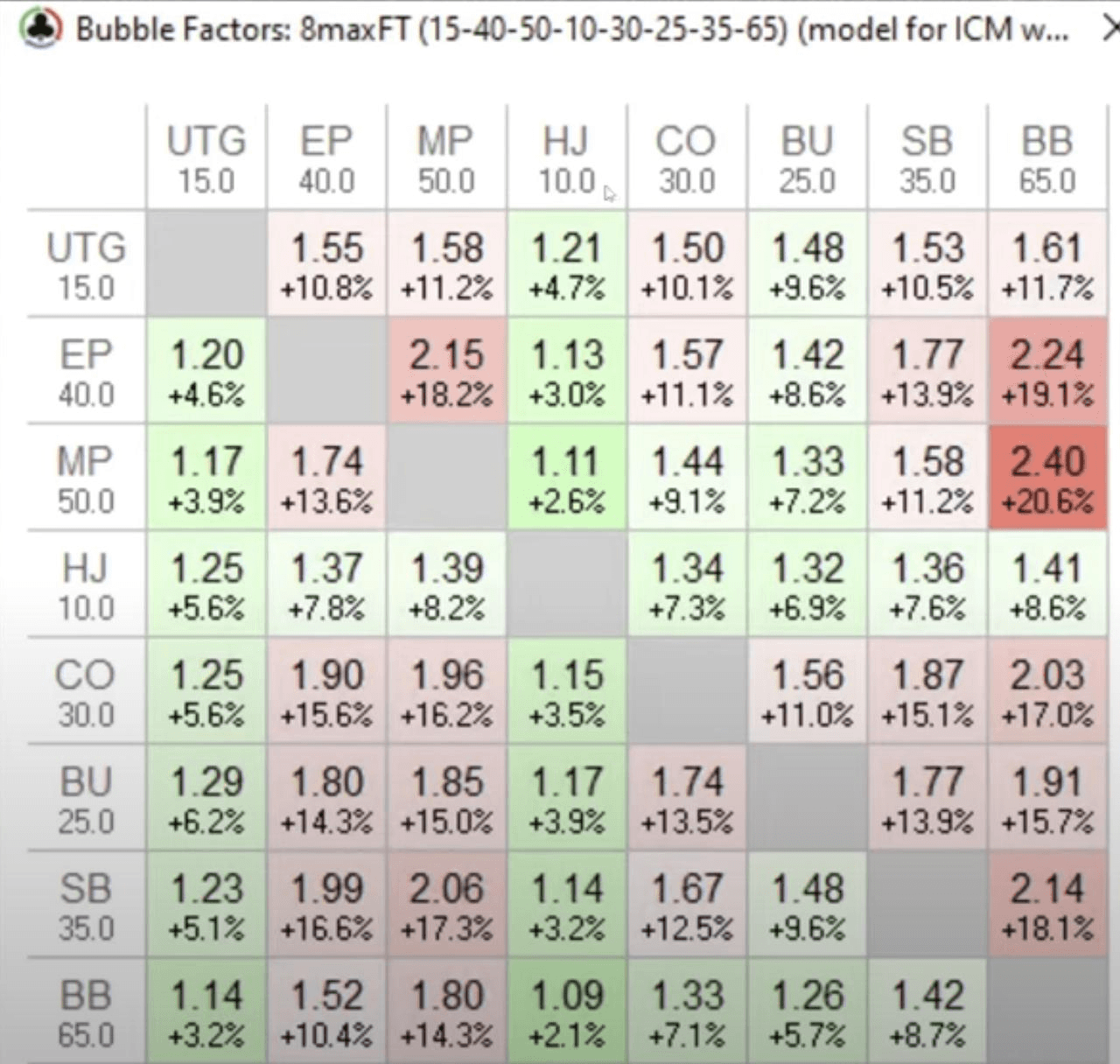
Let's look at the situation with the final table model shown. The player on the HJ has only 10 BB — the shortest stack at the table. When playing against the chip leader on the BB, his bubble factor is only 1.41, and the risk premium is 8.6%.
This means ICM puts relatively little pressure on him. If in a normal situation we need just over 50% equity for a profitable call, here around 58.6% is enough. The short stack is risking his tournament life, but he already has less to lose compared to players in the middle of the stack rankings.
We covered the bubble factor in more detail in our article on final table strategy. Go check it out and read it.
Bubble strategy for a big stack
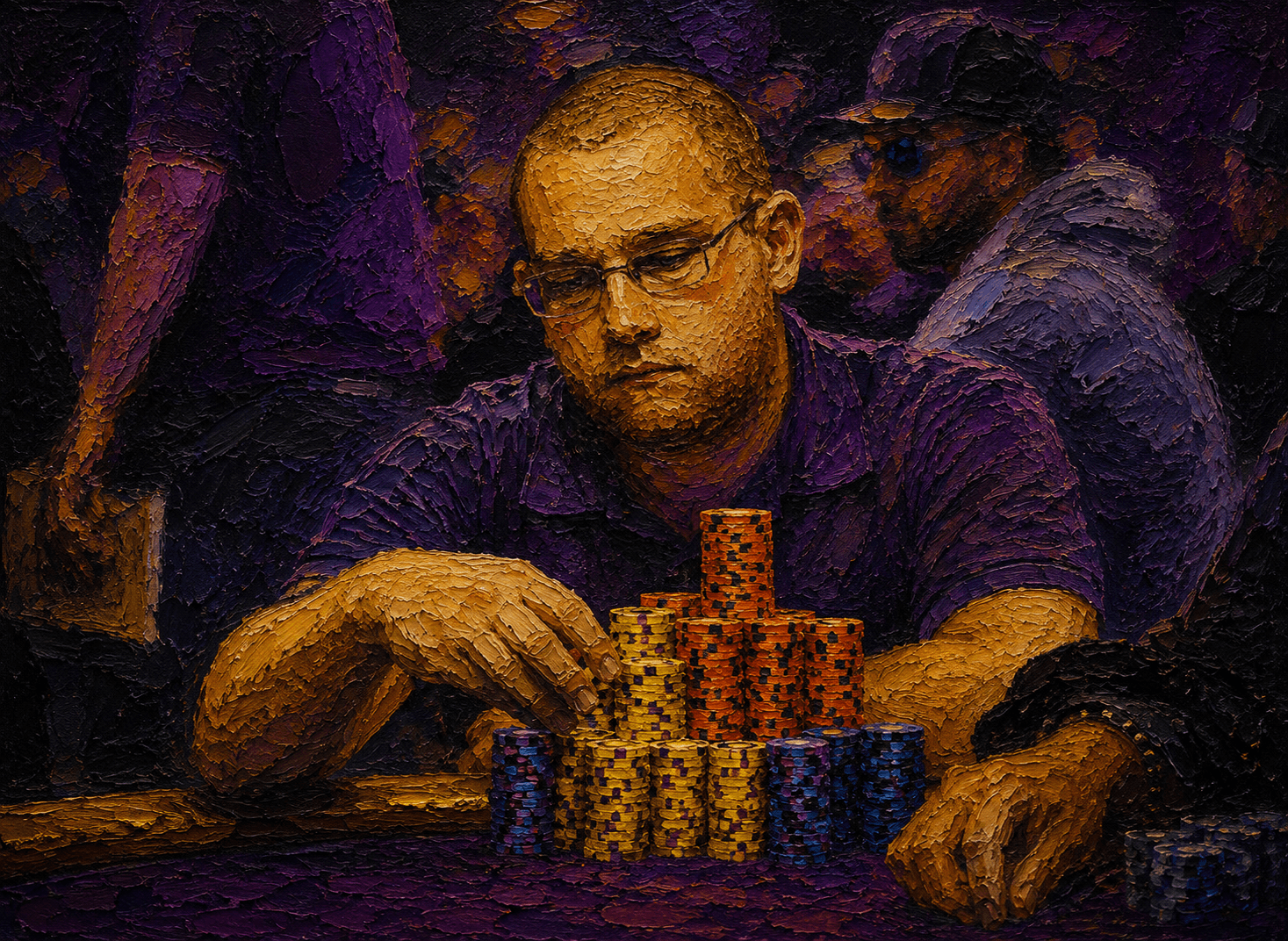
Players with big stacks gain the maximum advantage on the bubble. The main reason is that most opponents don't want to risk their tournament life for relatively small pots. The more players fear busting, the more opportunities chip leaders get to apply pressure.
This doesn't mean you should open any two cards and attack every hand. However, opening ranges do genuinely widen. Medium stacks become especially attractive targets. Such players are in a difficult position. They already have good chances of making the money, so they don't want to risk their entire stack. At the same time, their stack is large enough that losing several pots would noticeably worsen their tournament position.
A big stack can regularly apply pressure with raises, resteals, and continuation bets. Even if opponents understand that the aggression range is widened, not everyone is willing to defend widely enough.
*A resteal in poker is an aggressive counter-raise (3-bet) against an opponent's attempt to steal the blinds (steal raise). A steal is a preflop raise from a late position (BU, CO) aimed at making the players in the blinds fold and taking the pot without a fight.
*A continuation bet (c-bet) is a bet made by a player who was the aggressor on the previous street.
At the same time, it's important not to forget about the risks. Pressure works primarily against players who are strongly affected by ICM. Conflicts between two big stacks often become far less attractive, since losing such a pot can completely change the balance of power at the table.
For this reason, strong regulars rarely fight for every pot with other chip leaders. The main source of profit on the bubble is pressure applied to opponents who fear busting the most.
Strategy for a medium stack
A medium stack is considered the most difficult category on the bubble. If a short stack usually chooses between a push and a fold, and a big stack applies pressure, a medium stack ends up caught between the two extremes.
*A push is a bet of a player's entire stack. This action is also called all-in or going all-in.
On one hand, they have enough chips for comfortable play. On the other, one unfortunate showdown can turn them into a short stack or knock them out of the tournament entirely. That's exactly why medium stacks make the most mistakes on the bubble.
*A short stack is a situation where a player has a relatively small number of chips compared to their opponents at the table.
Some players start being overly cautious and practically stop participating in hands. Formally, they increase their chances of making the money, but at the same time, they let the blinds gradually eat into their stack. Others, on the contrary, try to fight for every pot and get into unnecessary conflicts with chip leaders.
It's especially important to look for situations where you can be the first to apply pressure on opponents. Players afraid of busting will fold significantly more often hands that they would normally continue with. In short, the strategy boils down to two main categories — apply pressure on short stacks when possible and avoid marginal clashes with chip leaders.
For a medium stack, it's important to:
avoid marginal showdowns
carefully assess stack sizes at the table
choose short stacks as targets for pressure
be cautious about aggression from chip leaders
preserve the ability to maneuver after a losing pot.

Strategy for a short stack
The strategy for a short stack on the bubble differs significantly from playing medium and big stacks. While chip leaders can use ICM pressure, short stacks are forced to think primarily about how to preserve enough chips to keep fighting.
When a stack shrinks to 10 BB or below, there's significantly less room to maneuver. Every round of blinds starts to put noticeable pressure on the stack, so the cost of waiting rises quickly.
The smaller the stack becomes, the bigger the role push/fold strategy starts to play. That's exactly why it's important for players to know their ranges in advance and not make decisions purely under the influence of emotions.
The bubble in different tournament types

Although the basic principles stay the same, the specific strategy depends on the tournament format. In tournaments with a slow level structure, players have more room to maneuver. The bubble can last quite a long time, and stack sizes allow for a wide range of strategic tools.
In turbo tournaments, blind pressure increases faster. The number of short stacks increases, and many decisions gradually come down to push/fold. In hyper-turbo formats, ICM's influence remains enormous, but there's significantly less time to make decisions. Often, the entire strategy is built around correctly choosing showdown ranges.
Satellites deserve special mention — tournaments where the prize is a ticket to a more expensive event. This is where ICM's influence reaches its maximum values.
The main feature of satellites is that all prize places receive the same reward. It doesn't matter to a player whether they finish first or last among the qualifiers — in both cases, they receive the same ticket to the target tournament.
Because of this, the value of extra chips drops sharply, while the cost of busting becomes extremely high. For example, a player with the second-biggest stack in the tournament can calmly fold a hand that would be a mandatory call in a regular MTT, if they realize that several short stacks are on the verge of busting.
For this reason, satellite strategy is often called one of the harshest from an ICM perspective. We covered the principles of playing satellites in more detail in this article.
Conclusion
It's precisely on the bubble that most players start deviating from optimal strategy under the influence of the fear of busting. Some become too passive and let opponents take chips without a fight. Others overestimate the strength of their hands and risk their tournament life in situations that don't call for such a high level of risk.
Successful play on the bubble is built on understanding ICM, correctly assessing stack sizes, and being able to use opponents' psychological pressure. The better we understand how the value of chips changes before the payouts, the more of an edge we can gain over the long run.
Apply to FunFarm to understand the ins and outs of playing the bubble and to get the most value out of this stage over the long run.

Free course · FF Start
Stop playing by guesswork
Get to grips with positions, bet sizing, bluffs and decisions against different opponents.