Straddle in poker
In this article, we'll break down what a straddle is in poker, how it works, what types exist, why theory considers it unprofitable in the long run, and in which situations it can still be justified.

Ilya is a Liga 2 player with six years of experience in online MTTs. He graduated from the Faculty of Journalism at RSUH and writes about poker for beginners, explaining complex things in simple, clear language. In his texts, Ilya combines his personal playing experience with his professional journalism skills to help newcomers confidently get into the game.
If you've played live poker at least once, you've probably encountered a situation where, even before the cards are dealt, one of the players silently puts two big blinds' worth of chips in front of them. The dealer announces: "Straddle," the starting pot immediately becomes bigger, and the entire hand starts to unfold along a completely different script.
For beginning players, this kind of bet often looks like a mandatory rule or a variety of the big blind. In reality, it's a completely voluntary action. Some players use it to add action at the table, while others consider the straddle one of the most expensive habits in poker.
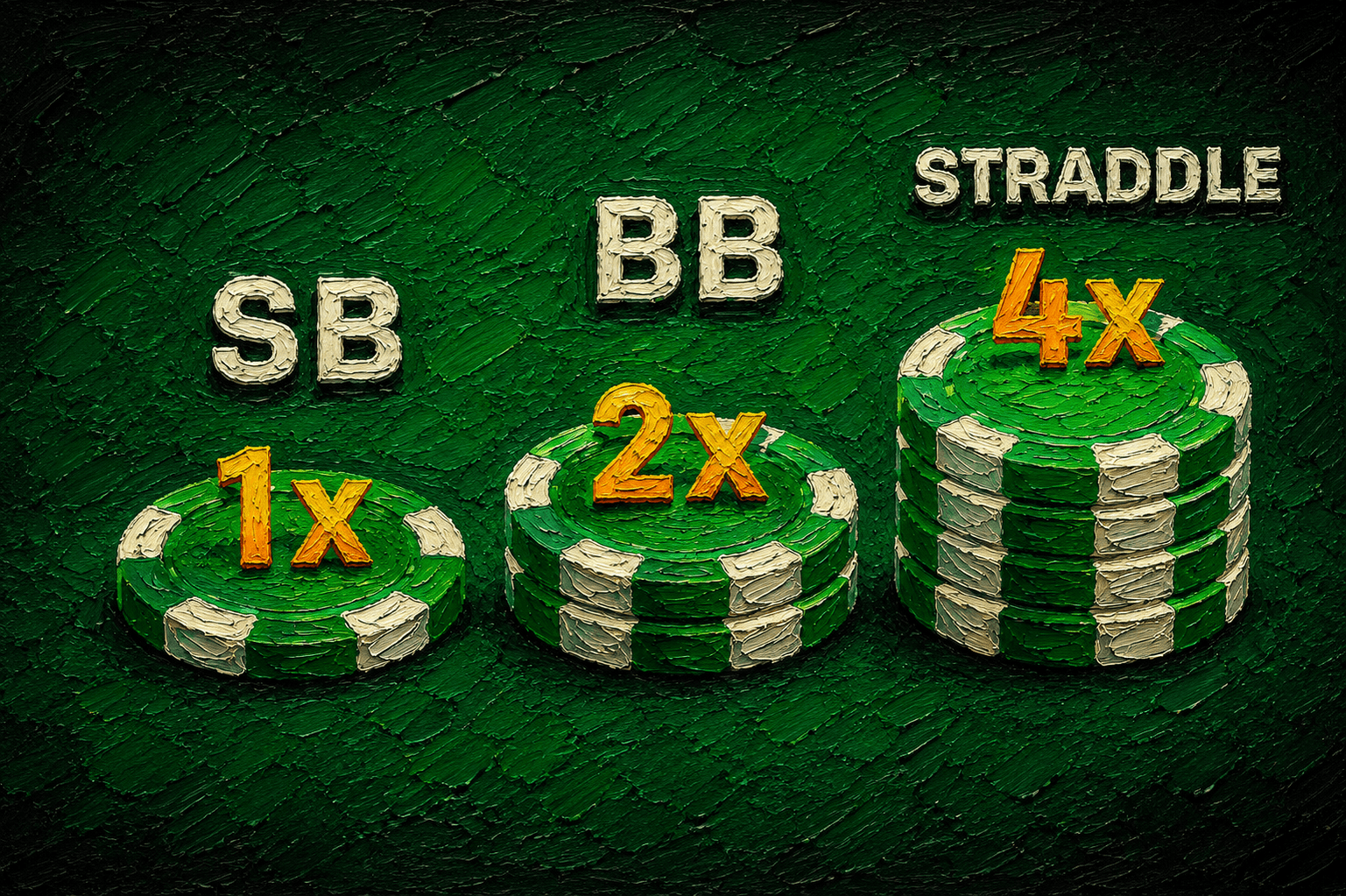
From a practical standpoint, the straddle really does make the game more dynamic and increases the pots. But if you look at the situation from the perspective of math and modern poker theory, the conclusion turns out to be far less obvious.
In this article, we'll break down what a straddle is in poker, how it works, what types exist, why theory considers it a losing play in the long run, and in which situations it can still be justified.

New breakdowns in your inbox
Subscribe to the FunFarm newsletter: fresh Poker ABC articles and material that helps you grow as a player.
What is a straddle in poker
A straddle in poker is a voluntary blind bet made before the hole cards are dealt. In the classic version, it's placed by the player sitting immediately after the big blind — in the UTG position.
What other positions exist in poker and how they affect game strategy, you can find out in this article. Follow the link and read.
Unlike the small and big blinds, the straddle isn't mandatory. The player themselves decides whether they want to put extra money into the pot before even seeing their cards. Most often, the size of the straddle is 2 big blinds, although in some poker clubs the rules allow for larger sizes or several consecutive straddles.
Let's say the game is being played with blinds of $1/$3.
Before the cards are dealt, the player on UTG announces a straddle and puts in $6. After that, the starting pot becomes bigger, and preflop begins already with a new mandatory bet.
The basic idea of the straddle is simple:
increase the size of the starting pot
make the game more dynamic
create more action right from the first decisions
That's exactly why the straddle is especially popular in live cash games. Many recreational lineups use it almost automatically so that pots grow faster and hands become more spectacular. However, a bigger pot doesn't automatically mean bigger profit. On the contrary, from a mathematical standpoint, voluntarily investing money blind comes with a cost, which we'll talk about below.
How the straddle changes the order of action preflop
Once a straddle appears, not only does the starting pot size change, but so does the betting order. If the classic straddle was placed by the player on UTG, the next participant around the table starts making decisions first. They can fold, call the straddle, or raise.
The player who placed the straddle acts last preflop — roughly the same way the big blind usually acts after opponents open. But there's an important nuance here:
Postflop, no advantages remain at all
*Preflop — the first round of betting, which happens after the hole cards are dealt but before the flop comes out. Example usage: "Most beginners make their mistakes right on preflop."
*Postflop — all the betting rounds that happen after the flop (flop, turn, and river). Example usage: "My preflop game is good, but I need to improve my postflop."
After the flop comes out, the order of action fully returns to the usual rules. The player on UTG who placed the straddle again finds themselves in one of the most uncomfortable positions at the table and practically always makes decisions among the first.
There's another important consequence that beginning players often forget about. A straddle actually reduces stack depth when measured in big blinds.
Let's imagine the game is being played with blinds of $1/$3, and each player has a stack of $300. Without a straddle, the depth is 100 BB. But if a $6 straddle is used before every hand, the effective depth becomes 50 BB.
At first glance, the amount of money in the stacks hasn't changed. But the strategy of the game becomes completely different. Many decisions that were standard at 100 BB depth no longer work at an effective 50 BB. Big pots occur more often, opening ranges become wider, and hands reach showdown much faster. That's exactly why experienced players view the straddle not as an extra bet, but as a change to the entire structure of the game.
Types of straddle in poker
Although the UTG straddle is considered classic, in different poker clubs you can encounter other variations of this bet. The rules depend on the specific room or the agreements between the players at the table. Let's look at the variations.
1. Classic UTG straddle
This is the most common variant of the straddle. The player voluntarily puts in two big blinds before even receiving cards. After that, the betting starts with the next player, and the straddler gets the last word preflop. Despite this small advantage, it's exactly the UTG straddle that's considered the most controversial from a strategic standpoint.
The reason is simple: after the flop comes out, the player once again finds themselves out of position against practically the entire table. Moreover, UTG is precisely the position from which the tightest opening ranges are used in a normal game. The straddle forces you to voluntarily put extra money in exactly where theory recommends acting with maximum caution.
2. Button straddle
In some poker clubs, a straddle from the button is allowed. This variant is considered significantly more interesting from a strategic standpoint.
The main advantage is that the button retains the best position on all postflop streets. Even after the starting pot increases, the player continues to act last, which allows them to more effectively realize the equity of their hands.
*Equity — our share of the pot, corresponding to your chances of winning at a given moment. Example usage: "With a pair of aces against a random hand preflop, our equity is about 85%."
The order of betting preflop may differ depending on the rules of a specific room. In some casinos, the small blind acts first, in others — the player on UTG.
From a mathematical standpoint, the button straddle is still a voluntary blind bet and doesn't automatically become profitable. However, the positional advantage makes it less unprofitable compared to the classic UTG straddle.
3. Mississippi straddle
In this case, practically any player at the table can place a straddle regardless of their position. Rules like this are encountered much more rarely and are usually used in individual casinos or home cash games.
The peculiarity of the Mississippi straddle is that the betting order becomes less standard. Players have to constantly keep track of exactly who placed the straddle and in what order the betting now proceeds.
4. Double and triple straddle
Sometimes after the first straddle, another player can announce yet another straddle of a larger size.
For example:
UTG puts in $6
the next player announces a $12 straddle
the next — $24.
This format is sometimes called a double or triple straddle. As a result, the starting pot sharply increases even before the cards are dealt, and the effective stacks become significantly shorter. Situations like this are more common in high-stakes live cash games, where players deliberately want to make the game more aggressive.
Learning at FunFarm, from any level
Is the straddle profitable
Most modern poker solvers agree on one conclusion: under standard conditions, the straddle is an action with negative expected value.
*A solver is a specialized computer program that calculates theoretically optimal strategies for specific game situations.
There are several reasons for this. First, the player puts money into the pot before even seeing their cards. This contradicts one of the fundamental principles of profitable poker — first assess the strength of the starting hand, and only then make a decision about investing chips.
Second, the classic straddle is done from the UTG position. This is exactly the position from which the narrowest range of hands is opened in a normal game. The player acts first after the flop against most opponents, so weak starting hands quickly turn into losing ones.
The straddle doesn't change this drawback. On the contrary, it increases the initial investment exactly in the position where discipline in hand selection matters the most.
Another reason has to do with stack depth. Let's say the game is being played with $300 stacks at $1/$3 blinds. Without a straddle, each player has a stack of about 100 BB. Once a $6 straddle appears, the effective depth drops to roughly 50 BB. This completely changes the strategy of the game.
Opening ranges become different, the value of strong made hands increases, and the number of stack-off showdowns rises noticeably. If a player keeps using a strategy designed for deep stacks, the number of mistakes quickly grows. So from the standpoint of modern theory, the general principle is fairly simple:
It's never more profitable to place a straddle than to place it too often
This doesn't mean the straddle is always a gross mistake. But under normal conditions, it doesn't bring additional expected value and is more often used to change the dynamics of the game than to increase profit.
Can a straddle be justified
Despite the general conclusion of theory, there are situations in which a straddle can bring additional profit. The main condition is that there must be opponents at the table who make serious mistakes right after the flop.
For example, if the game is being played against loose-passive players who like to call wide preflop but often give up under pressure on the later streets, increasing the starting pot can turn out to be profitable.
*A loose-passive player is a poker player who plays a lot of starting hands, but does so without aggression. They often enter the pot with a call, aim to see the flop cheaply, and postflop tend to respond passively to opponents' actions, rarely raising.
In this kind of situation, the player deliberately creates a bigger pot, expecting to outplay opponents thanks to a higher level of postflop understanding.
Sometimes a straddle is also used at very tight tables. If most participants only play the strongest starting hands and avoid difficult decisions, increasing the bets can change the dynamics of the game. Some opponents start to feel less comfortable, and a strong player gets the opportunity to pick up the increased pots more often through pressure.
*Tight — a style of play in which the player plays a very narrow and strong range of hands. Example usage: "The player to my right is very tight, if he raises, he definitely has a monster."
Another case is tables where practically all participants straddle. If this kind of tradition has already taken hold, giving up the straddle isn't always the best decision. The game still proceeds with increased pots and reduced stack depth, so it's often simpler to adapt your own strategy to the new conditions than to try to play by standard rules in a completely unusual structure.
However, it's important to understand that all the situations listed above are more like exceptions. The straddle itself doesn't create profit. Profit is created by opponents' mistakes after the pot has already increased.

How to play when an opponent straddles
If it wasn't you who placed the straddle at the table, that doesn't mean you need to automatically change your entire strategy. However, it's necessary to take the new hand structure into account, since the pot size and stack depth already differ from the usual ones.
1. Don't play tighter just because of the bigger pot
A common mistake among beginning players is thinking that an increased pot requires more cautious play. In reality, the size of the starting pot by itself doesn't make hands stronger or weaker. It's important to understand that the straddle affects not only the size of the pot, but also the ranges of the participants.
Since the effective stack depth becomes smaller, many opponents start opening wider and fighting for the pot more often already preflop. That's why decisions need to be made based on the new stack structure, not on the size of the pot.
*Effective stack — the size of the smallest stack among the players participating in a specific hand. It determines the maximum number of chips a player can win or lose in that hand.
2. Take into account the reduction in effective stacks
One of the main consequences of the straddle is a decrease in stack depth measured in big blinds. This means some hands that played well at 100 BB start to lose part of their value.
For example, low pocket pairs or suited connectors usually realize their advantage exactly at deep stack depths. As the SPR decreases and effective stacks shrink, the opportunities for realizing the hidden potential of hands like these become significantly lower.
3. Use 3-bets more often against weak straddlers
Many recreational players use the straddle purely for action, without changing their strategy going forward. As a result, they keep entering the pot wide and make a large number of mistakes after the flop.
If a player like this regularly straddles and opens too wide, their range becomes a good target for 3-bets, especially when we're in a late position.
However, you shouldn't turn this into an automatic rule. Before increasing your aggression, it's important to understand how often the opponent is capable of folding to a reraise and how they behave in big pots.
4. Plan the hand in advance
Because of the reduced stack depth, many pots with a straddle develop significantly faster. Even before entering the hand, it's useful to understand:
whether you're ready to continue against a 3-bet
how well your hand plays with a small SPR
which hands you're willing to play for a big pot
This approach helps avoid one of the most common mistakes — mechanically transferring a deep-stack strategy to a situation where the effective depth is already significantly smaller.
Conclusion
In most standard situations, the best strategy for playing against a straddle remains disciplined selection of starting hands and avoiding voluntary investments without any information about your own hand.
Free course · FF Start
Build your foundation in one course
Hand rankings, terminology and the logic of a hand — without scattered tips or complicated explanations.