Pot control in poker
In this article, we'll break down what pot control is, why it's needed, how the SPR metric helps with decision-making, in which situations it's worth shrinking the pot, and when trying to play it safe leads to lost profit.


Ilya is a Liga 2 player with six years of experience in online MTTs. He graduated from the Faculty of Journalism at RSUH and writes about poker for beginners, explaining complex things in simple, clear language. In his texts, Ilya combines his personal playing experience with his professional journalism skills to help newcomers confidently get into the game.
One of the most common mistakes players make postflop looks the same regardless of the stakes: we assume we're playing for value, we bet the flop, the turn, we want to apply pressure on the river, and suddenly we realize we've ended up in a huge pot with a hand whose strength we don't fully understand. The problem usually doesn't arise on the last street. The mistake happens much earlier — at the moment when the player stops thinking about the size of the pot relative to the strength of their hand.
*Postflop — all betting rounds that occur after the flop (flop, turn, and river).
In modern poker, it's not enough to simply understand which combination is currently ahead. It's important for us to assess how much money is worth putting into the pot against the opponent's range and what decisions will look like on the following streets. That's why the concept of pot control remains one of the most important parts of postflop strategy.

In this article, we'll break down what pot control is, why it's needed, how the SPR metric helps make decisions, in which situations it's worth shrinking the pot size, and when trying to play cautiously leads to losing profit.
What is pot control in poker
Pot control is the deliberate management of pot size in situations where our hand will have a certain value at showdown, but isn't strong enough to comfortably apply pressure on every street of the hand.
*Showdown — the final stage of a poker hand, at which the remaining participants reveal their cards to determine who holds the strongest combination.
The main goal of pot control isn't to avoid betting at all costs. The task is to preserve the ability to reach showdown without overpaying against stronger hands.
It's important to understand that pot control isn't passive play. We're not giving up value entirely. We're simply choosing the line that better matches the real strength of our hand and the opponent's range.
*Value — the profit you expect to get from your bet when you believe you have the best hand. A value bet is a bet made with the goal of getting paid off by worse hands.

New breakdowns in your inbox
Subscribe to the FunFarm newsletter: fresh Poker ABC articles and material that helps you grow as a player.
SPR — the main tool of pot control
One of the most important metrics for making postflop decisions is SPR. SPR is calculated using the formula:
SPR = effective stack / pot size
*Effective stack — the size of the smallest stack among the players who are participating in a given hand and competing for the pot.
SPR determines the space for decision-making. If the effective stack is 80 BB and the pot contains only 10 BB, the player has a large number of possible lines to play. They can use small bets, check part of their range, extract value on later streets, or control the size of the pot through various sizings.
*Sizing — the size of a bet.
If, however, the effective stack is 20 BB and the pot has already grown to 15 BB, any large bet starts to commit the players to the pot and gradually leads to getting all-in. That's why understanding SPR helps plan out the hand in advance, rather than making difficult decisions only on the river.
1. Low SPR (0–4)
With a low SPR, there's practically no room left to maneuver. If the pot contains 20 BB and the effective stack is 30 BB, any large bet will quickly bring the players to getting all-in. In such situations, pot control loses most of its effectiveness. The player more often has to decide whether they're willing to play for stacks with a particular hand. That's why a low SPR usually leads to a "play for stacks or fold" strategy.
2. Medium SPR (4–10)
This range is considered the most comfortable for pot control. The pot size is already large enough for bets to carry weight, while there's still room for decision-making across several streets. Here, check-calls, small bets, and blocking bets on the river gain maximum value. The player gets the opportunity to regulate the size of the pot and choose the most profitable line against a specific opponent range.
3. High SPR (10+)
With a high SPR, the pot remains small compared to the effective stacks, so getting all-in is usually still far off. This gives both players broad opportunities to maneuver on the following streets: they can vary bet sizes, apply pressure, and realize equity. That's why, with a high SPR, it's important to objectively assess the strength of your hand and not build up the pot unnecessarily. If we've made a medium-strength combination, large bets often lead to us ending up in a difficult spot by the river against a range that has managed to improve or was originally stronger.
When to play pot control
The main criterion for using pot control isn't a specific combination, but the ratio of our equity against the opponent's range. In most cases, pot control is applied when our hand is in an intermediate zone. We're too strong to fold, but not strong enough to play for a large pot.
*Equity — our share of the pot corresponding to your chances of winning at a given moment. Example of usage: "With pocket aces against a random hand preflop, our equity is approximately 85%."
Most often, we're talking about situations where the hand's equity against the opponent's estimated range is roughly in the range of 30 to 55%. This is exactly where the main question arises: is it worth continuing to build up the pot, or is it more profitable to limit its size and realize our share of equity at showdown?
At the same time, a pot control decision isn't always related to wanting to reach showdown more cheaply. Often it's made already on the flop or turn, when the board texture changes and the strength of our hand relative to the opponent's range changes as well. For example, we bet with top pair on the flop, got a call, and on the turn the board paired. Now the opponent's range contains more trips, and our top pair no longer looks like a hand with which it's profitable to collect value on three streets. In such a situation, checking on the turn allows us to keep the pot under control and avoid unnecessary investments against the strengthened part of the opponent's range.
Typical pot-control hands include:
top pair with a medium or weak kicker
second pair
an overpair on a dangerous board structure
weak two pair on dynamic boards with straights and flushes
It's important to understand that pot control doesn't mean playing to win at all costs. Its task is to extract maximum profit from medium-strength hands while at the same time avoiding large losses against the strong part of the opponent's range.
Learning at FunFarm, from any level
The main goals of pot control
Many players mistakenly believe that pot control is only needed in order to reach showdown more cheaply. In practice, its tasks are much broader.
1. Reach showdown in a small pot
The main goal of pot control is to prevent the pot from growing to a size where our hand starts to feel uncomfortable. The bigger the pot, the stronger the opponent's continuing range becomes. That's why a medium-strength hand wins a small pot much more often than a large one.
A typical example is checking the turn after a c-bet on the flop and calling a bet on the river. This strategy is especially effective against aggressive opponents who are inclined to put money into the pot on their own with a wide range.
Let's look at a situation to reinforce this.
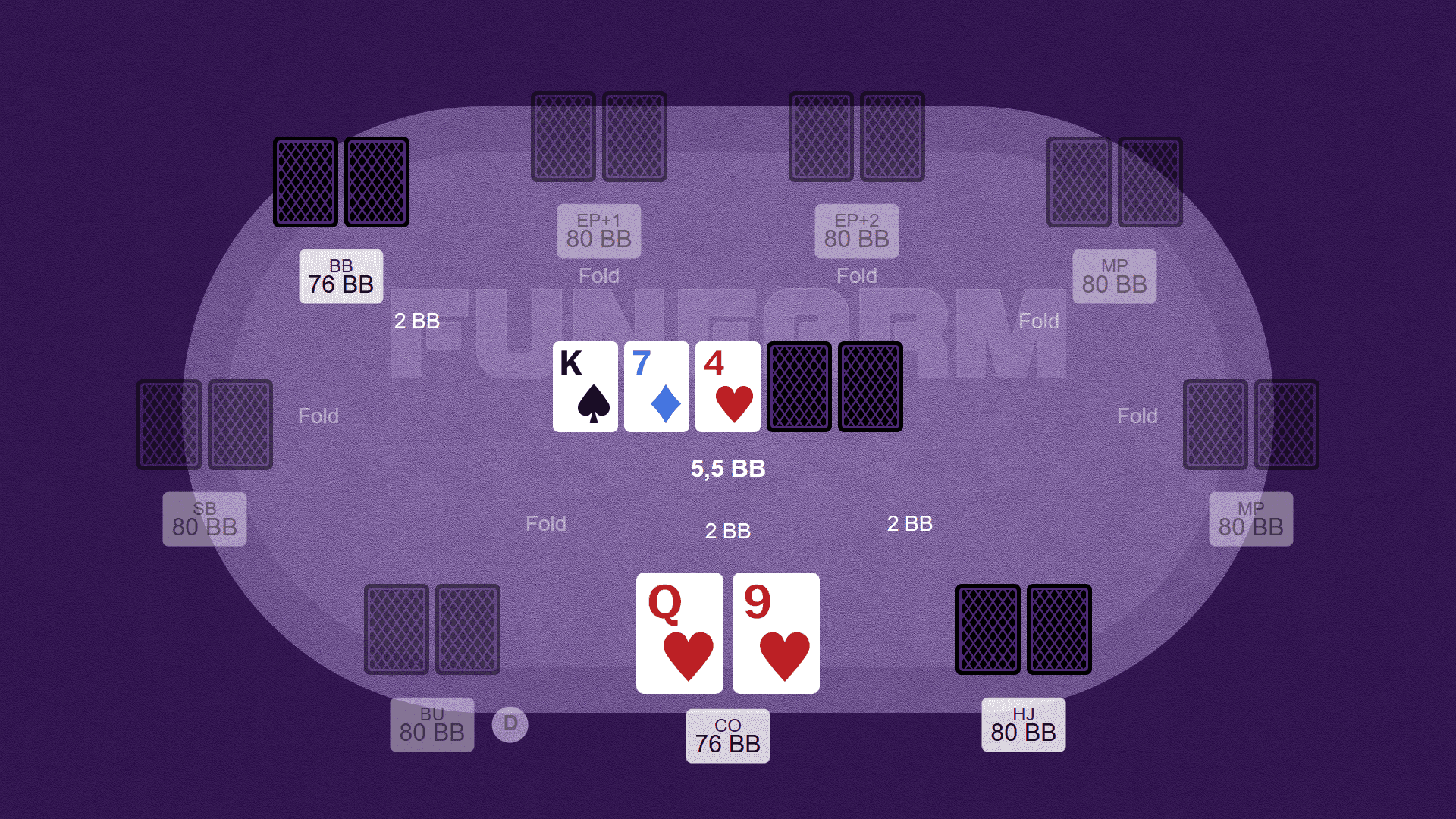
We open with Q♥️9♥️ from a middle position and get a call from the BB. On the flop, we see that we haven't connected with the board, but since it's a dry board and we're the preflop aggressor. The opponent has plenty of hands that we can push out right now — so we make a c-bet. The opponent calls.
*C-bet (Continuation Bet / C-bet) — a bet on the flop made by the player who was the preflop aggressor. Example of usage: "I raised with A-K, missed the flop, but still made a c-bet."
We covered this playing tool, the c-bet, in more detail in this article. Go and read it.
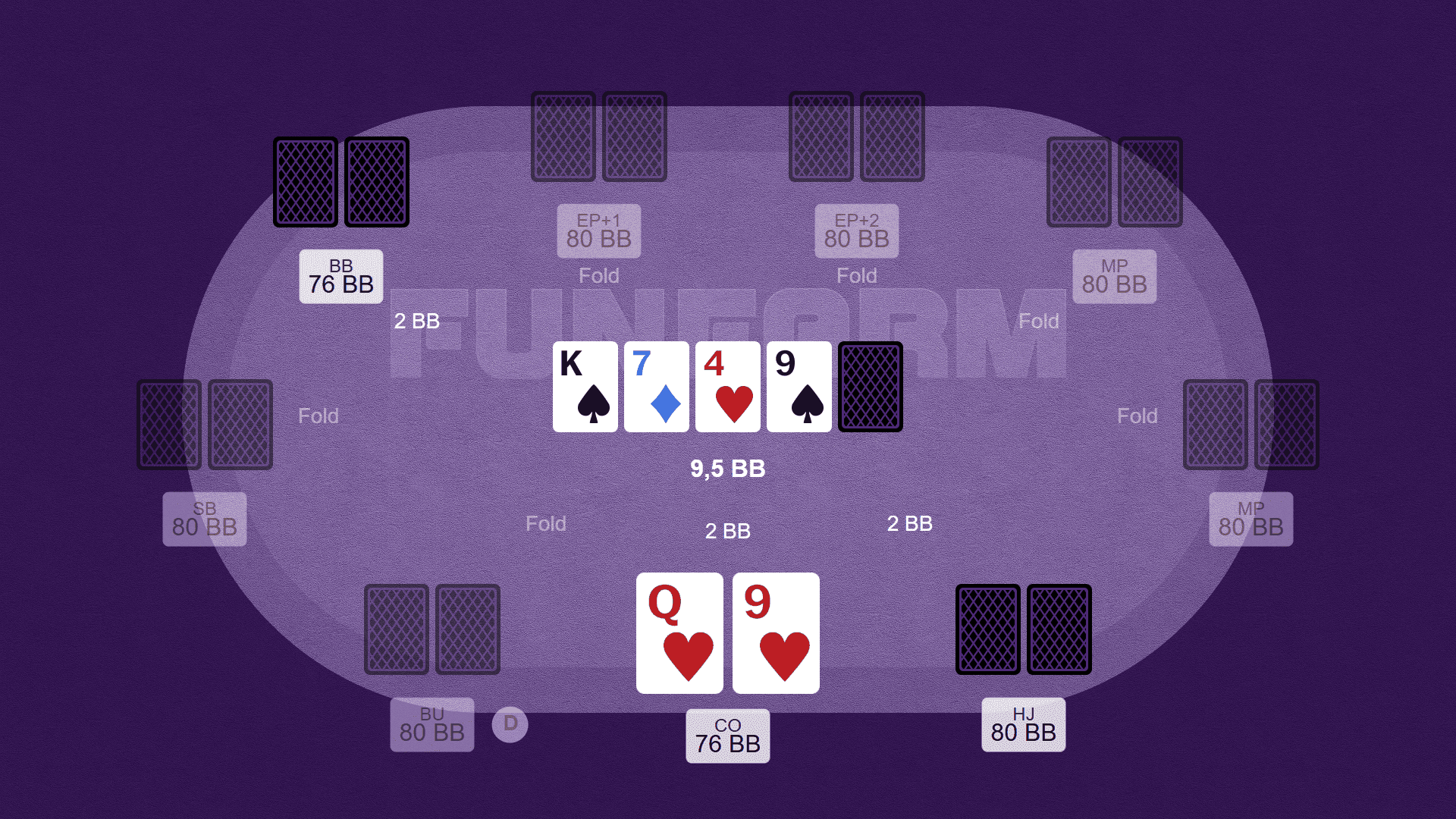
On the turn, we improve to second pair. At first glance, it might seem like we can bet on our own. However, this is exactly where a classic pot-control situation begins.
If we keep betting:
many weak hands will simply fold
strong kings will keep calling
part of the range will be able to check-raise
the pot will start growing quickly.
If, however, we choose to check:
we realize our equity for free
we keep the possibility of improving on the river
we leave missed draws, 7x, and 4x hands in the opponent's range
we avoid unpleasant decisions against aggression.
As a result, checking the turn brings in more profit than an automatic second barrel. Situations like these are exactly the foundation of proper pot control.
Pot control through small sizing
Many players mistakenly believe that pot control always means checking. In practice, this is far from true. One of the best tools for controlling the pot is small bets.
1. A 25–33% bet on the flop and turn
Small sizing allows us to solve several tasks at once. First, we keep the initiative. Second, we continue to extract value from weaker hands. Third, we don't build up the pot to an uncomfortable size.
In addition, a small bet doesn't allow the opponent to realize the equity of their draws for free. That's why, in many situations, a one-third-pot bet turns out to be preferable to a check.
In the late stages of tournaments, an additional factor comes into play — ICM. Because of it, some usual lines change. With short stacks, trying to control the pot becomes a mistake. If SPR is already low and the payout structure is exerting strong pressure, it's often more profitable for the player to make a decision right away.
In such situations, intermediate lines between aggression and folding start to lose effectiveness. That's why, on the bubble and at the final table, pot control must always be considered through the lens of ICM and the size of the effective stack.
You can learn more about how to act correctly at different stages of tournaments in this article.

Common mistakes players make with pot control

Pot control is considered a useful tool, but using it incorrectly can lead to serious EV losses.
1. Pot control with the nuts
Some players start controlling the pot even when they have a very strong hand. For example, having hit a set on a dry board, they're afraid to scare off the opponent and constantly choose to check. Most of the profit in poker is generated precisely through value betting with strong hands. If we deliberately shrink the pot in situations where we should be building it up, we lose a huge amount of value.
*Nuts — the strongest, unbeatable combination of cards possible at a given stage of the hand, taking into account the community cards on the table and the player's hole cards.
2. Pot control against a weak player
Recreational players are often willing to pay off much wider than regulars. That's why trying to play too cautiously against such opponents usually leads to under-betting for value. If a player is capable of calling three streets with a weak pair, there's no reason to hold back on betting.
3. Automatic check on the turn
One of the most common mistakes is using pot control on autopilot. The player sees top pair and automatically checks the turn without analyzing ranges. In practice, every such check should be accompanied by the question — do I have three streets of value? If, after our check, the opponent makes a large bet on the river, are we prepared to call? If not, perhaps the current line was chosen incorrectly from the start.
Conclusion
The better a player understands the relationship between hand strength, the opponent's range, and pot size, the less often they'll find themselves in situations where they have to make costly stack-off decisions with just one pair.
Submit an application to FunFarm to understand the concept of pot control and many other in-game strategies even better.

Free course · FF Start
Your first hands, with a clear plan
Learn to read the table, compare hands and understand the order of action.