How to Play Poker: Rules for Beginners
The rules of poker are the foundation of its popularity. To sit down at the table and get your first experience, all you need is to memorize the ranking of hands and the order of betting. That's why millions of people around the world play poker. In this article: we'll break down the key rules, explain the importance of position, and give practical tips on learning.

Ilya is a Liga 2 player with six years of experience in online MTTs. He graduated from the Faculty of Journalism at RSUH and writes about poker for beginners, explaining complex things in simple, clear language. In his texts, Ilya combines his personal playing experience with his professional journalism skills to help newcomers confidently get into the game.
Key facts about the rules
The most important poker rules for beginners look like this:
The game uses a 52-card deck.
The goal of the game is to take the pot.
You can win in two ways: show the best hand at showdown, or force your opponents out of the hand.
In Hold'em, the final hand consists of 5 cards.
The rules of poker provide for 10 winning hands: from high card to royal flush.
A Hold'em hand consists of four betting rounds: preflop, flop, turn, river.
In Hold'em, a player can go all-in at any point in the hand.

New breakdowns in your inbox
Subscribe to the FunFarm newsletter: fresh Poker ABC articles and material that helps you grow as a player.
What is poker and what is its essence
Poker is a collective term for several card games with similar rules. The player's task is to win the hand and take the pot.

You can win a hand in two ways: 1) show the best hand at showdown; 2) force your opponents to fold their cards and exit the hand
When people speak of poker in the broad sense, they mean several card games: No Limit Texas Hold'em, Pot Limit Omaha, draw poker, stud, short deck. The games share the rules of hand rankings and some elements of betting. In the narrow sense, poker is equated with its most popular variant — No Limit Holdem. Hold'em rose to a leading position in the 1970s. Online poker cemented NL Holdem's dominance at the start of the 2000s. The most important tournament in the industry — the Main Event at the World Series of Poker — is played by Hold'em rules. That's why this article will focus on NL Holdem.
Hundreds of millions of people play poker. The high interest in the card game is shown by Google Play data. The three most popular poker apps have been downloaded by over 110,000,000 people. In 2025, WSOP broadcasts attracted 3,000,000 viewers.
What you need to play poker
The rules of poker are one of the main reasons for the game's popularity: you can grasp the essence of Hold'em in a few minutes. Let's not discount the minimal setup requirements either. The most modest session requires: 1) a second player; 2) a deck of cards. To recreate a full casino atmosphere, you need:
A 52-card deck. Jokers are not used in the game.
A set of chips. The amount depends on the number of poker players. The general rule is — the more participants, the more chips you need.
A table for two to ten players. Its main features are the markings and the felt.
A dealer or a dealer button.
Six to nine players.
Modern conditions let you put together a poker set with minimal effort. A decent playing set can be ordered on a marketplace. For example, a set of 500 chips with two decks, a dealer button and felt costs around $120.
The goal of the game: how you win in poker
The simplest way to win a hand is to present the best hand at showdown. The showdown is the final moment of the hand, when the opponents show their final hands, compare their strength and determine the winner. The triumphant player takes the pot. The pot includes the forced bets of the players in the small and big blind and the voluntary investments of the other participants. Alongside the term "bank," poker uses "pot." They mean one and the same thing.
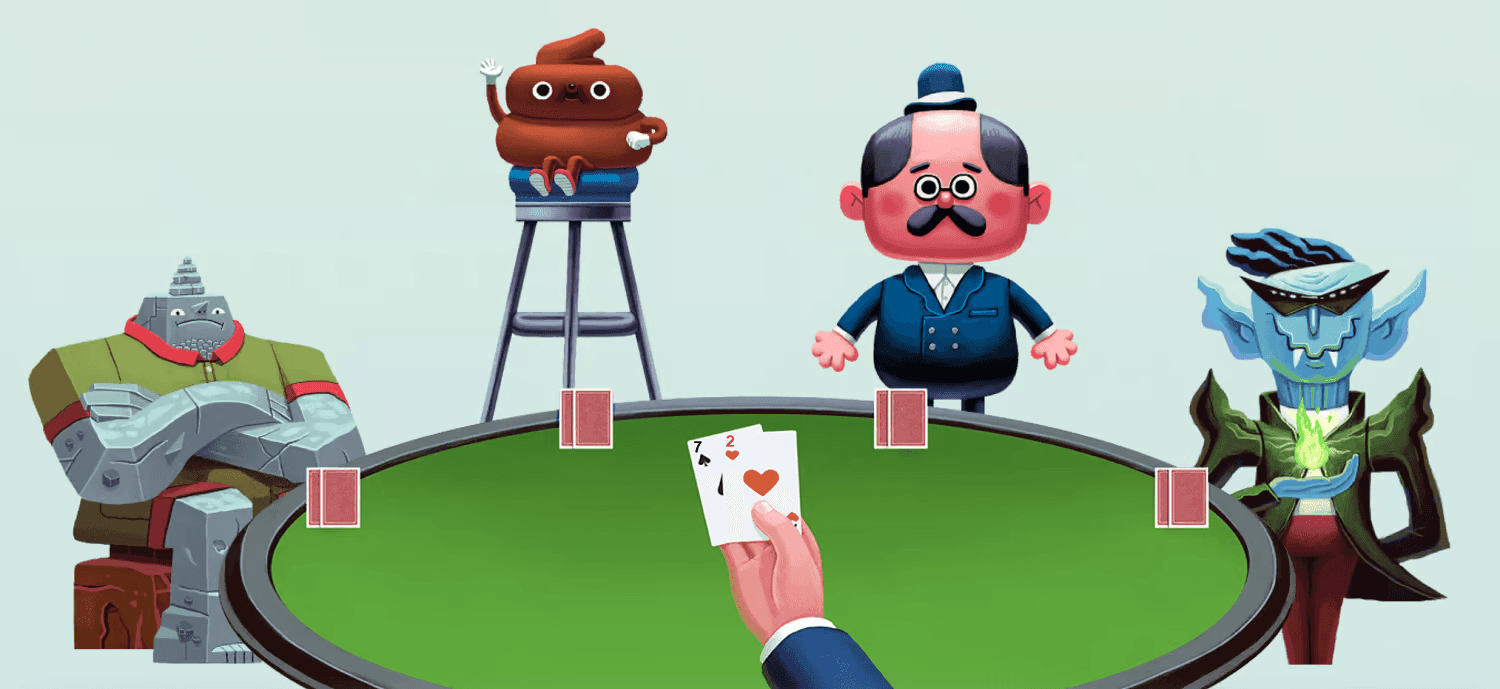
A good bluff requires high skill and the right situation. Opponents won't just hand over money for nothing
You can also win with a bluff. A bluff is a bet with a deliberately weak hand to convince an opponent to fold a stronger hand. We recommend that beginners use this move sparingly. For example, it's reasonable to make a bet on a suitable flop against a cautious opponent after our raise preflop. However, you shouldn't pull off a big bluff without serious grounds. The move's effectiveness depends on the player's skill. The more convincingly he portrays strong hands, the more often opponents fold.
Learning at FunFarm, from any level
Card hands in poker
The pot is taken by the holder of the best 5-card hand. In No Limit Texas Hold'em there is no rule requiring the hole-card ranks to be used in the final hand. It's easier to show with examples:
A player was dealt 88 preflop and the community cards 28AQ2 came. The best hand is a full house, 88822. It uses 2 of the player's ranks and 3 from the board.
A player was dealt K9 of hearts preflop. The dealer laid out the common board A2468 of spades. The best possible hand is a flush. It's formed by the spade cards on the table. The player's starting hand doesn't take part in the final hand.
Not in every type of poker can the final hand be made up entirely of community cards. In Omaha they use the formula "2 ranks from the starting hand + 3 ranks from the board." Read more about the difference between the games in a separate article about Pot Limit Omaha.
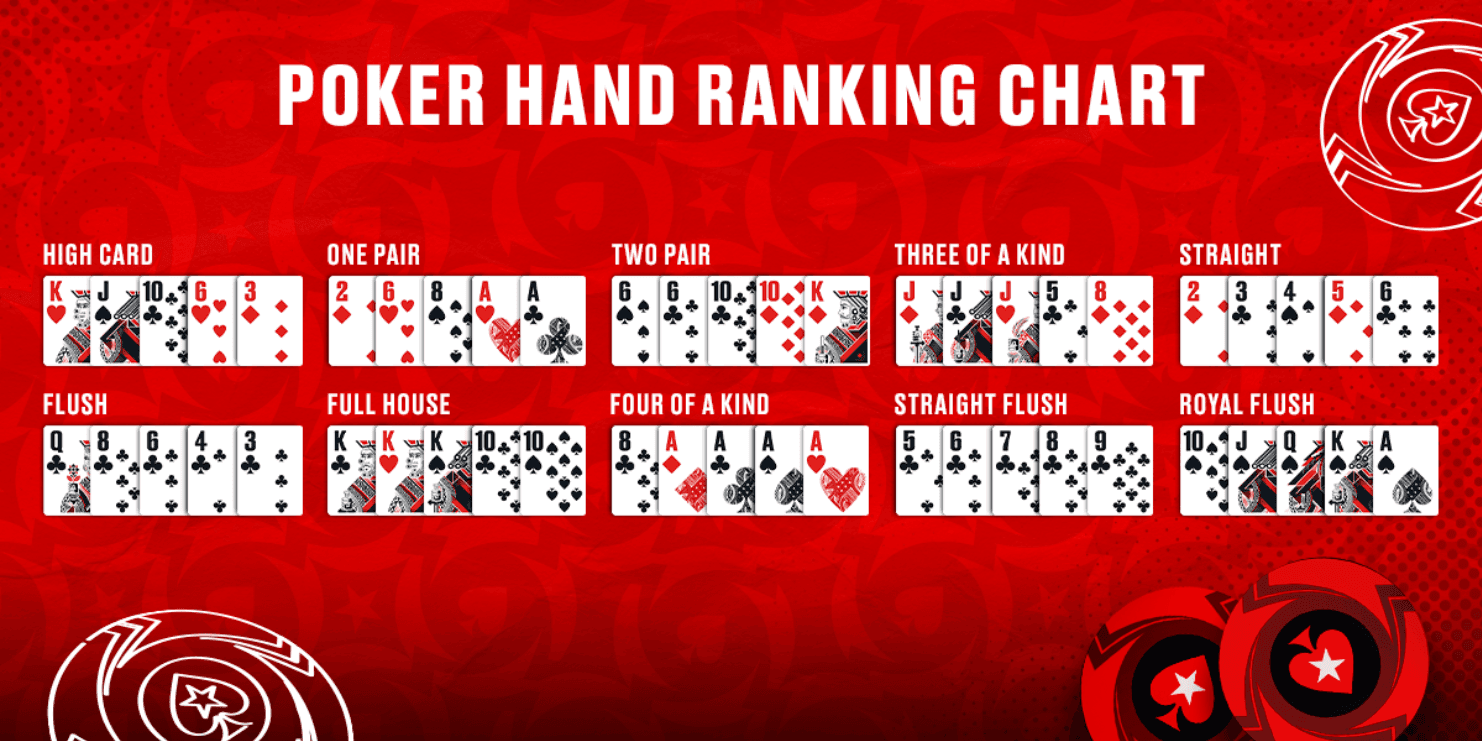
All winning poker hands in one picture
The rules of NL Holdem, PLO and other poker variants single out 10 winning hands. Here's how they look:
Hand name | Description | Example |
High card | If by the end of the hand the opponents have no pair or better hand, then the outcome is determined by the strength of the individual ranks | AT on the board 3579J gives a final hand of AJT97 |
Pair | A match between a starting-hand rank and the board | K9 and the flop 269 give a pair of 99 |
Two pair | If repeats of both starting-hand cards come on the board, then the player has made two pair | T8 on the flop T82 gives a two-pair hand: TT and 88 |
Set | A hand of three of the same rank | 77 and the common board 73A form a set of 777 |
Straight | Five consecutive cards of different suits | JT on the table 2689Q gives a straight QJT98 |
Flush | Five cards of one suit | A2 of hearts on the flop 47Q of the same suit form a flush |
Full house | Combines elements of a set and a pair | AK on the board AAK gives a full house AAAKK |
Quads | Four of the same rank | JJ on the flop JJ2 forms quads JJJJ |
Straight flush | Five consecutive cards of one suit | T9 of spades on a board of the same color 678 gives a straight flush T9876 |
The five highest ranks of the deck in one color | AJ of diamonds on the flop TQK of the same suit form a royal flush AKQJT |
In rarer types of poker, different hand-ranking rules are used. For example, in Omaha Hi-Lo the strongest hand is considered to be A2345.
Hand rules: the button, the blinds and the start of the hand
Much in poker depends on the order of decision-making. It's determined by the player's position at the table.
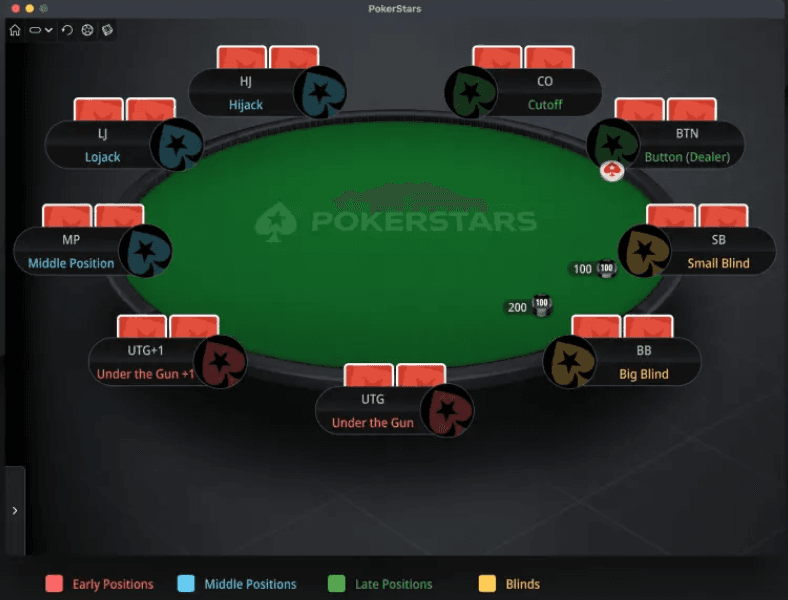
Sometimes the middle positions MP-1 and MP-2 are labeled Lojack and Hijack
When a player acts last, he knows his opponents' decisions. For example, a player sits on the BTN with 99. His action was preceded by: 1) a raise from a player in early position; 2) a 3-bet from an opponent in middle position. The opponents' actions indicate strength, so the BTN calmly folds 99 and doesn't enter the hand. From UTG with 99 he would have made a standard raise, gotten a 3-bet and ended up in a difficult spot. Positional advantage lets you gather information about opponents' actions.
At a 6-max table the following positions are distinguished:
Name | Description |
UTG or Under the Gun | Enters the game first preflop. In most situations UTG acts first postflop too. The exception is hands against the SB and BB. Plays a narrow set of hands. |
MP or Middle Position | Enters the game second after UTG preflop. Postflop has positional advantage over: UTG, SB and BB. Can play a bit wider than the opponent in early position. |
CO or Cutoff | Acts after: SB, BB, UTG and MP. The best position in poker after BTN. The CO gets the chance to steal blinds from the SB and BB. |
BTN or Button | The best seat at the poker table. Enters the hand last both preflop and postflop. Knows all the opponents' decisions. Can play the widest range and regularly steal blinds. |
SB or Small Blind | The worst position at the table. Before the start, the player on the SB makes a forced bet of 0.5 BB. Postflop the small blind always enters the game first. |
BB or Big Blind | Before the hand starts, posts a forced bet of 1 BB into the pot. Postflop acts first against everyone except the opponent on the SB. |
Let's supplement the information from the table with answers to some questions:
What is a blind in poker. A blind is a forced bet from the players on the SB and BB before the hand starts. The purpose of forced bets is to create dynamics, build a pot and motivate opponents to get into the action. Without blinds, every player would just sit and wait for strong starting hands. The big blind is the minimum bet at the table. In cash it equals 1% of a full stack. In tournaments the size of the big blind is set by the organizers. It grows every 15-20 minutes.
What is the ante. An additional forced bet. It's posted by all participants in the game. The size of the ante is set by the organizers, but most often it's set at the level of 10%-25% of the big blind. The ante is actively used in tournaments to increase player activity and speed up the conclusion of MTTs.
How positions are assigned before the first hand. Before dealing cards in poker, you need to assign the seats at the table. Each player gets one card before the start. The holder of the highest rank starts on the BTN. If players got identical cards, then their suit is looked at. The hierarchy of suits from best to worst looks like this: spades, hearts, diamonds, clubs.
How positions rotate. The movement goes clockwise. As a result, all opponents are on equal terms. Everyone pays the forced bets, gets positional advantage and suffers from a lack of information on UTG or MP.
Alongside short 6-max tables, the 9-max format is also popular in poker. It's also called Full Ring. At long tables the number of early and middle positions increases. The additional seats are labeled: UTG-1, MP-1, MP-2. We covered positions in more detail in another article.
How a hand plays out step by step: four betting rounds
To understand how to play poker, let's study the order of moves in a hand. In No Limit Hold'em there are 4 betting rounds: preflop, flop, turn, river.
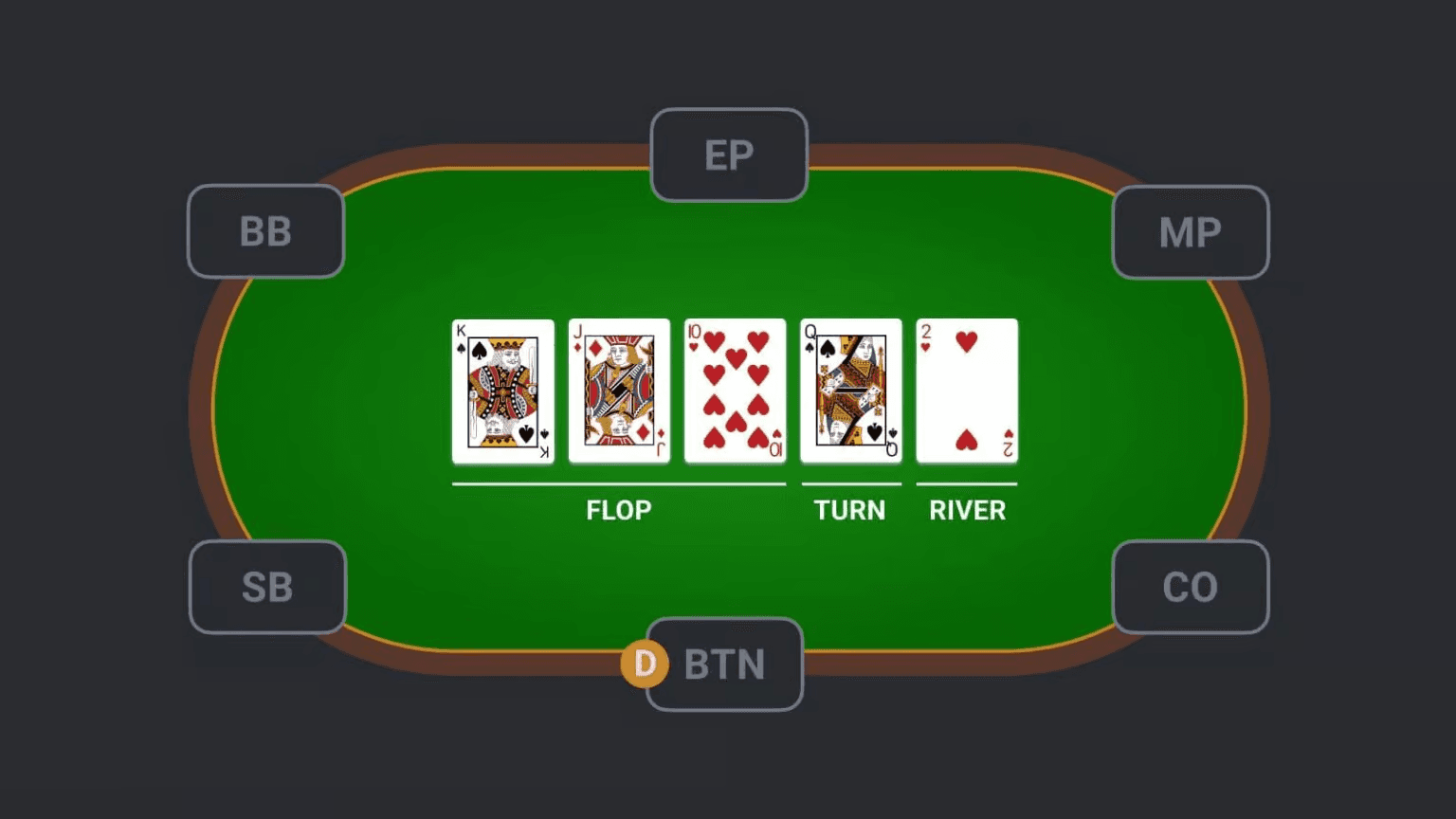
Betting rounds in poker are often called "streets"
An average hand plays out like this:
The small and big blind post the forced bets.
Each player gets 2 cards and evaluates their potential.
The holder of a good hand makes a raise. One or more opponents respond to the aggression.
The hand moves to postflop. 3 community cards are laid out on the table.
Players match their starting hands with the board ranks, reassess the situation and make bets.
The turn card comes. A betting round follows.
The river card comes. The opponents conduct the final stage of betting.
Players show their hands and determine the winner.
Not every hand in poker reaches showdown. The game can end at any stage. For example: UTG made a raise preflop, the opponents folded, UTG took the pot. The ability to go all-in on any street plays a big role in a hand. The size of the pot doesn't matter: the rules of Texas Hold'em don't forbid investing 100 BB into a 5 BB pot.
Let's look at the betting rounds and the players' options in more detail.
Preflop
The initial stage, where players evaluate the strength of their starting hands. Betting is opened by the player on UTG. He can: call the big blind's bet, raise it, or fold. If one of the participants in the hand made a raise, then the opponents get the chance to: respond with a call, declare a re-raise (3-bet) or fold. To a 3-bet the original aggressor can react with a 4-bet or a call. Provided that there are still contenders for the pot, the hand moves to postflop.
Beginners often ask the question: "Why is a re-raise called a 3-bet and not a 2-bet, if it was preceded by only one raise?" In Hold'em the forced bet of the player on the BB is counted as the first. As a result we get: the BB makes the 1-bet, the original aggressor — the 2-bet, the author of the re-raise — the 3-bet.
Flop
Postflop starts with the first betting round — the flop. The dealer lays three community cards on the table. All participants in the hand use them when building their hand. The poker players evaluate the strength of their hands in combination with the board and make a decision about continuing to bet.

Strong players plan out their hand in advance from flop to river
From the flop on, draws begin to play a big role in hands. A draw is a hand that's missing one card to a made hand. They include:
Flush draw. 4 ranks of one suit.
Straight draw. 4 consecutive cards of different suits.
Gutshot. A straight draw with 4 outs to improve. Example: J10 on the board AQ2 will only make a straight with a king. A regular straight draw is improved by 8 outs.
For example, a player with K♦Q♦ and the board J♣6♦2♦ will be helped by any of the nine clubs in the deck to complete a flush. The effectiveness of playing a draw is affected by pot odds and other concepts from poker math.
Turn
The fourth card is laid on the table. The opponents again reassess the situation and bet. In Limit Hold'em players can double the bet amount. With strong hands the poker players prepare the ground for an all-in on the river.
River
The last community card comes to the board. Players get their final hands. On the river poker players make value bets with strong hands or pull off spectacular bluffs. After the final betting round the opponents show their hands.
Showdown
At showdown players determine the winner. The pot is taken by the holder of the best five-card hand. Opponents with identical hands split the pot equally.

A poker player's actions at the table
We've covered the betting rounds in poker, now let's study the players' arsenal as well. Here are the actions the participants in a hand can take:
Fold. Giving up the fight for the pot. The player folds his cards and doesn't put chips into the pot.
Bet. The first bet in a betting round. In No Limit Hold'em you can bet from one big blind up to your entire stack.
Call. Matching an opponent's bet. To stay in the hand, the player puts in the same amount the opponent bet.
Raise. Increasing an opponent's bet. The player increases the size of the pot and forces opponents to make a more expensive decision.
Check. The player doesn't make a bet but stays in the hand.
All-in. The player bets all his chips. You can risk your stack either as the first word or in response to an opponent's aggression.
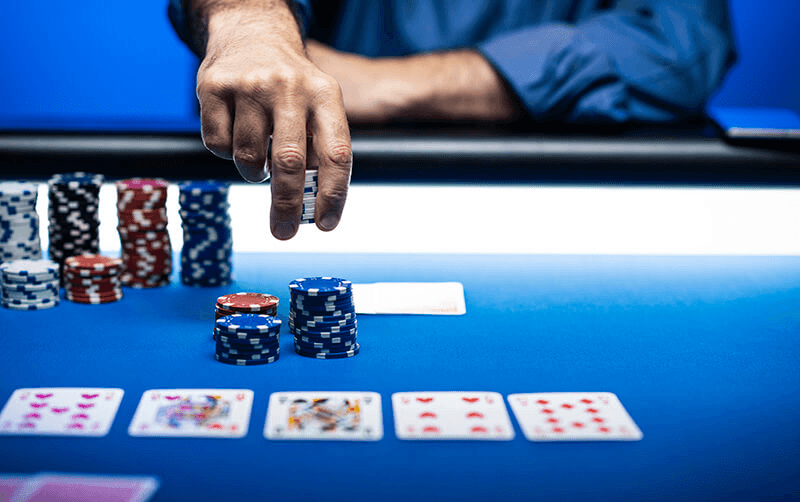
You can declare a check when none of the opponents has made a bet
Additionally, poker singles out the "limp" and the "donk." A limp is calling the big blind's forced bet preflop. In most cases a limp is considered weak play. A donk is a bet by a player out of position when the opponent showed aggression on the previous street. For example: the BTN made a raise, the BB responded with a call. On the flop the BB acts first and declares a bet. That bet of his is called a "donk."
Types of poker: what they are
We've broken down the industry leader — No Limit Texas Hold'em: 2 cards in the starting hand, 4 betting rounds, 5 ranks form the final hand. Second place in popularity is held by Omaha. The game differs from Hold'em in:
The number of cards in the starting hand. In classic Omaha the poker player is dealt four cards preflop.
The rules for forming the final hand. The final hand includes two ranks from the starting hand and three from the community board.
Greater variety. Alongside Pot Limit Omaha, poker players play five-card and six-card variants. Some platforms offer Omaha Hi-Lo and Courchevel.
In the past, draw poker drew great interest. At the start players were dealt a hand of five cards. After a betting round, the opponents could exchange from one to five ranks. Then a second betting round followed and the participants in the hand showed their final hands.
Seven-card stud has also lost ground. In stud there are no community cards: at the start of the hand players get 2 face-down cards and 1 face-up. In each round they draw one card. At the final stage the poker player's hand includes 4 face-up and 3 face-down cards. To read an opponent's final hand, a player matches the known ranks against his actions.
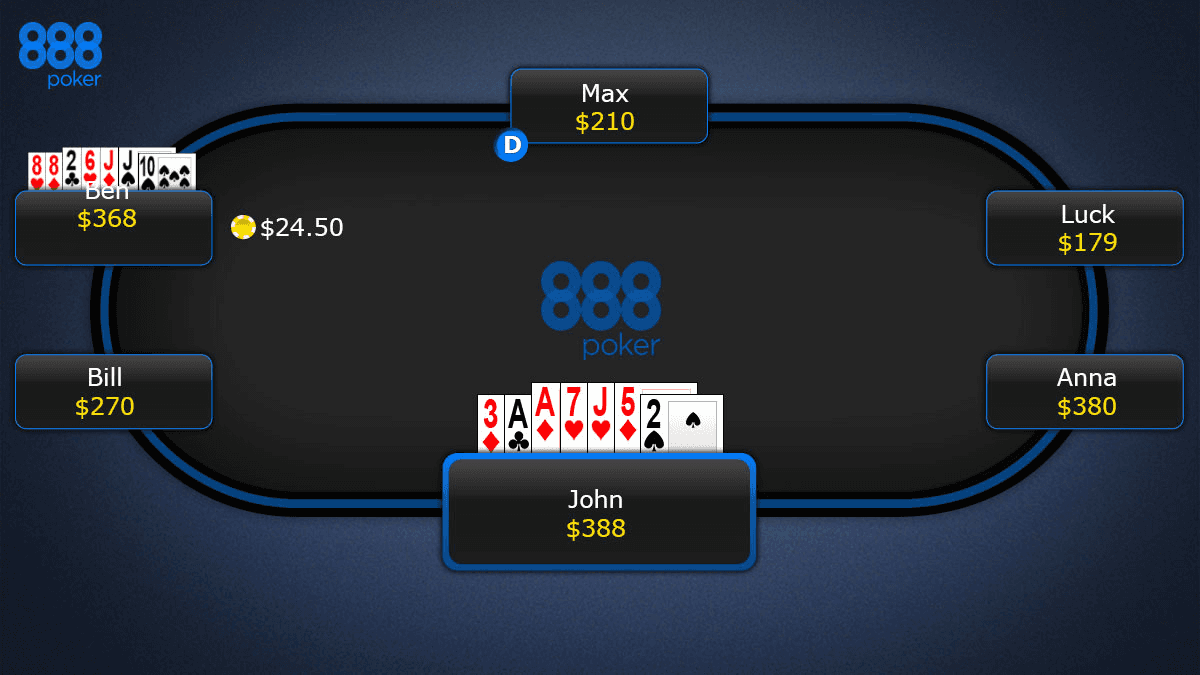
In draw poker and seven-card stud there is no community board
In casinos you can play Caribbean, Russian and other types of poker. In these the player goes up against the croupier. Over the long run such card games are unprofitable. Only the casino comes out ahead.
How to learn to play poker from scratch: tips for the beginner
Knowledge of hand rankings and betting rounds lets you understand the situation at the table, but doesn't give you an advantage over your opponents. To win consistently in poker, you need to:
Study theory. The internet provides access to a huge amount of educational material. At users' disposal are: thousands of videos, hundreds of books and dozens of dedicated poker sites. If you approach learning systematically, your first successes will soon come.
Reinforce theory with practice. Hone your skills in the fight against real opponents. Online poker gives you the chance to play for free. Many platforms hold freerolls. A diligent player will not only gain experience but also earn their first money.
Use poker software. Playing with statistical programs lets you earn more. Regularly analyzing hands in software speeds up learning. Most developers offer you the chance to try their programs for free. Take useful tools into your arsenal to increase your income and progress faster.
Follow the rules of bankroll management. Over the long run, results in poker are determined by the player's skills. Over a short stretch a lot depends on variance. Sound capital management lets you preserve your money. We covered bankroll management in more detail in a dedicated article.
Work on psychology. The essence of poker implies regular setbacks. Top professionals lose dozens of hands within an hour. Bad beats complicate the situation even more. No matter how well you play, the opponent can always catch their out and take the pot. That's why it's useful to develop psychological endurance and know techniques for fighting tilt.
Observe your opponents. Players fold most of their starting hands preflop. After folding, poker players make a mistake and stop following the hand. As a result, they miss important information and lose the chance to gain an advantage. Experienced professionals watch their opponents even after exiting the hand. We recommend not just following your opponents, but also taking notes on them.
Train range-based thinking. The sooner a player starts thinking about their opponents' possible hands, the faster progress will go. Enter the opponent's range into a calculator, match their actions with possible hands, exclude unnecessary hands. Over time you'll start reading opponents no worse than Daniel Negreanu.
A good entry point into poker for beginners is the FF Start program. The course includes 30 lessons and introduces you to: basic math, useful programs, strategy for playing the late stages of tournaments, and ICM principles. After each topic the player faces practical exercises in the trainer. At the end of the course you can take an exam. We invite graduates to the next level — the FunFarm school.

Free course · FF Start
From the rules to your first confident game
Work through the fundamentals in order: from hand rankings and positions to choosing starting hands.