Satellites in Poker: Cheap Way Into Big Tournaments
The industry knows dozens of stories where an entry fee of a couple of dollars turned into a million-dollar prize. Let's discuss what a satellite is in poker and recall the most striking successes of players who came from qualifiers.

Ilya is a Liga 2 player with six years of experience in online MTTs. He graduated from the Faculty of Journalism at RSUH and writes about poker for beginners, explaining complex things in simple, clear language. In his texts, Ilya combines his personal playing experience with his professional journalism skills to help newcomers confidently get into the game.
Tournaments are poker's calling card. The chance to turn a modest buy-in into a pile of cash draws thousands of people. The industry knows dozens of stories where an entry fee of a couple of dollars turned into a million-dollar prize. Let's discuss what a satellite is in poker and recall the most striking successes of players from qualifiers.

New breakdowns in your inbox
Subscribe to the FunFarm newsletter: fresh Poker ABC articles and material that helps you grow as a player.
Key facts about satellites
A satellite is a qualifying tournament where a ticket to a more expensive MTT is awarded.
Satellites let you take part in an expensive tournament or live series for a modest sum. Direct entry to an MTT costs dozens of times more than getting through via a qualifier.
Some poker rooms organize free qualifiers.
Satellites let you get into the biggest festivals: World Series of Poker, European Poker Tour, Russian Poker Tour.
Qualifying tournaments require a different strategy at the final table. The poker player's main goal is to reach the money, not to take first place.
What a satellite is in poker
A satellite is a qualifying tournament for a more expensive MTT. It gives you the chance to play in a big tournament for a modest sum.

The first offline satellites gave a chance to get into the WSOP ME. Later the idea of qualifying tournaments was picked up and developed online
For example, in April 2026 PokerKing ran The Venom with an $8,000,000 guarantee. Direct entry cost $2,650. However, qualifiers started several months before The Venom began. The first step on the path to the main tournament was offered for $0.11. Most online poker rooms organize satellites. They are also held offline.
Let's break down the math of a satellite with an example. Suppose a brand has scheduled a tournament with a $550 buy-in. To attract more players to the MTT, the room announces several qualifying tournaments. Taking part in the battle for a seat costs $55. For every $550, the prize pool is supplemented with a ticket to the main MTT. If a satellite gathers 40 people, the sum of their buy-ins comes to $2,200. The 4 best players in the satellite get seats.
Qualifying tournaments are beneficial both to poker players and to rooms. Players save money and get a chance to compete for a big prize. The platforms earn commission on the additional tournaments and advertise themselves. Stories in the spirit of "turned $1 into $100,000" attract a huge number of players.
Satellites were invented by the World Series of Poker tournament director, Eric Drake. The first tickets were awarded for World Series events. In 1983 the WSOP Main Event was won by the winner of one of the satellites — Tom McEvoy. Later the idea was borrowed and developed by online poker rooms. PokerStars promoted qualifiers most actively. One of PS's satellites changed the history of the industry.

In 2003 Moneymaker outlasted 838 players. Three years later 8,773 people took part in the WSOP ME. The winner's payout grew from $2,500,000 to $12,000,000
In 2003 Chris Moneymaker took part in a poker satellite for the WSOP ME. He got through all the qualifying rounds, made the top 3 of the final qualifier and won a $10,000 ticket. To go to the World Series, Chris borrowed money from relatives. Four days of grueling play later, Moneymaker took the champion's title. It came with a $2,500,000 prize. The success story of the "internet guy" went around the world and triggered the "poker boom." Millions of players from all over the world came into online poker. Everyone dreamed of repeating Chris's path.
Types of satellites in poker
In the early days of poker all tournaments followed freezeout rules: lose your stack — leave the MTT. Later players came up with Rebuy and other formats. Now the industry offers a large choice of tournaments: Freezeout, Flight, PKO, Mystery Bounty, Deep Stack, Shootout, Double Chance. Satellites have evolved too. Let's divide them into groups by: qualifying format and type of award.
By qualifying format
The simplest option is the direct satellite. The organizer runs a single tournament, and the winner gets a ticket. For example, the room provides a seat for every $100 in the prize pool. If 50 people register for a $10 satellite, the top 5 players are awarded tickets. There are other qualifying formats as well. Among them we highlight:
Steps. A system of several poker satellites with increasing buy-ins. At each step, tickets to a more expensive qualifier are awarded. Take the structure of PokerKing's steps to The Venom. A seat to the first level costs $0.80, to the second — $6, to the third — $46, to the fourth — $350. The winner of the last step gets a $2,650 ticket. The player chooses for themselves which stage to start from. The rules don't forbid skipping the first 3 levels and going into the $350 step.
Sit-and-go satellites. Single-table tournaments for 6–10 players. They start the moment the table is filled by the required number of participants. Often the winner is given a ticket, while the runner-up gets their buy-in back. The main advantage of the format is its high speed. The battle for a seat takes 30-40 minutes. The 1983 WSOP champion — Tom McEvoy — won his Main Event ticket in a 10-player Sit&Go satellite.
Hyper-turbo. A format with small stacks and rapidly growing blinds. Players start with 10-15 big blinds, and the forced bets increase every 1-2 minutes. There is no postflop in hyper-turbo — it all comes down to push/fold skill. Usually tickets to cheap tournaments are awarded in them.
Spin-and-go satellites. Three players take part in the tournaments, and the winner takes the ticket. Satellites in the Spin&Go format are often run by PokerStars. Tickets are also awarded in Twister on RedStar Poker. Winning a seat to the MTT you want through a spin-and-go is difficult because of the random-prize system.
Sometimes rooms combine several formats within a single qualifier. For example, a ticket to Step 1 is awarded in an ordinary freeroll. The remaining stages follow single-table Sit&Go rules.

Over the past 25 years, two WSOP champions reached the ME through online qualifiers. Moneymaker paved the way in 2003. In 2004 Greg Raymer repeated his example
By prize format
In most satellites winners are awarded tickets to a specific MTT. They must be used before they expire. Exchanging a seat for money is usually not allowed. Some rooms credit tournament dollars instead of tickets. T$ can be spent on entry to any MTT. You aren't allowed to sit at a cash table with them. Sometimes the organizers of qualifiers offer not tournament tickets but:
A participant package. For large festivals, like the WSOP, rooms award comprehensive prizes. Brands not only pay for tournament entry but also: the flight to the series venue, the hotel stay. They also allocate money for pocket expenses. The chance to go to the World Series of Poker for free attracts a huge number of amateurs.
Seat + buy-in. Some brands pay a cash prize in addition to the tournament ticket. The extra prize raises interest in the satellite.
Sometimes rooms organize qualifiers with mixed awards. For example, the trio of winners get WSOP packages, while the fourth player is given an iPhone or another consolation prize.
Learning at FunFarm, from any level
Strategy for playing satellites
The game plan in a satellite depends on the structure. If the fight is for a single prize, we use classic tournament strategy. In most qualifiers several identical awards are at stake. Finishing in the last qualifying spot with a one-chip stack brings the same ticket as the top spot with a huge blind advantage. That's why the usual MTT strategy of playing to win won't work in a satellite. A different approach is needed.

In a classic MTT the player's task is to take first place; in a satellite, it's to outlast the opponents
Independent Chip Model or ICM is one of the key concepts of tournament poker. ICM helps assess the profitability of decisions at different stages of an MTT. The key idea of the concept: the value of chips won is lower than that of chips lost. Let's show this with an example. Suppose a poker player takes part in a 6-handed Sit&Go with a $10 buy-in. If they bust in the first hand, they lose $10. Winning an opponent's stack increases the chances of an eventual success, but guarantees nothing. There are still 4 other people in the tournament. Two failures in a row and the holder of the double stack will leave with nothing.
At the closing stage of a satellite, the value of chips drops even more sharply. If players are given 5 tickets, there is no difference between first and fifth place. The goal of the tournament is to last to the money, not to take first place. With a stack that is comfortable for finishing, the player should fold top hands. The classic example is folding aces against a chip leader's shove. A double-up would bring the player a minimal advantage. A loss would deprive them of an almost guaranteed ticket.
Folding strong hands isn't the only conclusion from ICM. The concept allows you to play aggressively against medium stacks. The logic is the same: opponents won't risk the fate of their tournament and will fold most hands.
Stages of a satellite and game strategy
In a classic MTT the payouts depend on the final place. The largest award is paid to the tournament winner. That's why players aim to take first place. In a satellite, strategy is dictated by the number of tickets. If the seat is given to the champion, there's no point in deviating from the usual tournament strategy. However, in most qualifiers several tickets are awarded. So a different plan of action is needed. Let's look at each stage separately.
Early stage. Deep stacks, low betting levels. We play standard tight poker: we play strong hands, we avoid big pots without worthy combinations. We don't bluff beyond preflop 3-bets and continuation bets.
Middle stage. As the blinds grow, the margin of safety falls. We increase the number of steals. We continue to follow a careful postflop strategy. We respond to opponents' aggression only with strong hands, like top pocket pairs and AK. We don't call opponents in dubious situations.
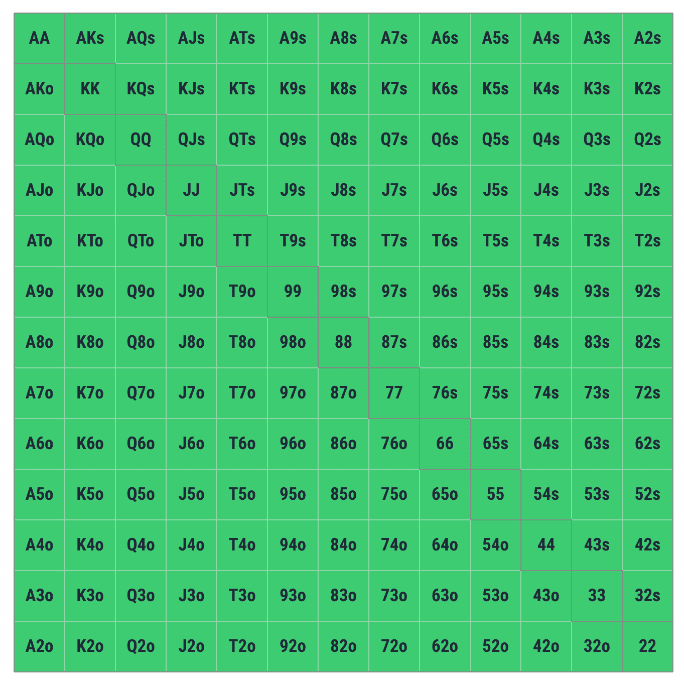
The folding range against the chip leader when there are short-stacked opponents at the final table
Late stage. Strategy is determined by the player's previous success. With a short stack we follow the rules of push/fold. With a deep one we pressure the medium stacks. Opponents also understand the principles of ICM, so they prefer to fold rather than risk the fate of their ticket in a confrontation with the chip leader.
At the final table we play carefully and don't take risks unnecessarily. We fold against big stacks and pressure the medium ones. We accept short opponents with a strong range. Sometimes a spot in the money is brought by opponents' mistakes, not the player's active moves.
Common mistakes in satellites
A refusal to adapt strategy is the main problem of satellite players. Poker players ignore the specifics of the format and hand tickets to their opponents. The most common mistakes look like this:
Playing for first place. A poker player doesn't understand the essence of a qualifying tournament and takes unjustified risks. Let's show it with an example. At the table sit: Phil with 30 BB, Daniel with 28 BB and Roman with 1 BB. Two players get tickets. Phil shoves all-in, Daniel catches AA and responds with a call. The chip leader cracks the aces, Daniel busts, Roman finishes in the money. Daniel lost an almost guaranteed seat because he didn't readjust his strategy for the satellite.
Calling short stacks with junk. Chip leaders want to finish the tournament faster, so they widely "close out" the short players. As a result they double them up and prolong the MTT. It's important to stay focused and make plus-EV calls.

Rooms regularly award packages to the WSOP and other landmark festivals
We'll also count overspending on attempts to break into an expensive tournament as a mistake. If the tickets cost sums comparable to the direct buy-in, save your energy and register directly. It's useful to consider the format of the qualifier too. Winning a ticket in a satellite with a fast structure is difficult. Sometimes it's more profitable to choose an expensive qualifier with a smooth blind increase.
Famous success stories of players from satellites
Moneymaker's win was a turning point in the history of the industry. However, "other satellite players" also triumphed in big tournaments. We've gathered a top 6 of the biggest successes:
Jerry Yang at WSOP-2007. Moneymaker's path was repeated in 2007. Yang got into the WSOP Main Event from a $225 satellite and won it. First place brought the player $8,250,000. Yang couldn't put spectacular wins on a conveyor belt: over the next 19 years the player increased his total winnings by $300,000.
Ramón Colillas at the Players Championship-2019. The Spanish fitness trainer got into the PokerStars Players Championship thanks to a free Platinum Pass. In the main tournament Ramón reached the final table, made it to heads-up and snatched the win from Julien Martini. First place brought the Spaniard $5,100,000.
Greg Raymer at WSOP-2004. He reaped the first fruits of the "poker boom." A year after Moneymaker's triumph he took a doubled sum — $5,000,000. Greg got into the WSOP ME through a PokerStars qualifying tournament. Raymer confirmed his good form at the WSOP ME-2005. The champion was stopped a couple of tables before the final.
David Matthew at the WPT. In 2006 the Canadian player broke into a tournament with a $25,500 buy-in through a $25 satellite and took second place. His winnings came to $1,903,950. David didn't become a poker star — over the next 20 years he increased his career winnings to $3,018,205.
Shurane Vijayaram at the Aussie Millions. In 2017 the Australian amateur came out on top in the largest live tournament. The poker player converted a $130 ticket into $1,208,367. At the final table Shurane outplayed poker stars — Fedor Holz and Jeff Rossiter. Vijayaram didn't build a professional career, but he went down in the history of the industry.
Fernando Pons at the WSOP. The Spanish poker player busted ninth at the WSOP ME in 2016. Leaving the final table of the main tournament is a shame, but $1,000,000 softened the disappointment. Pons broke through to the WSOP from a €30 online satellite.
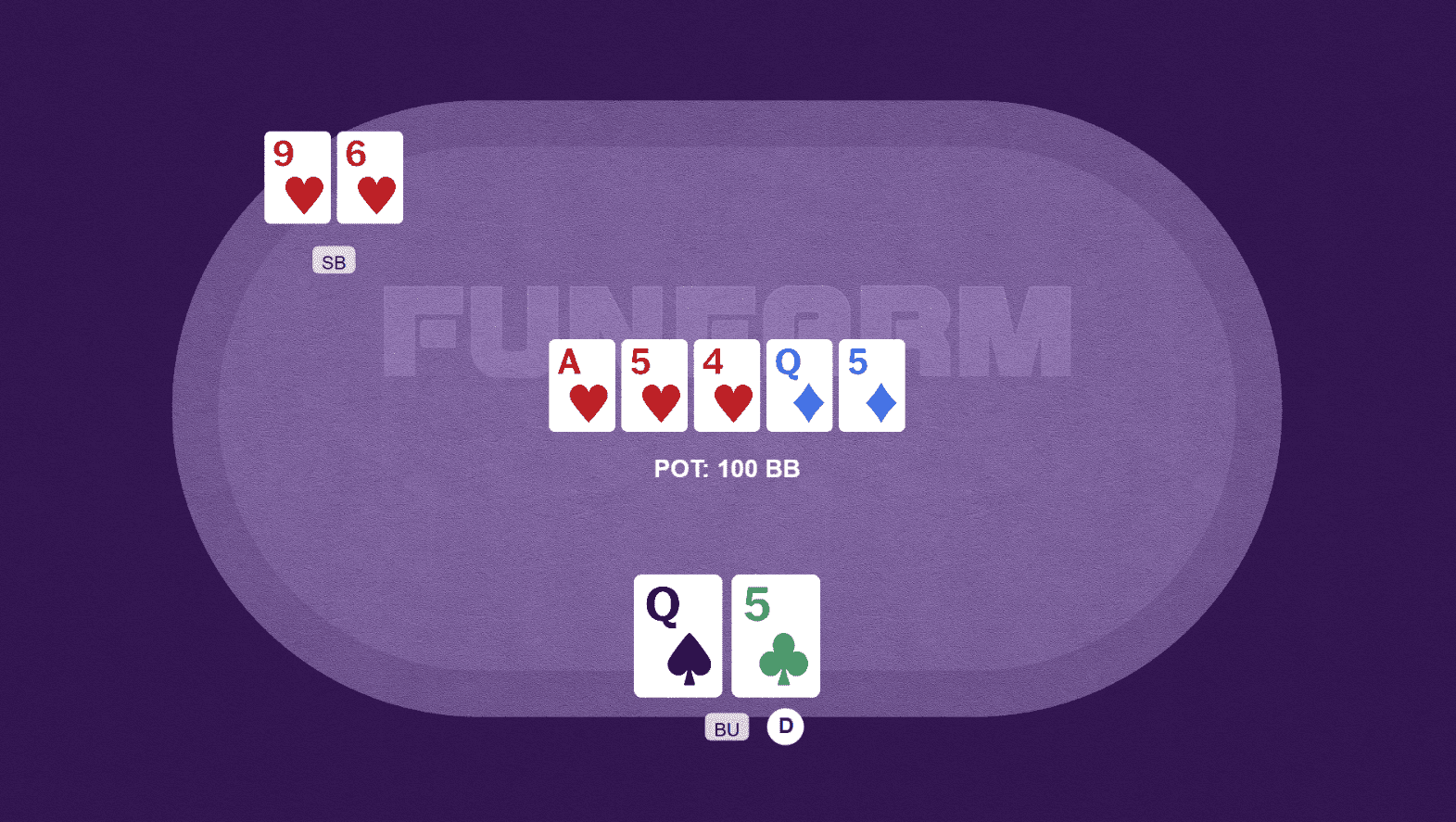
In the key heads-up hand Colillas shoved all-in on the flop with second pair against a flush and caught his 3%. Martini could do nothing against such a lucky opponent
Among the heroes of online play, we'll note Alec Stasiak's win in one of the WSOP Online 2020 events. The Canadian poker player turned $10 into $343,203. We'll also mention the achievement of the Brazilian player with the nickname "Mr. Havener." He took sixth place in The Big Blowout on PokerStars and got $167,360. The Brazilian got into the tournament with a $1,050 buy-in from a freeroll.
Step-by-step guide: how to get into a big poker tournament
Many online poker rooms organize satellites to big series. At the moment of writing this material, POKEROK is awarding tickets to the WSOP, RedStar Poker — to Battle of Malta and The Festival, Pokerdom — to the Russian Poker Tour. To take part in a big tournament for little money, you need a plan. In a generalized form it looks like this:
We determine the tournament we're interested in.
We find a room with satellites to it. In the browser's search bar we type "Festival name" + poker satellite.
We register an account and make a deposit.
We choose a satellite suitable in structure and buy-in.
We review the basic MTT game strategy and push/fold ranges. We remind ourselves of the specifics of ICM in qualifying tournaments.
We win a ticket.
We check the terms with support: whether the package can be exchanged, how the organizers will verify the tournament seat, whether participation needs to be confirmed in advance.
We arrange a visa, rent accommodation, think through the logistics.
For players with no experience of live festivals, we recommend starting with local series. For example, poker players from Russia can travel to a festival in a gambling zone.

Which rooms run satellites to festivals in Russia
Satellites to live series in Russia are organized by several rooms: Pokerdom, PokerPlanets, RPTBET and POKEROK. Let's discuss them in more detail.
Pokerdom. The leading Russian brand. It has been operating since 2014. The room's legal status is ensured by a Curaçao license. It runs satellites to all the popular Russian festivals: Sochi Poker Festival, Russian Poker Tour, Amber Poker Championship. You can get into a tournament series through a freeroll. See the current selection of satellites in the "Tournaments" section on the "Live" tab.
PokerPlanets. A newcomer to the industry that started in 2025. It operates under a Curaçao license. The platform hosts qualifiers to the Sochi Poker Festival and the Russian Poker Cup. PokerPlanets organizes many free satellites. See the list of upcoming qualifying MTTs in the "Tournaments" section on the "Satellites" tab.

Tournament series visit gambling zones every month
POKEROK. A popular international platform with a huge amount of online traffic. POKEROK was launched in 2016. The room's legal status is confirmed by Anjouan's authorization documents. PokerOK runs qualifiers to the Russian Poker Tour. They're usually placed in a themed tab on the right side of the lobby.
RPTBET. The room of the owners of the Russian Poker Tour festival. It has been operating since 2023. It got its gambling license in Curaçao. RPTBET awards a large number of tickets to RPT stages. For example, before the summer 2026 series the room gave away 120 seats in online satellites.
Pokerdom and RPTBET also run qualifiers to festivals in neighboring countries: Belarus, Armenia, Georgia.
How to learn to play poker
Satellites give a chance to: get into a big tournament, gain experience playing against strong opponents and win a substantial prize. However, professional players achieve success through skill, not a positive variance swing. Training is what will let you reach a high level.
You can study poker in different ways: read books, watch videos, analyze hands in software, discuss hands with other players. The key problem of self-study is the lack of a systematic approach. Finding a suitable methodology takes months, sometimes years. Want to speed up your progress — join FunFarm.

The school's team regularly improves its materials and teaching methodology
The FF Start program suits beginning players. Over 30 lessons, a novice builds the foundation for future success. A trainer will help hone the theory. We accept course graduates into FF Player Path. The advanced program will let you get past the microstakes and reach a professional level. Students of the school also receive other privileges: backing, consultations with psychologists, free software and access to a tight-knit community of players.

Free course · FF Start
Cash or tournaments? Choose with intent
Compare the formats and get a foundation that lets you start without jumping chaotically between disciplines.