Rake in poker: how rakeback is calculated
Beginning players rarely pay attention to rake when choosing a poker room. More often they look at: the size of the first-deposit bonus, the selection of payment methods, and the loyalty program. The importance of the commission shouldn't be underestimated: a platform's excessive appetite reduces players' earnings. In this article we'll discuss: rake, methods of calculating it, and popular VIP systems.

Ilya is a Liga 2 player with six years of experience in online MTTs. He graduated from the Faculty of Journalism at RSUH and writes about poker for beginners, explaining complex things in simple, clear language. In his texts, Ilya combines his personal playing experience with his professional journalism skills to help newcomers confidently get into the game.
Key facts about rake and rakeback in poker
Here are the main facts about rake:
Both casinos and online rooms charge a fee for hosting the game.
In cash games, players pay rake on every pot; in tournaments the payment is made at registration.
The rake cap limits the operator's share of the pot.
The industry offers 3 methods of calculating rake: Dealt, Contributed, Weight-Contributed.
Weight-Contributed accounts for players' contributions most fairly.
Rooms return part of the fee as rakeback.
The terms and form of the return depend on the brand's loyalty program.
A calculator will help you roughly estimate rakeback.

New breakdowns in your inbox
Subscribe to the FunFarm newsletter: fresh Poker ABC articles and material that helps you grow as a player.
What is rake in poker
Rake is the venue's fee for hosting the game. To run a cash game or tournament, a casino: hires croupiers, security and technical staff, rents premises, obtains a license, pays taxes, covers utility bills for electricity, and buys poker sets and tables.

An inflated fee reduces a player's income. For some poker players it turns them into losing players altogether
Let's not forget about the income for the business itself. The casino includes all expenses in the rake. In online poker, companies don't hire dealers or cleaners, but they spend money on: developers, support teams and the security department. Substantial resources go to maintaining servers.
Rake strongly affects results in poker. The higher the casino's or room's fee, the less money remains for players. An increase in rake can turn a slightly winning poker player into a losing one or kill an entire format. That's why beginners are advised to pay extra attention to rake, caps and rakeback when choosing a platform.
How rake is calculated in cash games
In cash games the operator takes a fee from every pot. In most online poker rooms, platforms take rake from hands where play reached the flop. If opponents folded preflop, the platform won't withhold a fee. Exceptions include POKEROK and other rooms of the Good Game network. On 3-bets and subsequent raises the brand takes 5% rake.
The fee in poker is counted as a percentage of the pot. Let's explain with the example of RedStar Poker. At the NL50 stake, the room set rake at 5%. Two poker players went all-in and formed a pot of €100. At a 5% fee, the winner takes €95. Another €5 goes to RedStar Poker. However, the room's rules contain a clause about an upper limit on the fee, or rake cap. On NL50 pots the platform withholds 5%, but no more than €1. Therefore the hand's winner will win €99, and RSP's fee will be €1
Here's what the fee calculations look like for different stakes and different numbers of players in the PokerKing room:
NL100. Let's say two players took part in the hand: Igor and Liv. Igor raised preflop, Liv called. By the flop there were 7.5 big blinds in the middle of the table. Igor bet 5 BB and Liv folded out of the hand. The final pot equals 12.5 BB or $12.5. In a vacuum PokerKing will take rake of 0.05 × $12.5 = $0.62. However, on NL100 the platform has a rake cap of $0.50. As a result Igor gives up $0.50.
NL600. Three players take part in the hand: Igor, Liv and Phil. Igor opened the action with a bet of 3 BB preflop, Liv and Phil called. On the flop the pot size was 10.5 BB. After the community cards came out, Igor made a continuation bet of 7 BB and got 2 calls. At the start of the turn the pot equals 31.5 BB. Igor continued the aggression with a bet of 23 BB and his opponents folded. By the end of the hand there were 54.5 BB or $327 in the pot. Without accounting for the cap, PokerKing would withhold a fee of 0.05 × $327 = $16.35. However, on NL600 a rake limit of $1.5 applies. The final fee will be $1.5.
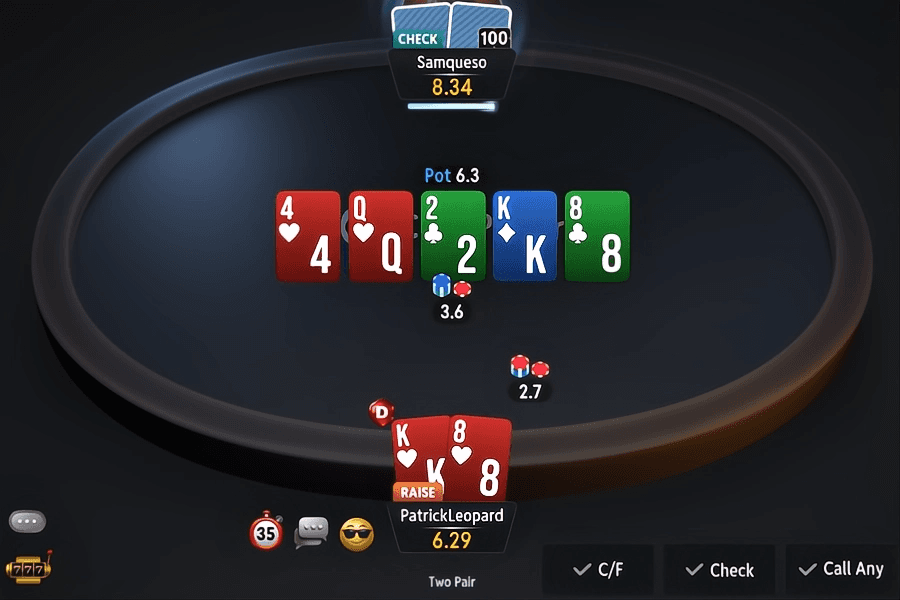
In online poker rooms take rake automatically. In live play it's withheld by the dealer
In both examples the poker player paid less thanks to the rake cap. The gap is especially noticeable at high stakes: on NL600 Igor was charged a fee of just 0.25 BB. That's why it's important to look not only at the room's fee percentage, but also at its upper limits. At low stakes the rake's share relative to the stack is higher than at medium or high stakes. The fee amount also depends on the number of players in the hand. From multi-way pots poker rooms withhold more rake than from hands between two players.
Approximate rake and rakeback figures at NL10-NL100 look like this:
Stake | Rake per 50,000 hands | Rakeback 10% | Rakeback 30% | Rakeback 50% |
NL5 | $300 | $30 | $90 | $150 |
NL10 | $550 | $55 | $165 | $275 |
NL25 | $1,200 | $120 | $360 | $600 |
NL50 | $2,100 | $210 | $630 | $1,050 |
NL100 | $3,800 | $380 | $1,140 | $1,900 |
A poker player's style of play affects the final fee. A loose-aggressive player will pay almost 2 times more rake than a tight-passive one. That's why beginners are advised not to be highly active and fight for every pot.
Learning at FunFarm, from any level
Rake in MTT and Sit&Go tournaments
The fee in a tournament is easier to determine. Most rooms state the rake directly in the line with the buy-in. For example, on RedStar Poker you can see the fee size if you click the Info icon. On PokerKing the rake is shown when you open the tournament lobby. In PKO-format MTTs they use the formula: "buy-in + rake + bounty".
The rake size in tournaments depends on the stake. In MTTs the logic applies: the lower the buy-in, the higher the rake relative to it. Let's take tournaments from the PokerKing schedule as an example:
Name | Buy-in | Rake | Share of buy-in in % |
$400 GTD | $1.50 | $0.15 | 10% |
$10,000 GTD | $15 | $1.5 | 10% |
Daily $30,000 | $100 | $9 | 9% |
Venom $8,000,000 | $2,500 + $1,250 | $150 | 4% |
Phil's Thrill | $10,000 | $300 | 3% |
The table allows us to draw 2 conclusions:
As buy-ins grow, the room reduces the fee.
The real effect of the reduced rake is felt by players in the most expensive tournaments. Players at medium and low stakes almost always pay 10%.
In Sit&Go the fee is indicated the same way. Players at low stakes pay around 10%. As buy-ins grow, the poker room reduces the rake.
The fee size plays a decisive role in Spin&Go. In fast tournaments with a random prize, players' prospects in the discipline depend on 1%. Here's what the rake situation looks like on different platforms:
Room | Average rake | Maximum win |
PokerKing | 6% | $1,000,000 |
RedStar Poker | 5.8% | €200,000 |
PokerStars | 6.5% | $800,000 |
888Poker | 8% | $1,000,000 |
PokerOK | 7% | $1,000,000 |
Methods of distributing rake between players
Rake distribution systems play an important role in online poker. The calculation method determines both the player's losses and the rakeback amount. At the dawn of the industry, rooms used the Dealt system. Later they abandoned it in favor of Contributed. Now Weight-contributed has become the market standard. Let's examine each system in more detail.
Dealt. The rake amount was divided among all participants in the hand. If a player received cards preflop, they were credited an equal share with the other poker players. As a result, passive and loose-aggressive players were paid the same rakeback regardless of their actual contribution. The method is no longer used anywhere for calculating rake.
Contributed. The room credited a player's contribution if they invested at least $0.01 in the pot. The fee was divided among all active participants in the hand. Contributed cut off the portion of poker players who folded preflop. However, the system equated calling 1 big blind preflop with playing for the whole stack. The method ignored the efforts of aggressive players.
Weight-contributed. The room distributes rake in proportion to players' contributions. The formula looks like this: (player's contribution / final pot) × the hand's fee. Weight-contributed is the fairest method of calculating rake. The more money a poker player invests in the pot, the more rakeback they receive. The system is used by most online poker platforms, like PokerStars or PokerKing.
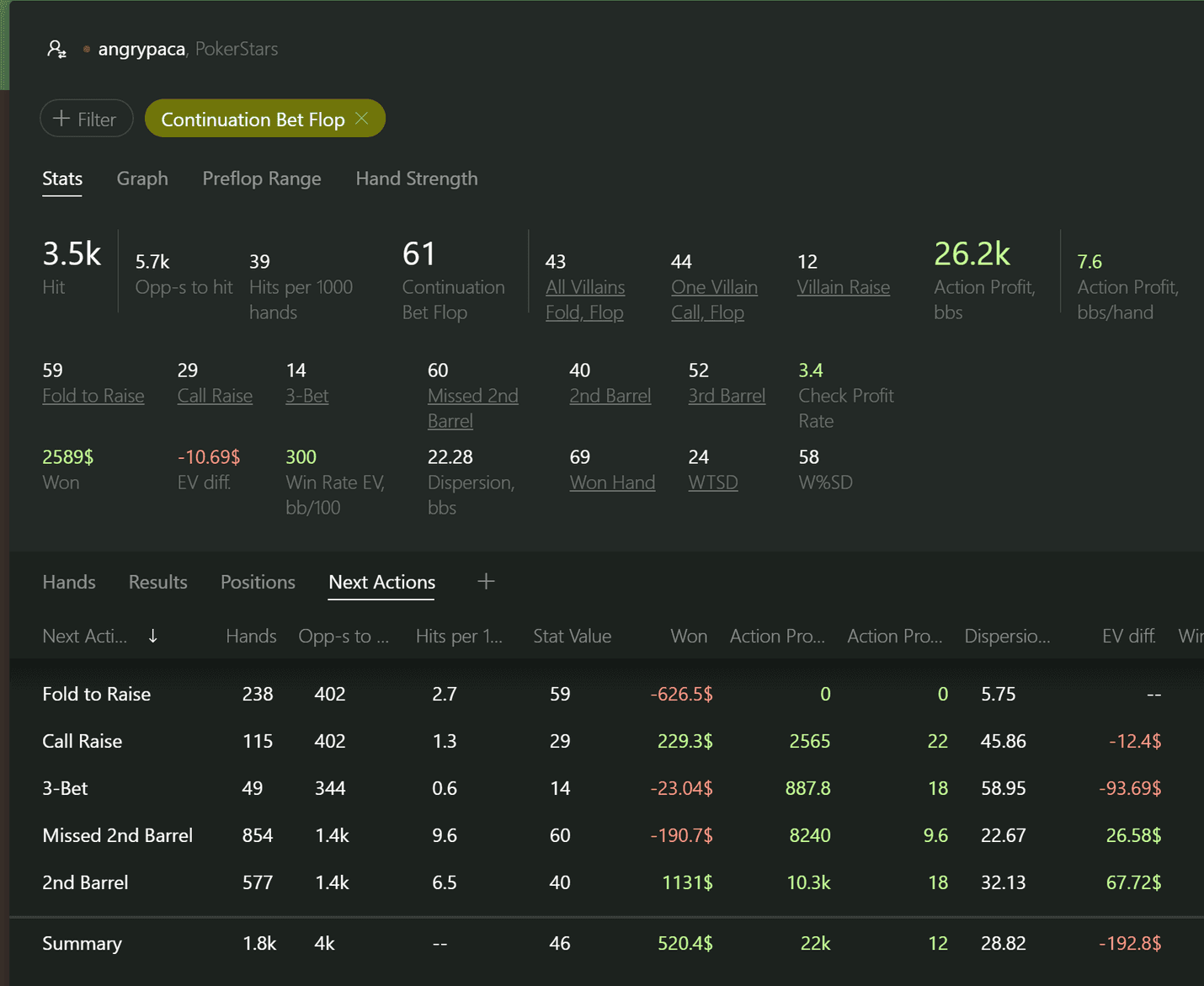
Tracking rake on your own is difficult. Poker trackers, like Hand2Note or PokerTracker 4, will help collect the information
Some poker rooms use hybrid methods of calculating rake. They take Weight-contributed as the basis, but introduce additional factors. POKEROK uses a hybrid system. It accounts not only for players' contributions to a specific pot, but also for the Player Value Index, or PVI. A number of factors affect the PVI formula, like the number of a client's deposits and cashouts. The Player Value Index raises the return percentage for amateurs and lowers it for professionals.
Rake specifics at micro stakes
Beginners rarely pay attention to rake. However, a high fee is one of the main reasons for slow progress through the stakes. For example, at NL10 a poker player pays around $500 of rake over a distance of 50,000 hands. The room's fee "eats up" over 10 BB per 100 hands. In a vacuum, 10BB/100 is considered a good figure for micro stakes. The platform's rake reduces a winning poker player's efforts to zero. To get past low stakes, a player must:
Play fewer marginal hands. Many coaches promote an aggressive style of play. However, they ignore the high fee and its impact on the final result. When building charts, take the impact of rake into account.
Choose bet sizes wisely. A high fee significantly reduces the profit of thin value bets. Make larger bets. Increasing sizing solves 2 tasks: 1) it compensates for the high rake; 2) it allows you to earn more, because weak opponents are often willing to call bets of any size.
Avoid "coin flips". A high fee turns a neutral coin flip into a losing action.
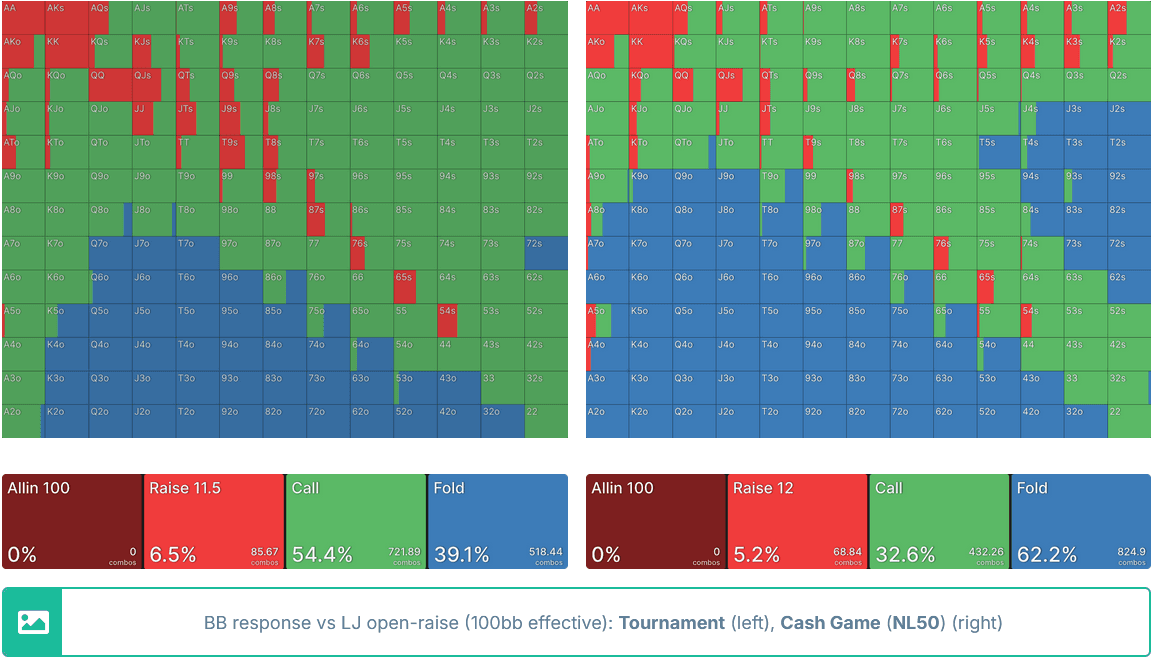
Advanced professionals account for rooms' fees when building ranges
Tournament players have it easier with rake. Almost all online poker platforms take 10%. Let's reduce a low-stakes regular's task to choosing MTTs with the most attractive ratio of buy-in to guarantee. Sometimes it's useful to track rooms' tournament promotions. For example, in March 2026 CoinPoker switched to new software. They celebrated the client update by canceling the fee in MTTs: for a month players were exempt from rake. An industry newcomer — BCPoker — organized a similar promotion.
Sometimes it's hard to put together a tournament schedule competently. A player must consider several factors:
the room's rake;
the structure of the average MTT on the platform;
the formats most profitable for themselves.
Advanced players also take the room's internal schedule into account. If the top MTTs fall in the dead of night in the player's time zone, it's hard to show a decent level of play. The FF team will help select suitable tournaments. Advanced algorithms make it possible to analyze a player's database and choose the most profitable formats. Submit an application to join the fund and build a successful poker career.

What is rakeback in poker
Rakeback is a way of rewarding active players. If a client plays a lot, the room returns part of the rake they paid. Most online poker platforms offer loyalty programs with rakeback. The VIP system retains existing players and attracts new ones. Many professionals choose where to play precisely by rakeback. A good loyalty program is a powerful argument in the fight for players. Rakeback significantly increases the income of enduring and hardworking poker players.
It wasn't the rooms that came up with rewarding active players. Rakeback was invented by affiliates. The scheme worked like this:
The affiliate site brought players to PokerStars, partypoker or another platform.
The room paid the affiliate a share of the recruited player's rake. The specific amount depended on the brand. The average figure ranged from 30% to 40% of the fee.
The affiliate transferred to the poker player a share of his own rake.
Later rooms began paying rakeback directly. In the best years of online poker, players received money both from affiliates and from poker platforms. Some poker players gave up moving up in stakes and made a living from rakeback.
PokerStars offered the most impressive loyalty program. Holders of Supernova Elite status were returned up to 74% of the fee. The PokerStars VIP system was remembered not only for its high rakeback. In the rewards store, players exchanged points for prizes. Among clothing, keychains, poker sets and electronics, the Porsche Cayman especially stood out. Several players took the opportunity and converted points into a premium car.

Italian poker player Dario Minieri was the first to receive a Porsche from PokerStars
After "Black Friday" rooms began raising the fee and reducing rakeback. Along with that, the requirements for the highest loyalty program statuses increased. Currently the most attractive terms are created by:
PokerKing. The combination of the VIP system and rake races gives players rakeback of around 85%-90%.
RPTBET. Pays cash players rakeback of up to 70%. You can raise the return percentage thanks to the monthly leaderboard.
Pokerdom. The "Time Machine" loyalty program lets you return up to 70% of the fee.
In modern online poker there's no point in playing for rakeback. It's more reliable to increase income by moving up in stakes. However, a good loyalty program will help keep your bankroll in working condition during a bad streak. You shouldn't completely ignore rakeback.
How rakeback is accrued and paid out
Loyalty programs in poker differ not only in the return percentage, but also in the payout method. The most popular options look like this:
Fixed direct rakeback. Let's show with an example. Suppose a room offers users a VIP system with a 33% return of the fee. If a player made $750 of rake in a month, they'll be credited $250 of rakeback. The money will hit the client's account automatically. The payout day is usually stated in the promotion's rules. In the modern industry, CoinPoker uses the fixed-percentage approach. The crypto room pays out 33% rakeback.
Exchanging points. The poker player accumulates loyalty program points and exchanges them for money. Often the VIP system provides additional multipliers or a more favorable rate for holders of high statuses. Point-exchange programs operate on PokerStars, POKEROK and RedStar Poker. There's a catch in VIP systems with point conversion. If you don't exchange points for money in time, they expire. For example, RSP lets you convert points until the end of the month following the day a player received them.
Payout for reaching a level. If a player meets the points requirement and reaches a level, the room automatically pays them a cash reward. That's how the partypoker loyalty program works.
Often VIP systems borrow elements from each other. For example, the Pokerdom "Time Machine" loyalty program. It consists of 9 levels, but the money hits the player's account automatically on the first day of the following month.

Some rooms run promotions with tasks. They can be counted as indirect ways of increasing rakeback
Income from a loyalty program is supplemented by rake races and leaderboards. Their essence is simple: play more hands or tournaments — and you got a reward. Sometimes the combination of a loyalty program and a rake race gives record rakeback in poker. For example, on PokerKing a player is returned up to 90% of rake. On RPTBET you can reach 100% rakeback.
Rakeback calculator: how to count your rake
Rakeback is an important parameter when choosing a poker room. Platforms understand players' priorities, so they emphasize VIP systems. Let's take the industry leader — POKEROK — as an example. It promises to return up to 80% of rake. In practice players get less because of the PVI system and other hidden details. A rakeback calculator will help avoid disappointment. It makes it possible to find out the approximate return amount in advance.
Many poker sites offer calculators. To compute the rakeback amount, the user is asked to specify several parameters:
working stake;
number of tables for simultaneous play;
number of hours of poker per day.
Rakeback calculators produce approximate results, because they ignore the poker player's style of play. A tight-aggressive player pays less rake than a loose-aggressive one. Rakeback drops proportionally. Other shortcomings of the calculator include the selection of rooms and outdated data. The list of platforms on the first site in the search results included 8 brands. Three of them are part of the Winning Poker Network. The portal with the calculator ignores POKEROK, RedStar Poker and PokerStars. Rooms frequently revise fee sizes, which rakeback calculators don't always account for.
Tournament players find it easier to count rake. It's enough to know the average buy-in and the number of MTTs per month. For example, a poker player plays 500 tournaments monthly with ABI = $30. Usually the fee in a $30 MTT is 10% or $3. We get the formula: $3 × 500 = $1,500 of rake per month. To compute rakeback, we multiply the fee by the return percentage. Let's take RedStar Poker with a fixed rakeback of 35%. Per month the player will be returned $1,500 × 0.35 = $525. On platforms with a multi-level loyalty program it's important to account for additional multipliers. They make it possible to get more.

Free course · FF Start
Protect your bankroll from the first stakes
Learn the rules of money management and tell normal variance apart from dangerous play beyond your bankroll.