History of Playing Cards: From Chinese Roots to 52 Cards
The history of playing cards spans more than 1,000 years. China, India, Persia, and Egypt all compete for the role of inventor of the deck. Let's take a closer look at the main theories.

Ilya is a Liga 2 player with six years of experience in online MTTs. He graduated from the Faculty of Journalism at RSUH and writes about poker for beginners, explaining complex things in simple, clear language. In his texts, Ilya combines his personal playing experience with his professional journalism skills to help newcomers confidently get into the game.
The modern version of Texas Hold'em was popularized in the 1960s. The first relevant poker variants — five-card draw and stud — were invented in the 1860s. Playing cards were invented much earlier: the first sets date back to the 9th century AD. Let's discuss the millennium-long evolution of the deck.

New breakdowns in your inbox
Subscribe to the FunFarm newsletter: fresh Poker ABC articles and material that helps you grow as a player.
Key facts about the deck
The deck and card games were invented in China. Arab and Persian merchants brought them to Europe in the 10th century.
Card games were first mentioned in official documents in the second half of the 14th century.
The modern version of the suits was invented in France in the 15th century. Swords, cups, coins, and staves were replaced with spades, hearts, diamonds, and clubs.
The modern deck consists of 52 cards. It includes ranks from two to ace.
Jacks, queens, and kings on the cards represented specific historical and mythical heroes. Caesar — K♦️, Alexander the Great — K♣️.
The first decks were brought to Russia by European merchants in the 17th century. The most popular set of cards was drawn by Adolf Iosifovich Charlemagne. His "Atlas" deck is still produced today.
Where did playing cards come from: theories of origin
The history of playing cards spans more than 1000 years. China, India, Persia, and Egypt compete for the role of inventor of the deck. Let's take a closer look at the main theories.
The first cards were made of paper and decorated with hieroglyphs
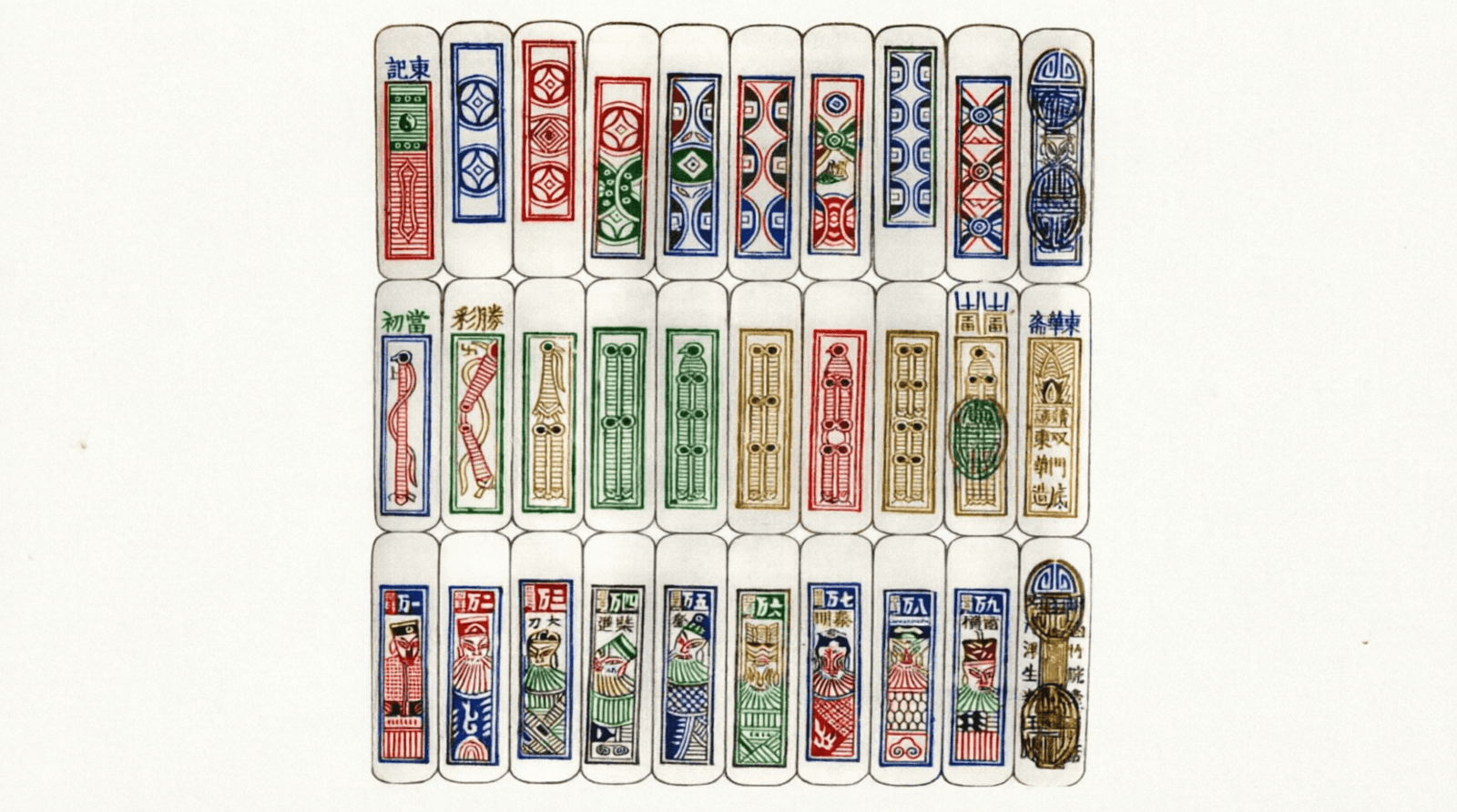
China. Most researchers believe that cards were invented in China. The moment of invention is considered to be the final period of the Tang dynasty's rule: the 8th-9th century AD. Prototypes of modern decks were made of paper. The cards were made in the shape of a long rectangle. Each one was decorated with hieroglyphs or symbols. Opponents of the hypothesis insist that the Chinese deck resembled domino tiles more than modern cards.
India. Supporters of the Indian version link the modern deck to the traditional game "Ganjifa". It is first mentioned in the 8th century. Ganjifa was played with round cards. The shape symbolized the wheel of samsara. In India, the creators of the deck drew inspiration from religion. The set included 10 suits of 12 cards each. Sacred hymns were sung during the game of Ganjifa. The process resembled a ritual more than a game of chance.
Persia. This hypothesis does not deny the Chinese and Indian versions of the origin of playing cards. Arabs and Persians brought the deck to Europe via the Great Silk Road. They wrote the first set of rules for card games, added a new rank to the deck — the naib — and made the suits abstract. The first cards reached Spain and Italy in the 10th-11th centuries.
Egypt. The most mystical version of the history of playing cards' origin. The deck was invented by the priests of Ancient Egypt. It is based on a repository of the world's wisdom — the encoded "Book of Thoth". The number of cards — 52 — symbolizes 52 doors of wisdom or weeks of the year. Archaeologists have not been able to confirm the hypothesis with physical evidence.
China's role is supported by finds in burial sites and ruins of ancient settlements in Central Asia. Fragments of paper with money suits date back to the 9th-11th centuries. They are several hundred years older than European cards. Other versions cannot be discounted either: both the people of India and Persian merchants contributed to the development of the deck.
The Mamluk deck — ancestor of European cards
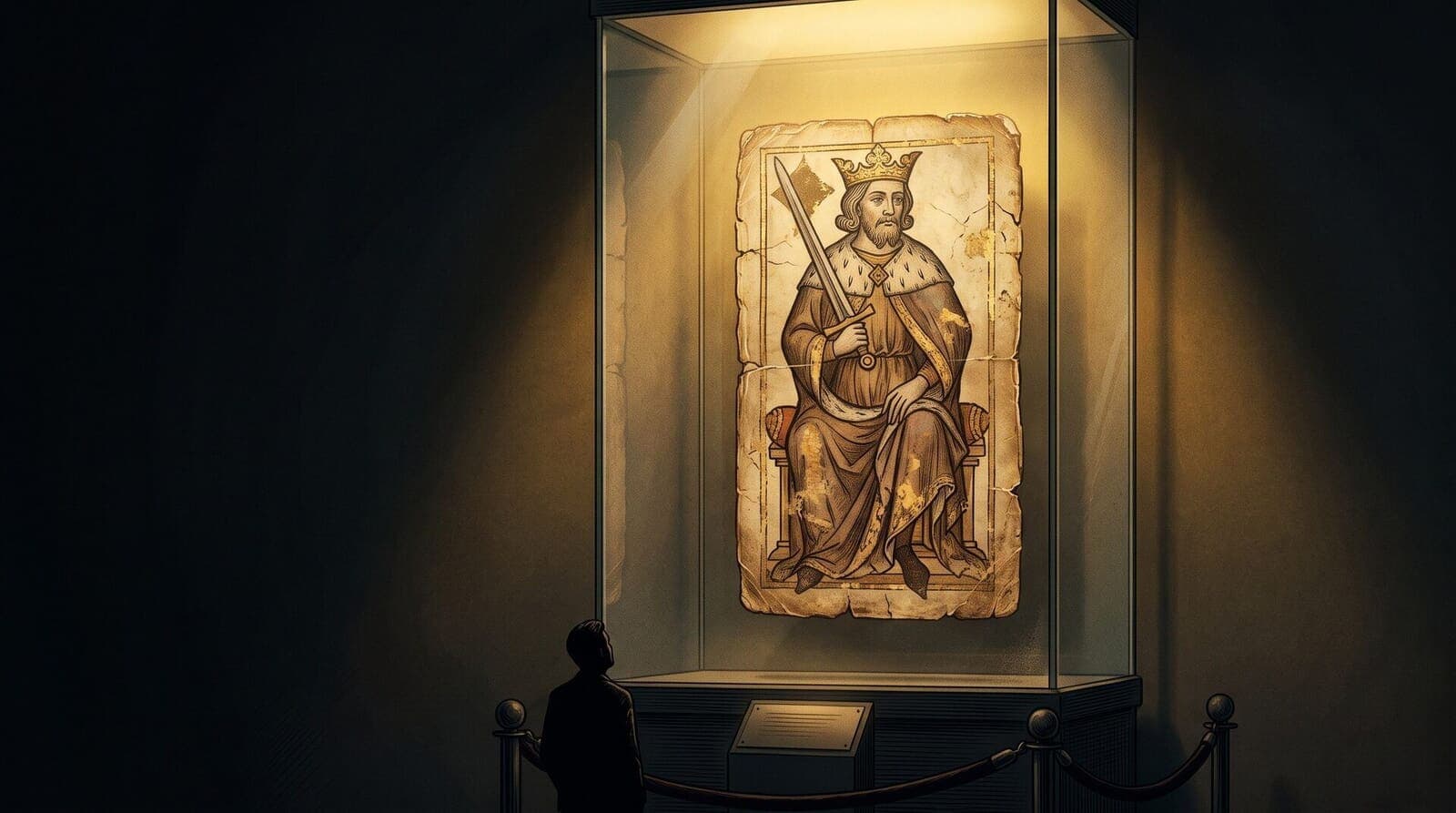
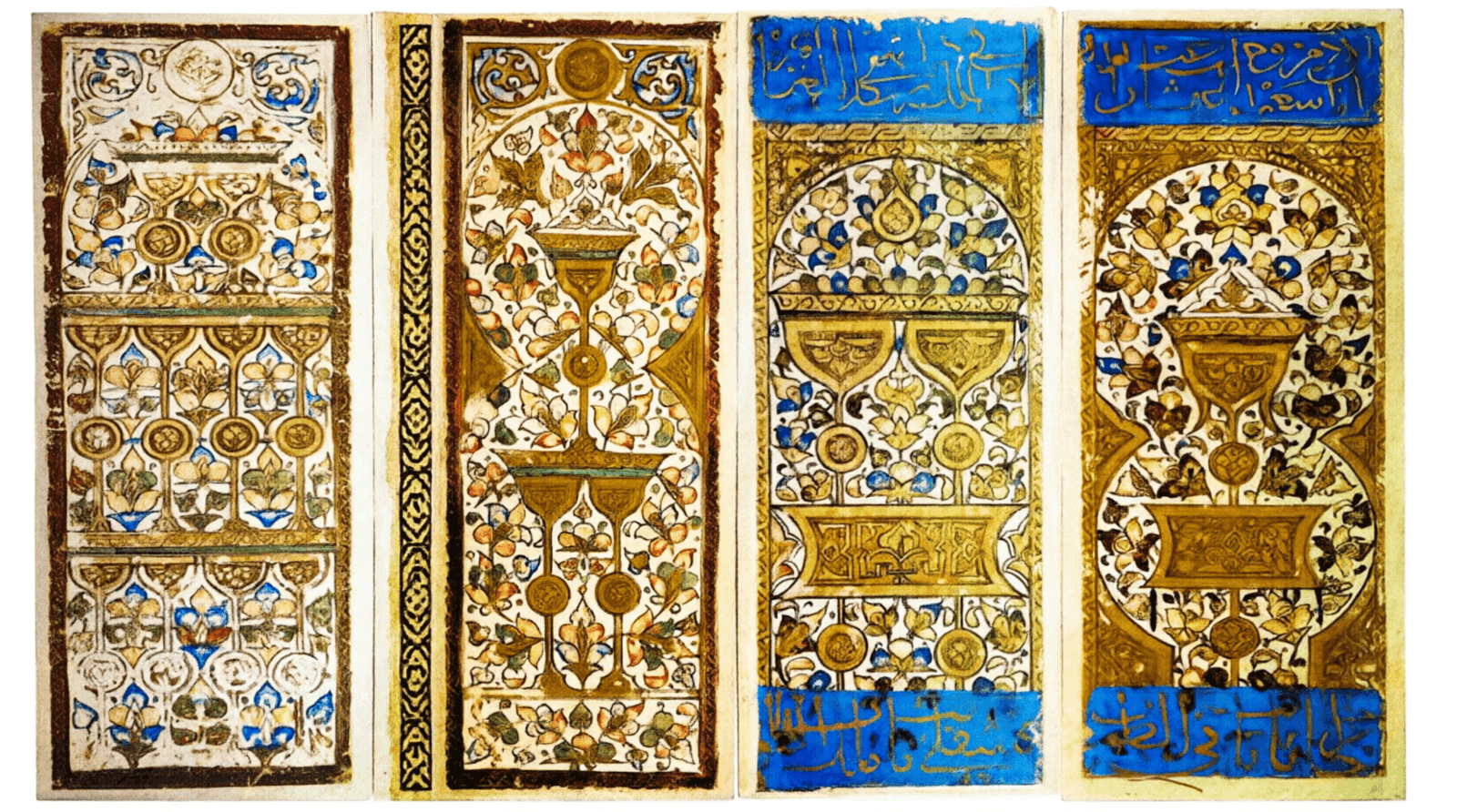
The European deck was invented in Asia. The first classic set was found in the Middle East. It was played during the Mamluk era: from 1250 to 1517. The history is confirmed by the discovery of a well-preserved deck in the residence of the Ottoman sultans. It consists of 52 cards. The deck also has 4 prototypes of modern suits: swords, polo sticks, cups, and coins. Italians and Spaniards later renamed "cups" to "cups" (copas), "swords" to "swords" (espadas), and "coins" to "money" (oros).
The number of cards and suits in the Mamluk deck matches its modern versions
The hierarchy of ranks in the Mamluk deck differed from the standard one. Its main features:
Ranks went from 1 to 10.
The ace served as a one, not the highest card.
Three highest ranks got a "face". The king was the strongest card in the deck, the naib or viceroy was second in importance, and the second viceroy closed out the trio of highest ranks.
In the European deck, the viceroys were replaced with a queen and a jack. Islam had a strong influence on the Mamluk deck. The religion forbids depicting living creatures. So you won't find a crowned person on the deck's highest card. It was replaced by an abstract inscription with the name of the rank. The rest of the rectangle's space was filled with geometric ornaments. Ranks from 1 to 10 were also decorated with a pattern of suit symbols. For example, ten swords or 5 cups.
Before the discovery of the Mamluk deck, it was believed that the standard of 52 cards and 4 suits was invented by Europeans. However, the found set proved the more ancient roots of the modern deck. Europeans copied the sample from the Middle East, replaced the ornaments with portraits, and introduced the queen among the ranks.
How cards came to Europe: first mentions
The first card games were brought to Europe in the 10th century. The growing popularity of games of chance attracted the attention of authorities. Cards were mentioned in a decree of the Bern city council in 1367. It banned games of chance and equated the deck with "the devil's spawn". The harsh wording indicates a high level of interest in cards among medieval townspeople. In 1377, card games were described in detail by the Dominican monk John in the treatise "On the Customs and Rules of Human Communication". By the end of the 14th century, gambling games were banned throughout Europe: in Nuremberg, Augsburg, Ulm, and cities in France.
An alternative version of the origin of playing cards is offered by the legend of Jacquemin Gringonneur. In 1392, the court jester created 3 decks to entertain King Charles VI of France. However, the story cannot be confirmed by original documents. It was first mentioned by the monk Menestrier 3 centuries after the event — in 1704. The dates also work against the legend: cards were banned in Bern 25 years before Jacquemin Gringonneur.
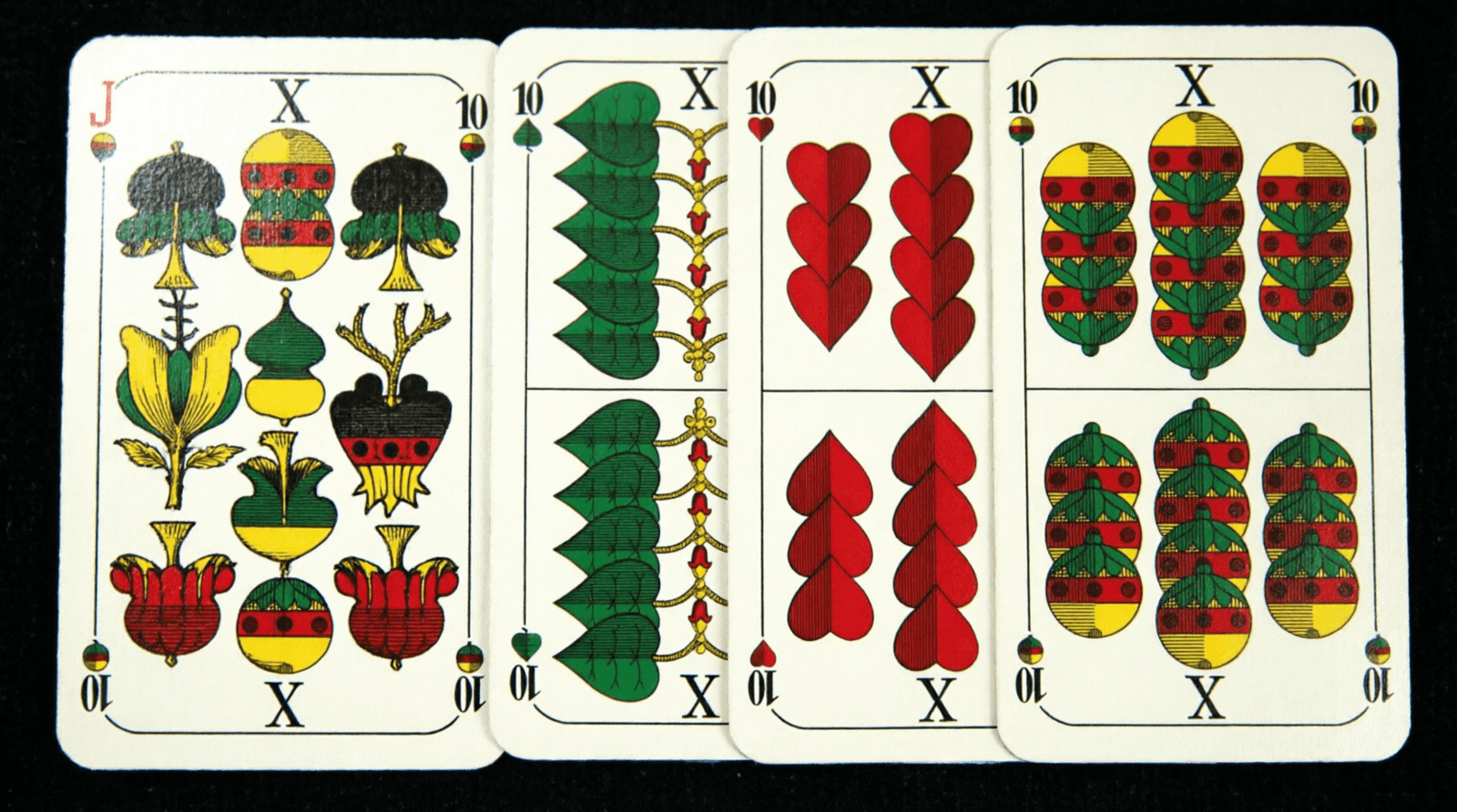
More experimentation with the deck happened in the territories of modern Germany than anywhere else
Europeans took the Mamluk deck as a base, but it soon acquired local features. In Italy and Spain, cards retained most elements of the base version. In the Latin deck, kings, knights, and jacks took the place of abstract ornaments. In the German version, the eastern symbolism was completely replaced by local imagery. The suits in the deck were divided into: leaves, hearts, bells, and acorns.
Learning at FunFarm, from any level
Why exactly 4: theories on the origin of the suits
Over a millennium, cards went a long way. The suits familiar to us today looked different in medieval decks. France played a key role in the history of playing cards. Local craftsmen took the Latin deck as a base and radically reworked it. The result surpassed its competitors, and the French version took the lead worldwide. Brief information about the evolution of the deck is collected in the table:
Latin suit | French suit | Russian suit | Differences |
Swords (espadas) | Piques (spades) | Spades ♠️ | The tip of the sword was replaced by a spearhead or pike |
Cups (copas) | Cœurs (hearts) | Hearts ♥️ | The stem was removed from the cup, turning it into a heart symbol |
Coins (oros/denari) | Carreaux (tiles, diamonds) | Diamonds ♦️ | The round coin was turned into a diamond shape |
Staves/clubs or (bastos) | Trefles (trefoils, clover) | Clubs ♣️ | The curved club was transformed into a three-leaf clover |
Before the invention of the French deck, each suit was denoted by its own color. For example, swords were black, cups were red, coins were yellow, and staves were green. The French kept two colors — red and black. The first included hearts and diamonds, the second — spades and clubs. Simplifying the symbols paid off: a heart or diamond was easier to carve on a wooden block. This was used in mass production of cards. Replacing manual labor made the deck cheaper to produce. As a result, French cards flooded the European market and pushed out competitors by the end of the 17th century.
Why French craftsmen chose spades, hearts, diamonds, and clubs is a debatable question. The most popular hypothesis links the symbols to the classes of medieval society:
Spades — aristocracy, nobility. Symbol — knights' weapons.
Hearts — clergy. Symbol — the communion cup. Later transformed into a heart as a symbol of love for God.
Diamonds — merchants, bourgeoisie. Symbol — a coin. Some medieval coins resembled a diamond shape.
Clubs — peasantry, farmers. Symbol — clover. The plant refers to nature, land, and rural labor.
The deck depicted a simplified model of society at the time.
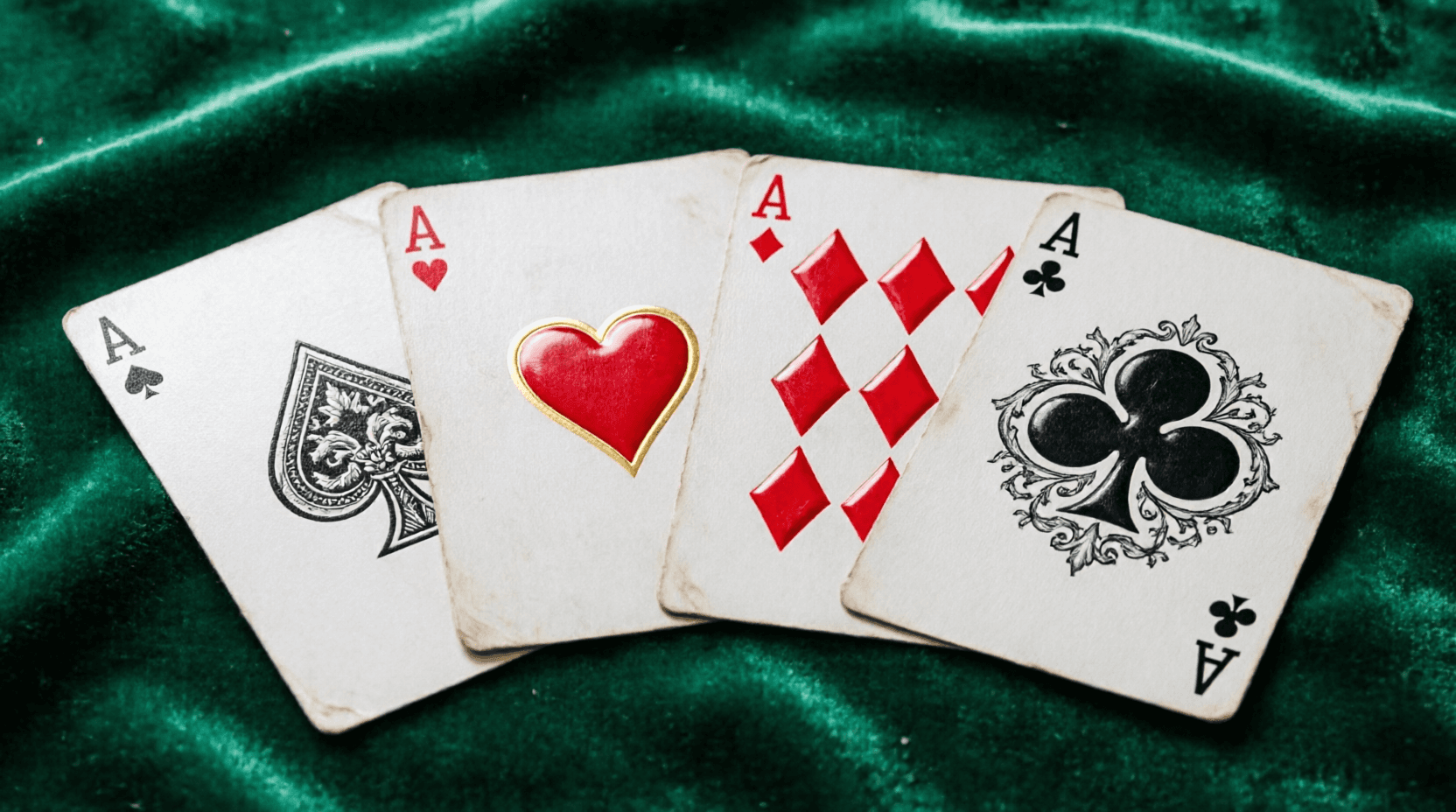
The French deck defeated its competitors thanks to the simplicity of production
Alternative hypotheses take the 4 seasons or the 4 elements as a basis. Fans of occult knowledge draw parallels between the four letters of the tetragrammaton or the four cardinal directions. Whether French craftsmen put esoteric meaning into the deck's symbols is hard to say.
Why there are 52 cards in a deck
In the process of evolution, not only the suits and appearance of the ranks changed, but also the number of cards in the deck. The classic German set included 48 cards. In Venice, a deck of 78 cards was used, and in Florence — 98. However, the French version with 52 ranks won out over the competition. The number of cards in the deck is explained by symbolism and mathematics.
The suits represent the 4 cardinal directions or the 4 seasons. Each includes 13 ranks. Multiply 13 by 4 — you get 52 cards. The number of ranks is also linked to the calendar. A year consists of 52 weeks. A season lasts 13 weeks. Each suit acts as a metaphor for a season, and together they make up the annual cycle.
The parallel between the calendar and the deck can be developed further. If you convert the images into numbers and add up all the ranks of one suit, you get the progression: 1 + 2 + 3 + 4 + 5 + 6 + 7 + 8 + 9 + 10 + 11 + 12 + 13 = 91. In these calculations, the ace is equated to 1, the jack to 11, the queen to 12, and the king to 13. Multiply 91 by 4 and you get 364. That's one less than the number of days in a year. That's why one or two jokers are added to a full deck. The first joker symbolizes the 365th day of the year, and the second — the 366th day for leap years.
When the jack, queen, and king appeared
When European craftsmen modified the Mamluk deck in the 15th century, they replaced the faceless cards with a jack, queen, and king. Now it's hard to make out a specific personality in the deck's ranks. However, French card manufacturers drew inspiration from real historical and mythological prototypes. The information is collected in the table:
Card | Personality |
K♠️ | The biblical King David — a wise ruler and slayer of Goliath |
K♥️ | Charlemagne — founder of the Holy Roman Empire |
K♦️ | Gaius Julius Caesar — emperor of Rome and greatest military commander of antiquity |
K♣️ | Alexander the Great — king of Macedon and conqueror of the world |
Q♠️ | Athena — the ancient Greek goddess of wisdom and war |
Q♥️ | Judith — a heroine of the Old Testament. She saved her home city from the Assyrian invasion |
Q♣️ | Argine — a composite image from knightly legends |
Q♦️ | Rachel — matriarch of the Israelite people |
J♠️ | Ogier the Dane — a knight among Charlemagne's paladins |
J♥️ | Lahire or Lahel — a mythical character from French epic poetry |
J♣️ | Lancelot — the famous knight of King Arthur's Round Table |
J♦️ | Hector — prince of Troy |
The selection of heroes changed under the influence of historical events. For example, Judith replaced Helen of Troy as Q♥️. In parallel with Athena, Joan of Arc occupied the "position" of Q♠️. J♦️ is also a subject of debate. The most popular version puts forward Hector of Troy as the prototype. Alternative hypotheses mention Hector des Mares and Hector de Troyes. The first was among the Knights of the Round Table. The second invented the famous "Paris pattern" for playing cards.
The emergence of double-sided cards and the joker
Before the beginning of the 19th century, all ranks were depicted in full length. This approach created difficulties. If a card lay upside down, the player had to turn it over. The extra actions slowed down the game. In the 1830s-1840s, decks with mirrored figures began to be produced. Artists drew kings, queens, and jacks so that they were inverted relative to each other. One character's head faced up, and the other's faced down. The deck update made cards readable from any position. The kings', queens', and jacks' legs were sacrificed for convenience.
In the 1860s, indices — small symbols of rank and suit in the corners of the rectangle — were added to the cards. This new stage in the deck's evolution allowed all the information to be seen with minimal effort. Indices sped up the game and hid cards from the eyes of neighbors at the table. At the same time, the joker was added to the deck. It was invented for the game of euchre. The highest-ranking card beat all other trumps. Later, the joker took on the role of a universal wild card and could replace any rank in the deck.

Over a span of 50 years, cards gained: mirrored characters, corner indices, a joker, and rounded corners
In the 1880s the corners of cards were rounded off. Ordinary rectangular ranks quickly bent and delaminated. Rounded corners increased the deck's durability and lifespan. The new solution also made life harder for card cheats: it became more difficult to mark the updated ranks.

History of Russian playing cards
The first decks were brought to Russia by European merchants in the 17th century. The new pastime quickly gained popularity in the upper circles. Games of chance soon spiraled out of control: nobles lost huge sums of money and estates. The criminal code of the time — the Sobornoye Ulozhenie of Alexei Mikhailovich — declared card games a grave crime. Players were punished by having their nostrils torn out and being branded with hot iron. Under Peter I, playing cards for money was banned in 1717. The import of decks into the country also fell under restrictions.
Gradually, the state moved from a policy of bans to control. In 1798, the right to manufacture and sell playing cards in the empire was transferred to the Foundling Home — a charitable institution. In 1817, the Imperial Playing Card Factory was founded in St. Petersburg. Emperor Alexander I permitted the production of decks in Russia while simultaneously banning imports from other countries.
In 1855, it was decided to update the design of the deck in the empire. Options from well-known artists were rejected due to the high cost of card production. The commission was given to Adolf Iosifovich Charlemagne. His project was recognized as the best. He proposed sketches for printing in four colors — black, blue, yellow, and red. Charlemagne's drawings formed the basis of the most famous Russian deck.
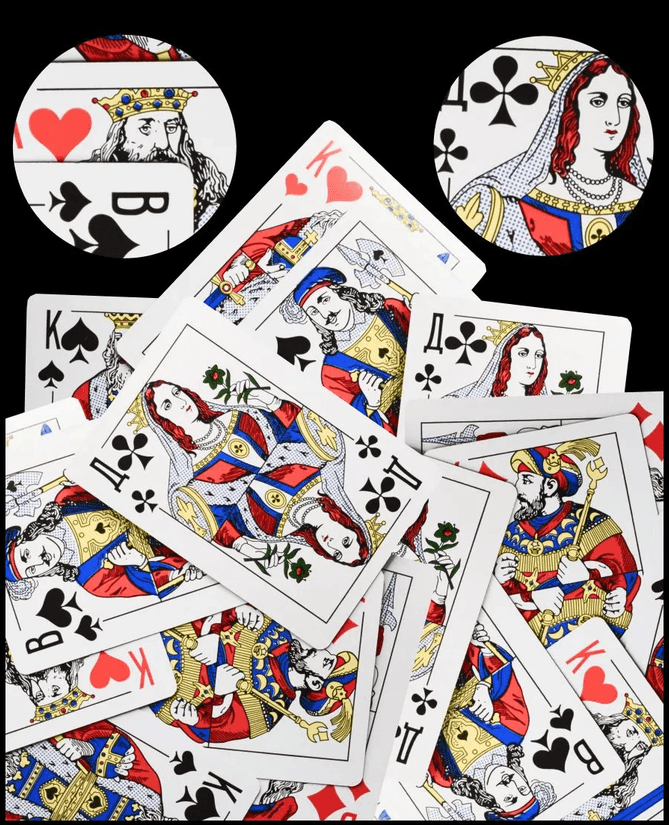
Charlemagne's "Atlas" deck proved so successful that it has been reprinted from the mid-19th century to this day
In the process of working, Charlemagne replaced the characters of several ranks. For example, the place of Athena on Q♠️ was taken by the Byzantine empress Theodora. Elizabeth of Austria replaced Judith on Q♥️.
The modern poker deck
Poker is played with a 52-card deck with 4 suits. Jokers are not used in play. It is used in: Texas Hold'em, Omaha, seven-card stud, draw poker, and Pineapple. The only deviation from the standard is made in Holdem 6+. Short deck is played with a reduced set of 36 cards. Let's note the dual role of the ace in the poker deck. It simultaneously:
acts as the high card of the best straight T-J-Q-K-A;
opens the worst straight A-2-3-4-5.
Modern decks feature double-sided figures on the cards and indices in the corners. The ranks themselves are made in the shape of a rectangle with rounded corners. All these solutions speed up the game and simplify determining the strength of a hand or combination.
Professional decks are made of plastic. They are produced by:
KEM;
Copag;
Bicycle;
Modiano.
Advantages of plastic cards:
don't absorb moisture and sweat;
withstand hundreds of hands while retaining a decent appearance;
easy to shuffle thanks to a smooth surface;
hard to bend or mark.
Cheaper sets are printed on paper. Their advantage is low cost. Paper or cardboard decks cost $2-3. The price of plastic cards starts at $10-$15.
How to learn to play poker
To win at poker, you don't need to know the history of suits or the biblical prototype of Q♥️. A rational beginner studies the ranking of hands, the flow of betting, and the names of positions at the table. Once they master the basic ideas, they can move on to more complex concepts. You can improve your skills with: books, courses, software, discussions with other players, or coaching sessions. FunFarm poker school offers the most systematic approach.

Fund students receive: a bankroll for playing, free software, access to the salary project, and other privileges
Beginners will benefit from taking the FF Start course. It will help lay the foundation for future success. At the end of the program, the student takes an exam. Graduates are accepted to the next step — FF Player Path. Over 8 months of training, a poker player reaches a professional level and moves past the microstakes.

Free course · FF Start
Learn poker systematically
From the first rules to strategy, math and a clear development plan.
Frequently asked questions
Read next

Стивен Чидвик: биография, достижения и стиль игры
Online Poker History: First Hand to Billion-Dollar Industry