Omaha Hi-Lo: How to Win Half the Pot (or All of It)
No-Limit Texas Hold'em is the most popular card game in the world. NL Hold'em owes its leading position to its simple rules. However, other poker variants are worth your attention too. Let's talk about Omaha Hi-Lo.

Ilya is a Liga 2 player with six years of experience in online MTTs. He graduated from the Faculty of Journalism at RSUH and writes about poker for beginners, explaining complex things in simple, clear language. In his texts, Ilya combines his personal playing experience with his professional journalism skills to help newcomers confidently get into the game.
What is Omaha Hi-Lo poker
Omaha is an umbrella term for several card games with similar rules. The three key differences between PLO and the more popular NL Holdem look like this:
the starting hand contains 4 or more cards;
the final combination is formed by two of the player's cards and three from the board;
the bet size is limited by the current size of the pot.
The betting rules, the ranking of combinations, and the positions at the table are the same in Holdem and Omaha.

Omaha Hi Low is sometimes denoted as Omaha 8 or PLO8. The eight is the highest possible card for a "low" combination
The main difference between Omaha Hi-Lo and the classic version is the ability to take half the pot with the worst combination. This new option makes hands more dynamic. Players with weak starting hands get a chance to take part in the fight rather than fold and wait for the next hand.
In Omaha Hi Lo, half the pot goes to the holder of the best combination and half to the holder of the worst. A "low" combination contains cards no higher than an eight. By the rules of the game, the ace is considered the lowest card of the deck. For example, a starting hand of 27AA and a flop of 346 give the player the combination A2346. When building the worst combination, straights and flushes do not count. Let's say QhKh2s5s is held and the flop comes 6s4s7s. The combination 2s4s5s6s7s allows you to claim the lower half of the pot. The best "low" combination in Omaha Hi Lo Poker is A2345. The worst combination is counted from the highest card. A2346 gives a 6-low, A2345 a 5-low.
Sometimes a player makes the best and the worst combination at the same time. Let's show this with an example. The player's starting hand is KK45 and the board is K36A6. The player simultaneously has:
A full house KKK66;
A 6-low A3456.
A situation like this at the table is called a scoop.

New breakdowns in your inbox
Subscribe to the FunFarm newsletter: fresh Poker ABC articles and material that helps you grow as a player.
What other types of Omaha exist in poker
Pot-Limit Omaha is the base version of the card game. Most online poker rooms offer it. Omaha Hi Lo draws less interest. However, there are other Omaha variations too. Let's list them:
PLO5/PLO6/PLO7. At the start of the game, players are dealt 5, 6 or 7 hole cards. The final combination contains 2 cards from the player's hand and 3 from the shared board. Apart from the number of cards on the preflop, the rules match Pot-Limit Omaha.
Courchevel. At the start of the hand, each player is dealt 5 hole cards. The dealer places 1 shared card on the board. Players play a round of betting on the preflop. If two or more opponents keep contesting the pot, 2 more cards are placed on the shared board. On the turn and river, the hand proceeds by the classic rules.
Drawmaha. Combines elements of Omaha and draw poker. At the start, players are dealt 5 hole cards. A round of betting takes place on the preflop. The dealer lays out the flop and players are given a chance to exchange one to three cards. The following rounds proceed by the usual scheme.
You can get your first experience playing Omaha Hi Lo in PokerBros and other free apps
Among the offshoots of Omaha we can count Oklahoma. It resembles Pot-Limit Omaha in every way except the turn and river. On those two last streets, players must fold one card of their starting hand each.
In what other games is there a hi and a lo
The worst combination takes half the pot not only in Omaha. The low rules are applied in:
Lowball. The rules of the game do not involve strong combinations. The player's task is to make the worst combination of classic poker. The ace plays the role of the highest card, and straights and flushes count. So the absolute nuts in lowball is the combo 2-3-4-5-7.
2-7 Single Draw. The essence of the game is similar to lowball. Players are dealt 5 cards, they have one exchange opportunity, after which they must show their combination to the dealer and opponents. You can swap from 1 to 5 cards. The best combination in 2-7 single draw is 2-3-4-5-7.
Stud Hi-Lo. Half the pot goes to the strongest combination, half to the weakest. Straights and flushes do not count in the low combination. The ace plays the role of the worst card of the deck. The best combination in Stud Hi-Lo is A-2-3-4-5.
Razz. The pot is won by the holder of the worst combination. The rules ignore straights and flushes, so the top combination looks like: A-2-3-4-5.
Learning at FunFarm, from any level
What does the ranking of combinations look like in Omaha Hi Lo
In Omaha Hi Lo, half the pot goes to the best combination, half to the worst. In the first case, the classic ranking rules apply. They match No Limit Holdem and other types of poker. The full list of winning combinations looks like this:
High card. For example, a starting hand of AKT5 and a board of 24689 give the final combination AK986.
Pair. On the preflop the player was dealt QJ67. The flop J92 gives the player a pair of jacks.
Two pair. For example, a starting hand of J982 and a flop of J8A give the player pairs of jacks and eights.
Set. On the preflop the player got AAJ3. The flop A2Q lets them make a set of aces.
Straight. A starting hand of JT25 and a board of 98Q form the straight QJT98.
Flush. On the preflop the player got AsJs2d8h. The dealer put Ts4d9sQsAh on the board. Together they give the flush AsQsJsTs9s.
Full house. A starting hand of AKT6 and shared cards K624K form the full house KKK66.
Quads. On the preflop the player was dealt TT26. On the flop TT4 they form quad tens.
Straight flush. A starting hand of 9h8h6s5d and a flop of JhTh7h give the straight flush JhTh9h8h7h.
Royal flush. The combination of the starting hand AdQd and the board KdTd2s4sJd gives the player the royal flush AdKdQdJdTd.
The requirements for the final combination in Omaha are higher than in Holdem. While in NL Holdem strong pairs regularly take pots, in Omaha Hi Low even a straight is often not enough. Aggressively protect vulnerable combinations and switch to pot control when you suspect your opponent has a stronger combination.
To get half the pot with the worst hand, you need a combination with small cards. The watershed of combinations is the eight. If a player's final combination contains cards higher than an 8, they cannot claim the low part of the pot. The smaller the cards in the combination, the higher the chance to take the lower half of the pot. The rules of Omaha Hi Lo ignore straights and flushes. So the strongest combination in PLO8 is considered to be A-2-3-4-5. The combination is counted from the highest card. So A-4-5-6-7 is called a "7-low", and A-3-4-5-6 a "6-low".
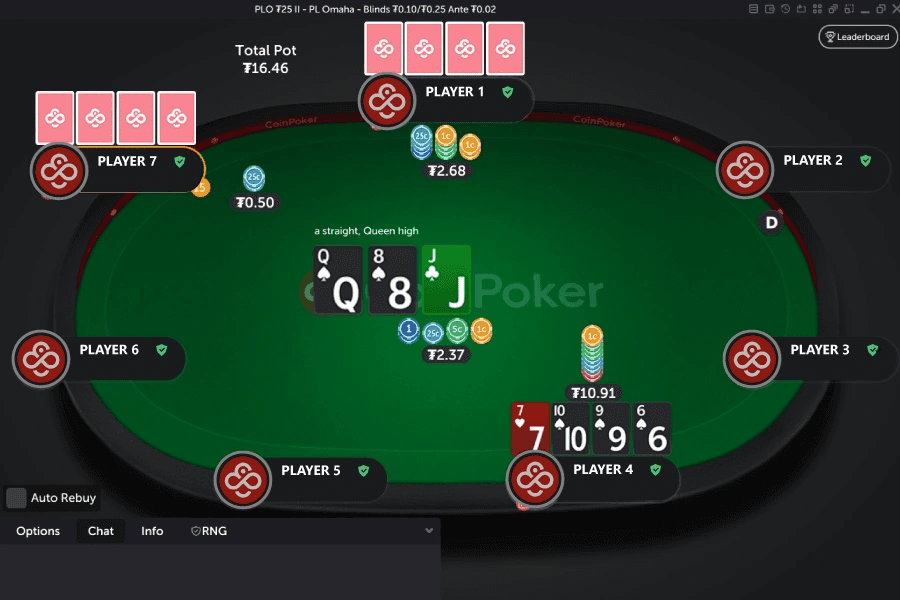
In Pot-Limit Omaha, the highest priority goes to hands with the potential to make a straight or a flush. In Omaha Hi-Lo, combinations with low cards are valued: A234, A235
Sometimes a player makes the best and the worst combination at once. As a result, they take both halves of the pot. For example, a starting hand of A2K6 and a board of 637KK give the player a full house K-K-K-6-6 and a low A-2-3-6-7. Both combinations give good chances to take the whole pot.
How a hand plays out in Omaha Hi Lo Poker
The rules of Omaha Hi Lo almost entirely match No Limit Holdem. Omaha is played with a deck of 52 cards. The table can hold from two to nine participants. Before the hand begins, two players — the big and small blinds — make forced bets. The big blind equals 1% of the maximum allowed buy-in stack. The small blind is half of the big one. In the next hand, other players post the forced bets. The movement goes clockwise. The count starts from the player on the button.
A lot in Omaha depends on the player's position. Your seat at the table determines the order of action. The later a player makes a decision, the more they know about the strength of their opponents' hands. Let's look at the players' positions at a 6-max table.
UTG. Under the Gun. The player always acts first on the preflop and often on the postflop. The lack of position forces you to play a narrow range. UTG is sometimes denoted as EP or Early Position.
MP. Middle Position. Makes a decision second after UTG. Can slightly widen the range.
CO. Cut-off. One of the most profitable seats at the table. The positional advantage gives the chance to open less strong hands.
BTN. Button. The best position in Omaha Hi-Lo. The player on the BTN has the last word both on the preflop and the postflop. This seat at the table lets you steal blinds from the SB and BB.
SB. Small Blind. Posts a forced bet on the preflop. Almost always announces a decision first.
BB. Big Blind. Posts the mandatory blind on the preflop. Acts out of position against everyone except the small blind.
A 9-max table adds a few early and middle positions. They are denoted as: UTG+1, UTG+2, MP1.
On the preflop, each player receives 4 hole cards. If a player considers the hand promising, they announce a raise. The other opponents can respond with a call, a 3-bet, or a fold. If two or more players are contesting the pot, the hand moves to the flop.
At the start of the round, the dealer deals 3 shared cards. The participants in the hand assess the strength of made combinations or the prospect of completing a draw. The first player can bet or check. In the latter case, the player stays in the hand but does not put money into the pot. The second player can announce a check in turn or bet.
On the turn, the dealer deals the fourth shared card and another round of betting follows. On the river, players get the last shared card and make final bets. When the betting comes to an end, the opponents show their final combinations and the winner is determined.
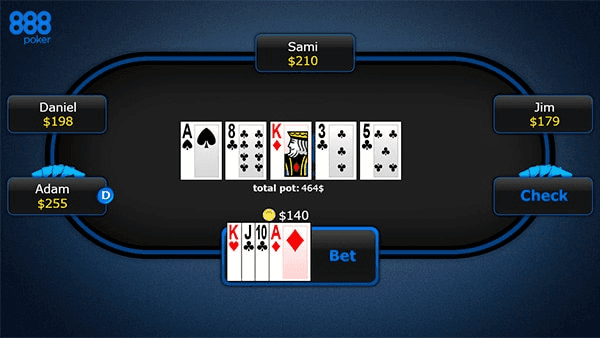
At any stage of the hand a player can make a bet, see the opponent fold, and take the pot
In Omaha Hi Low, the pot is split by specific rules. For example, player A takes half the pot with the best combination. Player B and Player C show equal lows at showdown and take 1/4 of the pot each. If there are three holders of equal combinations, they will get 1/6 of the total pot each.
The "counterfeit" rule also complicates the player's life. If a card comes to the board that matches one of the small cards of your starting hand, that card cannot be used in the final combination. Let's show this with an example. Suppose a player entered the hand with JT32. The flop came A45. The player caught the best low and is claiming half the pot. On the turn comes a 9. The card does not change the situation, unlike a three on the river. It counterfeits a card from the player's hand. The player loses the ability to use the three when building a low and is forced to fold.
How to play Omaha: basic recommendations
Splitting the pot into two halves changes the playing strategy and the requirements for starting hands. In Omaha Hi Lo, priority goes to versatile combinations. The player must have a chance to catch the best and the worst combination at once. Above all others, starting hands with aces and small cards are valued: A234, A245 and so on. Do not play combinations with middle cards like 8765. Even if the player makes a low, it will often lose to opponents' lower combinations. A starting hand of 8765 will rarely bring the upper part of the pot, because opponents will catch better combinations on the later streets.
Omaha Hi Lo also differs from the classic version in postflop tactics. Sometimes a player must throw away nut combinations on the flop. If the shared cards have left chances to fight only for half the pot, it is wiser to get out of the game. Do not invest money in a vulnerable hand for the sake of a share of the pot. The final success often does not pay off the effort. You definitely should not play drawing hands hoping to take half the pot. For example, with AQJ7 on a board of 56T the player has a chance to catch a low. However, an opponent may show a better combination at showdown. The player does not claim the upper part of the pot.
The preflop plays a decisive role in Omaha Hi Lo. A reasonable choice of starting hands often predetermines the final success

Where Pot Limit Omaha tournaments take place
Most online poker tournaments are run by the rules of No Limit Texas Holdem. Far behind in second place is Pot-Limit Omaha. PLO tournaments are organized by: PokerOK, PokerStars, Winamax Poker, Pokerdom, RedStar Poker. The most attention to PLO is paid at PokerOK: over 100 Omaha MTTs run on the platform daily. Sometimes a poker room organizes separate festivals, like the Omaholic Series with a $10,000,000 guarantee. However, there are no Omaha Hi Lo tournaments in the regular schedule. The game is remembered as part of major series, like SCOOP.
In 2025, the Spring Championship of Online Poker was held on PokerStars. Over $60,000,000 was awarded across 380 tournaments. 18 events were dedicated to Omaha Hi Lo. The largest of them awarded $100,000. A comparable number of PLO8 tournaments was also added to the WCOOP schedule.
Omaha Hi Low is not ignored at the most prestigious live series, the World Series of Poker, either. WSOP-2025 held 100 events. Six of them were dedicated to Omaha Hi Lo. The largest tournament was won by Philipp Sternheimer. He left 385 opponents behind and took $763,087.
Why NL Holdem is better than Omaha Hi Lo Poker
The key advantage of No Limit Texas Holdem is its scale. For example, the daily schedule of PokerOK includes 1,000 tournaments, and most of them are played by the rules of NL Holdem. Less than 10% of events are allotted to all variations of Omaha. There are no PLO8 tournaments on PokerOK. The situation is similar in cash: a Holdem fan finds it easier to find a table on any platform.
Other arguments in favor of Holdem look like this:
Prize pools. At WSOP-2025, the winner of the main Holdem tournament got $10,000,000. The champion of the largest Omaha Hi Lo event was paid $763,087. There is no point at all in comparing the standing of the games in online poker. Not a single room regularly runs Omaha Hi Lo tournaments. PLO8 is only remembered at big online festivals, like SCOOP. But even there the guarantees are tens of times lower than for Holdem events.
Variance. In Holdem, the losing streaks are less protracted. In Omaha, due to frequently playing for stacks with 60:40 odds, sharp drops of tens of buy-ins occur regularly. In No Limit Holdem a professional has more control than in Omaha Hi Lo. That is why a more substantial bankroll is needed for PLO.
Training. There is significantly more material on Texas Holdem than on Omaha. In recent years the number of training courses on PLO has been growing, but the advantage is still on the side of NL Holdem.

Winning the PLO8 tournament brought Philipp Sternheimer a solid $763,087. However, it pales next to the $10,000,000 prize of the ME WSOP champion
We recommend that beginners start with NL Holdem tournaments. The FF Start course will help you lay a solid foundation. In it we break down: basic tournament strategies, adapting to different types of opponents, short-stack play, and the basics of poker math. You can put the theory into practice in a special trainer.

Free course · FF Start
Understand the logic of MTTs
Study the early stage, the bubble, short stacks and the final table as one system.
Frequently asked questions
Read next
Chinese Poker Pineapple: rules, hands, and scoring
What sports poker is and how it works
Types of Poker: Popular Variations, Their Rules and Features