Chinese Poker Pineapple: rules, hands, and scoring
Chinese Poker Pineapple, or Open-face Chinese poker (OFC), is a card game with classic hand rankings and original rules.

Ilya is a Liga 2 player with six years of experience in online MTTs. He graduated from the Faculty of Journalism at RSUH and writes about poker for beginners, explaining complex things in simple, clear language. In his texts, Ilya combines his personal playing experience with his professional journalism skills to help newcomers confidently get into the game.
Texas Hold'em is the most popular card game in the world. ME WSOP broadcasts draw hundreds of thousands of viewers. The prize pools of leading tournaments reach millions of dollars. However, people also play other variations of poker. Pineapple is one of them. Let's discuss this original game in more detail.

New breakdowns in your inbox
Subscribe to the FunFarm newsletter: fresh Poker ABC articles and material that helps you grow as a player.
Key facts about Chinese poker
Chinese Pineapple poker and Open-face Chinese poker offer similar rules. The main difference between the games is the number of rounds. In Pineapple, all rows are filled over 5 turns. In OFC, the hand takes 9 rounds.
During play, opponents fill 3 rows: the top or front, the middle, and the bottom or back. The front holds 3 cards, the middle and back 5 each.
Chinese poker uses the same hands as no-limit hold'em. The weakest winning combination is high card, the strongest is the royal flush.
Increasing hand strength is the most important rule of Pineapple. The following scheme applies: front < middle < back.
If a player breaks the order of combinations, their hand is declared dead. They are credited with an automatic loss. They pay 6 points to each opponent.
The score in the game is kept in points, or kushes. They are awarded for the best row among opponents. If a player beat their opponents in every row, they receive bonus points. Additional points are granted for specific combinations.
The rules of Chinese Pineapple poker provide a bonus for a combination of QQ or better in the top row. In the next hand, the player is dealt all 14 cards at the start. As a result, they build the strongest possible combinations and receive the maximum reward for their hands.
What is Chinese Pineapple poker and where did it come from
Chinese Pineapple poker, or Open-face Chinese poker (OFC), is a card game with the classic hand ranking and original rules.
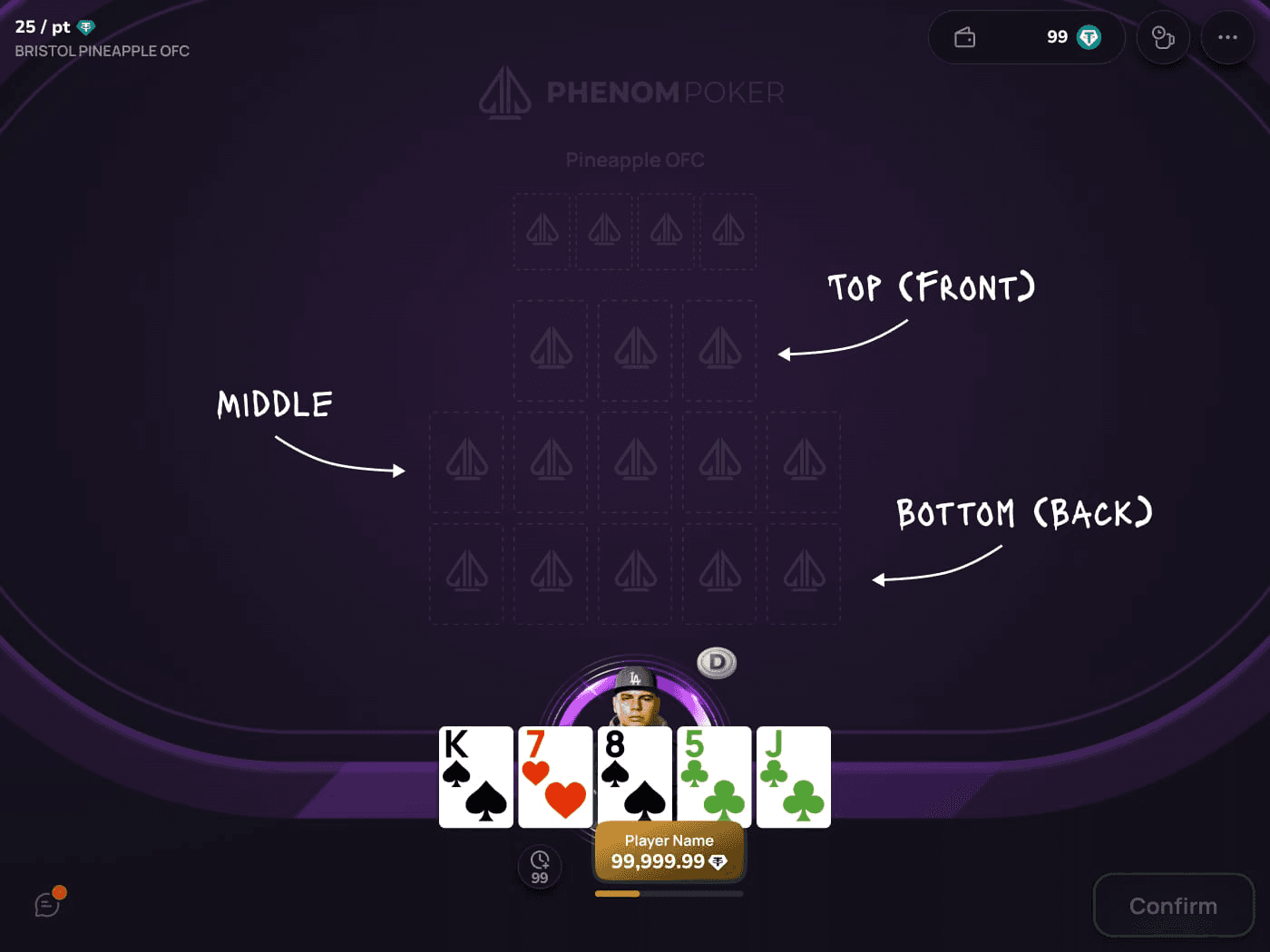
Once a player has distributed the ranks of their starting hand across the rows, they are dealt new cards. The rules of Chinese poker forbid revisiting past decisions
OFC shares the hierarchy of winning combinations with no-limit hold'em. At a Chinese poker table, players assemble combinations from high card to the royal flush. In other respects, Pineapple is more reminiscent of solitaire. OFC players don't compete with each other directly. The rules don't include a board with community cards, betting streets, or the option to force an opponent out of the pot with a bluff.
To win a round, players fill 3 rows of cards with combinations of increasing strength. Each player in the hand is dealt 13 cards in total. The result of the round depends on the number of points. In Chinese poker, points are called "kushes." Points are awarded for the best row compared to opponents and for individual combinations. From 2 to 4 people play at an OFC table. The deck doesn't allow more. In alternative versions of Chinese poker, no more than three players can gather.
Open-face Chinese poker was invented in Finland in the mid-2000s. A few years later the game was popularized worldwide. The fast pace of hands and the gentle mechanics attracted recreational players. Later, poker rooms took notice of OFC too. You can play Pineapple on Pokerdom and other platforms. Chinese poker is sometimes remembered at live festivals as well. In 2013, an OFC tournament was held at the PokerStars Caribbean Adventure.
Rules of dealing and laying out cards in Pineapple
At the start, players in the hand are dealt 5 face-down cards. The players' task is to distribute them across three rows, or boxes. Each of them has its own name:
Front. The top row of three cards.
Middle. The middle row of five cards.
Back. The bottom row of five cards.
Once a player places all 5 ranks across the rows, opponents see them. The rules of Chinese poker don't allow changing the order in subsequent rounds. That's why it's important to calculate the situation in advance. In the second round of Pineapple, opponents receive 3 ranks. The player uses two of them to build combinations, and discards one. Players in the hand receive 3 cards three more times. By the end of the fifth round, opponents have filled every box.
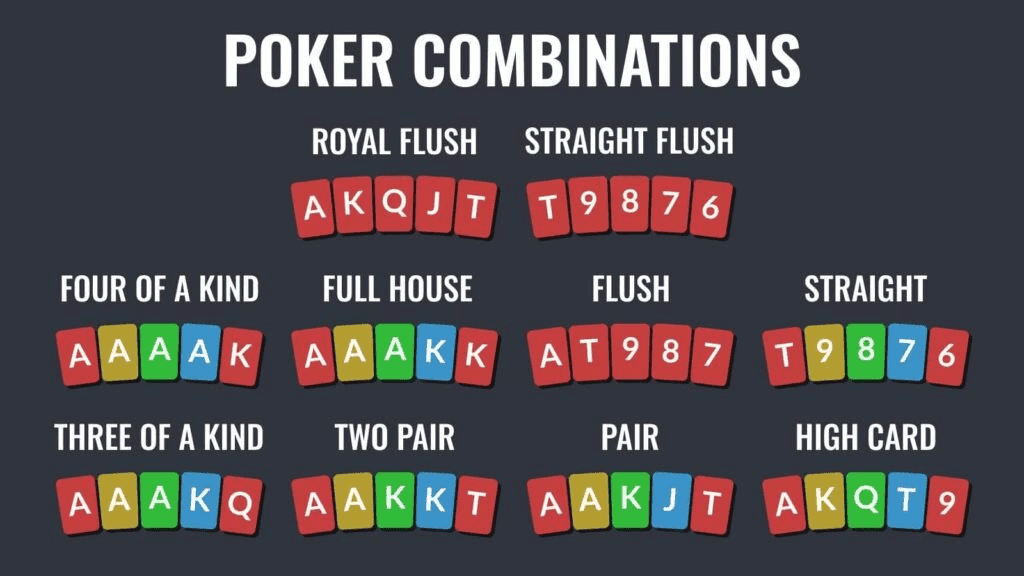
In Open-face Chinese poker you can make the same combinations as in hold'em. The exception is the front. There you can't assemble a combination stronger than a set
The key role in Chinese poker belongs to the ranking of combinations. The strength of the combinations must consistently increase from the top to the bottom row. If this rule is broken, the hand is declared dead and the player automatically loses. For example, the combination "front — pair, middle — set, back — straight" keeps the player in the hand. With the combination "front — pair, middle — straight, back — set," the player is eliminated from the hand. The rules of Pineapple allow forming rows from identical but increasing combinations. Example: "front — 333, middle — 444, back — 555."
In some variations of OFC, players receive a different number of ranks per round. In ordinary Chinese poker, players in the hand are dealt one card at a time. In total, the hand consists of 9 rounds. In Pineapple, the game goes faster — in 5 rounds.
Combinations in Chinese Pineapple poker
The rules of Chinese Pineapple poker provide for the same hand ranking as in hold'em:
high card;
pair;
two pair;
set;
straight;
flush;
full house;
quads;
straight flush;
royal flush.
The middle and back consist of 5 cards, so they allow any combination to be made. The front allows you to build a combination of 3 ranks. The best combination in the top row is a set. A combination of 3 cards of the same suit, like A♠️K♠️2♠️, doesn't make a flush. You need 5 ranks. The same goes for the straight, straight flush, and royal flush.
Learning at FunFarm, from any level
What is a dead hand
A dead hand is a sequence that breaks the hierarchy of combinations: back > middle > front. If a player fails to meet the rule's requirement, they are credited with a loss. The strength of the other rows doesn't matter. An example of a dead hand:
Front. 7♣️7♦️7♠️.
Middle. J♣️T♦️9♠️8♥️7♥️.
Back. 8♣️8♦️8♠️K♣️A♥️.
The set of eights on the back is weaker than the straight in the middle, so the player is eliminated from the hand. An example of a dead hand made of same-rank combinations:
Front. 9♣️9♦️A♠️.
Middle. K♣️K♦️Q♠️2♥️4♥️.
Back. J♣️J♦️2♠️3♣️A♥️.
The pair of nines is weaker than the kings, so the sequence of front and middle keeps the player in the hand. However, the jacks in the bottom row are weaker than the kings in the middle, which leads the player to a loss.
A dead hand loses to any live one. A player can assemble even a royal flush in one of the boxes and still lose to an opponent with a high card or a pair. A player with a dead hand pays for 3 lost rows.
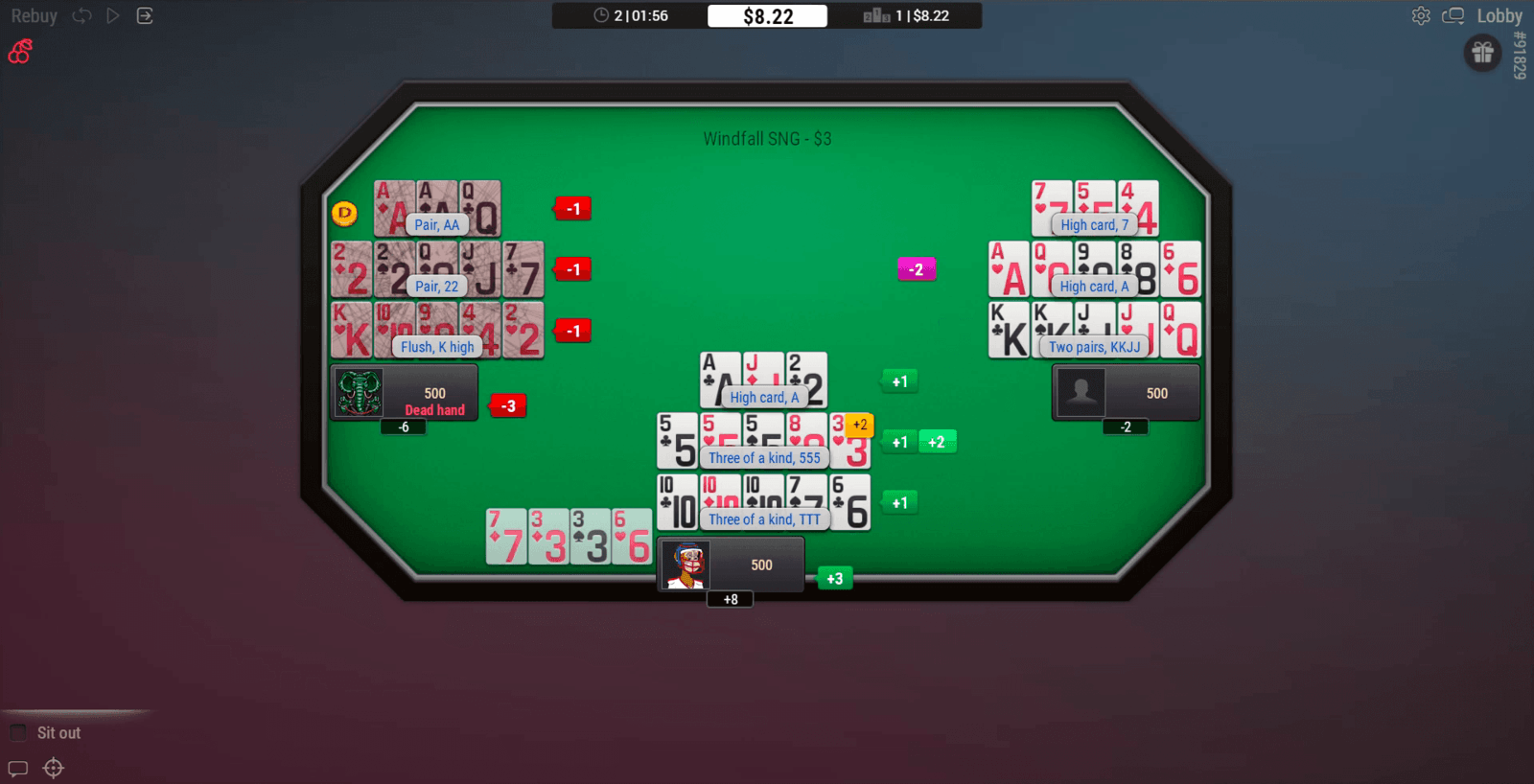
A pair of aces on the front + a pair of twos in the middle = a dead hand and a loss in the hand
The main mistake of beginners is "greed" with the front. Beginning players want to assemble a very strong combination in the three-card row. The other boxes take a back seat. As a result, they can't build decent combinations on the other rows and end up with a dead hand.
Alongside the term "dead hand," poker also uses the concept of "dead man's hand." Its history goes back to the days of the Wild West and is unrelated to Chinese poker.
How to count points and royalties in Pineapple
In Chinese poker, the winner is determined by points, or kushes. The rules provide two sources of points: comparing players' rows and rewards for combinations. Let's take them in order.
Comparing rows. The strongest combination in a row brings the winner 1 kush. Players compare in order: front against front, middle against middle, and back against back. The rules of Chinese Pineapple poker provide for a special order of comparing combinations. At a table with three players, it looks like this:
The player to the left of the button (the first) compares their combination with the next opponent (the second) clockwise.
Then the rows are compared between the first player and the button (the third).
The hand concludes with the comparison of the second and third players' combinations.
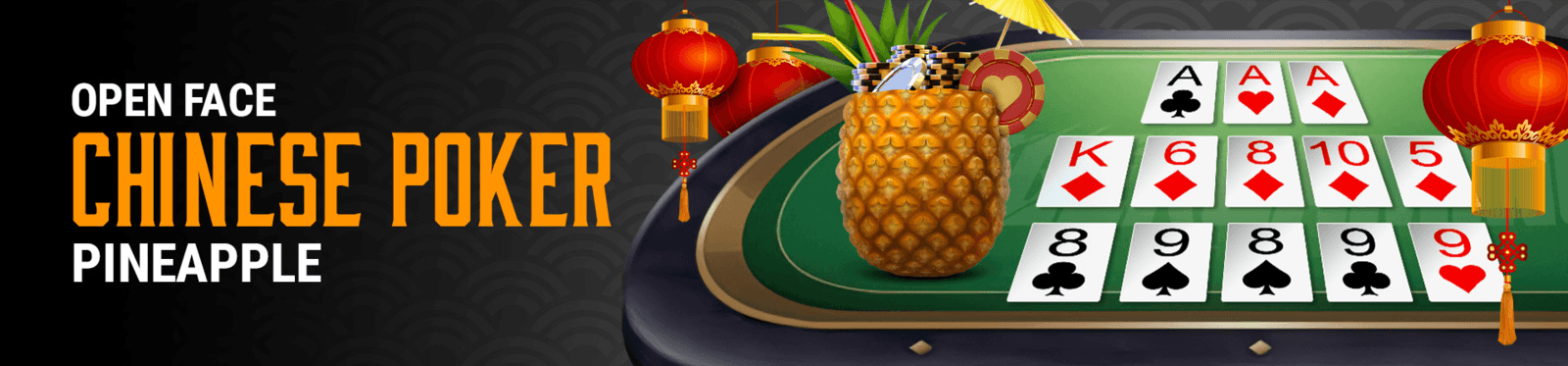
Poker rooms set different rules for playing Pineapple. To avoid unpleasant surprises, study the reward system and other aspects in advance
If a player beats an opponent in every row, they are awarded 3 additional points. In total they receive 6 points. The situation where a player takes the win in all boxes is called a scoop. When combinations in a row are equal, players are awarded no points.
There is no single set of competition rules for Pineapple, so an alternative kush-scoring system is sometimes used. It provides 1 additional point for winning two rows. A total success in three rows doesn't change the picture: the victor takes one point. In total they are awarded 4 points.
When a player makes a mistake and assembles a dead hand, they not only lose the chance to win the hand but also pay 6 points to each opponent.
Royalties. Players receive separate points for specific combinations. For example, for a pair of eights in the top row a player is given 3 points, for a set of sevens in the middle 2, for quads in the bottom 10. Chinese poker uses 2 point-scoring systems: the American and the Russian. The first looks like this:
Box | Combination | Points |
Front | 66 | 1 |
77 | 2 | |
88 | 3 | |
99-AA | 4-9 | |
222 | 10 | |
333 | 11 | |
444 | 12 | |
555-AAA | 13-22 | |
Middle | set | 2 |
straight | 4 | |
flush | 8 | |
full house | 12 | |
quads | 20 | |
straight flush | 30 | |
royal flush | 50 | |
Back | straight | 2 |
flush | 4 | |
full house | 6 | |
quads | 10 | |
straight flush | 15 | |
royal flush | 25 |
No points are awarded for 22-55 in Pineapple. As the rank of the pair in the top row grows, the reward increases by one point. The same rules apply to sets.
The Russian system offers no points for combinations in the front. More modest rewards are also set for the other boxes:
Box | Combination | Points |
Middle | quads | 16 |
straight flush | 20 | |
royal flush | 30 | |
Back | quads | 8 |
straight flush | 10 | |
royal flush | 15 |
For a set, straight, flush, or full house, players don't receive bonus kushes on the middle and back.
Let's go over the order of settlements between players. It's determined by the number of kushes at the start. We'll explain with an example. Suppose Kristen brought 30 kushes to the table, and Alex 50. If Alex won by a margin of 35 points, then Kristen will pay no more than 30 kushes. Her starting stack won't allow her to lose more. In a hand with three participants, the situation is more complex. Kristen may win additional kushes from the third opponent and concede them to Alex.
What is Fantasy and why fight for it
Fantasy gives a player a privileged position in the round. At the start of the hand, a player with Fantasy immediately receives 14 cards. When you know the whole layout, distributing cards across the boxes is much easier. To secure this advantage, you need to fulfill 2 conditions:
assemble a pair of queens or a better combination in the top row;
avoid a dead hand.
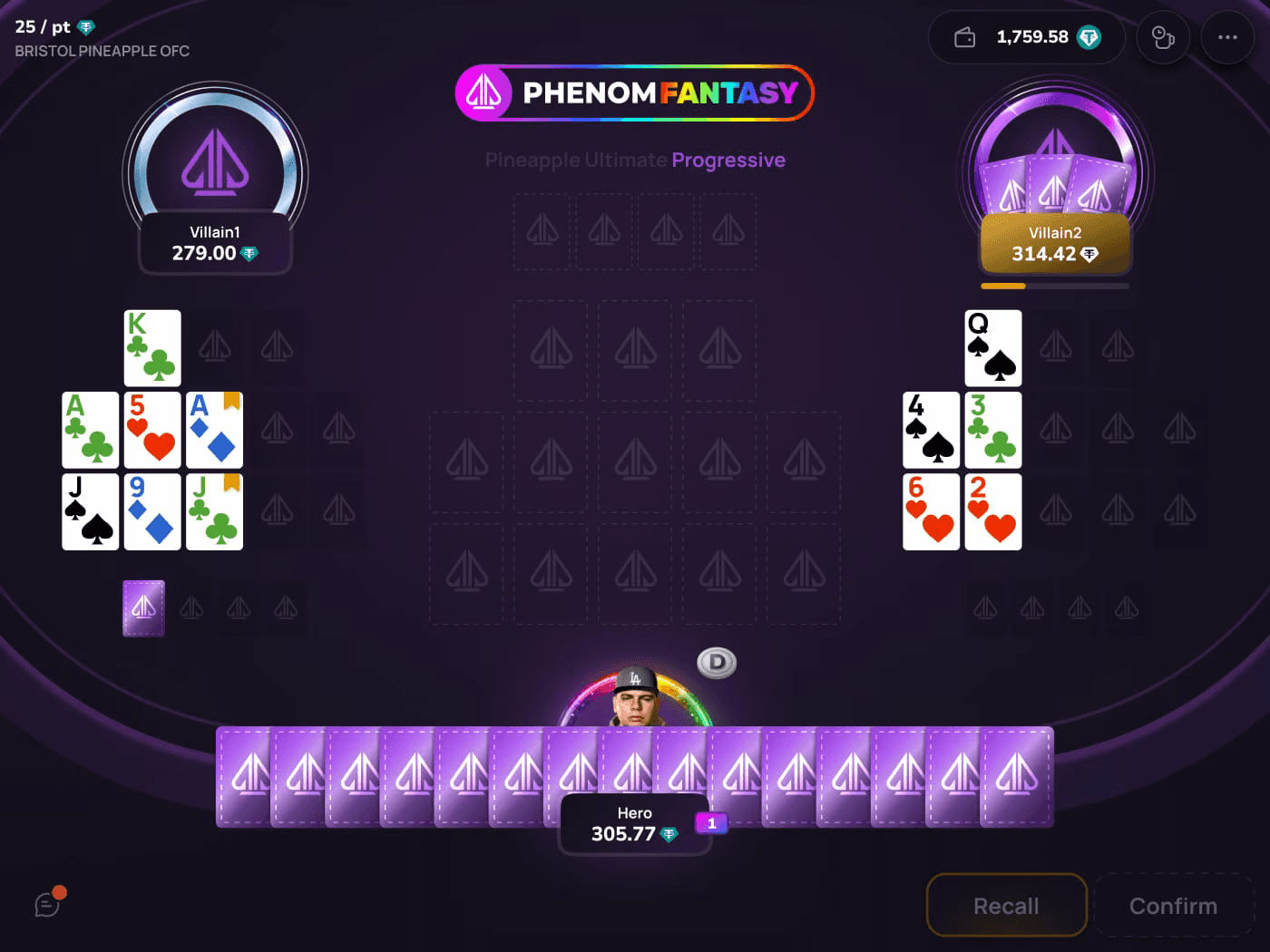
Some platforms modify the rules of Chinese poker. As a result, a player with Fantasy is dealt 15 cards instead of 14
The rules of Chinese poker allow getting two Fantasies in a row. In the second case, higher requirements are placed on the player:
front — set;
middle — full house or a better combination;
back — quads or a better combination.
Fantasy gives a chance to build the strongest combinations in every box. As a result, the player is awarded the maximum royalties.
Varieties of Pineapple
Chinese poker is an umbrella term for several games with similar rules. In classic Pineapple, the hand consists of 5 rounds. In the first, opponents are dealt 5 cards, in the rest 3 each. Let's list other variations of OFC:
Turbo Pineapple. The hand consists of four stages. At each one, opponents receive 4 cards. In the second, third, and fourth rounds, players discard one rank each.
Big Pineapple. A modified version of OFC for two players. In total, opponents are dealt 18 cards each. They must fill 4 boxes. The hand includes 7 rounds. Players' starting hands include 6 cards. From the second to the seventh stage, opponents are given 3 ranks: they use two to build a combination, and pass the third. If an opponent assembles a dead hand, the player is awarded 12 points.
2-7 Pineapple. A game with reversed combination values. The weakest combination wins. The low combination in the middle must include cards no higher than a ten. The combination on the back must be weaker than the front.
Progressive Pineapple. OFC with special Fantasy rules. In ordinary Chinese poker, Fantasy gives a player 14 cards at the start of the first round. In the progressive version, the number of ranks is determined by the strength of the hand in the top row. A pair of queens brings 14 cards, kings 15, aces 16, any set 17. The extra ranks allow earning the maximum number of points for royalties.
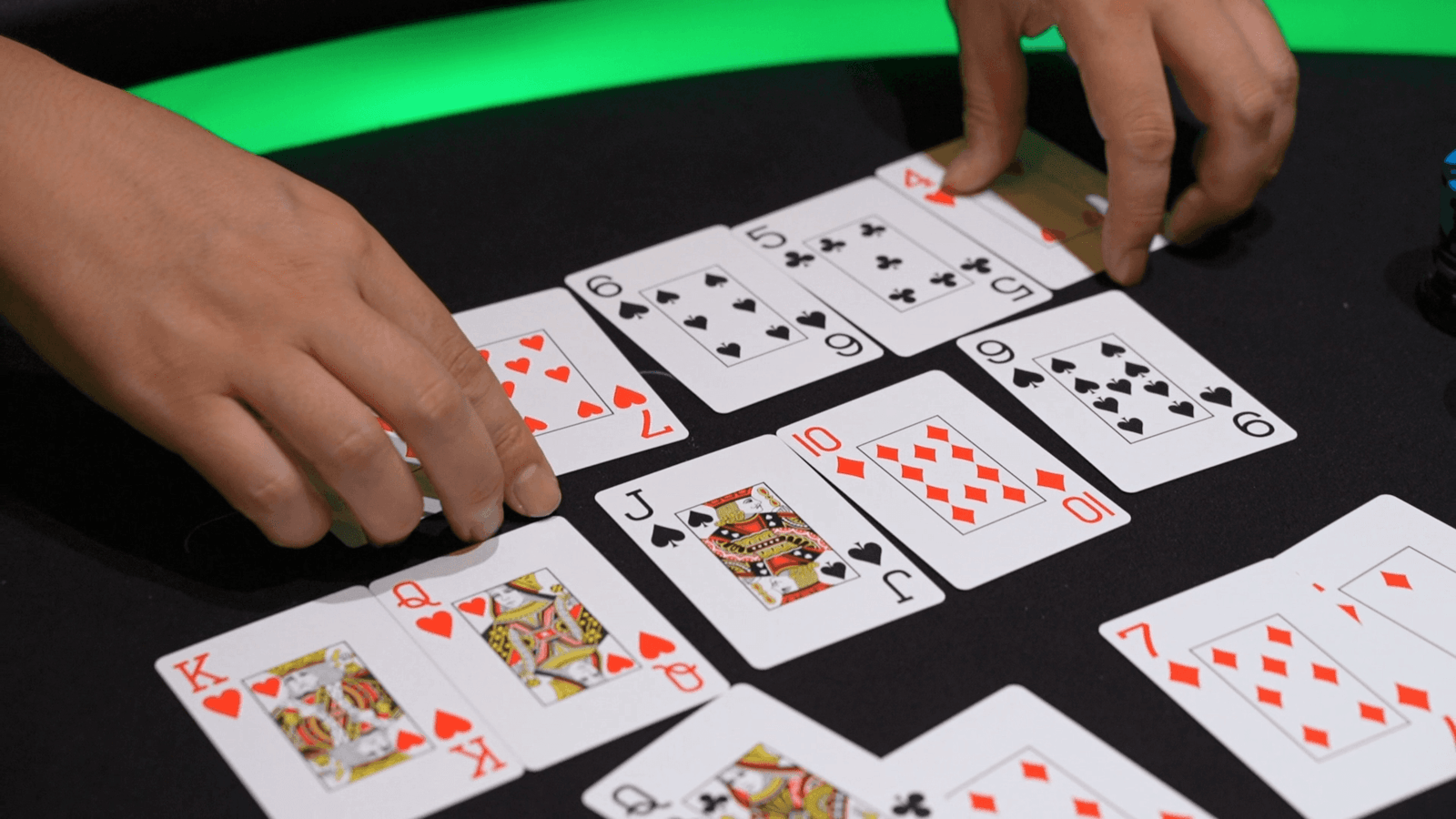
To win at Pineapple, watch your opponents' exposed cards. The faster a player analyzes the situation, the higher their chances of success
Poker rooms also make Pineapple more varied. For example, Pokerdom offers OFC in all disciplines: cash, tournaments, Spin & Go. Each version accumulates new rules.

How to play Pineapple: recommendations
On first acquaintance, Chinese poker doesn't give the impression of a game of skill. In Pineapple you can't make a thin value bet, force an opponent with a weak range out of the pot, or catch an opponent on a bluff. Players receive cards and lay them out across three rows. In such a situation it's hard to gain an advantage over opponents. A deeper dive into OFC changes the picture.
At a Chinese poker table, a player sees an opponent's cards during the hand. Knowledge of math and open information allow you to calculate how the hand will develop. A simple example: by the third round an opponent has assembled a set A♣️A♦️A♠️ on the back and a straight in the middle. They're hoping to catch A♥️ on later streets. We know they won't be able to complete the combination, because we discarded A♥️ in the second round. The rules of Pineapple won't allow the opponent to rebuild their rows — an automatic loss with a dead hand awaits them.
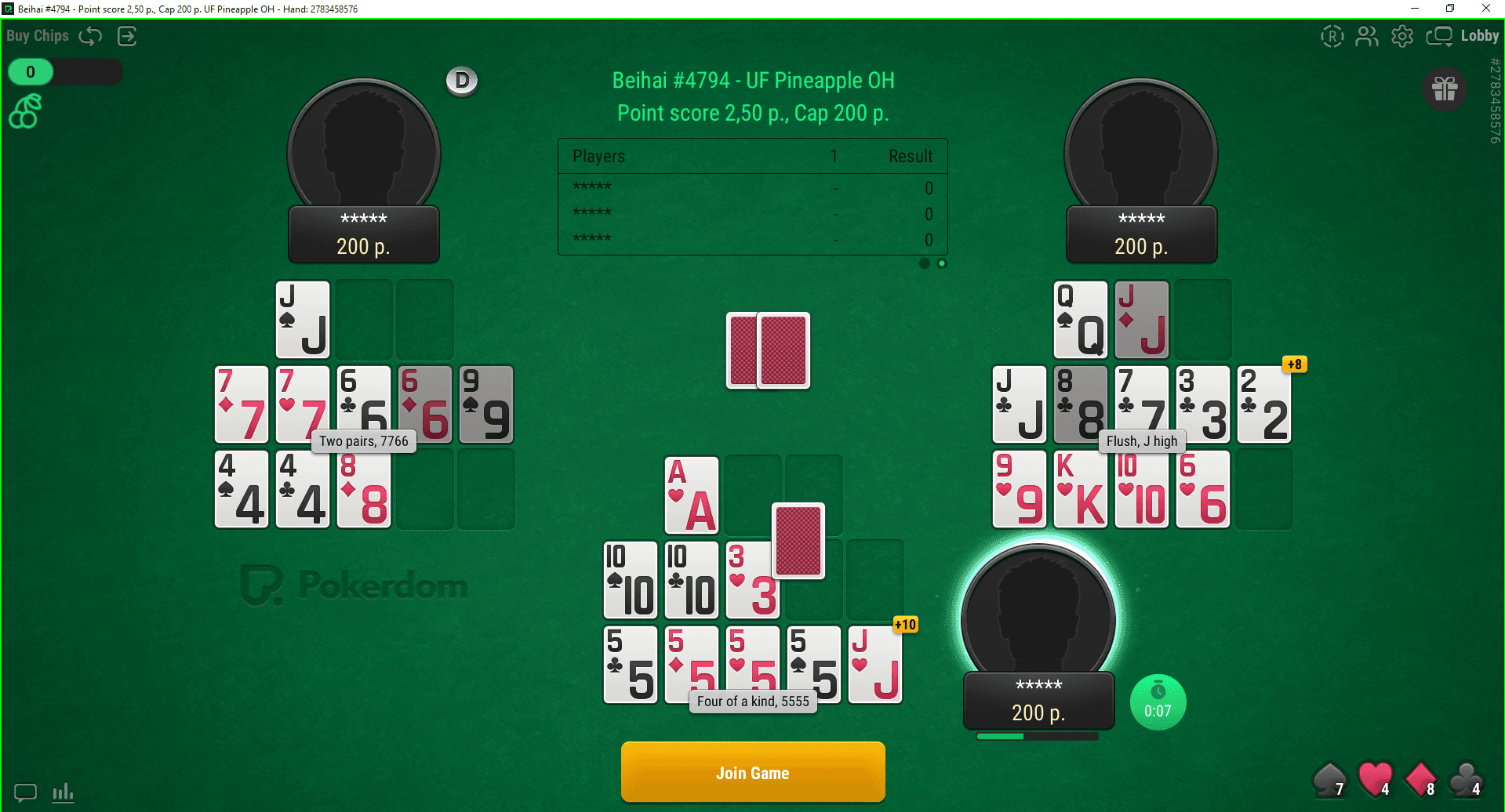
A Chinese poker table on Pokerdom. The points table and suit counter make players' lives easier
The best OFC players pay maximum attention to their opponents' boxes. They track the exposed cards and analyze opponents' potential chances of improving.
When building your own rows, keep the dead hand in mind. Avoid risky situations. Losing one point with a weak front is more profitable than taking an automatic loss and -12 points. Don't miss situations where you can assemble a pair of queens in the top row and catch Fantasy.
Where to play Chinese poker
Pineapple can't be counted among the popular types of poker. The leading platforms of the industry ignore OFC. It's not on: POKEROK, PokerStars, RedStar Poker, PokerKing. But it is offered on:
Room | Discipline |
Pokerdom | cash, tournaments, Spin & Go |
TigerGaming | Spin & Go |
Phenom Poker | cash |
CoinPoker | cash |
KKPoker, ClubGG, PPPoker, PokerBros | cash |
Pokerdom created the most attractive conditions for playing Chinese poker. The Russian room found a place for Pineapple on every tab. Cash players have tables with kushes from 2.5 rubles to 1,000 rubles. In the Windfalls section, players are met by Spin & Go's with buy-ins from 50 to 25,000 rubles. The maximum prize on this tab reaches 5,000,000 rubles. Every day Pokerdom also organizes several Chinese poker MTTs. The schedule also includes freerolls under Pineapple rules. The platform also organizes a separate leaderboard for OFC fans. Every week 50,000 rubles are raffled off.
On TigerGaming, Pineapple was placed in the Windfalls section. You can play tournaments for $3 and $8. If the maximum multiplier comes up, a player receives $4,000. Other platforms organize cash play under Chinese poker rules. However, it doesn't generate much interest from audiences.
Why hold'em is better than OFC
Chinese poker is valued for its original rules and gentle playing conditions. However, you can't build a professional career in Pineapple. OFC isn't on most online poker platforms. Pineapple is also a rare guest at live tournaments. No-limit Texas Hold'em occupies the opposite position. NL Hold'em is the foundational type of poker online and offline.
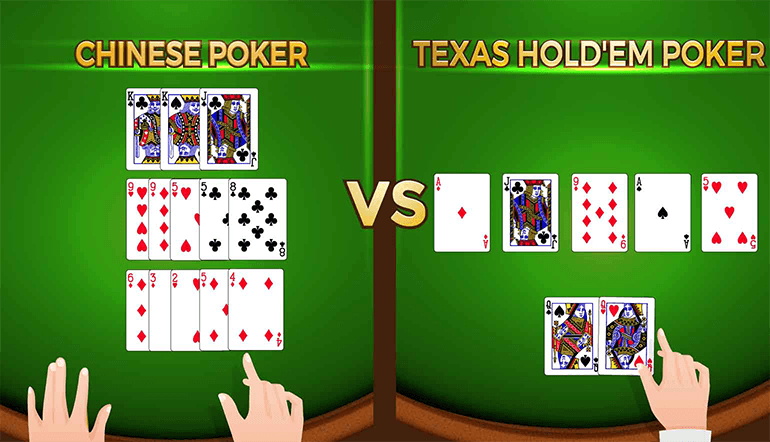
Chinese poker tournaments on the level of the WSOP aren't held. Cash play also lags far behind Texas Hold'em
Hold'em is more popular than all other card games combined. Other factors also speak in favor of NL Hold'em:
Depth of strategy. Texas Hold'em is more complex than Chinese poker. Through training, a player can gain a substantial advantage over opponents. In Pineapple, a player's edge depends on their ability to memorize an opponent's cards and calculate probabilities. Hold'em offers more options to realize an edge over an opponent.
Prize money. Hold'em tournaments award millions of dollars. For example, the WSOP Main Event champion in 2025 took $10,000,000. The leader of the all-time money rankings — Bryn Kenney — has earned over $85,000,000 in poker tournaments. Payouts in Open-face Chinese poker are several orders of magnitude more modest.
Worldwide recognition. The names of top NL Hold'em players are known across the entire industry. Some players even make it into Hollywood films and Katy Perry music videos. The best OFC players aren't recognized even by many Chinese poker fans.
Versatility. Having learned hold'em, you'll easily master Omaha, because the basic principles of playing hands and counting outs are similar. Skills from Pineapple won't help in other types of poker.
Number of study materials. Thousands of books, videos, and articles are devoted to hold'em. Hundreds of programs allow you to hone your NL Hold'em skills. There is less information about OFC and it's harder to find.
To learn how to play no-limit Texas Hold'em, join FunFarm. We recommend that beginners take the FF Start course. It will allow you to lay a solid foundation for a professional career. The trainer will help reinforce the lessons. We accept graduates of the starting program onto the advanced level — FF Player Path. The training takes 8 months. During their studies, players get through the microstakes and reach a monthly income of $1,200 or more.

Free course · FF Start
Understand the logic of MTTs
Study the early stage, the bubble, short stacks and the final table as one system.