How many chips to deal out in poker
The number of chips depends on several factors at once: whether you're playing cash or tournament, how many people are seated at the table, what blinds are used, and how long the playing session should be. Let's take a closer look at all these questions in this article.


Ilya is a Liga 2 player with six years of experience in online MTTs. He graduated from the Faculty of Journalism at RSUH and writes about poker for beginners, explaining complex things in simple, clear language. In his texts, Ilya combines his personal playing experience with his professional journalism skills to help newcomers confidently get into the game.
Almost everyone organizing a home poker game for the first time asks the same question: how many chips should be dealt to each player?
At first glance, the answer seems simple — just split all the chips equally. But after just a few hands, it becomes clear that this isn't enough. Some players run short of small denominations to pay the blinds, others have to constantly change large chips, and the dealer keeps getting distracted by making change instead of running the game.

A properly selected chip set makes the game much more comfortable. Players count bets faster, pots become clearer, and the session itself runs without unnecessary pauses. That said, there's no universal answer. The number of chips depends on several factors at once: whether you're playing cash or a tournament, how many people are at the table, what blinds are used, and how long the session should last.
Let's break down all these questions in more detail in this article.

New breakdowns in your inbox
Subscribe to the FunFarm newsletter: fresh Poker ABC articles and material that helps you grow as a player.
What determines the number of chips
Before buying a poker set or distributing chips among participants, you need to determine the format of the upcoming game. This is exactly what determines how many chips each player will need and which denominations should be more numerous.
There are several main factors.
1. Game format
The most important distinction is cash game vs. tournament. The distribution of denominations for tournaments and cash games will differ noticeably.
In a cash game, each chip has a monetary value. A player can rebuy their stack at almost any moment, and after the session ends, exchange the remaining chips back for money.
In a tournament, it's different. After paying the buy-in, each participant receives an equal starting stack, which is used only within the competition. The value of individual chips doesn't matter — what matters is only their relative size compared to the blinds.
2. Number of players
The more participants gather at the table, the more chips will be needed.
For a group of four people, a set of 300 chips is quite sufficient. If eight or ten participants play regularly, it's better to get a set of at least 500 chips right away. This will allow you to run both cash games and small home tournaments without any problems.
In addition, it's a good idea to have a small reserve. It will come in handy for breaking down large denominations, rebuys in a cash game, or replacing lost chips.
3. Blind structure
The size of the starting stack is always calculated relative to the big blind. For example, if the game starts with blinds of 1/2, a stack of around 200 units is considered classic — this corresponds to 100 BB.
In tournaments, the logic is similar. With a starting stack of 5,000 chips and initial blinds of 25/50, a player starts the competition with a stack of 100 BB, which allows them to comfortably play through all stages of the tournament without having to immediately switch to push/fold play.
*Push/fold is a strategy in which, preflop, a player limits themselves to two actions: pushing (going all-in — betting the entire stack) or folding (discarding the cards). It's used in tournament poker, especially in the later stages, when a player's stack becomes fairly short.
4. Denominations and colors of poker chips
A standard color scheme for poker chips has developed worldwide. It's the one used by most casinos and poker clubs. Even if you only play at home, it's better to stick to these conventions — this makes it easier for players to navigate their stacks and count the size of the pot faster.
The most common scheme looks like this:
Color | Denomination |
White | 1 |
Red | 5 |
Green | 25 |
Black | 100 |
Purple | 500 |
Yellow | 1,000 |
Pink or blue | 5,000–10,000 |
Some amateur sets include additional denominations — for example, 10 or 50. Their color may differ between manufacturers, so before starting the game, it's important to agree on the value of each color.
It's worth noting that there's no strict international standard for home sets. If the whole table already knows the value of each chip in advance, you can use almost any color scheme. However, classic conventions significantly simplify the game, especially if some participants have already played in casinos or poker clubs.
How many chips to distribute in a cash game
In cash games, a simple rule applies: the starting stack is usually around 100 big blinds.
For example:
with blinds of 1/2, a player receives a stack of 200
with blinds of 5/10 — a stack of 1,000
with blinds of 10/20 — a stack of 2,000
However, it's not just the number of chips that matters, but also how they're distributed across denominations. The 40/40/20 rule is considered optimal.
This means that:
about 40% of the stack should be small denominations
another 40% — medium ones
the remaining 20% — large ones
This distribution is considered the most convenient. Small chips are constantly used for paying blinds, small bets, and calls. Medium denominations become the main ones after just a few betting rounds.
Large chips allow you to quickly build big pots and keep a player's stack from turning into an unwieldy tower of a hundred identical chips.
For example, for a starting stack of 1,000, you could use the following structure:
20 chips of 5
16 chips of 25
5 chips of 100
1 chip of denomination 500
Such a stack is easy to count, takes up little space, and suits most home cash games.
How many chips to distribute in a home tournament
In a home tournament, chips are not equal to real money. All participants pay the buy-in and receive an equal starting stack. The game then continues until one player collects all the chips, or until the participants agree on a deal to split the prize pool.
*A deal (chop) is an agreement between the players remaining in the tournament on how to distribute the unplayed prize pool among themselves.
For a standard home tournament, it's convenient to use a starting stack of 3,000 in nominal value. One simple distribution option:
Denomination | Quantity | Total |
25 | 8 | 200 |
100 | 8 | 800 |
500 | 4 | 2,000 |
Total: | 20 chips | 3,000 stack |
Such a stack is easy to count, doesn't take up much space, and doesn't clutter the table with unnecessary chips.
If the tournament starts with blinds of 25/50, then a starting stack of 3,000 gives each player 60 BB. This is a good balance for a home game: participants get enough room to play hands out normally, but the tournament doesn't drag on all day.
If you want to make the game deeper, you can increase the starting stack to 5,000 or 10,000. But it's better to raise the nominal value of the stack rather than the physical number of chips. Otherwise each player will end up with too many small denominations, and counting bets will become inconvenient. For example, for a stack of 10,000, you can add more chips of denomination 1,000 and 5,000, but avoid giving each player 80–100 small chips. In a tournament, it's important for the stack to be readable and for bets to be counted quickly at the table.
Learning at FunFarm, from any level
How many chips in total are needed for a poker game
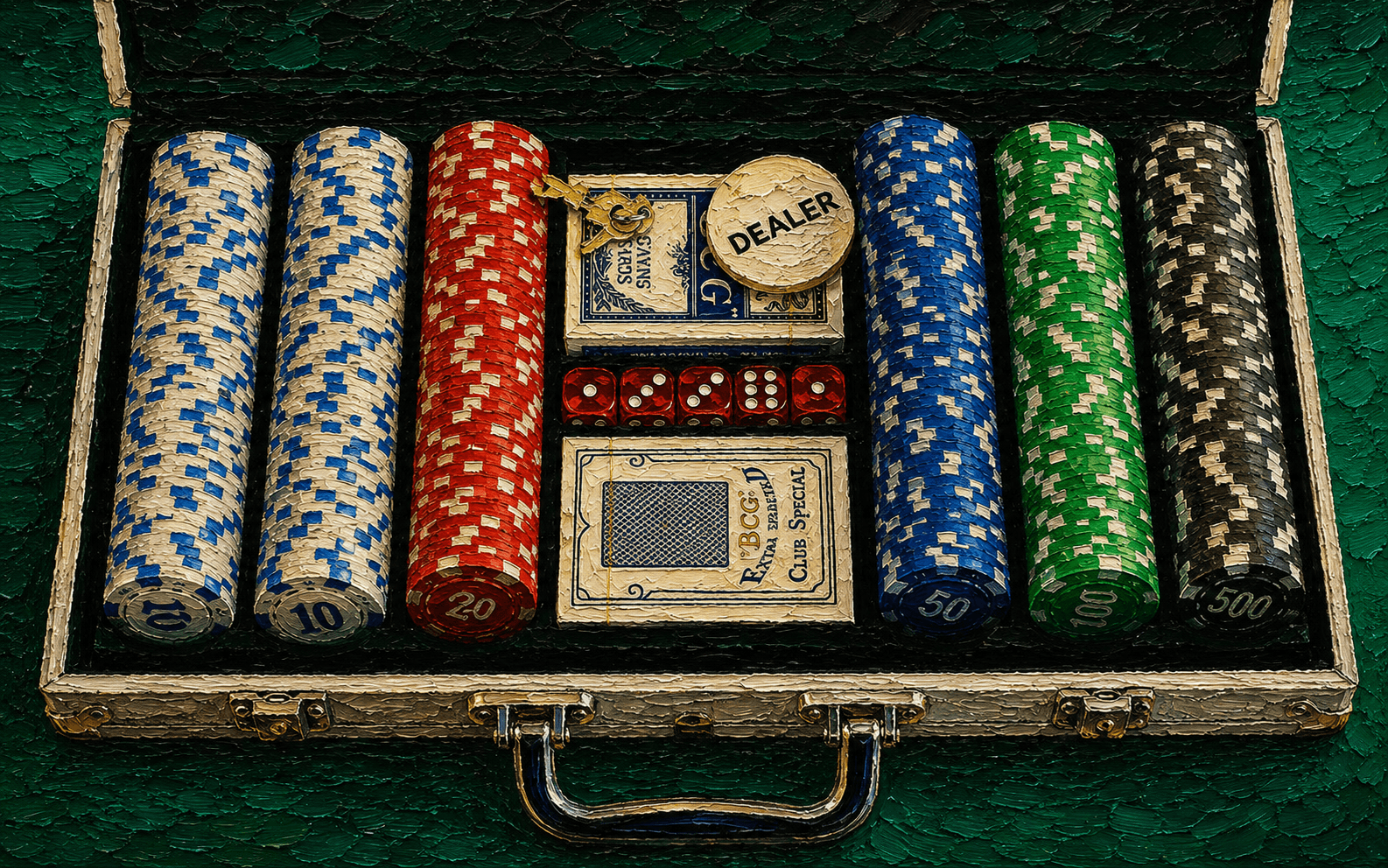
The total number of chips depends on the number of players and the format. For home games, you can use a simple guide:
Number of players | Recommended set |
2–3 players | 100–150 chips |
4–6 players | 300 chips |
7–10 players | 500 chips |
10+ players | 800–1,000 chips |
For a small group of 4–6 people, a set of 300 chips is usually enough. Such a set allows you to comfortably run a cash game or a small tournament without a complex structure.
If 7–10 people regularly gather at the table, it's better to get a set of 500 chips right away. It provides more flexibility: you can use different denominations, keep a reserve for rebuys, and run tournaments with a smooth blind increase.
It's important to keep some chips in reserve. Usually it's enough to leave 20–30% of the set in reserve. These chips will come in handy for rebuys, exchanging denominations, and breaking down large chips during play.
Sets with only three colors are better suited for short heads-up games or a very simple cash session. For a tournament with 4+ people, it's better to use at least four denominations. Otherwise, after just a few blind levels, problems will arise with breaking down and changing small chips.
Changing chip colors
As the blinds increase, small chips gradually lose their significance. For example, if the tournament started with levels of 25/50, chips of 25 are actively needed in the early stages. But when the blinds grow to 200/400 or 500/1,000, the small denomination just gets in the way. At this point, a chip color change is carried out. This procedure is often called a color up.
The idea is simple: small chips are removed from play and replaced with larger denominations. For example, if a player has twenty chips of 25 left, they can be exchanged for one chip of 500. The stack becomes more compact, bets are counted faster, and the table doesn't turn into a set of tall towers of small chips.
It's better to agree on the rules for color changes before the tournament begins. If this isn't done, disputes can arise in the middle of the game: who should round off the remainders, how to exchange an odd number of chips, and who is responsible for making change.
For a home game, a simple rule is enough: when the smallest denomination becomes less than a quarter of the big blind, it can be removed from play.
Which chip set to choose for home use
If you play rarely and gather a small group, you can start with a set of 300 chips. It's suitable for 4–6 players and simple cash games.
If you're planning regular sessions, tournaments, rebuys, or a table of 7–10 people, it's better to buy a set of 500 chips right away. It's more versatile and doesn't limit the structure of the game.
When choosing a set, pay attention not only to the quantity but also to the composition of denominations. A good set should contain enough small and medium chips. These are the ones that will be used most often. Large denominations are needed, but there shouldn't be too many of them. They help build large stacks and carry out color-ups, but they don't replace small chips at the start of the game.

Typical mistakes when distributing chips
The first mistake is distributing too few small denominations. At the start of the game, these are the ones used most often: for blinds, calls, small raises, and making change. If there aren't enough small chips, the game keeps stopping.
The second mistake is distributing too many large chips. For example, if almost the entire stack consists of chips of 100, it becomes inconvenient for players to make raises to 250 or 350. Every pot requires making change, and the pace of the game drops.
The third mistake is starting a tournament with only three colors. This may work in the early levels, but after several blind increases, the structure will become inconvenient. For a proper tournament, it's better to use at least four denominations.
The fourth mistake is not keeping a reserve. If one player wants to make a rebuy, or someone needs to break down a large chip, the organizer has to take chips from other participants. This creates confusion and slows down the game.
The fifth mistake is not agreeing on the value of colors in advance. In home sets, colors sometimes differ from classic standards. That's why, before the first hand, you need to clearly announce how much each chip is worth.
Conclusion
The organizer's main task isn't just to give everyone an equal number of chips, but to make the game comfortable. When denominations are chosen correctly, pots are easy to count, bets go through without pauses, and the home poker night runs smoothly and without unnecessary confusion.
We wish you enjoyable poker home games. And to learn how to make money playing online, apply to FunFarm.

Free course · FF Start
Build your foundation in one course
Hand rankings, terminology and the logic of a hand — without scattered tips or complicated explanations.