Pot-Limit Omaha Rules: 5 Key Differences from Hold'em
No-Limit Texas Hold'em is the leading card game of the past few decades. The industry's biggest live tournaments are played under NL Holdem rules. Hold'em also dominates the lobbies of online rooms. However, other poker variants deserve attention too. Let's discuss the rules of Pot-Limit Omaha. We'll look at the platforms where you can play it.
Ilya is a Liga 2 player with six years of experience in online MTTs. He graduated from the Faculty of Journalism at RSUH and writes about poker for beginners, explaining complex things in simple, clear language. In his texts, Ilya combines his personal playing experience with his professional journalism skills to help newcomers confidently get into the game.
What is Pot Limit Omaha
Pot Limit Omaha, or PLO, is the second most popular card game after No Limit Texas Hold'em. The main feature of Pot Limit Omaha is the number of cards in the starting hand.
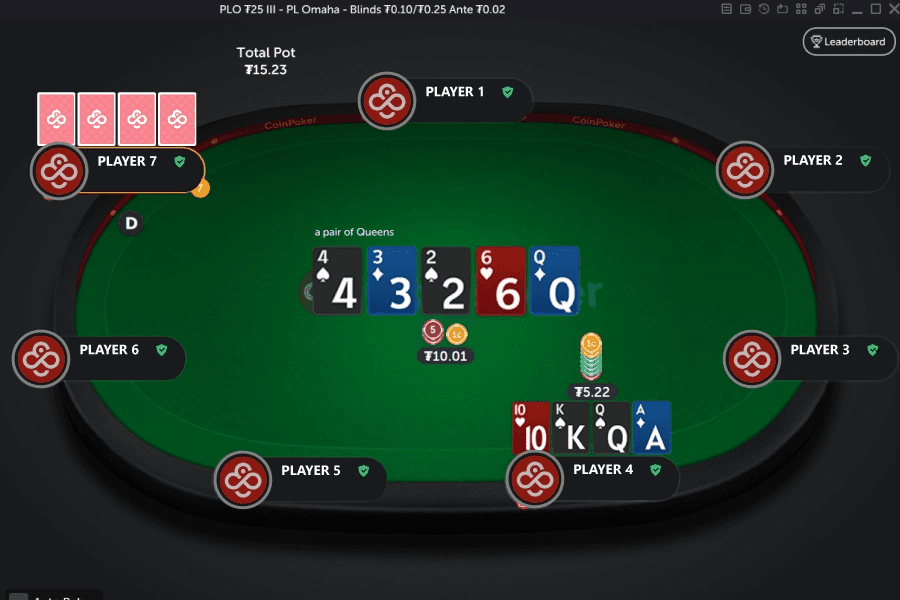
In terms of player numbers, PLO is ahead of seven-card stud, short deck, and other types of poker. Only Texas Hold'em is ahead
While in Hold'em a player receives 2 cards preflop, in Omaha it's 4. The final hand in PLO is made from 5 cards. It includes 2 cards from the starting hand and 3 cards from the community board. For example: a player is dealt the preflop hand JsTs9d8d. The dealer puts As2s6s on the flop. As a result, the player has made the spade flush AsJsTs6s2s. In Omaha, you can't form a final hand any other way. With the hand 7s8s9sTs and the board AdKdQdJdTd, the player's strongest combination would be the straight QdJdTd9s8s. The rules don't allow you to ignore the starting hand and build a royal flush from the community cards.
Omaha poker was invented in the late 1970s in the USA. The first to try the game were patrons of the Golden Nugget casino in Las Vegas. In 1983, PLO tournaments were organized at the Stardust casino. Pot Limit Omaha quickly gained momentum — in 1983, one of the World Series of Poker bracelets was awarded under PLO rules. The trophy and $25,500 were taken by David Sklansky. The 1985 WSOP schedule already included 3 Omaha events. Some experts predicted that PLO would surpass NL Holdem in popularity. Pot Limit Omaha didn't become the industry leader, but it left seven-card stud and draw poker behind.
No Limit Texas Hold'em generates more interest than other poker variations. Its dominance is indicated by the amount of traffic on PokerOK and other industry platforms. The largest poker tournament — the WSOP Main Event — is held under NL Holdem rules. However, PLO has records too. The biggest pot in the history of online poker was played on CoinPoker at an Omaha table in 2022. The winner of the hand — Antanas Guoga — took $7,750,652. The previous records also belong to PLO Poker.

New breakdowns in your inbox
Subscribe to the FunFarm newsletter: fresh Poker ABC articles and material that helps you grow as a player.
What sets PLO apart from NL Holdem
The key difference between Omaha and Hold'em is the rules for forming the final hand. In Omaha, a player makes the best hand from two hole cards and three community cards. In Hold'em, a player uses any 5 cards out of 7. You can take one card from the starting hand and combine it with 4 board cards. The rules also don't prohibit building a hand from just the table cards. PLO rules don't allow that flexibility: the final hand must include 2 cards from the starting hand and 3 from the board.
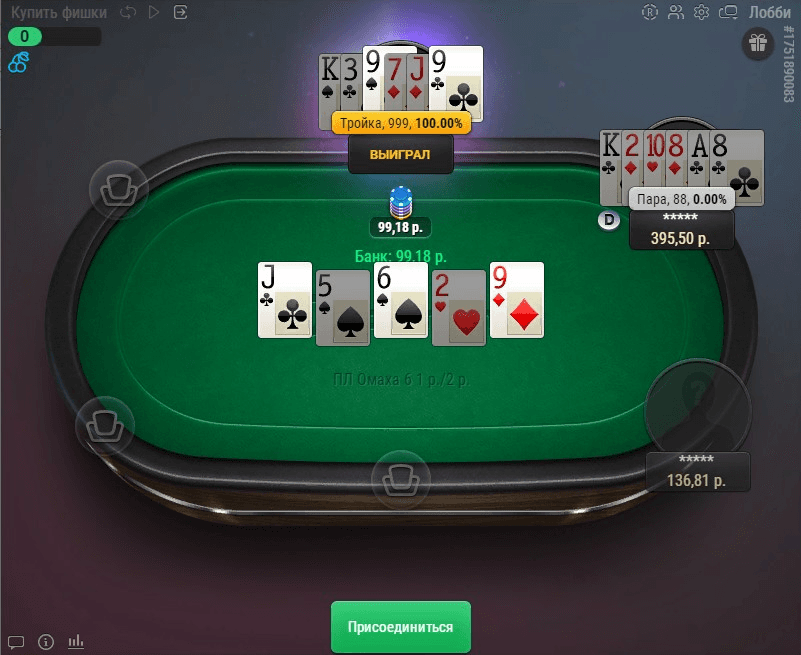
Four cards at the start isn't the limit. In some Omaha variations, players start with 7 cards
Let's look at other differences:
Bet limit. The game's name points to this feature. In Omaha, you can't go all-in at any moment of the hand. The rules don't let you bet more than the pot. Let's show with an example. Suppose a player is last to act on the flop. Preflop, the opponents invested $100. The opponent bet another $75 postflop. The player can raise no more than $250. The limit is determined as: $100 in the pot, $75 — the bet on the flop, and $75 — the cost of a potential call.
Number of starting hands. In Hold'em, you can get 1,326 combinations preflop. Four cards increase the number of starting hands to 270,000. You can't build a simple and clear hand matrix in Pot Limit Omaha. Omaha's rules also affect the mathematical probabilities. In Hold'em, a player hits the flop in 30% of cases. In PLO, any starting hand can catch a flush draw, straight draw, or set.
Variance. No Limit Texas Hold'em is a more predictable game. Pocket AA will beat 22 when all-in preflop 82% of the time. In PLO, you can't get such a significant edge. In most hands, the chances of success will be 60%. Flop favorites regularly give up pots on the river to lucky opponents. That's why a more conservative bankroll is recommended for playing PLO Poker.
Learning materials. Texas Hold'em's advantage over other types of poker is evident in the number of training books and videos. There are significantly fewer courses and manuals on Pot Limit Omaha. PLO players also aren't offered a large selection of training programs. There aren't many calculators, solvers, and trainers for Omaha.
We'll also count the number of weak players among the differences. In terms of traffic, PLO trails NL Holdem, but the percentage of amateurs at Omaha tables is higher. The lineups are especially pleasing in the five-card, six-card, and seven-card variations of Pot-Limit Omaha.
What other types of Omaha are played
The pot limit version of Omaha is the most popular, but there are others. Among them:
PLO5. The starting hand includes 5 hole cards. The rest of the rules match the regular version of Omaha. The final hand is made from two cards of the starting hand and three from the community board. The extra card increases the dynamics of the hand.
PLO6. At the start of the hand, each player is dealt 6 hole cards. There are no other differences from classic PLO.
PLO7. At the start of the hand, players receive 7 hole cards. Due to deck limitations, PLO7 is only played at short 6-max tables. Otherwise, there wouldn't be enough cards for the players.
PLO Hi/Lo. A player's starting hand includes 4 hole cards. Half the pot is won by the strongest hand, half by the weakest. Straights or flushes don't count in the worst hand. For example, 3s4s5d6d7c isn't considered a straight in Omaha Hi-Lo. To make a low, you need cards no higher than an eight. Under Hi/Lo rules, the ace is counted among the weakest cards in the deck. If no one at the table has made a low, then both halves of the pot go to the holder of the best hand.
Courchevel. At the start of the hand, opponents receive 5 hole cards. At the same time, one community card is placed on the table. Then comes a round of betting. If there are still contenders for the pot, two more cards are placed on the board. The rest of the hand proceeds in the standard manner.
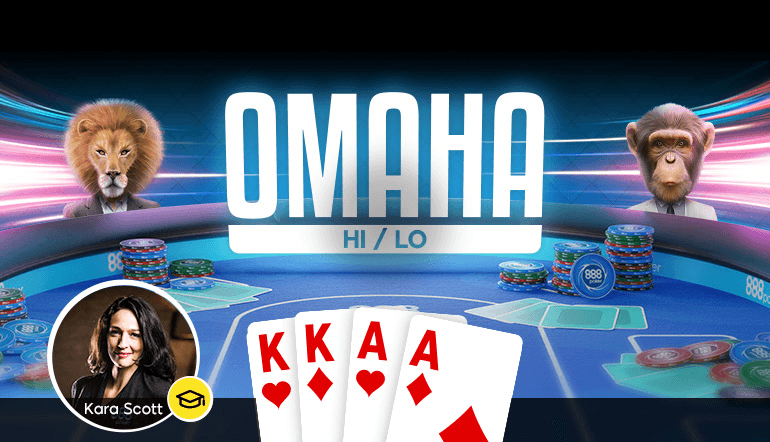
In recent years, rooms have been actively promoting rare types of Omaha
Let's also mention Oklahoma. Its rules match PLO, except for a single detail: after the flop and turn, opponents discard 1 card from the starting hand each.
Learning at FunFarm, from any level
What the hand rankings look like in Omaha poker
No Limit Texas Hold'em and Pot Limit Omaha have the same hand ranking hierarchy. Let's look at each winning PLO hand individually.
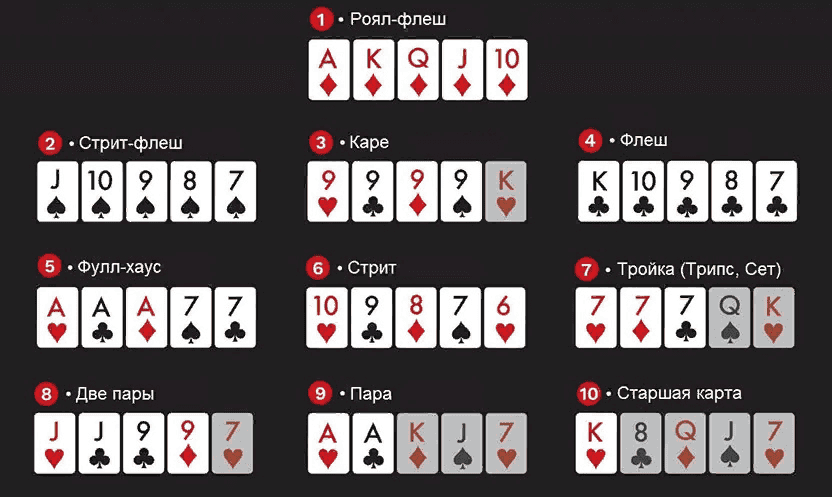
In Omaha, players catch strong hands far more often than in Hold'em. So play more carefully with vulnerable made hands
High card. If no one has even made a pair, the pot goes to the holder of the highest card in their five-card hand. For example, Patrick was dealt AcKhJs9d on the board 5c8dThQs2d. Tom's starting hand is AsJh4c3c. Neither opponent has a made hand, but Patrick will win the hand thanks to the king.
Pair. Two cards of the same rank. Patrick got AsKdTc5h preflop. The dealer put Kh7c9d2s4h on the table. As a result, the player made a pair of kings. In Omaha, you can also get a pair in the starting hand.
Two pair. Two different pairs in one hand. For example, Patrick was dealt AdQd7s2h and the flop 8c8hQs. His hand is two pair, queens and eights.
Set. The hand is formed by three identical cards. For example, the starting hand AhTh9c4d and the board Ts6hTd2cKs give a set of tens.
Straight. Five consecutive cards of different suits. Suppose JsTd7c2h and the board 9c8h4dAsQc form the straight JsTd9c8h7c.
Flush. Five cards of the same suit. For example, the starting hand AcQc7s5h and the flop Kc9c2c form the strongest flush AcKcQc9c2c.
Full house. Combines the features of a set and a pair. Suppose a player was dealt AsQh7c4d preflop. The board came AcQdQs2h5h. The hand and board gave a full house QdQhQsAsAc.
Four of a kind. Four identical cards form quads. For example, the starting hand As5sKd2h and the board 5c5dJs5h8c give quads 5d5c5s5hAs.
Straight flush. A sequence of 5 cards of the same suit. For example, a player got JsQs7d3d preflop. The community board Ts9s8d2hKs was dealt to them. As a result, the player made the straight flush KsQsJsTs9s.
Royal flush. The combination A, K, Q, J, T of the same suit. Suppose the starting hand AhKh2d3d and the board QhJh5s7sTh give a heart royal flush.
In Pot Limit Omaha, hands are made by the same rules as in No Limit Hold'em. However, their value in PLO is lower. While in NL Holdem two pair gives good chances to win, in Pot Limit Omaha they will more often lose to a stronger hand.
How a hand plays out in PLO poker
Up to 9 people play at PLO tables. Before the hand, two players make forced bets: the big and small blind. They encourage opponents to enter the fight for the pot. Without blinds, players would turn poker into a routine where everyone waits for a top starting hand. In the next hand, other players make the forced bets. The dealer serves as the reference point. The blinds move clockwise.
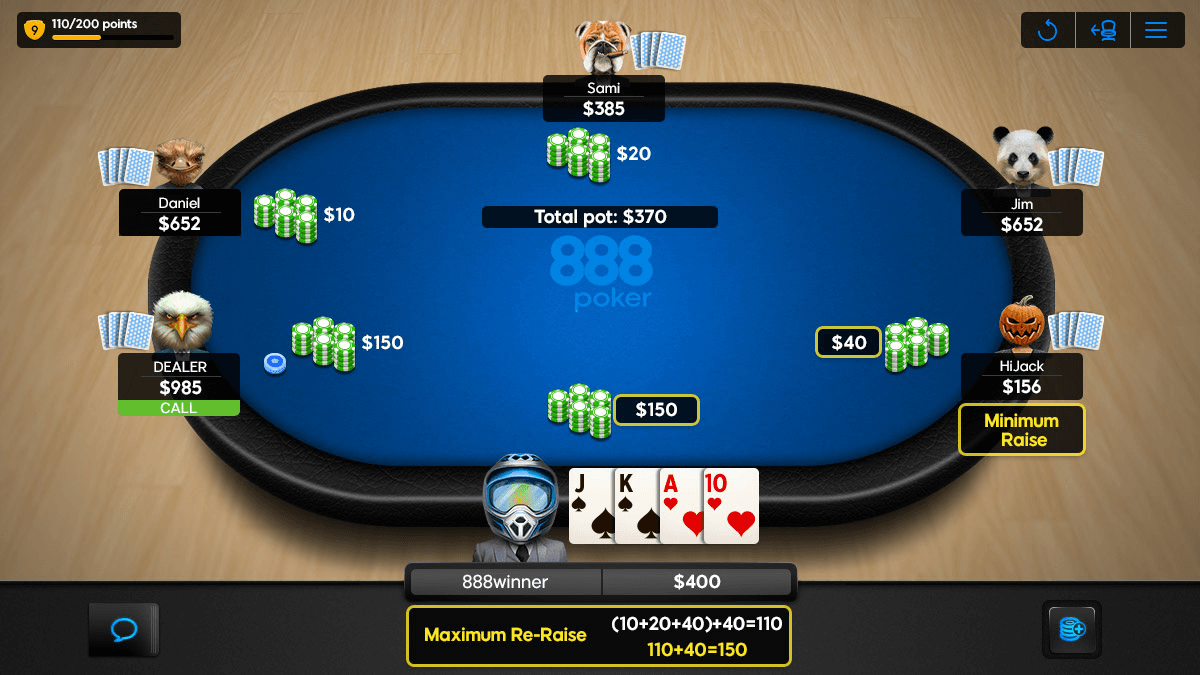
In PLO Poker, going all-in is harder than in NL Holdem
Preflop, players receive starting hands of 4 cards and assess their prospects. With a worthy hand, a player puts money into the pot. Usually players announce a bet, but you can also choose a passive line by calling the big blind. Among the other opponents' options are: raise, call, fold.
If two or more opponents continued the fight for the pot, the game moves to postflop. It includes 3 betting rounds: flop, turn, river. Let's go in order.
Flop. The dealer deals 3 community cards. The participants in the hand assess the strength of their hands and choose between: check and bet. A check lets you continue playing and not put money into the pot. If the first opponent checks and the second bets, then as a response you can: fold, call the bet, or raise.
Turn. The dealer deals the fourth community card. Betting proceeds the same way as on the flop.
River. The dealer deals the fifth community card. Opponents make their final bets and show their final hands. The moment of revealing is called the "showdown." The holder of the best hand takes the pot.
The order of actions in a hand depends on positions. At a 6-max table, they look like this:
UTG. The abbreviation stands for "Under the gun". The player on UTG acts first both preflop and postflop. Therefore, they should play strong hands and not enter the pot with marginal hands. Sometimes UTG is referred to as "Early Position" or EP.
MP. Middle Position. Acts later than UTG, so can widen the range.
CO. Cut-off. One of two late positions. Allows playing weaker hands thanks to having the "last word".
BTN. Button. Acts last. Knows the decisions of all the other opponents at the table. The positional advantage allows playing the widest range.
SB. Small Blind. Forced to put half a big blind into the pot. Postflop always acts first.
BB. Big Blind. Invests the mandatory bet of 1 BB into the pot. Postflop always acts first, except when facing the small blind. If only SB and BB are involved in the hand, then the big blind has the last word.
At a 9-max table, players occupy additional seats at UTG and MP. They are designated as: UTG+1, MP1, and so on.
How to play PLO Poker: basic recommendations
Positions, betting, and hand rankings are the same in Omaha and Hold'em. However, you can't use the same strategy in both games. To win regularly in PLO Poker, you need a different approach. The first important factor is starting hand selection. Top Omaha hands have high chances of catching strong and varied draws. Here's what the top-20 best starting hands in PLO look like:
1-10 | 11-20 |
AAKK | KQJT |
AAJT | KKTT |
AAQQ | KKAQ |
AAJJ | KKAQ |
AATT | KKAJ |
AA99 | KKAT |
AAxx | KKQJ |
JT98 | KKJT |
KKQQ | QQJJ |
KKJJ | QQTT |
Being suited increases a hand's value. The combination AsAdKsKd is valued higher than AsAdKhKc thanks to the potential to make a flush. The more connected the cards are to each other, the better.
To win in Omaha, you need to bluff less. A four-card starting hand hits the board much more often, so opponents fold less to a continuation bet or second barrel. It's wiser to emphasize semi-bluffs with hands that can become a strong combination by the river.
Careful play of weak flushes and straights will also benefit you. In No Limit Hold'em, the win in a hand is often given by relatively weak hands, like top pair. In Omaha, opponents regularly show strong hands at showdown. Seeing several straights, flushes, or full houses at showdown is the norm for PLO. So play weak straights and flushes carefully. Keep in mind that the opponent may have a stronger hand. Control the pot size.
Remember the makeup of your starting hand. If you have two spades, the opponent has fewer chances to build a flush on later streets. The hand AQT9 and the board JQK reduce the probability of opponents having the top straight. Accounting for your own cards helps assess opponents' strength and avoid costly mistakes.
Play aggressively with strong hands and multi-way draws, but show discipline with vulnerable hands. Pots in PLO grow quickly, and mistakes are costly.

Where Pot Limit Omaha tournaments take place
Omaha is the second most popular type of poker. The World Series of Poker 2025 schedule found room for 20 events with different PLO variations. In the largest of them, the winner took a bracelet and $2,292,155. However, not so many Omaha tournaments are held online. Let's look at the most attractive platforms. We've collected brief information in a table.
Room | How many PLO tournaments it holds per day | Buy-in range | Are there separate PLO series |
PokerOK | Over 100 MTTs | From $1 to $1,050 | Yes. Omaholic Series with a $10,000,000 guarantee |
PokerStars | Up to 15 per day | From $1.10 to $16.50 | No |
RedStar Poker | Up to 10 per day | From €1 to €20 | Yes, Omaha Championship with a €200,000 guarantee |
Winamax Poker | Up to 25 per day | From €0 to €250 | No |
Pokerdom | Up to 10 per day | From $0 to $60 | No |
PokerOK. PokerOK pays the most attention to four-card poker. Daily, the room organizes over 100 tournaments under PLO rules. The largest regular MTT awards $4,000. Omaha tournaments are also included in online festivals. For example, in January 2026, PokerOK held Omaholic Bounty with a $500,000 guarantee. Sometimes the room also organizes separate PLO series. For example, in summer 2025, PokerOK held the Omaholic Series festival with a $10,000,000 prize pool.
PokerStars. The former industry leader hardly offers any PLO tournaments. In the daily schedule you can find up to 15 Omaha MTTs. The guarantee of the largest is $500. Many PLO tournaments make it into the WCOOP and SCOOP series schedules. For example, at SCOOP-2025, 45 events were dedicated to Omaha. Among them, we'll highlight a tournament with a $500,000 guarantee and a $5,200 buy-in. PokerStars doesn't organize PLO online festivals.
RedStar Poker. Each day RSP holds about 10 PLO tournaments. Entry to the most expensive costs €20. It awards €1,000. Omaha events also make it into tournament series. For example, in January 2026, the room held the Elite Series XL festival with a €12,500,000 guarantee. Omaha tournaments were also included in its schedule. RedStar Poker also organizes PLO festivals. In 2025, RSP held the Omaha Championship with a €200,000 prize pool.
Winamax. The French room offers 25 tournaments per day. The biggest of them awards €1,500. Within online festivals you can find more substantial events. An example — in January 2026, the room awarded €50,000 in a tournament with a €250 buy-in. Winamax doesn't hold separate Omaha series.
Pokerdom. The Russian room organizes up to 10 PLO tournaments daily. The largest event in the schedule awards about $200. There are also a couple of Omaha freerolls. During tournament series, Pokerdom offers more attractive MTTs. For example, within ROPL a tournament with a $12,500 guarantee was held. The room doesn't organize Omaha festivals.
Why NL Holdem is better than PLO
The main argument in favor of No Limit Texas Hold'em is popularity. Take PokerOK's tournament schedule. Each day the room organizes 1,000 tournaments. Most of them are held under NL Holdem rules. PLO is allotted 10% of the schedule. A similar ratio can be observed in cash too. A Texas Hold'em fan finds it easier to find opponents on any platform.
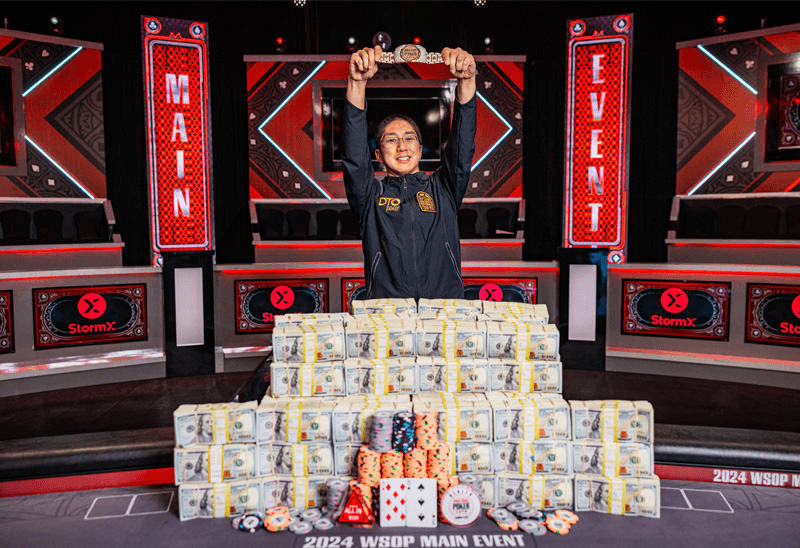
Texas Hold'em offers more opportunities than Omaha
Among NL Holdem's other advantages, we'll note:
Tournament prizes. A clear example is WSOP-2025. The winner of the largest Omaha event earned $2,292,155. The champion of the most important Hold'em tournament took $10,000,000. Online poker rooms offer a similar picture. The gap in prizes is especially noticeable when comparing regular schedule tournaments. Guarantees in Omaha are hundreds of times smaller than in Hold'em.
Variance. In Hold'em, it's easier to survive a stretch of bad luck than in Omaha. Regularly playing for stack with 60:40 odds implies more unpleasant streaks in a negative swing of variance. In NL Holdem, the player has more influence on the result. A stronger bankroll is needed in PLO.
Training. There are more learning materials on Hold'em than on Omaha. Thousands of YouTube videos and hundreds of training programs will help you master NL Holdem. Less attention is paid to PLO.
We recommend beginners start their career in NL Holdem tournaments. The FF Start course will help lay the foundation for future success. It offers: basic tournament strategies, methods for adapting to different opponents, the fundamentals of short stack play. We also cover poker math in the course. A unique trainer will let you reinforce your knowledge in practice.

Free course · FF Start
Find your poker format
Understand how cash games, tournaments and other formats differ — and where a beginner should start.
Frequently asked questions
Read next
Chinese Poker Pineapple: rules, hands, and scoring
What sports poker is and how it works
Types of Poker: Popular Variations, Their Rules and Features