Types of Poker: Popular Variations, Their Rules and Features
Poker is an umbrella term for card games with similar rules. The exact number of variants is hard to count because the game is constantly evolving. The greatest audience interest is drawn by: Texas Hold'em and Omaha. In the past, draw poker and seven-card stud held the leading positions. Let's discuss the popular types of poker.

Ilya is a Liga 2 player with six years of experience in online MTTs. He graduated from the Faculty of Journalism at RSUH and writes about poker for beginners, explaining complex things in simple, clear language. In his texts, Ilya combines his personal playing experience with his professional journalism skills to help newcomers confidently get into the game.
Key facts about poker variants
Texas Hold'em dominates online poker. Over 85% of hands played online are NL Holdem. Other facts about poker variants look like this:
Most games use a 52-card deck.
Online you can play: Hold'em, Omaha, Seven Card Stud, draw poker, Short Deck, Badugi, Pineapple, H.O.R.S.E. and 8-Game.
Games with a community board include: Hold'em, Omaha and Short Deck.
In mixed games, a lot of attention is paid to Stud and its variants.
Simple rules, popularity and a large amount of learning material make Hold'em the best poker option for beginners.
The largest tournaments in the industry are played under NL Holdem rules.

New breakdowns in your inbox
Subscribe to the FunFarm newsletter: fresh Poker ABC articles and material that helps you grow as a player.
How many poker variants exist and how they differ
Let's focus on the most in-demand poker variants. The schedule of the most prestigious live festival — the World Series of Poker — will help gauge interest in the games. In 2025, 100 tournaments were held in Las Vegas. Let's compile the statistics into a table:
Poker variant | Number of tournaments |
No Limit Holdem | 51 |
Omaha | 19 |
Seven Card Stud, Razz | 7 |
Mixed Games | 7 |
Lowball | 5 |
Limit Holdem | 3 |
H.O.R.S.E. | 3 |
Badugi, T.O.R.S.E. and others | 1 each |
No Limit Texas Hold'em leads by a wide margin. Omaha comes second. Among the other variants, we'll highlight: Short Deck, Chinese poker, draw poker, Seven Card Stud, Razz, Badugi, HORSE.
Poker variants are classified by:
Betting rules. In Hold'em, Omaha and Short Deck, players bet on four streets: preflop, flop, turn, river. In five-card poker, betting takes place before and after the draw. In Stud and Razz, opponents bet from the 3rd through the 7th street.
Betting limits. In no-limit versions of poker, you're allowed to invest any amount of money on any street. In pot-limit variants you can't bet more than the pot. The rules of limit games restrict players the most. For example, in Limit Hold'em on preflop and flop you may add no more than one blind. On turn and river you can make a bet of 2 BB. The number of raises is also limited.
Objective of the game. In Hold'em, Omaha and Stud, the pot goes to whoever holds the strongest hand. The rules offer a standard hierarchy from high card up to the royal flush. In Razz, Omaha Hi-Lo, Lowball and several other games, the holder of the worst hand wins.
You can also draw a dividing line by other criteria. For example, by the number of cards in the deck: Texas Hold'em uses the 52-rank variant, Short Deck uses the 36-card one. Poker variants are also distinguished by mechanics: in Pot-Limit Omaha we play against live people, in Oasis — against the croupier in a casino.
Texas Hold'em: the most popular poker variant
Texas Hold'em has dominated the industry since the 1970s. The most important tournament of the year — the WSOP Main Event — is played under NL Holdem rules. The transition of poker to the internet cemented Hold'em's popularity. NL Holdem holds the leading position today as well. To gauge Texas Hold'em's edge over its competitors, let's look at the tournament schedule of the leading online room POKEROK. As of March 2026, 90% of the tournaments in the lobby were played under NL Holdem rules. The cash game section offered comparable statistics, where over 80% of hands were Hold'em.
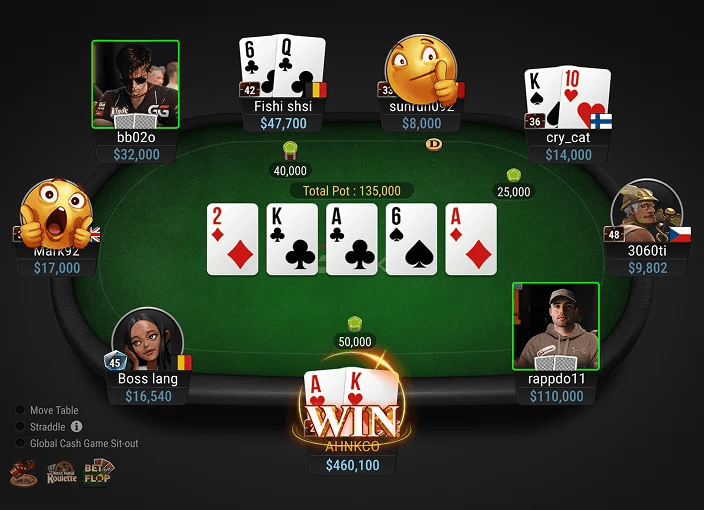
On the POKEROK platform you can play the following poker versions: Texas Hold'em, Omaha and Short Deck
A hand in NL Holdem starts with two forced bets from the players on the small and big blinds. Their contributions encourage entering the pot more often rather than waiting for premium cards. A hand consists of four betting rounds: preflop, flop, turn and river. On the preflop, each player receives two cards. Opponents can: bet, call, raise or fold the hand. If the game reaches the flop, 3 community cards are placed on the board and a second betting round takes place. Later a fourth and fifth card are added to them. The arrival of each rank is accompanied by a new round of betting.
The best position at the table is the button, or BTN. The player on the BTN acts last and knows the other opponents' decisions. The hardest spot is for the player in early position, or UTG. He enters the pot first and has no information about his opponents' actions.
The most popular variant of Texas Hold'em is no-limit. In it a player can risk all their chips at any moment of the hand. At the dawn of online poker, Limit Hold'em enjoyed high interest. The rules of Fixed Limit Hold'em restrict bet and raise sizes. In Pot-Limit Hold'em a player can bet no more than the current size of the pot.
Short Deck
Short-deck poker, or Short Deck, was invented in 2015. The game was presented at the Triton Poker tournament series in 2018. Soon Short Deck, under various names, appeared in the lobbies of PokerStars, RedStar Poker, PokerOK and other rooms.
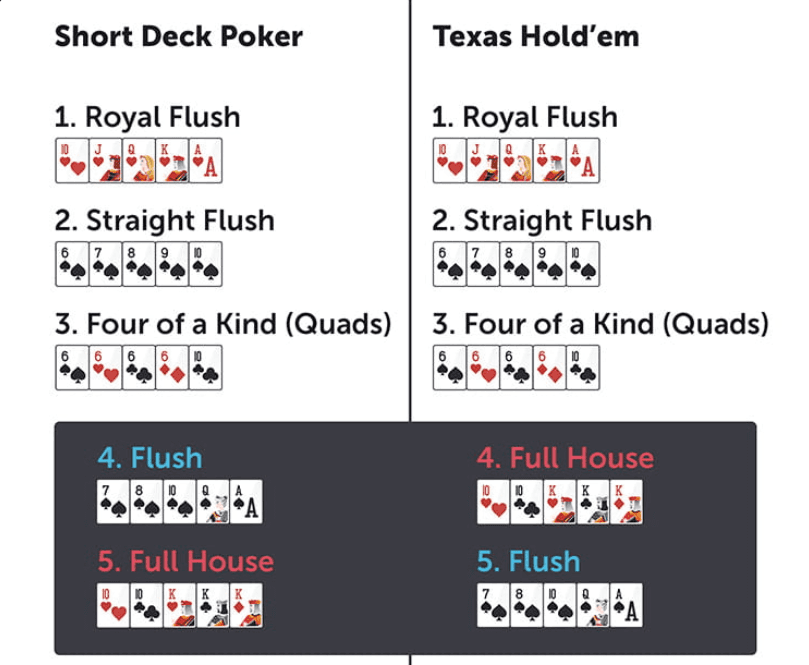
Before you start playing, study the Short Deck rules in the specific room. Platforms apply different approaches when determining the strongest hand
The main difference between Short Deck and Texas Hold'em is the reduced deck of 36 cards. The low ranks were removed from it: deuces, threes, fours and fives. The rules also changed:
A flush became higher than a full house. Reducing the deck cut the number of outs for the single-suited hand and raised its status in the hierarchy.
The lowest straight is formed by different cards. In a full deck the weakest straight consists of A-2-3-4-5. In Short Deck the hand includes A-6-7-8-9.
Blinds were replaced with antes. In short-deck poker, all opponents at the table pay the forced bets. The BTN puts in a double ante.
On some platforms a set is stronger than a straight.
Dropping the low ranks increased the game's dynamics. Players began making strong hands more often. The variance also rose.
Learning at FunFarm, from any level
Omaha — the second most popular poker variant
Omaha was invented in the late 1970s. The game quickly gained popularity: in 1983 it was added to the WSOP schedule. A couple of years later the number of PLO events was increased to three. At WSOP 2025, Omaha poker with all its variants took second place by number of tournaments.
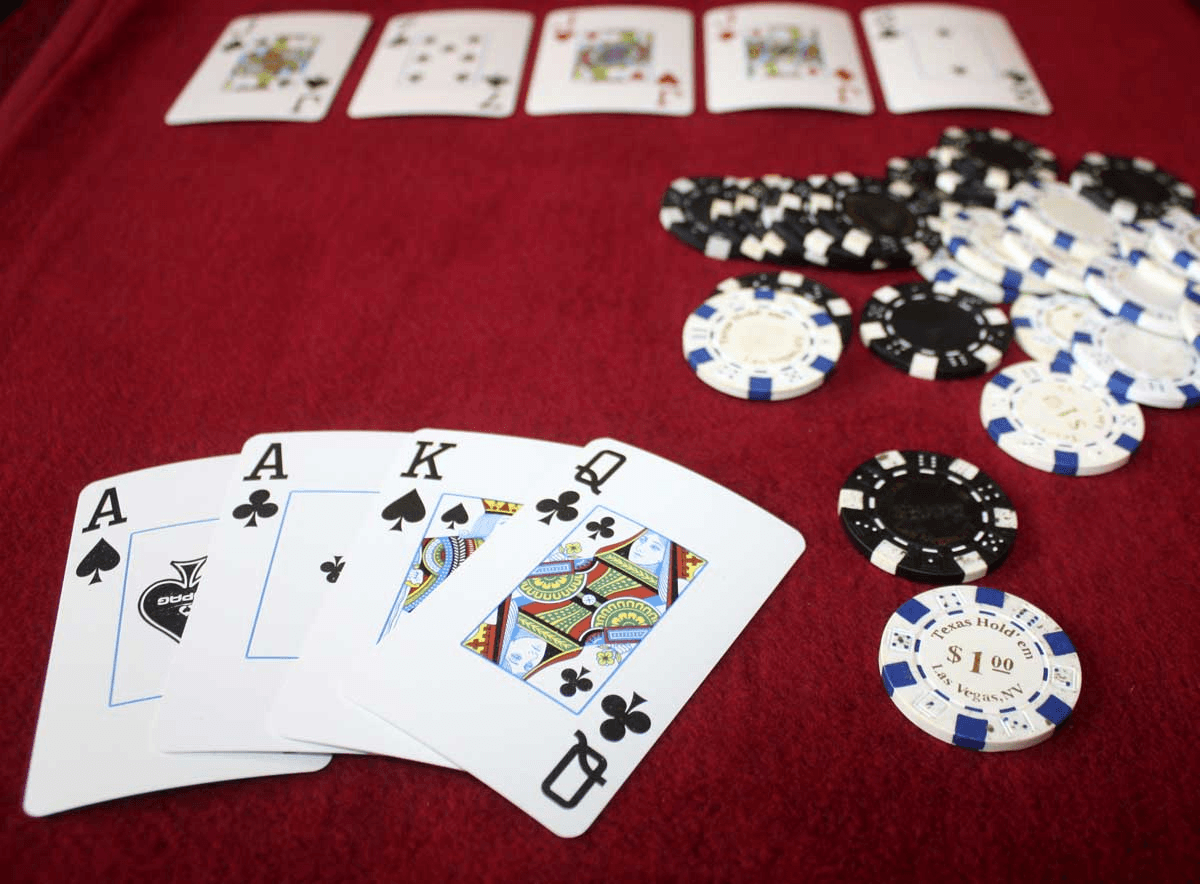
The largest pot in the history of online poker was played out in an Omaha hand: the winner took $7,750,652
PLO differs from NL Holdem in the number of cards in the starting hand. At the Omaha table opponents receive 4 ranks. The second feature of PLO: the rules require that the final hand include two cards of the starting hand and three of the board. You can't build a flush from five suited table cards in Omaha.
Pot-Limit Omaha is the most popular but not the only variant of the game. Let's list the rest:
Five-card Omaha. Its key difference — the starting hand includes five cards. The other rules match PLO.
Six-card Omaha. Players receive six ranks on the preflop.
Omaha Hi-Lo. The holders of the worst and best hands split the pot in half. Straights and flushes are not counted when making the low. That's why A-2-3-4-5 is recognized as the top low hand. The rules of the game allow a player to make the best and worst combination at the same time. Then he wins the entire pot.
Courchevel. On the preflop opponents are dealt 5 cards. The dealer puts one more rank on the table. Then the first betting round starts. The community card on the table lets you better assess the prospects of the hand. On the flop two more ranks are placed on the board. Turn and river follow the classic scenario.
Players don't stop experimenting with Omaha. As a result new poker variants emerge, like Drawmaha.
Stud poker: 7-card Stud and Razz
The peak of Seven Card Stud's popularity fell in the mid-20th century. Its main difference from Texas Hold'em is the absence of a community board. During the hand players receive 7 cards and form their final hand from them. To win at Seven Card Stud, a player must correlate opponents' actions with the exposed ranks.

Online, 7-Card Stud doesn't generate much interest. Stud poker is offered by: PokerKing, Phenom Poker, SWC Poker
In Seven Card Stud there are no blinds: the starting pot is formed from the players' antes. Each participant in the hand is dealt 3 cards: 2 face-down and 1 face-up. The holder of the worst exposed rank makes a forced bet — the bring-in. Betting takes place over five rounds, or streets. In the fourth round players receive one face-up card each. The first to act is the holder of the best combination or the highest rank. He puts in the small bet. In the fifth and sixth rounds opponents are dealt a new face-up card. On the final stage — the river — players receive a face-down card. The first to bet is the player with the strongest hand among the visible ranks.
Several variations of the game exist in parallel. Among them:
Stud Hi-Lo. Half the pot goes to the holder of the best hand, half to the worst. To make a low and claim the bottom part of the pot, you need a hand of cards no higher than an eight.
Razz. The goal of the game is to make the weakest combination. Another difference from Seven Card Stud — the first to bet is the holder of the best exposed rank. In the classic version the opening action belongs to the player with the worst card.
Mississippi Stud. The rules of the game involve skipping betting in the fifth round. On the seventh street opponents are dealt not separate face-down cards but a single community one.
Seven-card poker yielded the lead to Hold'em, but the game with its unique mechanics has many fans. Stud is part of the discipline pool of H.O.R.S.E. and 8-Game.
Draw poker and Lowball
Draw poker dominated before the rise of No Limit Texas Hold'em. The game's main difference from NL Holdem is the absence of community cards. Each player receives a starting hand of 5 face-down ranks. The hand can be improved by exchanging cards during the hand.
Lowball is more popular than classic draw poker
From two to six people play at the table. The starting pot is formed from blinds or antes. Opponents receive 5 face-down cards each. Players assess the strength of the starting hand and bet. If participants remain in the hand, the moment of the draw arrives. The rules allow replacing from one to five ranks. Opponents see the number of cards drawn. Then a final betting round follows. After that comes the showdown, where opponents compare hand strength by classic rules.
In draw poker there's no community board, so guessing about opponents' hands is harder. Clues can be given by: the number of ranks drawn, the level of an opponent's aggression and his reputation.
Let's highlight a few variations of five-card poker:
Lowball. A game with reversed priorities — the hand is won by the worst combination. In Lowball the top combination is considered 2-3-4-5-7. The rules count straights and flushes, so A-2-3-4-5 is not considered the strongest low.
2-7 Triple Draw. A variation of Lowball with three draw rounds.
2-7 Single Draw. A variation of Lowball with one draw round.
Five-card poker provides less room for analysis. The version with classic hand rules is less popular than Lowball.
Badugi
Badugi is a card game with elements of Lowball and Razz. This poker variant was invented in South Korea in the 1980s. PokerStars made the game famous: the room added Badugi poker to its lobby in 2004. Each participant in the hand is dealt a starting hand with four face-down ranks. There's no board with community cards in the game. The winner in Badugi is the holder of the worst possible combination. The best hands include unsuited low ranks. The analog of the royal flush in Badugi is A-2-3-4 of different suits.
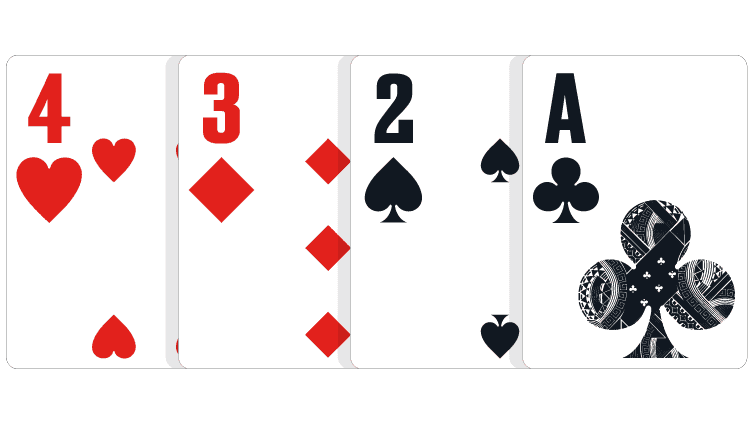
In Badugi poker you can turn the course of the hand around at the very last moment
During the hand players take part in four betting rounds. They are preceded by mandatory bets from the small and big blinds. The rotation of positions in Badugi goes clockwise. The first betting takes place when opponents receive their starting cards. Before the second betting stage players get the opportunity to exchange from one to four ranks. The third and fourth rounds proceed by the scenario of the second. Then opponents show their final hands and determine the winner.
The most popular variant of Badugi involves play with fixed bets. Players can't go all-in at any moment of the hand. To grow the amount in the pot, you have to make systematic bets.
In Badugi there are special rules for comparing hands at showdown. If a player's hand includes suited cards or matching ranks, they are excluded from the hand. In a confrontation between a player with four cards and a player with three cards, the former is automatically recognized as the winner. For example, the hand 2s3d4c5s will lose to AsKdQcJh, because the spade five is removed from the count. When both players have an equal number of cards, their ranks are examined. The loser is the holder of the highest card. If the first ranks are equal, the next ones are examined.

Chinese poker (Open Face Chinese or Pineapple)
Pineapple was invented in the mid-2010s. OFC shares with classic poker: 1) a 52-card deck; 2) the hand hierarchy. In other respects Pineapple more resembles solitaire. In Chinese poker there's no community board. Opponents don't face off directly. You can't take the pot with a bluff. Opponents don't post blinds.
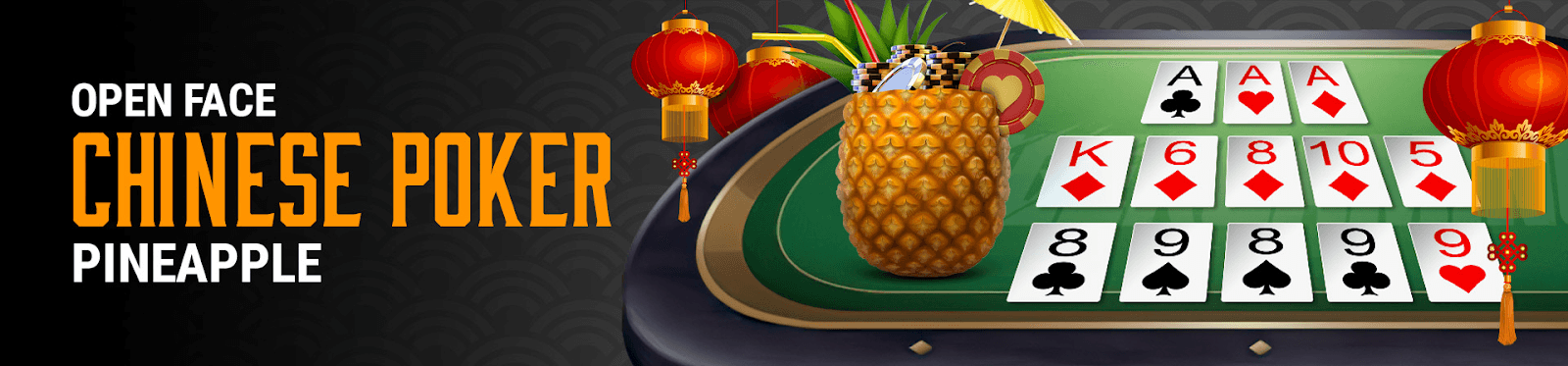
You can play Pineapple on: Pokerdom and Chico Poker
From 2 to 4 people play at the Chinese poker table. Each is dealt 13 cards. The players' task: fill 3 rows with combinations and outscore opponents on points. The first line includes 3 cards, the second and third — 5 each. The strength of the combinations must increase from the first row to the third. If in the first line a player made a pair of 99, then in the second you can't put a combination lower than TT. Violating the rule of increasing combinations leads to an automatic loss.
Points in Pineapple are called royalties. When a player shows the best combination in a row, he is awarded 1 point. Additional points are given for specific combinations. For example: a pair of aces in the top line brings 9 points, a set of kings — 21. For a royal flush in the bottom row you'll be awarded 32 points. The number of points awarded depends on the specific platform.
In parallel with classic Chinese poker there's also Pineapple 2-7. To win it, a player must weaken his combination with each row.
H.O.R.S.E. and mixed games (8-Game)
H.O.R.S.E. and 8-Game are considered the most difficult disciplines. H.O.R.S.E. includes 5 poker variants:
Holdem.
Omaha Hi-Lo.
Razz.
Stud.
Eight or Better Seven Card Stud.
During the game Hold'em, Omaha Hi-Lo, Razz, Stud and Stud Hi-Lo succeed one another. Each discipline is allotted an equal number of hands or amount of time. In recent years the approach of rotating poker variants every 8 hands has dominated. To win at H.O.R.S.E., a player must display a high level of skill in all poker variants. That's why winning a WSOP H.O.R.S.E. tournament is very prestigious.

At recent WSOPs more than 10% of the schedule is devoted to mixed games
8-Game demands more versatility from a player, because in it 8 poker variants succeed one another:
Lowball.
Limit Hold'em.
Omaha Hi-Lo.
Razz.
Seven Card Stud.
Seven Card Stud Hi-Lo.
No Limit Hold'em.
Pot-Limit Omaha.
Mixed games gained momentum gradually. The first HORSE poker tournament at the WSOP was held in 2003. It was won by Doyle Brunson. In pursuit of variety, players came up with T.O.R.S.E., where Hold'em was replaced with 2-7 Triple Draw. The next step toward versatility was 8-Game. The industry didn't stop at eight games, so the Dealer's Choice format was invented. In it the player on the button determines which poker variant the hand will be played under. In the next hand a different game can be chosen. The whole assortment includes 20 poker variants.
Comparison table of all poker variants
Let's combine the key information about poker variants into a table:
Variant | Cards in hand | Community cards | Betting limit | Objective of the game | Rule complexity |
Texas Hold'em | 2 | 5 | no-limit, pot-limit, limit | make the best hand | ★ |
Short Deck | 2 | 5 | no-limit | make the best hand | ★★ |
Omaha | 4-7 | 5 | pot-limit | make the best hand | ★★★ |
Seven Card Stud | 7: 3 face-down, 4 face-up | none | limit | make the best hand | ★★★★ |
Razz | 7: 3 face-down, 4 face-up | none | limit | make the worst hand | ★★★★ |
Draw poker | 5 | none | no-limit, limit | make the best hand | ★ |
Lowball | 5 | none | no-limit, limit | make the worst hand | ★★ |
Badugi | 4 | none | limit | make the worst hand | ★★★★ |
Chinese poker | 13 | none | royalties | build the best lines | ★★★ |
H.O.R.S.E. | from 2 to 7 | 5 or none | limit | Depends on the discipline | ★★★★★ |
Where to start: which poker variant a beginner should choose
We recommend starting your acquaintance with poker via No Limit Texas Hold'em. NL Holdem is easier to master than the other card games. The amount of learning material also speaks in Hold'em's favor. Thousands of videos and hundreds of books are devoted to it. We also can't discount NL Holdem's popularity online. The game is offered by every room in the industry. Many platforms organize free tournaments with cash prizes.
When you reach a high level in Texas Hold'em, you can turn your attention to Pot-Limit Omaha. PLO is more difficult than NL Holdem due to: four cards in the starting hand and high variance. A clear example: in Hold'em on the preflop a player can get 1,326 combinations, in Omaha — over 270,000. Let's also factor in the discipline's breadth. Omaha combines several games: pot-limit, five-card, six-card, Hi-Lo, Drawmaha, Courchevel. Each variant has its own features.

Omaha poker is more difficult than Hold'em, so we don't recommend starting with it
Fans of mixed games should master Seven Card Stud. In H.O.R.S.E. 60% of hands are played in Stud and its variations. Seven Card Stud skills will also be useful in 8-Game. Stud differs greatly from Hold'em, which complicates learning. There's no community board in the game. Betting also proceeds by a different scenario. The minimal amount of learning material speaks against Stud.
The FF Start training course will help you take your first steps in tournament poker. It consists of 30 lessons and includes key topics: poker math, adapting to different types of opponents, short-stack strategy and final-table strategy. A trainer lets you hone your skills in practice. An exam wraps up the training. We invite graduates to the next level in FF Player Path.

Free course · FF Start
Master tournament poker
Understand tournament structure, stages of play, stack sizes and the key decisions.