Poker Variance: The Math Behind "Bad Luck
Almost every player has a moment when poker stops feeling like a set of rules and starts being perceived as a profession. We begin to play with discipline, get to grips with the logic of betting, optimal playing strategies, and expect that the quality of our decisions will fairly quickly turn into a clear financial result.

Ilya is a Liga 2 player with six years of experience in online MTTs. He graduated from the Faculty of Journalism at RSUH and writes about poker for beginners, explaining complex things in simple, clear language. In his texts, Ilya combines his personal playing experience with his professional journalism skills to help newcomers confidently get into the game.
This is exactly where poker usually reveals its main feature: even correct decisions don't always turn into money in your account. We can play an excellent session in terms of decisions and still not earn anything, but we can also make mistakes — and still be in the green over a short stretch. In poker, this difference between expectation and reality is called "variance."
In this article, we'll break down:
what variance is and why it's inevitable
how variance relates to the term downswing
which factors amplify or soften the swings of variance
what to pay attention to in order to reduce the impact of variance
And most importantly: we'll frame the takeaways so that variance is perceived as an inseparable part of the game, rather than something that frightens and demotivates.
What variance in poker is, in plain words
Variance in poker is the deviation of actual results from mathematical expectation. To put it more simply: it's the difference between how much we should earn on average given our level of play, and how much we actually earn over a specific stretch of the long run.
A simple example that captures the mechanics
Imagine a situation: we regularly get it in with a 60% edge. By EV, this is a good scenario: over a large sample, we should win more than we lose. But over a short stretch — for example, 20 all-ins — we can:
win 16 out of 20 — a result above EV
win 12 out of 20 — roughly on EV
win 8 out of 20 — a result below EV
And all of these outcomes are statistically possible, they just have different probabilities.
* EV (Expected Value) is a mathematical assessment of the expected profitability or unprofitability of a particular action or decision in a specific game situation.
* Getting it in in poker is when two or more players have put all their chips in the pot and shown their cards.
It's important to nail down a few fundamental points right away.
First, variance works in both directions. It can manifest both as negative deviations — prolonged stretches of losing play — and as positive ones — when results temporarily turn out better than we deserve.
Second, variance says nothing about the quality of decisions over a short horizon. We can play correctly and lose, and we can play with mistakes and win. This isn't a contradiction, but a direct consequence of the probabilistic nature of the game.
And third, variance is a fundamental property of the game, without which poker couldn't exist and bring income to professional players. If you imagine poker without variance, the result of every decision would be determined — like in chess. Stronger players would steadily and quickly take money from weaker ones without any deviations. In such an environment, amateurs would have no chance of success, no hope of winning, and no motivation to come back to the table. The poker economy would simply grind to a halt.
That's why the correct conclusion sounds like this: variance isn't always pleasant, but it's necessary. It's precisely what makes the existence of the game, the inflow of amateurs, and the long-term profit of strong players possible.
Variance calculator in poker
The main problem for beginners and even many experienced players isn't variance itself, but the inability to accept this factor as part of the game and the profession.
We tend to think like this: "If I play correctly, then my results should be stable too." In practice, this isn't the case — especially in tournament poker. Even with a positive ROI, long stretches are possible where the result will be zero or negative.
To make this clearer, it's useful to look not at individual sessions, but at the probability ranges of results over the long run.
For this, the poker world has variance calculators, which help players take a more realistic look at the likely scenarios for their career.
Let's examine the situation with a concrete example.
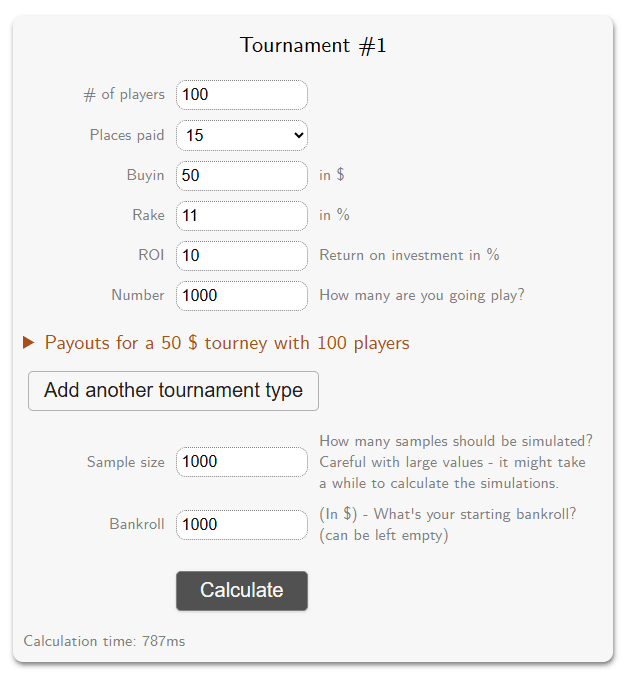
The first row is Number of players: here we specify the total number of participants who took part in the tournament. Usually this is the average number of participants in tournaments of all the formats we play. Let's put a value of 1500 people in this cell.
A bit lower is Places paid. This is the number of paid places paid out to players in the tournament. Usually this value ranges from 16 to 20%. Let's take 18% — something in the middle.
You can find the payout structure in the lobby by dividing the number of paid places by the total number of entries.
Next is Buy-in: the cost of entering the tournament. Note that we specify the buy-in separately from the rake. You can find out the exact rake amount in the tournament lobby — just like the buy-in. Let's say, for tournaments with a 5.50 buy-in, we put 5 in this row and 0.5 in the rake row.
Next comes ROI. This is the profitability of play: how much money you expect to receive for every dollar you invest in the game. On average, for microstakes, an ROI of around 20% would be considered decent. Naturally, some will show better profitability, some worse, but let's take 20% as an example.
Even lower, we specify the long run (Numbers) we want to calculate. Let's try to estimate what will happen to us using a one-year stretch as an example. We'll base it on the play volume of FunFarm players — on average that's 400 tournaments per month. We enter a value of 4800 tournaments in the row.
A bit lower we specify the sample size, that is, how many times the calculator should run a simulation of these tournaments to give a final result. The bigger, the better. Let's do 20,000 simulations.
We click Calculate — and below we see the result.
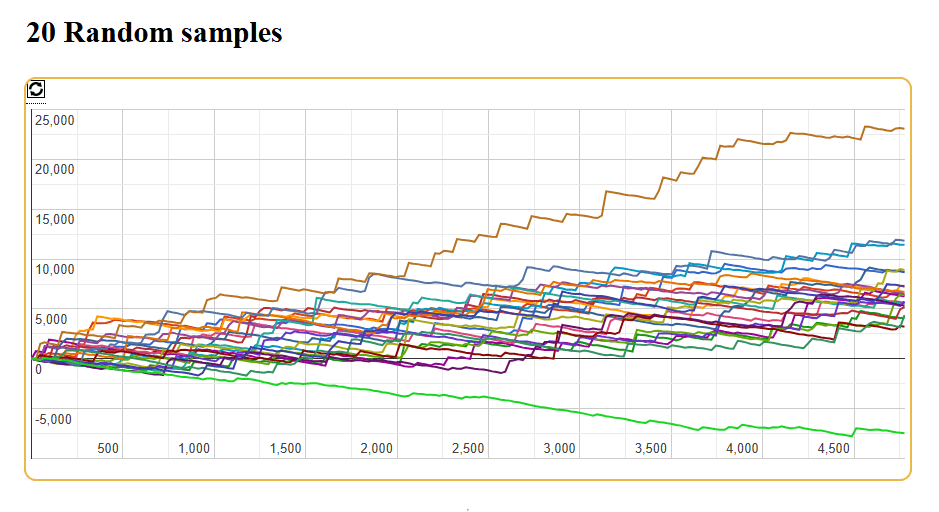
Here a distribution graph is shown, where the X-axis indicates results, and the Y-axis indicates probabilities.
We see that most scenarios are above zero, but in one of the cases we'll play the year at a loss, i.e. most likely we'll earn on average about $5,000 over the year, in the best case — about $25,000, and in the worst — about -$5,000.
Learning at FunFarm, from any level
How to reduce the impact of variance in practice
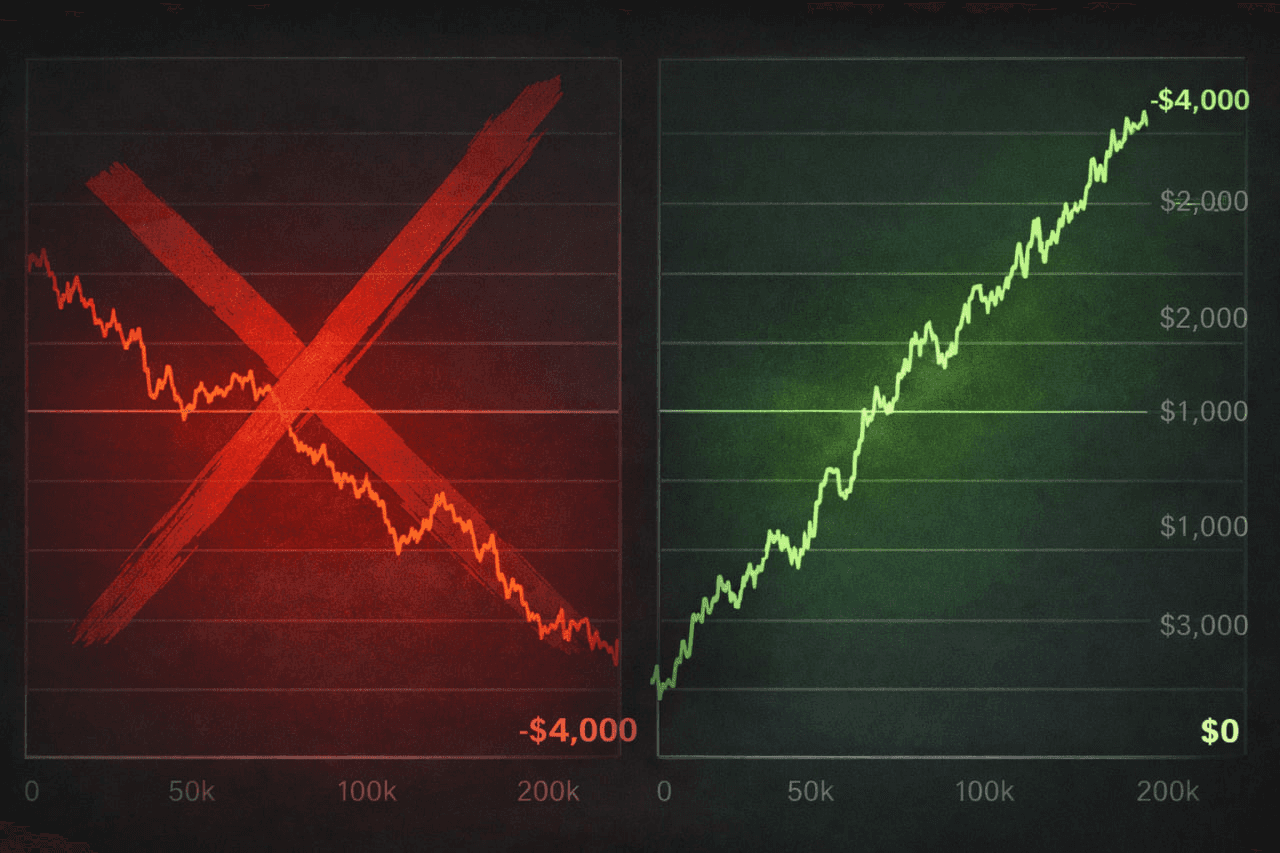
When we talk about variance, we usually describe a statistical phenomenon — the result deviates from expectation.
But in actual play, variance is felt not as a formula, but as a downswing — a period when the final results are consistently worse than we're used to seeing or than our EV suggests.
What a downswing in poker is
A downswing is a stretch of the long run over which we register a series of weak results: losing sessions, no deep runs, frequent busts, a prolonged plateau without any noticeable gains.
It's important to understand the connection between the terms: variance is the statistical spread of results around expectation, a downswing is the practical manifestation of this spread in the negative direction over a specific stretch.
At the same time, a downswing isn't always pure variance. It can consist of two components: bad luck and normal swings and/or a dip in the quality of play — fatigue, tilt, mistakes, poor tournament selection, a mismatch between the stakes and your level.
If we want to reduce the impact of variance, our task is to build a system that helps us get through any normal swings, prevents a decline in play from amplifying the downswing, and preserves EV and bankroll. Below are practical measures that solve this task.
1. Improve the quality of play
The higher our real ROI, the narrower the range of possible negative deviations. Even a small improvement in expectation significantly reduces the probability of deep and prolonged losing periods.
Let's take the scenarios from the previous block as an example, but instead of an ROI of 20, let's set an ROI of 30.
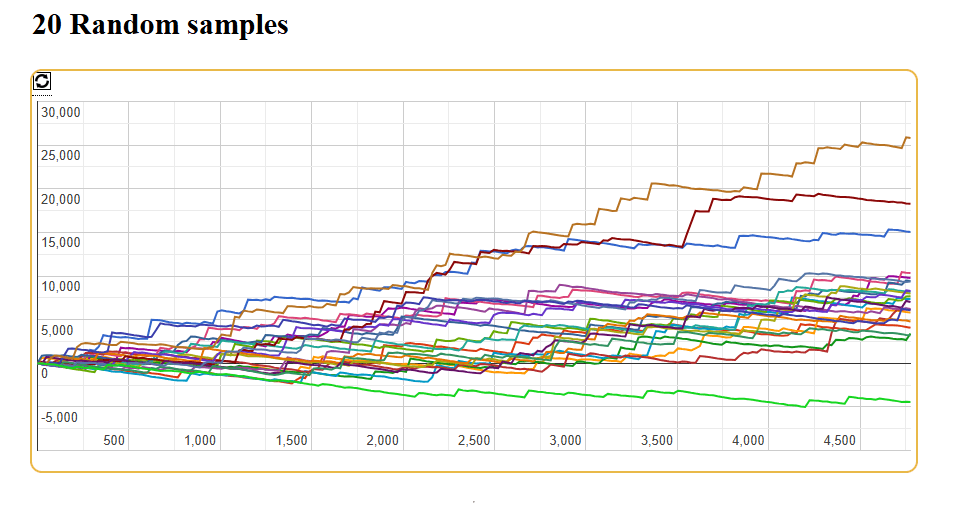
As we can see, the average expectation has risen above $5,000, more scenarios have appeared in the range between $5,000 and $25,000, and the worst of them has gotten closer to $0.
Conclusion: the most important thing isn't what result your actions lead to, but how correct they are.
2. Adjust expectations
The first step isn't motivational, but managerial: we acknowledge in advance that in tournament poker, long losing stretches are possible even with a positive ROI.
Why is this critical?
if we expect steady and "fair" growth, any loss is perceived as an alarm signal
if we expect the possibility of a downswing, losing periods become a reason to check our game processes rather than an emotional reaction
The practical point of acceptance isn't to resign ourselves, but to not make decisions on emotion — not to change strategy chaotically, not to jump around in stakes, not to increase volume in an attempt to beat variance.
3. Separate variance from poor-quality play
This is the central diagnostic block. A downswing is dangerous not in itself, but in that we often start playing more cautiously and lose EV, try to win it back, switch our tournament schedule to a riskier one, and accordingly drop in quality of play and emotional stability.
We need a sober audit. What do we check first?
Signs that we're dealing with variance:
it feels like we're playing as usual, without any decline in discipline
decisions in standard spots stay the same
the problems are mainly in realization: all-ins, coolers, no big scores.
Signs that we're dealing with a dip in play:
we play tired more often, extend sessions
the number of impulsive decisions has increased
a desire to win it back or not to lose has appeared
The best format of work at this stage is reviewing the database on your own or with a coach. It's important to look at where we lost EV in typical lines, whether our ranges have changed, whether the quality of postflop and late stages has dropped, and whether our tournament selection has gotten worse.
4. Rebuild the tournament schedule
The same strategy can give a very different ROI in different pools and structures. That's why a downswing is sometimes amplified not because of the hands, but because we play too many hyper/turbo tournaments, load up on large fields without a compensating volume of stable tournaments, and play what's in the lobby rather than what gives EV.
If the goal is to reduce the impact of variance, we make the schedule more manageable: more tournaments with an adequate structure and more attention to the lineups and the quality of the field.
This doesn't mean avoiding variance at any cost. It means controlling its level so that it matches your bankroll and psychology.
5. Build a financial cushion and run sound bankroll management
When there's no financial control, in a downswing one of two states will almost inevitably appear: too much risk (playing higher than you should) or too low quality (tilt, panic, forcing yourself to play).
That's why the system looks like this:
we determine conservative bankroll limits in advance
we separate game money from living money
we regularly lock in part of large results, so as not to build a plan on the next big score
If we play MTTs professionally, a financial cushion outside the bankroll — living expenses for several months — isn't a luxury, but a reduction of the risk of mistakes during the most vulnerable period.
6. Lower your ABI, don't raise it
This is one of the most practical ways to reduce the pressure of variance. The logic is simple: lowering your ABI increases our expectation relative to the field, ROI grows, variance becomes easier to bear, and it's easier to return to expectation.
A typical mistake is trying to play higher in order to earn more. In practice, this more often makes the situation worse: the field is stronger, our ROI is lower, variance is higher, and the cost of mistakes is higher.
If we want a stable exit from a downswing, we choose the path that increases the probability of recovering EV, not the path that increases the bet on chance.
7. Work on your mental state
A downswing almost always weighs on the quality of decisions. Even if we don't notice tilt, it can manifest through:
reduced boldness in difficult spots
refusing profitable aggression
using strategies on autopilot
a desire to finish the session faster
If we feel that emotions are starting to change our style of play, working with a mental coach or a systematic mental routine is a necessity.
For how to cope with a downswing psychologically, read this article.
8. Balance between play and study
In a downswing, two popular extremes are equally harmful.
The first extreme is "I'll out-grind the long run." We sharply increase volume, play without days off, get tired, and the quality drops. ROI decreases — variance becomes even harder.
The second extreme is "I'll stop playing until I figure it out." We study, but don't accumulate volume. In tournament poker, the long run is part of the work: without it, we don't return to the expected distribution of results.
The working strategy is to maintain a regimen that at the same time allows us to accumulate volume, preserves quality, and gives time to review and correct mistakes.
9. Ensure stability through additional income
This is a practical point that's often ignored, but it directly affects the quality of play. If we don't have a financial resource, stress starts to govern decisions.
In such a situation, it's rational to reduce the load, temporarily strengthen stable sources of income, and remove the feeling that "we have to win right now."
For players with a suitable level, coaching is often a working option: it reduces financial pressure and at the same time reinforces strategy through repeating and structuring the material.
Conclusion
If we want stable development in poker, we must separate result from the quality of decisions and understand that in tournament poker, rare large results create long stretches without visible success — even with a good ROI.
Join our team to handle variance, accept it as part of the game, and learn to track your weak and strong sides as a player.
Free course · FF Start
Protect your bankroll from the first stakes
Learn the rules of money management and tell normal variance apart from dangerous play beyond your bankroll.
Frequently asked questions
Read next

Poker Variance Calculator
What is winrate in poker and what counts as a good one

A, B, C game: how to stop giving away blinds to your own inner monkey