How to Cope with a Downswing
Poker gives you freedom. The best players travel the world, play in the biggest tournaments, and earn millions of dollars. But on their way to the top, they regularly hit rough patches. Ordinary poker players suffer from downswings too. Let's discuss what a downswing is and how to overcome it.


Tatiana develops mental support courses and leads a team of psychologists and mental coaches. Thanks to her attentiveness and professional approach, the school and fund have a mental care department that helps players maintain balance and stay resilient and motivated.
What is a downstreak in poker
Ups and downs are a natural part of human life. No one is capable of acting successfully 100% of the time. Let's take an example from European football. In 1999 Manchester United won the Premier League, the FA Cup, and the Champions League. A year later the strongest club in the world crashed out in the quarterfinals of the Champions League and lost all its domestic trophies except the championship. Poker players don't escape downturns either. When defeats accompany a poker player over a long stretch of time, we're talking about a downstreak.

Alongside "downstreak," players use the term "downswing." They carry the same meaning
A downstreak is a losing streak in poker. In cash, a downstreak is indicated by playing at break-even or in the red over several tens of thousands of hands. In tournaments, the poker player stops making the money or regularly busts in 10th–15th place. During a downswing a player:
Gets mediocre starting hands. In most cases, poker players are dealt poor combinations preflop. By the math, AK is dealt every 82 hands, AA even less often — once every 221 hands. That's why "trash" combinations like 93o or J7 come up far more often. During a losing streak, many poker players don't see strong combinations at all. Sometimes you're dealt so much junk that even J7 feels like the nuts.
Suffers from coolers. A cooler is a hand where a player got a strong hand, played it correctly, but lost to an even stronger combination. Getting it all in with KK and seeing AA in your opponent's hand is a classic poker situation. Today we lose with kings, tomorrow we win with aces. In a downstreak, the player constantly gets kings and loses to aces. Sometimes cooler misfortunes happen several times a day.
Loses to bad beats. A bad beat is a hand where a poker player with high odds to win loses to a worse hand because of luck. Take a blind-vs-blind situation in the late stage of a tournament. Say we're on the BB and pick up KK preflop. The player on the SB shoves all-in with T9o, we happily call, see his hand, and wait to double up. On the flop we hit a set, but by the river the opponent makes a straight — we bust. In a downswing, losses to underdogs become the norm.
Draws don't get there. By the math, a player with a flush draw will hit the needed out with a probability of 35% over 2 streets. During a losing streak he never hits it. And when the flush does come, the opponent will show a full house.
It's important to distinguish a downstreak from bad play. Many poker players find it hard to admit they're outmatched in skill by their opponents. It's easier to shift the responsibility onto luck and the random number generator. Both experienced professionals and green beginners fall into downswings. A high ROI or winrate over the long run lets you talk about a losing streak more boldly. However, past successes don't protect against bad decisions in the present. So even professionals shouldn't blame everything on a downstreak. Sometimes results drop because of real mistakes, not an imaginary losing streak.
What causes a downstreak
If a poker player makes the right decisions but loses — variance is to blame. The concept was borrowed from mathematics. Variance is the deviation of the actual result from the mathematical norm. Let's break it down using a player named Gus as an example. Say the poker player played 100 tournaments at $10 and won $1,500. Each tournament brought Gus 50% profit on the invested dollar. In a perfect world his graph would rise evenly. But variance made its corrections, and Gus played the first 50 tournaments in the red. The impressive ROI and income came from the second half of the run.
A graph with sharp ups and downs is the outward manifestation of variance. In each of Gus's first 50 tournaments he was accompanied by bad beats, coolers, and poor starters. Over an infinite run, all players get the same number of pocket aces and other starting hands. The thing is, they're dealt unevenly. Take those same 100 tournaments as an example. One player gets all the strong combinations within a couple of tournaments, the second — over 20, the third — has them "smeared" across a hundred. Variance hits the first poker player hardest: for the next 98 tournaments the RNG will deal him junk.
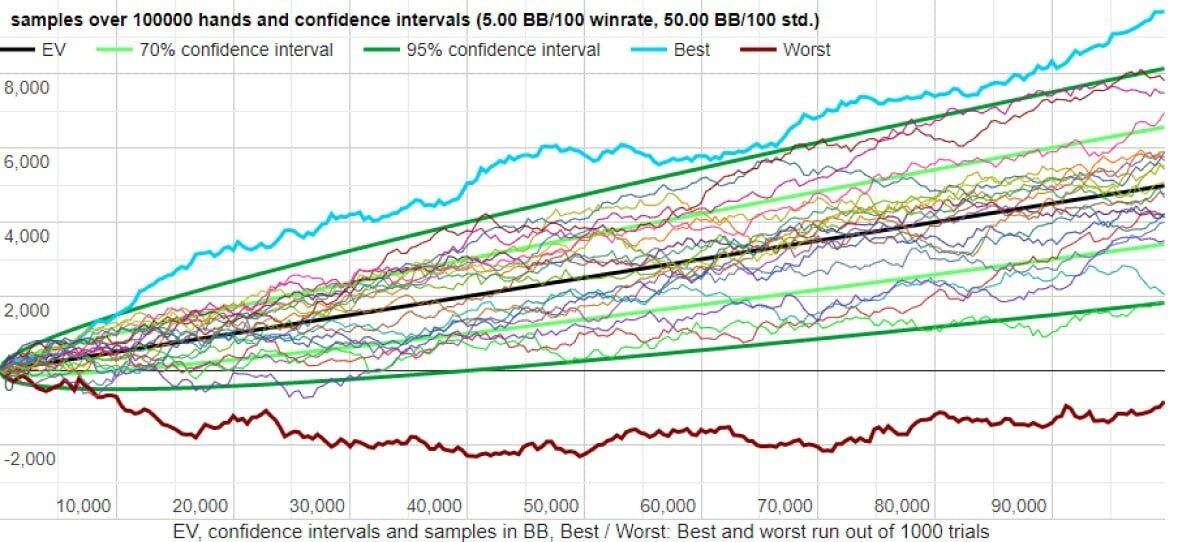
With identical play, a poker player can show either a good profit or sink into a solid loss. It all depends on variance
A prolonged downstreak creates favorable conditions for tilt. Constant defeats cause irritation, anger, and despair. If the losing streak has dragged on for several weeks, fear sets in for the player. The brain projects yesterday's experience onto today's session: "why open tables if I'll just lose again?" The joint "work" of a downswing and tilt has ended the careers of many players. To avoid joining their ranks, we recommend studying the materials on tilt at FunFarm.
The mental care department helps fund players cope with tilt. Professional psychologists and mindset coaches regularly run group and individual sessions. All the specialists are familiar with poker, so they understand players' problems. Submit an application to FunFarm to overcome a downstreak and tilt.
Sometimes a player radically rethinks his strategy because of a small losing streak. For example, a poker player 3-bet AK 2–3 times, hit top pair of kings postflop, but lost the hands. All the misfortunes fit into a single session. Under their influence he stopped 3-betting AK and started bringing the hand in with a call preflop. As a result the player abandoned the correct strategy. A few more negative "adjustments" and the poker player will start losing money not because of a downswing, but through his own fault.
Learning at FunFarm, from any level
What you shouldn't do during a downstreak
Not all strategies for fighting a downstreak are equally good. Let's look at popular but dubious techniques. Here's what you shouldn't do:
Power through the losing streak with volume. Many players try to "fast-forward" a downswing by increasing the number of hands or tournaments. The logic is simple: "if I'm going to be dealt badly all week, it's easier to ramp up the volume and endure the pain for 1–2 days." In real life this only increases the losses and stretches out the downswing. The combination of a time shortage and a larger number of tables won't let you make better decisions.
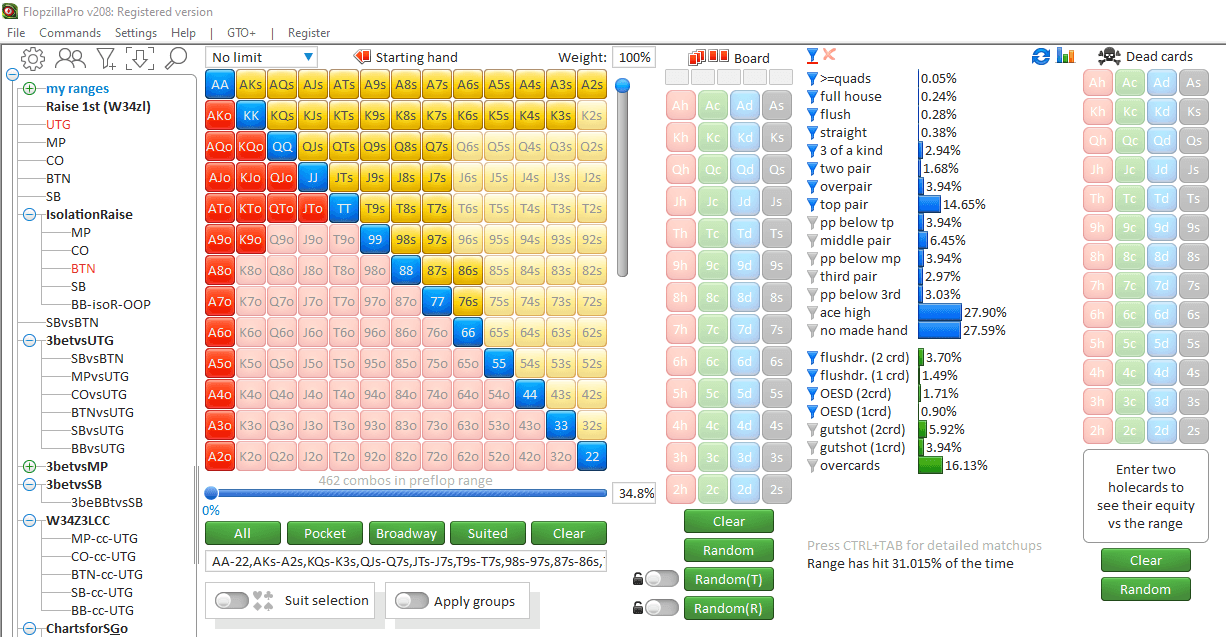
A downstreak is a bad time for big changes
Radically change your strategy. A losing streak forces some poker players to drastically change their playing style. Some players abandon bluffs, others narrow their ranges, still others start 3-betting very aggressively. Poker strategy includes a huge number of small details — abrupt movements can break the whole mechanism. Introduce new ideas gradually and under controlled conditions. A downswing is a bad time for radical changes.
Recoup losses in more expensive tournaments. A big win compensates for the losses from a prolonged downturn. That's why some poker players go to win it back in tournaments with high buy-ins. Playing outside your bankroll isn't a good decision even over a stretch with "normal" variance. During a downstreak, such "shots" will lead to catastrophe. Let the rules of bankroll management protect you from going broke.
How to get out of a downstreak
A downstreak is an integral part of a poker player's career. The collective mind of players has developed a huge number of methods for fighting it. Let's discuss the most effective ones.
Rest. Daily defeats throw you off balance. Some poker players take losses calmly, but over time it gets harder and harder to keep emotions under control. If misfortunes pursue you for several weeks, there's a high chance of building up accumulated tilt. To avoid it, take a break for a few days. Devote time to yourself, family, and friends. You won't forget how to play over a short break, but you'll get a rest from the downswing. A reset will preserve motivation and extinguish negative emotions.
Work on strategy and psychology. Systematic training lays the foundation for future success. However, many players remember about studying at the moment of crisis. If the losing streak won't let go, concentrate on learning. Review your hand history, drill push/fold, watch topical videos. When the downstreak comes to an end, fresh knowledge will help you reach a new level of play and income.
If the losing streak has caused tilt and shaken your faith in your own abilities, give special attention to psychology. Examine your reaction to defeats and study the topic of tilt. We talked about how emotions affect play in the article on "tilt triggers." (link)
Moving down a limit. Some poker players wait out a losing streak in cheaper games. The logic is simple: if they keep being dealt badly, the player loses less. An additional plus — against weaker opponents you can win thanks to a skill advantage.
Reducing the number of tables. To increase income, many players open several tables at once. In a downswing this approach will bring additional losses. Cutting the number of tables will boost concentration. The player will be able to watch opponents more closely, make better decisions, and lose less. When the losing streak is in the past and confidence in your game returns, the number of tables can be increased.

Reduce the number of tables to raise the quality of your decisions
Changing discipline or poker variant. Temporarily switching to another game helps redirect your attention. Many professionals rest from tournaments in cash. Some study rare poker variants with interest, like Badugi or H.O.R.S.E. An additional plus of the new experience — the player's versatility grows. The experiment may bear fruit in the future. For example, in a Mixed Games tournament at the WSOP.
Honing a specific skill. Many-sidedness is one of poker's main advantages. Thousands of unique situations arise at the tables, and a good player is ready for each one. To reach a high level of mastery, you need to hone skills in the process of playing. Choose a specific topic before the start of a session and give it heightened attention. Say you're losing a lot of money in blind battles. Build a BB-vs-SB 3-bet range and follow it diligently. Working on the skill will come to the forefront, and the downstreak will recede into the background.
Setting a Stop-Loss. Limits on the number of lost stacks or buy-ins will let you reduce losses during a losing streak. Hit the daily limit — close the room's client. A Stop-Loss will preserve a player's bankroll from extra losses. In cash, following the rule is easier: lost 5 stacks — ended the session. In tournaments we recommend tracking your load. For example, you've spent $200 on buy-ins — you don't start new tournaments. Some players criticize the method because it reduces the number of hands or the number of tournaments. However, surviving a downswing in poker is more important than putting in volume at the cost of your bankroll.
Balancing your daily routine. Many players give heightened attention to poker. Other aspects of life fade into the background. When things are going well, the imbalance doesn't cause big difficulties. During a downturn the situation changes: the poker player has nothing to distract himself from the misfortunes. We recommend drawing up a schedule and following it strictly. Look for an interesting hobby, sign up for the gym, fix up your sleep schedule. Each activity will let you get poker out of your head and restore your mental state. Don't abandon your daily routine even after the downstreak ends.
Switching to the FunFarm salary project. To minimize the impact of variance, you need a stable income. A special fund program provides it. Here's how it works:
a month in the red — we pay a fixed salary;
a month in slight profit — we add the necessary amount;
a month in good profit — we split the profit.
Submit an application and become a participant in the FunFarm salary project.
Free course · FF Start
Learn faster, play more deliberately
Get a clear workflow: theory, practice, hand reviews and fixing mistakes.
Frequently asked questions
Read next

A, B, C game: how to stop giving away blinds to your own inner monkey

Poker Without Burnout: How to Balance Playing with Work, Study and Family

A cooler in poker