Omaha Hi-Lo: cómo ganar la mitad del bote (o todo)
El Texas Hold'em sin límite es el juego de cartas más popular del mundo. El NL Holdem ha conseguido su posición de líder gracias a sus reglas sencillas. Sin embargo, otras variantes del póker también merecen atención. Hablemos del Omaha Hi-Lo.


Ilya es un jugador de la Liga 2 con seis años de experiencia en los MTT online. Se licenció en la Facultad de Periodismo de la RGGU y escribe sobre póker para principiantes, explicando cuestiones complejas con un lenguaje sencillo y claro. En sus textos, Ilya combina su experiencia personal de juego con sus habilidades profesionales de periodista para ayudar a los novatos a entrar en el juego con confianza.
Qué es el póker Omaha Hi-Lo
Omaha es un término genérico para varios juegos de cartas con reglas similares. Las tres diferencias clave entre el PLO y el más popular NL Holdem son las siguientes:
la mano inicial incluye al menos 4 cartas;
la combinación final se forma con dos cartas del jugador y tres del board;
el importe de la apuesta está limitado por el tamaño actual del bote.
Las reglas de las rondas de apuestas, la jerarquía de combinaciones y las posiciones en la mesa coinciden en el holdem y en el omaha.

A veces el Omaha Hi Low se denomina Omaha 8 o PLO8. El ocho es la carta más alta posible para una combinación «low»
La principal diferencia del omaha hi-lo respecto a la versión clásica es la posibilidad de llevarse la mitad del bote con la peor combinación. Esta nueva opción hace que las manos sean más dinámicas. Los jugadores con manos iniciales malas tienen la oportunidad de participar en la lucha en lugar de retirarse y esperar a la siguiente mano.
En el Omaha Hi Lo, la mitad del bote se la lleva quien tenga la mejor combinación y la otra mitad quien tenga la peor. La combinación «low» incluye cartas que no superen el ocho. Según las reglas del juego, el as se considera la carta más baja de la baraja. Por ejemplo, una mano inicial 27AA y un flop 346 le dan al jugador la combinación A2346. Al construir la peor combinación, las escaleras y los colores no cuentan. Supongamos que con QhKh2s5s en la mano sale el flop 6s4s7s. La combinación 2s4s5s6s7s permite optar a la mitad inferior del bote. La mejor combinación «low» en el Omaha Hi Lo Poker es A2345. La peor combinación se cuenta desde la carta más alta. A2346 da un 6-low y A2345 un 5-low.
A veces un jugador reúne al mismo tiempo la mejor y la peor combinación. Lo mostramos con un ejemplo. La mano inicial del jugador es KK45 y el board es K36A6. El jugador tiene a la vez:
Full house KKK66;
6-low A3456.
A esta situación en la mesa se la llama scoop.

Nuevos análisis en tu correo
Suscríbete al boletín de FunFarm: nuevos artículos del ABC del póker y materiales para crecer como jugador.
Qué otros tipos de Omaha existen en el póker
El Omaha pot-limit es la versión básica del juego de cartas. La ofrece la mayoría de las salas de póker online. El Omaha Hi Lo despierta menos interés. Sin embargo, existen otras variantes del omaha. Las enumeramos:
PLO5/PLO6/PLO7. Al inicio del juego, los jugadores reciben 5, 6 o 7 cartas tapadas. La combinación final incluye 2 cartas de la mano del jugador y 3 del board común. Aparte del número de cartas en el preflop, las reglas coinciden con las del Omaha pot-limit.
Courchevel. Al inicio de la mano, a cada jugador se le reparten 5 cartas tapadas. El repartidor coloca 1 carta común en el board. Los jugadores realizan una ronda de apuestas en el preflop. Si la lucha por el bote la continúan dos o más rivales, se colocan otras 2 cartas en el board común. En el turn y en el river la mano se desarrolla según las reglas clásicas.
Dramaha. Combina elementos del omaha y del póker draw. Al inicio, los participantes reciben 5 cartas tapadas. Se realiza una ronda de apuestas en el preflop. El repartidor pone el flop y a los jugadores se les da la oportunidad de cambiar de una a tres cartas. Las siguientes rondas se desarrollan según el esquema habitual.
Puedes conseguir tu primera experiencia jugando al Omaha Hi Lo en PokerBros y otras aplicaciones gratuitas
Entre las variantes del omaha podemos incluir el oklahoma. Se parece al Omaha pot-limit en todo, excepto en el turn y el river. En estas dos últimas calles, los jugadores deben descartar una carta de su mano inicial.
En qué otros juegos hay hi y lo
La peor combinación se lleva la mitad del bote no solo en el omaha. Las reglas del low se aplican en:
Lowball. Las reglas del juego no contemplan combinaciones fuertes. La tarea del jugador es reunir la peor combinación del póker clásico. El as actúa como carta alta y las escaleras y los colores sí cuentan. Por eso, los nuts absolutos en el lowball son la combinación 2-3-4-5-7.
2-7 Single Draw. La esencia del juego es análoga al lowball. A los jugadores se les reparten 5 cartas y tienen una sola oportunidad de cambio, tras el cual deben mostrar su combinación al repartidor y a los oponentes. Se pueden cambiar de 1 a 5 cartas. La mejor combinación del 2-7 single draw es 2-3-4-5-7.
Stud Hi-Lo. La mitad del bote se la lleva la combinación más fuerte y la otra mitad la más débil. Las escaleras y los colores no cuentan en la combinación low. El as actúa como la carta más baja de la baraja. La mejor combinación del stud hi-lo es A-2-3-4-5.
Razz. El bote lo gana quien tenga la peor combinación. Las reglas ignoran las escaleras y los colores, por lo que la combinación top es: A-2-3-4-5.
Formación en FunFarm, desde cualquier nivel
Cómo es la jerarquía de combinaciones en el Omaha Hi Lo
En el omaha hi lo, la mitad del bote se la lleva la mejor combinación y la otra mitad la peor. En el primer caso se aplican las reglas clásicas de jerarquía. Coinciden con el holdem sin límite y otras modalidades de póker. La lista completa de combinaciones ganadoras es la siguiente:
Carta alta. Por ejemplo, una mano inicial AKT5 y un board 24689 dan la combinación final AK986.
Pareja. En el preflop al jugador se le reparte QJ67. El flop J92 le da al jugador una pareja de jotas.
Doble pareja. Por ejemplo, una mano inicial J982 y un flop J8A le dan al jugador parejas de jotas y ochos.
Trío. En el preflop el jugador recibió AAJ3. El flop A2Q le permite reunir un trío de ases.
Escalera. La mano inicial JT25 y el board 98Q forman la escalera QJT98.
Color. En el preflop el jugador recibió AsJs2d8h. El repartidor puso en el board Ts4d9sQsAh. Juntos dan el color AsQsJsTs9s.
Full house. La mano inicial AKT6 y las cartas comunes K624K forman el full house KKK66.
Póker. En el preflop al jugador se le reparte TT26. En el flop TT4 forman un póker de dieces.
Escalera de color. La mano inicial 9h8h6s5d y el flop JhTh7h dan la escalera de color JhTh9h8h7h.
Escalera real. La combinación de la mano inicial AdQd y el board KdTd2s4sJd le dan al jugador la escalera real AdKdQdJdTd.
Los requisitos para la combinación final en el omaha son mayores que en el holdem. Mientras que en el NL Holdem las parejas fuertes se llevan botes con regularidad, en el Omaha Hi Low a menudo no basta ni con una escalera. Defiende de forma agresiva las combinaciones vulnerables y pasa al control del bote cuando sospeches que el rival tiene una combinación más fuerte.
Para llevarte la mitad del bote con la peor mano, necesitas una combinación con cartas bajas. La línea divisoria entre las combinaciones es el ocho. Si en la combinación final del jugador hay cartas más altas que el 8, no puede optar a la parte low del bote. Cuanto más bajas sean las cartas de la combinación, mayor será la probabilidad de llevarse la mitad inferior del bote. Las reglas del omaha hi lo ignoran las escaleras y los colores. Por eso la combinación más fuerte del PLO8 es A-2-3-4-5. La combinación se cuenta desde la carta más alta. Por eso A-4-5-6-7 se llama «7-low» y A-3-4-5-6 «6-low».
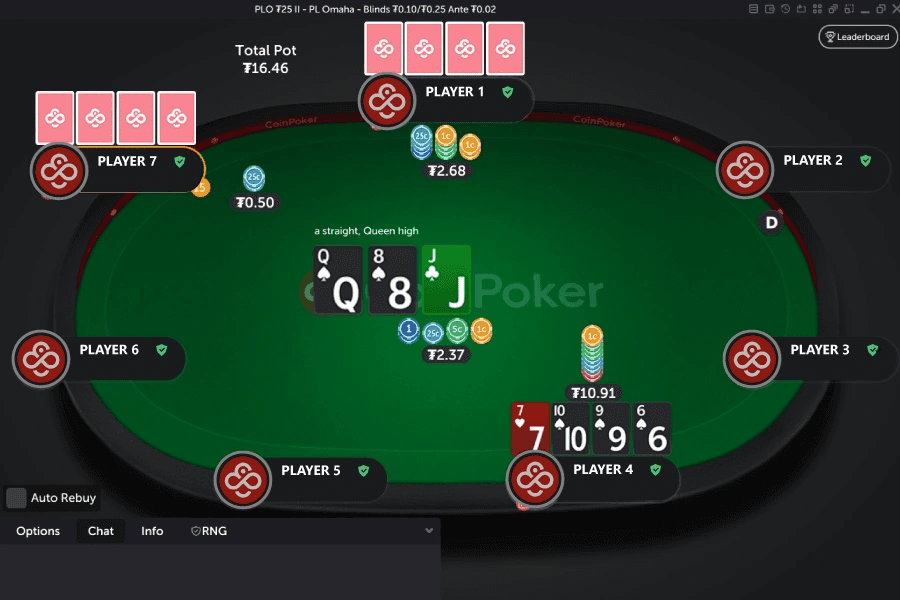
En el Omaha pot-limit se da la máxima prioridad a las manos con potencial para formar escalera o color. En el omaha hi-lo se valoran las combinaciones con cartas bajas: A234, A235
A veces un jugador obtiene al mismo tiempo la mejor y la peor combinación. Como resultado, se lleva ambas mitades del bote. Por ejemplo, una mano inicial A2K6 y un board 637KK le dan al jugador el full house K-K-K-6-6 y el low A-2-3-6-7. Ambas combinaciones ofrecen buenas posibilidades de llevarse el bote entero.
Cómo se desarrolla una mano en el Omaha Hi Lo Poker
Las reglas del Omaha Hi Lo coinciden casi por completo con las del No Limit Holdem. El omaha se juega con una baraja de 52 cartas. En la mesa pueden reunirse de dos a nueve participantes. Antes de empezar la mano, dos jugadores —la ciega grande y la ciega pequeña— hacen apuestas obligatorias. La ciega grande equivale al 1% del stack máximo permitido para sentarse. La ciega pequeña es la mitad de la grande. En la siguiente mano, las apuestas obligatorias las ponen otros jugadores. El movimiento es en el sentido de las agujas del reloj. El recuento parte del jugador en el botón.
En el omaha, mucho depende de la posición del jugador. El sitio en la mesa determina el orden de juego. Cuanto más tarde tome la decisión el jugador, más sabe sobre la fuerza de las manos de los rivales. Veamos las posiciones de los jugadores en una mesa 6-max.
UTG. Under the Gun. El jugador siempre actúa primero en el preflop y, a menudo, en el postflop. La falta de posición le obliga a jugar un rango estrecho. A veces el UTG se designa como EP o Early Position.
MP. Middle Position. Toma la decisión en segundo lugar, después del UTG. Puede ampliar un poco el rango.
CO. Cut-off. Uno de los sitios más rentables de la mesa. La ventaja posicional permite abrir manos menos fuertes.
BTN. Button. La mejor posición en el omaha hi-lo. El jugador en el BTN tiene la última palabra tanto en el preflop como en el postflop. Su sitio en la mesa permite robar las ciegas a la SB y la BB.
SB. Small Blind. Coloca una apuesta obligatoria en el preflop. Casi siempre anuncia su decisión primero.
BB. Big Blind. Pone la ciega obligatoria en el preflop. Actúa sin posición frente a todos, excepto frente a la ciega pequeña.
La mesa 9-max se completa con varias posiciones tempranas y medias. Se designan como: UTG+1, UTG+2, MP1.
En el preflop, cada jugador recibe 4 cartas tapadas. Si el jugador considera que su mano es prometedora, anuncia un raise. Los demás rivales pueden responder con: igualar, 3-bet o retirarse. Si optan al bote dos o más jugadores, la mano pasa al flop.
Al comienzo de la ronda, el repartidor reparte 3 cartas comunes. Los participantes de la mano evalúan la fuerza de las combinaciones hechas o la perspectiva de completar un proyecto. El primer jugador puede apostar o pasar. En el segundo caso, el jugador permanece en la mano pero no pone dinero en el bote. El segundo jugador puede anunciar a su vez un pase o apostar.
En el turn, el repartidor reparte la cuarta carta común y sigue otra ronda de apuestas. En el river, los jugadores reciben la última carta común y hacen las apuestas finales. Cuando las apuestas llegan a su fin, los rivales muestran sus combinaciones finales y se determina al ganador.
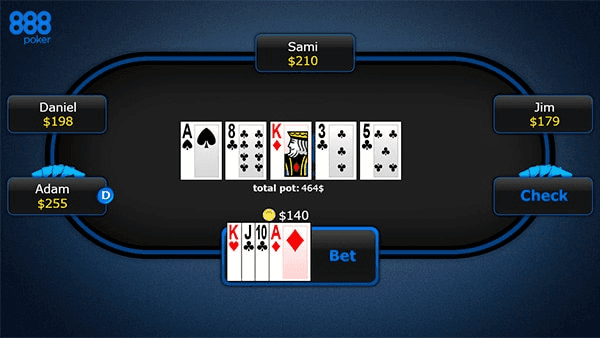
En cualquier fase de la mano, el jugador puede apostar, lograr que el oponente se retire y llevarse el bote
En el Omaha Hi Low, el bote se reparte según reglas específicas. Por ejemplo, el jugador A se lleva la mitad del bote con la mejor combinación. El jugador B y el jugador C muestran en el showdown el mismo low y se llevan 1/4 del bote cada uno. Si quienes tienen combinaciones iguales resultan ser tres, recibirán 1/6 del bote total cada uno.
La vida del jugador también se complica por la regla del «desplazamiento». Si en el board aparece una carta que coincide con una de las cartas bajas de la mano inicial, esta no se puede usar en la combinación final. Lo mostramos con un ejemplo. Supongamos que el jugador entró en juego con JT32. Salió el flop A45. El jugador atrapó el mejor low y opta a la mitad del bote. En el turn ponen un 9. La carta no cambia la situación. A diferencia del tres en el river. Este desplaza una carta de la mano del jugador. El jugador pierde la posibilidad de usar el tres al formar el low y se ve obligado a descartar su mano.
Cómo jugar al Omaha: recomendaciones básicas
La división del bote en dos mitades cambia la estrategia de juego y los requisitos para las manos iniciales. En el omaha hi lo se da prioridad a las combinaciones versátiles. El jugador debe tener la posibilidad de atrapar a la vez la mejor y la peor combinación. Por encima del resto se sitúan las manos iniciales con ases y cartas bajas: A234, A245 y así sucesivamente. No juegues combinaciones con cartas medias, como 8765. Aunque el jugador consiga un low, este a menudo será inferior a las combinaciones más débiles de los rivales. La parte alta del bote rara vez la conseguirá una mano inicial 8765, porque los oponentes atraparán mejores combinaciones en las calles tardías.
El omaha hi lo también se diferencia de la versión clásica en la táctica del postflop. A veces el jugador debe descartar combinaciones de nuts en el flop. Si las cartas comunes solo dejan posibilidades de luchar por la mitad del bote, es más sensato salir del juego. No metas dinero en una mano vulnerable por una parte del bote. El éxito final a menudo no compensa el esfuerzo. Desde luego, no conviene jugar manos en proyecto con la idea de llevarse la mitad del bote. Por ejemplo, con AQJ7 en un board 56T el jugador tiene la posibilidad de atrapar un low. Sin embargo, el rival puede mostrar en el showdown la mejor combinación. A la parte alta del bote el jugador no opta.
El preflop tiene un papel decisivo en el omaha hi lo. Una selección sensata de las manos iniciales suele predeterminar el éxito final

Dónde se celebran torneos de Pot Limit Omaha
La mayoría de los torneos del póker online se disputan según las reglas del holdem de Texas sin límite. En segundo lugar, con una enorme diferencia, está el Omaha pot-limit. Los torneos de PLO los organizan: PokerOK, PokerStars, Winamax Poker, Pokerdom, RedStar Poker. La mayor atención al PLO se presta en PokerOK: a diario se celebran más de 100 MTT de omaha en la plataforma. A veces la sala de póker organiza festivales aparte, como las Omaholic Series con una garantía de $10,000,000. Sin embargo, no hay torneos de Omaha Hi Lo en el calendario regular. Del juego se acuerdan en el marco de grandes series, como las SCOOP.
En 2025 se celebró en PokerStars el Spring Championship of Online Poker. En 380 torneos se repartieron más de $60,000,000. Al omaha hi lo se le dedicaron 18 eventos. En el mayor de ellos se repartieron $100,000. Un número comparable de torneos de PLO8 se incluyó también en el calendario de las WCOOP.
El Omaha Hi Low tampoco se ignora en la prestigiosísima serie en vivo World Series of Poker. En la WSOP-2025 se celebraron 100 eventos. Seis de ellos se dedicaron al omaha hi lo. El mayor torneo lo ganó Philipp Sternheimer. Dejó atrás a 385 oponentes y se llevó $763,087.
Por qué el NL Holdem es mejor que el Omaha Hi Lo Poker
La ventaja clave del holdem de Texas sin límite es su carácter masivo. Por ejemplo, el calendario diario de PokerOK incluye 1,000 torneos y la mayoría se juegan según las reglas del NL Holdem. A todas las variantes del omaha se les destina menos del 10% de los eventos. No hay torneos de PLO8 en PokerOK. La situación es análoga en el cash: para un aficionado al holdem es más fácil encontrar mesa en cualquier plataforma.
Otros argumentos a favor del holdem son los siguientes:
Botes de premios. En la WSOP-2025, el ganador del torneo principal de holdem recibió $10,000,000. Al campeón del mayor evento de Omaha Hi Lo se le pagaron $763,087. Comparar la situación de los juegos en el póker online no tiene ningún sentido. Ninguna sala celebra torneos de omaha hi lo de forma regular. Del PLO8 solo se acuerdan en los grandes festivales online, como las SCOOP. Pero incluso allí las garantías son decenas de veces inferiores a las de los eventos de holdem.
Varianza. En el holdem las rachas negativas son menos prolongadas. En el omaha, debido al juego frecuente por el stack con probabilidades 60:40, los descensos bruscos de decenas de buy-ins se producen con regularidad. En el holdem sin límite un profesional tiene más control que en el omaha hi lo. Por eso, el bankroll necesario para el PLO es más considerable.
Formación. Hay muchísimo más material sobre el holdem de Texas que sobre el omaha. En los últimos años el número de cursos de formación sobre PLO crece, pero la ventaja sigue del lado del NL Holdem.

La victoria en el torneo de PLO8 le reportó a Philipp Sternheimer unos sólidos $763,087. Sin embargo, palidecen frente a los $10,000,000 de premio del campeón del ME WSOP
A los principiantes les recomendamos empezar por los torneos de NL Holdem. Para sentar una base sólida te ayudará el curso FF Inicio. En él analizamos: estrategias básicas de torneo, la adaptación a distintos tipos de oponentes, el juego con stack corto y los fundamentos de las matemáticas del póker. Puedes aplicar la teoría en la práctica en un entrenador especial.

Curso gratuito · FF Inicio
Entiende la lógica de los MTT
Analiza la fase inicial, la burbuja, los stacks cortos y la mesa final como un único sistema.
Preguntas frecuentes
Sigue leyendo
Chino Pineapple: reglas, combinaciones y cómputo de puntos

Qué es el póker deportivo y cómo funciona
Tipos de póker: variantes, reglas y claves