How to Beat Microstakes and Start Growing in Poker
How to beat the microstakes, which mistakes hold back your progress, and how much money you need to move up to the next level.


One of our first coaches: on the team since the very founding of the project. He prioritizes simple and practical training with an emphasis on real game situations and decision-making over the long run. Val doesn't just "beat the games" as a player, but also instills a systematic approach to the game and discipline in his students.
The world's strongest poker players contest pots worth hundreds of thousands of dollars and compete in tournaments with million-dollar guarantees. However, most players never reach the top. Often the barrier on the road to success is low stakes. Let's discuss: how to beat the microstakes, which mistakes hold back progress, and how much money you need to move up to the next level.

New breakdowns in your inbox
Subscribe to the FunFarm newsletter: fresh Poker ABC articles and material that helps you grow as a player.
Key facts about moving up in stakes:
You beat the microstakes through solid ABC poker with: strong preflop ranges, good value bets with made hands, selective bluffs, and the right table or format selection.
Progress is slowed by: poor bankroll management, ignoring training, tilt.
At low stakes, GTO and other complex concepts bring minimal benefit.
Rakeback, leaderboards, and other promotions speed up the climb.
What are microstakes in poker
Stakes in poker are distinguished by the price of entry at the table. In cash games, the reference point is a stack of 100 big blinds. For example, to sit at an NL10 table, you need 100 BB or $10.

There is no single classification of microstakes in poker. In cash, the dividing line is NL25. In tournaments, moving up to the next level is confirmed by playing MTTs with buy-ins of $15 and up
In tournaments, the buy-in is taken as the basis. In MTTs, an alternative criterion is also applied — Average Buy-In or ABI. It shows the average cost of tournament entry over: a week, a month, or a year. To calculate ABI, you add up all of a player's buy-ins over a specific period and divide by the number of tournaments played.
Basic information on distinguishing stakes is provided by poker room filters. For example, RedStar Poker offers the following classification:
Name | Which stakes are included |
Micro | NL2, NL4, NL10, NL25 |
Low | NL50, NL100 |
Mid | NL200, NL400, NL600 |
High | NL1000, NL2000, NL4000 |
The microstakes section may include other stake levels as well. On most platforms, NL5 is played instead of NL4. There is no canon for the other groups either. Sometimes the selection includes "nosebleed stakes." This refers to NL10000 tables and above. In tournaments, the equivalent is events with a buy-in of $1,000 and up. They are usually marked in the lobby as "high roller" events. A generalized classification of tournaments by buy-in looks like this:
Name | Buy-ins |
Micro | From $0 to $7 |
Low | from $7 to $20 |
Mid | from $30 to $150 |
High | from $200 to $1,050 |
Super | from $1,500 to $10,000. |
Poker schools use an advanced approach and group stakes by the level of opponents, the difficulty of learning materials, and other criteria. For example, FunFarm operates a system of 5 tiers:
Tier | ABI |
FF Start | from $0 to $2 |
Liga 3 | from $2 to $10 |
Liga 2 | from $10 to $50 |
Liga 1 | from $50 to $100 |
Elite | from $100+ |
Players not only play more expensive tournaments but also receive a different learning plan. The qualification level of the coaches increases as well.
Who plays microstakes in poker
At the microstakes tables you can meet all sorts of players. Beginners are learning the rules and taking their first steps, amateurs chase pretty hands at any cost, "maniacs" go all-in every hand, regulars accumulate money to move up to the next level.

At the poker table you won't find two identical players. Each has their own traits. However, they can be reduced to a few types: rocks, maniacs, calling stations, TAGs, LAGs
A distinctive feature of cheap tournaments and cash tables is the low skill level of opponents. At the microstakes, opponents: pull off bad bluffs, enter the pot with trash, ignore poker math. For example, a loose-passive opponent with a flush draw on the flop will often go all the way to the river regardless of the price of the call.
Typical mistakes of microstakes players:
They enter the pot with very weak hands. Many beginners start their poker journey by memorizing preflop charts. Strong ranges protect against big mistakes postflop. Not all players study theory and memorize charts. Most beginners come to the tables without preparation. As a result, they play hands with dubious holdings and lose money.
They play strong combinations passively. In poker, good hands come rarely. For example, a pocket pair hits a set on the flop 11.8% of the time. When the moment comes, players start "luring" opponents into a trap. As a result, they either win less or give the pot away to opponents.
They overvalue made hands. Many microstakes players pay off 3 streets of bets with top pair no kicker. They ignore the opponent's image, the board structure, or the bet sizing. Often it's hard for them to accept that the best hand on the flop has turned into a mediocre combination by the river.
A typical microstakes player looks at flops and collects combinations rather than following strict math and a thought-out strategy.
Learning at FunFarm, from any level
Why microstakes are hard to beat
Most professional players get past the microstakes within a year. To gain an edge over the field, you don't need the talent of Stu Ungar or a perfect knowledge of GTO. It's enough to eliminate the typical mistakes. The most glaring of them:
Weak bankroll management. Many players don't realize the impact of variance on results. In pursuit of fast growth, they move up before their time, hit a bad run, and take a rollback. Sometimes a losing streak leads to bankruptcy. To climb stakes successfully, follow the rules of bankroll management. If experienced players recommend accumulating $650 to move into tournaments with a $5 buy-in, be patient and build a safety margin.

Frequent cashouts also count as poor decisions. Regular withdrawal of funds gets in the way of building a bankroll and climbing stakes
Excessive bluffs. Low stakes in poker can be beaten by carefully playing strong hands. The recipe for effective play sounds simple: wait for good cards and make value bets. However, squeezing opponents out of the pot with trash is much more fun. So players regularly lose money on bad bluffs. Attempts to push loose-passive opponents out of the pot look especially terrible. You won't move up a stake if you systematically give money away to opponents.
Poor opponent searching. Deliberately targeting weak opponents — selection — plays a big role in poker. Amateurs bring in the main income for professionals. The more hands a player has against recreational players, the better their results over the long run. In tournaments, selection comes down to choosing the right MTTs. A sensible player will keep profitable events in their schedule and cut out unprofitable ones.
Lack of training. Poker owes its high popularity to the simplicity of the rules. The ranking of hands can be memorized in a few minutes. Reaching a high level of mastery is much harder. To become a top player, it takes years of painstaking work. Many microstakes players either ignore training or approach the matter without a system.
Regular tilt. Poker is a fascinating game with a huge number of unique situations. However, dramatic twists don't always bring delight. For example, an opponent winning with pocket 2♠️2♣️ against our A♥️A♦️ will provoke irritation. Several losses in a row will open the door to tilt. The flood of emotions will lead to a loss of control and big mistakes. It's hard for tilting players to beat the microstakes. In 2-3 bad sessions players wipe out weeks or months of work.
High rake. For organizing the game, poker rooms take a commission. Microstakes players bear the highest costs. For example, at NL10 a player gives up about $500 in rake over a distance of 50,000 hands. At higher stakes the platforms' demands are more modest. For example, at NL600 in the PokerKing room, a player will pay $1.5 in rake from a $327 pot. Similar conditions are offered in tournament poker too. In a $15 MTT the commission is 10% of the buy-in. In a $10,000 tournament the rake is reduced to 3%. That's why it's hard for microstakes players to leave them. Rakeback improves the situation a bit.
We cover the strategic shortcomings in more detail in the articles: "Top 6 mistakes preflop" and "Top 5 mistakes postflop".
How to beat the microstakes
Climbing stakes requires discipline and a systematic approach. To progress quickly, you need to:
Play ABC poker. A straightforward strategy will let you get past low stakes. Build solid preflop ranges, make value bets with strong hands, avoid expensive bluffs, give up in obviously losing situations, abandon slowplaying and creative lines. Study the concept of automatic profit. For example, many players in the blinds fold more often than they should. Against them it's profitable to raise any two cards. Poker software will point out suitable spots for betting.

Careful poker lets you get past the low stake levels. Strong ranges, big value bets, and disciplined folds are the key to long-term success
Bet more with strong hands. Opponents at the microstakes rarely find the "Fold" button, so punish them. Don't be afraid to scare off an opponent with a fat value bet. For example, a player with K♠️Q♥️ sees a flop of Q♣️8♦️3♠️. They're up against a loose-passive opponent. On a relatively dry board, many players will bet around 2/3 pot. In practice, the "calling station" will call an even bigger value bet. You can bet 3/4 and even 4/5 of the pot. The opponent may even call a pot-sized bet. Over the long run, a difference of a few blinds grows into a large sum of profit left on the table.
Bluff less. Low-stakes players rarely think about opponents' ranges. If they like their hand, they don't fold it. So we recommend cutting back on the number of bluffs. Limit yourself to continuation bets, blind steals from late positions, second barrels on scary cards, and semi-bluffs with draws. At the microstakes in poker you can also meet reasonable opponents. Against them, bluff more often. In the best case you get a fold, in the worst — you earn experience for the future.
Use positional advantage more often. The button is the most profitable seat at the table. The player on the BTN knows the decisions of the other opponents. Having the last word lets you widen your range. For example, against tight opponents in the blinds it's sometimes profitable to raise with any hands. Positional advantage lets you more effectively: value bet, bluff, and control the pot size.
Select better. Recreational players are the main source of income for professionals. Don't sit at tables without amateurs. At NL2, NL5, NL10, and NL25 stakes it's easy to find weak opponents. In tournaments you can't pick the table lineup. However, a player can analyze their database and weed out the least attractive MTTs. For example, a player shows good results in tournaments with deep stacks and loses money in events with fast blind increases. The sensible decision would be to choose tournaments with a deep structure.
Not every brand offers a worthy MTT schedule. Often it's hard for a player to find tournaments that fit their ABI within a single room. Registering on other platforms will help solve this. Playing several clients at once takes some getting used to, but it pays off over the long run. Some brands publish their tournament schedule on their websites. So you can find the MTT selection without even registering. If you couldn't find the information on the room's portal, download its software. Most sites let you study the lobby without an account too.
For tournament players, we recommend paying attention to new platforms. Phenom Poker, BCPoker, or Up Poker don't run record series or Sunday MTTs with huge prize pools. In their favor are a weak field and regular overlays. An overlay is the difference between a tournament's announced guarantee and the actual sum of players' buy-ins. Players fight for a big prize against fewer opponents. In some rooms MTTs resemble multi-table Sit&Gos.
Work on psychology. Beginners underestimate the role of emotions in poker. Loss of control causes tilt and leads to big losses. A systematic approach to the matter will solve the problem. Track your emotional state during the session. Note the situations that provoke anger. For example, if tilt comes after bad beats, shift the focus from the result to the process. The correct line of play is more important than the momentary outcome. We examined the topic in more detail in the article on the psychology of endurance.

Income from the welcome promotion and rakeback will help you build a bankroll faster to move up. The extra money can be spent on software or a coach
Use promotions. Some platforms organize leaderboards for tournament players. They let you get extra money for success in MTTs. For example, Pokerdom gives away 650,000 rubles every week. Many rooms organize races as part of major online festivals. In May 2026, CoinPoker announced a $500,000 leaderboard in honor of the World Poker Masters. A first-deposit bonus, a loyalty program, and leaderboard prizes won't bring huge income, but they will let you grow your bankroll.

Bankroll management for climbing stakes
Many microstakes players neglect bankroll management. Abandoning financial discipline slows development and leads to stagnation. As a result, skilled players sit at low stakes for years.

High stakes require a solid bankroll. A reserve of money lets you weather a bad run more calmly
Effective bankroll management is the foundation of long-term progress. A sensible player will determine in advance:
a sufficient number of buy-ins for each stake;
the threshold for moving up to the next level;
the minimum mark for dropping down a stake.
There is no single approach to bankroll management. The specific figures depend on: the player's skill level, discipline, psychological resilience, the presence of other income sources. For example, in MTTs variance is higher, so tournament players need a larger safety margin.
Here's what approximate bankroll management for cash players looks like:
Stake | Bankroll | Move up | Drop down |
NL2 | $50 or 25 buy-ins | $150 | — |
NL5 | $150 or 30 buy-ins | $400 | $75 |
NL10 | $400 or 40 buy-ins | $1,250 | $250 |
NL25 | $1,250 or 50 buy-ins | $3,000 | $875 |
NL50 | $3,000 or 60 buy-ins | $7,000 | $2,250 |
As you climb stakes, increase the safety margin. The higher the stake level, the stronger the opponents and the more dangerous the variance. Cash players rarely completely remove the old stake from their filters and switch to a new one. Usually they combine tables with different stake levels. So the bankroll requirements can be averaged out too. If a player plays NL5 and adds NL10, they can open higher-stake tables at the $250-$300 mark.
Tournaments require a more conservative bankroll. To play $1 MTTs, you need $100. The general recommendations are given in the table:
ABI | Bankroll | Move up | Drop down |
$1 | $100 or 100 buy-ins | $220 | $50 |
$2 | $220 or 110 buy-ins | $360 | $170 |
$3 | $360 or 120 buy-ins | $650 | $285 |
$5 | $650 or 130 buy-ins | $1,120 | $500 |
$8 | $1,120 or 140 buy-ins | $1,500 | $880 |
$10 | $1,500 or 150 buy-ins | $2,400 | $1,200 |
$15 | $2,400 or 160 buy-ins | $3,400 | $1,950 |
$20 | $3,400 or 170 buy-ins | $4,500 | $2,800 |
$25 | $4,500 or 180 buy-ins | $5,700 | $3,750 |
Usually players combine tournaments with different entry fees. So the rules of bankroll management should be adapted to the ABI. For example, $2,000 is enough to play MTTs with buy-ins from $10 to $15 simultaneously.
Some players practice "shots." A shot is participation in a significantly more expensive tournament relative to a player's ABI. So that shots don't damage your bankroll, win tickets into big MTTs through satellites. Most online poker rooms run them.
When you can move up a stake
The size of the bankroll is not the only criterion for moving up. The history of online poker knows many examples of players "carrying" a big tournament and losing touch with reality. They went into expensive MTTs or nosebleed cash stakes and quickly parted with their bankroll. A sample of a thousand tournaments and an in-depth database analysis will let you objectively assess a player's skill level.
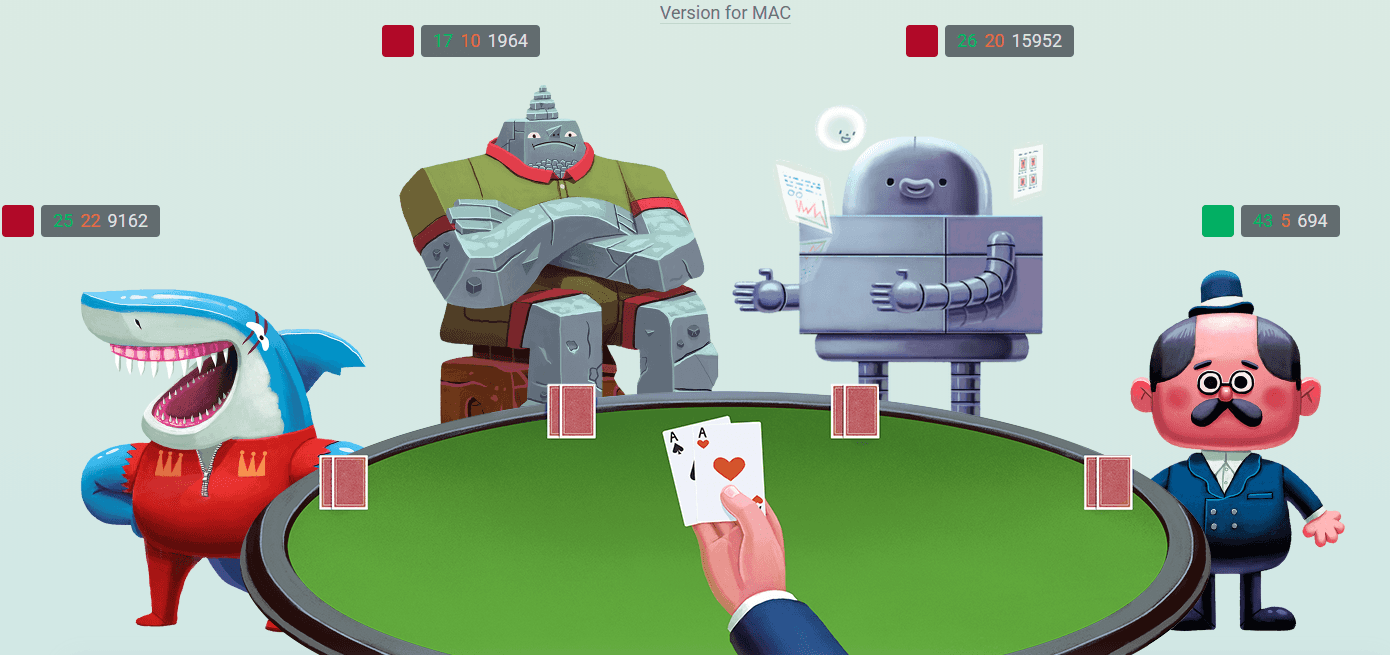
Poker software will help you do systematic work and track progress. A tracker will be most useful at the start
Climbing stakes can be tied to acquiring specific skills. The plan might look like this:
NL2 → NL5. Learn to fold in obviously lost hands. Get acquainted with a poker tracker and basic statistical indicators. Add a second table to play simultaneously.
NL5 → NL10. Increase the average value bet size. Integrate Fold to Steal, Fold to 3-Bet, and other stats into the HUD. Add a third table for multitabling.
NL10 → NL25. Systematically review hands in a poker calculator. Widen ranges in late positions. Write notes on opponents.
NL25 → NL50. Review preflop ranges. Defend the blinds more aggressively. Increase the number of bluffs. Get acquainted with GTO.
Tournament players don't need to think through a plan on their own. The FunFarm team has done it all for them. Training in the fund consists of several levels:
FF Start. A basic course for beginners. Includes 30 lessons. The curriculum covers: poker math, adapting to different types of opponents, final-table strategy, and push/fold. A trainer helps hone theory in practice. We invite FF Start graduates to the next level.
FF Player Path. The intermediate stage of evolving from an amateur into a poker professional. The step-by-step curriculum consists of 15 levels. In it: real strategies are offered, a more aggressive preflop is taught, the logic of running a hand is explained, and the principles of bluffing and value play are revealed more deeply. Students get a full set of knowledge and tools for getting past the microstakes. On average, players complete the course in 8 months.
Elite, Liga 1, and Liga 2. Levels for professional players. Students: move on to advanced exploitation of opponents, master independent hand and statistical analysis, and gain a deeper understanding of ICM and other poker concepts. The difficulty of the materials grows along with the player's mastery. The fund offers: sessions with top coaches and mental coaches, access to private research, individual and group sessions, in-depth database review, full backing, and a salary project.
To beat the microstakes and achieve success in poker, join FunFarm. We invite beginners to take FF Start. FF Player Path is suitable for experienced players.
Which stake should I start at if I'm new to poker?
It depends on the starting bankroll. If you set aside $500 for a deposit, you can start at NL10 or $3-$5 tournaments. Many beginners take their first steps at NL2 or in $1 MTTs. The skill level of opponents at the microstakes hardly differs, but starting at the minimum stakes will let you save money on mistakes.
How long does the path from NL2 to NL25 take?
You can get through the microstakes in poker in 1-1.5 years. A lot depends on discipline and the player's attitude toward training. Participants in the FF Player Path program get past microstakes MTTs in 8 months.
Do you need a solver at the microstakes?
Balanced poker plays an important role in expensive games. So it's useful to study the basics of GTO in advance. However, at low stake levels ABC poker works great. We recommend that beginning players buy a poker tracker and an equity calculator.
What should I do if I keep losing?
Over a short distance, a lot depends on variance. However, more often the issue is not a prolonged bad run but a low level of play. To get out of the crisis, rethink your approach to training. Regularly review hands, hire a coach, or join a poker school.
How do I know I'm ready for the next stake?
Skill level and bankroll size are the main criteria for readiness. In cash games, a player's skills are assessed by the winrate in big blinds. In tournaments, the reference point is Return on Investment or ROI. To judge a player's skill objectively, you need to take the distance into account. In cash, a sample of several tens of thousands of hands is taken. In MTTs, ROI is measured over a stretch of a thousand tournaments and up.

Free course · FF Start
Fix costly beginner mistakes
Learn when to bet, call or fold — and when putting pressure on an opponent pays off.