Sit & Go: how to reach the money and win
Poker is an umbrella term for several card games: Texas Hold'em, Omaha, draw poker, stud. Each poker variation also has its own internal hierarchy. Players are offered a choice of several disciplines: cash, tournaments, and Spin & Go. In the past, Sit & Go stood alongside them. Let's discuss Sit n Go tournaments in more detail.
Ilya is a Liga 2 player with six years of experience in online MTTs. He graduated from the Faculty of Journalism at RSUH and writes about poker for beginners, explaining complex things in simple, clear language. In his texts, Ilya combines his personal playing experience with his professional journalism skills to help newcomers confidently get into the game.
What is Sit&Go
Sit&Go is a simplified version of tournament poker. The format's main feature is its start time: a Sit and Go begins the moment the stated number of players have registered for it.

Sit & Go is a good entry step on the path to tournament poker. Ben Rolle — winner of the ME WSOP Online 2025 — started his career in SNGs
The format's key feature is reflected in the literal translation of "sit and go": "sat down and off we go." For example, a 6-max tournament begins after the sixth player registers, a 10-max after the tenth, and an 18-max after the eighteenth. A classic multi-table tournament has a fixed start time.
The format was invented at the dawn of online poker. The first single-table tournaments were offered by Planet Poker. The discipline was developed by Paradise Poker, where Sit&Go was called "Instant Tournament." Later, the Sit and Go format was adopted by PokerStars, Partypoker, and Full Tilt Poker. The modern label — Sit&Go — was popularized by PokerStars.
Many newcomers started their online poker careers with Sit n Go. The format let players prepare for tournaments in gentler conditions. The format's key advantages:
Speed. Many Sit n Go games last no more than 20-30 minutes. In a classic tournament, the path to the final table takes hours. It's easier to put in a big volume in a Sit and Go.
Simplicity. To post decent results in the discipline, it's enough to sharpen your push/fold and act carefully in the early stages of the event. Playing a winrate doesn't require complex bluffs or deep GTO knowledge.
Preparation for regular MTTs. Sit&Go gives an excellent opportunity to practice play in the late stages of a tournament. In regular MTTs, reaching the final table is harder due to the larger number of opponents. In Sit n Go it's easier to build a bankroll for regular tournaments.
When Winamax invented and PokerStars popularized the Spin&Go format, interest in regular Sit and Go declined. In 2026 the discipline is in crisis. Some rooms, like Vbet Poker, have dropped it entirely. Sit n Go are relatively in demand on: PokerOK, RedStar Poker, Winamax, and TigerGaming.
What types of Sit and Go exist
The first Sit&Go resembled tournaments in miniature. The prize pool was paid to the top three players. Every few minutes the blinds rose and stack sizes fell. Gradually opponents shifted to a push/fold strategy and determined the best player. That's what classic Sit and Go tournaments looked like. Later, other formats were invented: Double or Nothing, Heads Up, Multi-Table Sit&Go, Knockout, Steps, On Demand. Let's discuss them in more detail.

Winners of a Double or Nothing tournament were paid an equal reward
Double or Nothing. Half the players took double their buy-in, half left with nothing. If 10 people took part in the tournament, the game ended when the sixth player busted. A 6-max tournament ended when the fourth opponent busted. The final number of chips didn't matter. The chip leader and the short stack received identical prizes. PokerStars experimented with the format and invented Fifty. In those, the final payouts also depended on the number of chips.
In classic Sit and Go, the prize pool is distributed depending on the number of players at the table. In 9-max, the winner gets 50% of the prize pool, the runner-up 30%, and third place 20%. In 6-max, the money is paid to the winner and the second-place finisher. The champion gets 65%, the silver medalist 35%.
Heads Up. A one-on-one duel. The most demanding in terms of skill level. Top players posted sky-high ROI in HU SNG. For example, the player nicknamed SkaiWalkurrr earned $877,130 in Sit&Go Heads Up tournaments in 2012. Gradually the top stakes were taken over by "cartels" and interest in the format fell. A cartel is a group of professionals blocking lobby access to other players.
Multi-Table Sit&Go. The Sit and Go format closest to classic tournaments. The 360-, 180-, and 90-player versions differed only in the start point and the cap on the number of participants. For decades PokerStars remained the leading platform for MTSNG. A huge number of multi-table SNGs were played on PS. Many professionals built their bankroll on MTSNG and moved into full-fledged tournament poker. The format's decline was driven by:
the growing popularity of Spin&Go;
increased rake and the cancellation of rakeback on PokerStars.
In 2021, PS removed many popular MTSNG from its schedule. Over time, the room removed the Sit&Go tab from the lobby.
Spin&Go. Fast three-player tournaments with a random prize were invented by Winamax Poker. Later the format was adopted by PokerStars. Then other platforms joined in. The chance to win a million in a few minutes attracted a huge number of recreational players. As a result, the other Sit&Go formats fell into decline. Today Spin&Go is offered by most online poker rooms. This variation of Sit and Go has far surpassed the base discipline. The chance to become a millionaire in a few minutes is offered by: PokerOK, PokerKing, and 888Poker.

Spin&Go is on every online poker platform, Sit&Go — you still have to hunt for it
Steps. They offer a way to qualify into a major tournament through a chain of qualifying Sit&Go. For example, PokerKing lets you convert $1.1 into a $2,650 ticket. The path can't be called easy — you have to get through 6 rounds of qualifiers.
On Demand. Sit&Go with late registration and re-entry. You can enter an already-running tournament within 15-30 minutes from the start. You can find this format in Winning Poker Network rooms.
Knockout. A regular Sit and Go with additional rewards for knocking out opponents. Payouts for prize places in Knockout are smaller than in SNG 6-max or 9-max.
Rooms also invent original formats, like Mystery Battle Royale or 8-Bomb. They usually combine features of different Sit n Go. For example, Mystery Battle Royale is an 18-player MTSNG with the chance to win a jackpot and a stage of automatic all-ins before the final table.
By the speed at which blinds rise, Sit&Go are divided into:
Regular. Levels rise every 10 minutes.
Turbo. Levels rise every 5-6 minutes.
Hyper-Turbo. Levels rise every 2-3 minutes. The standard speed for Spin & Go.
Learning at FunFarm, from any level
How to play Sit and Go tournaments
The strategy depends on the Sit n Go format. In Heads Up and Spin&Go, aggressive players win. You can't sit and wait for premium hands. Pocket pairs and Broadway combinations are dealt rarely: aces come once every 221 hands, AK once every 82 hands. On average, Spin&Go run 25-30 hands. Heads Up last longer, but there too caution leads to defeat. Through steals, opponents will gain a chip advantage, and push/fold won't always turn the situation in your favor. To win at Heads Up, you need good postflop play. In Spin&Go, push/fold will be the decisive factor.
In MTSNG, On Demand, and classic Sit&Go, the strategy resembles play in a multi-table tournament. The main principle is to follow the Independent Chip Model. ICM is a mathematical concept justifying the higher value of lost chips compared to won ones. It's easier to explain with an example. Suppose a player registers in a regular $5 Sit&Go and busts on the first hand. The money can't be recovered. Doubling up on the first hand raises the chances of success but guarantees nothing. The player can lose a few medium pots and leave the tournament.
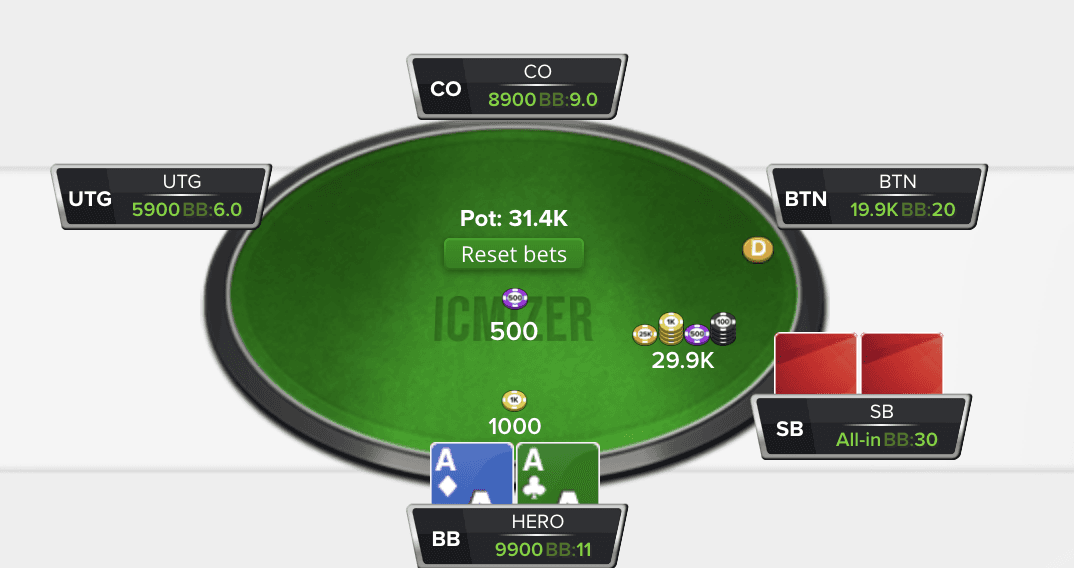
In all Sit n Go formats, short-stack play plays an important role. You can improve the skill by training in ICMIZER 3 and other software
The simplified strategy looks like this:
In the early stage, we act carefully and don't hand chips to opponents. We play strong hands and extract the maximum with them.
In the middle stage, the value of chips grows, so you need to steal blinds more actively from the CO, BTN, and SB positions. At the same time, the appeal of calls drops. It's more profitable not to enter against raises and to preserve a working stack longer.
In the late stage, we switch to push/fold. If you've managed to double up or build a stack, we add min-raises from late positions.
Sit&Go was analyzed in more detail by Collin Moshman in his book "Sit 'n Go Strategy." It consists of 4 sections. The author devoted the first three to the early, middle, and late stages of the tournament. In the last one, Moshman discussed psychology and multi-tabling. The book can easily be found in Russian.
Which rooms offer Sit n Go
In the discipline's heyday, the title of best venue for Sit and Go was held by PokerStars. The room pleased players with a variety of formats and high traffic. If you set Spin&Go aside, the discipline is in decline. Many platforms have completely abandoned Sit&Go, Heads Up, Double or Nothing, and other formats. In the remaining rooms the discipline survived, but with few players. Let's look at the Sit & Go situation on the leading online poker venues.
Room | Sit&Go formats | Buy-in range | Traffic | Additional promotions |
PokerOK | MTSNG 18-max | From $0.25 to $25 | At peak time 350-400 tournaments are running | Daily $10,000 leaderboard; Mystery Bounty Jackpot up to $10,000 |
PokerStars | MTSNG | From $0.55 to $16.50 | In the evening 10-15 tournaments run | None |
RedStar Poker | DON, HU, Turbo SNG | From €0.10 to €50 | In the evening up to 80 tables of all formats are played | Monthly $25,000 lottery |
PokerKing | On Demand, Turbo SNG | From $0.55 to $31.50 | In the evening 15-20 tournaments run | Weekly Sit&Crush leaderboard |
Winamax Poker | DON, HU, MTSNG, Turbo SNG | From €0.50 to €500 | In the evening 200-250 tables of all formats are played | Daily €500 leaderboard |
TigerGaming | Turbo SNG, Heads Up | From $0.25 to $30 | In the evening 30-35 tournaments are played | Daily $2,000 leaderboard |
PokerOK. The industry leader set aside a separate lobby section for SNG — Mystery Battle Royale. In it, players are offered an 18-player MTSNG. Clients have access to tournaments with buy-ins from $0.25 to $25. The money goes to the top three players. If, 10 minutes after the start, more than 9 participants remain in Battle Royale, all players with short stacks automatically go all-in. The average tournament takes 30 minutes. In the evening, several hundred Mystery Battle Royale run in parallel. An additional incentive to take part in the local Sit and Go is the daily $10,000 rake race and the Mystery Jackpot Bounty.
PokerStars. PokerStars went from being the best place for fans of the discipline to a room without Sit&Go in the lobby. A mention of Sit and Go can be found in the Power Path section. At one of the steps, players are offered to play a 16-player Sit&Go. The winner gets a ticket to an $11 tournament. If a player gets through 4 stages of Power Path, they're rewarded with a $10,300 package. A variation of MTSNG can be found in the PokerStars tournament lobby. For example, an evening tournament with an $11 buy-in and a $500 guarantee features 18 players.
RedStar Poker. The leading room of the iPoker network kept a separate tab for the discipline. On the platform people play: Double or Nothing, Heads Up, and Turbo SNG. The RSP audience prefers DON. In the evening up to 30 Double or Nothing 6-max tournaments run simultaneously. The most popular are €2 and €5 DON. There's also demand for classic Sit&Go tournaments with buy-ins of: €2, €5, and €10. Heads Up are also played on RSP.
PokerKing. The discipline was placed in a separate lobby section. Sit&Go don't generate much interest among the Winning Poker audience. At peak time, around 15 On Demand tournaments and 5-6 classic Sit&Go are played on the platform. The minimum buy-in in On Demand is $0.55, the maximum $22. Thanks to late registrations, the tournaments offer good prizes. The winner of the $22 On Demand will take $208. In regular Sit & Go, traffic and prizes are lower. At peak time, 2 tournaments run for $6.6 and 3 for $3.3. An additional incentive to play Sit&Go is the progressive Sit&Crush rake race.
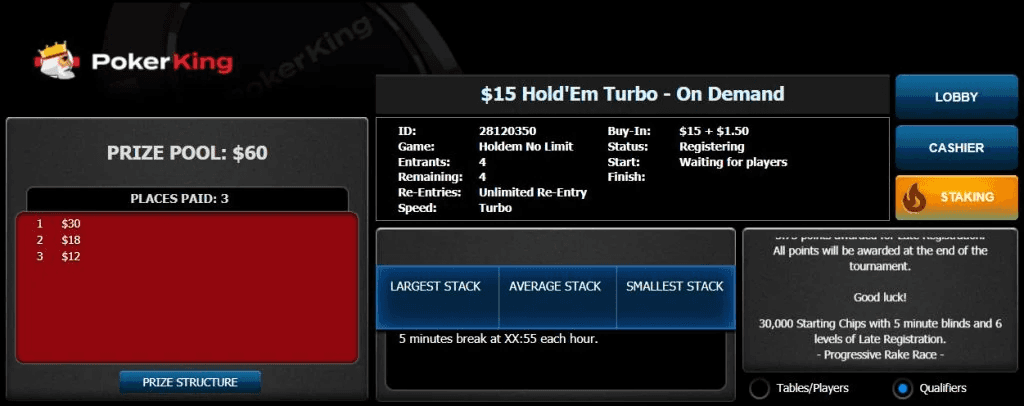
Re-entries increase the prize size in On Demand
Winamax. The French room also didn't abandon Sit&Go. By the number of players on the tab, Winamax holds second place after PokerOK. In the evening, more than 100 Double or Nothing tournaments alone are held. The most popular are DON with buy-ins up to €10. Heads Up are also of interest to the audience. You can take part in the cheapest 1v1 duel for €0.50, and in the most expensive for €500. Note the relatively high interest in the 15-player MTSNG. In the evening up to 30 tables of the format are played. Classic SNG don't attract the audience. As part of the Sit&Go Challenge leaderboard, players are awarded €500 per day.
TigerGaming. On TG, the most popular is the original 8-Bomb format. It's run by the rules of classic Sit&Go tournaments, except for every 8th hand. In it, opponents pay an ante, skip the preflop, and start the hand from the flop. An 8-player pot increases the dynamics of play. The other formats don't generate interest among the audience. In the evening 3-4 Heads Up are played. A modest figure against the backdrop of 25-30 8-Bomb tournaments.
Why multi-table tournaments are better than Sit and Go
Sit & Go is a good entry point into poker. They don't require advanced postflop skills and offer less brutal competition compared to regular tournaments. In the past, Sit and Go allowed players to earn well. Now the discipline is in crisis, which makes it less appealing. Many rooms have removed Sit&Go from the lobby. Where the discipline has been kept, there's little interest in it. Multi-table tournaments occupy a more advantageous position. Thousands of tournaments are held online every day.
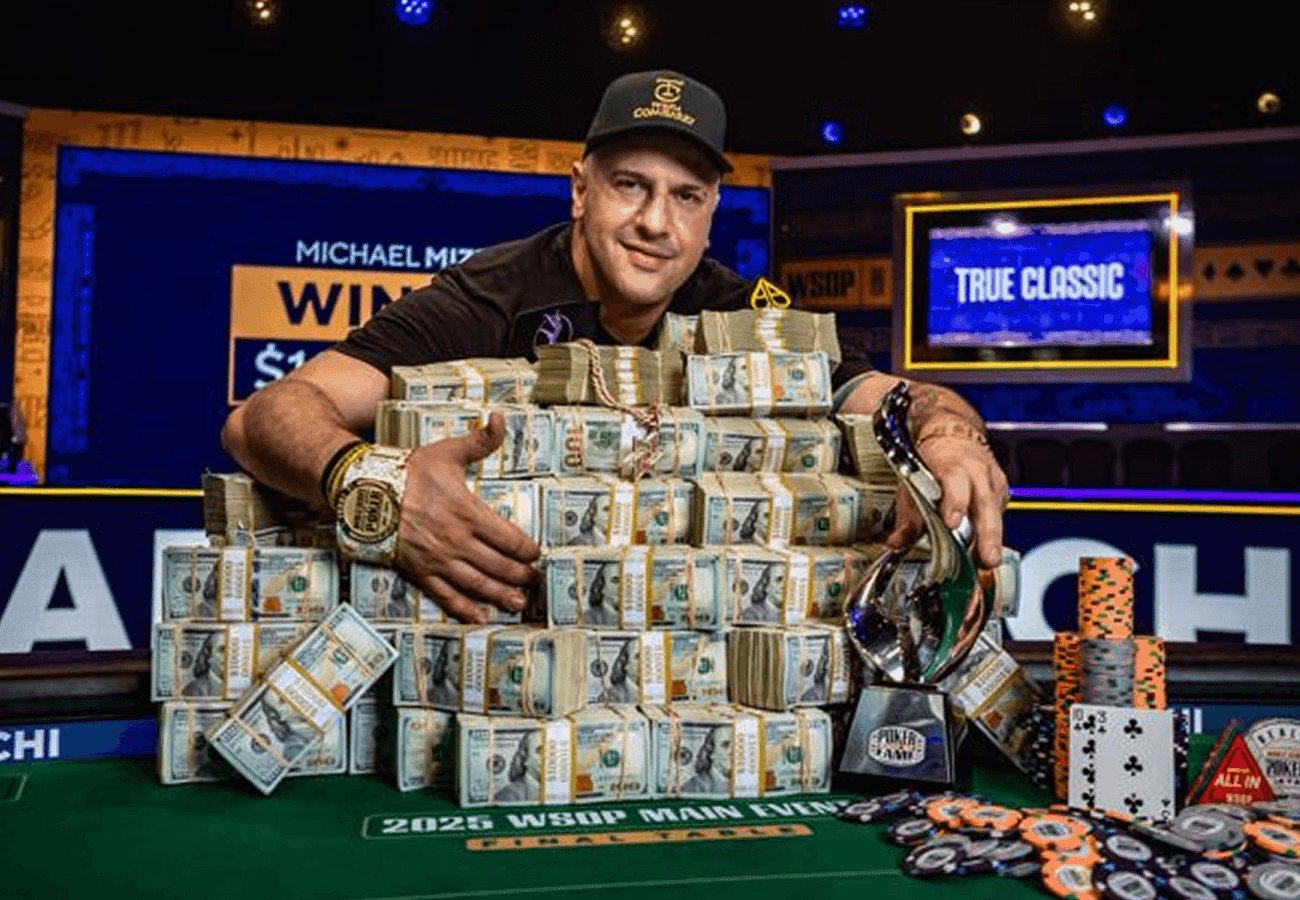
The most prestigious poker competition — the World Series of Poker — is held in tournament format
It's not only the wide selection that argues in favor of multi-table tournaments. Other advantages of MTTs:
Prizes. According to SharkScope statistics, the best Sit&Go player earned $233,000 in 2025. The income of a top multi-table tournament regular reached $1,940,000. SNG also falls short at the local level. For winning the most expensive Sit&Go, a player gets a few buy-ins. Success in a tournament can multiply the entry fee hundreds of times and make a player a millionaire.
Recognition. The nickname of the best Sit n Go player is known to a narrow circle of fans of the discipline. The name of the WSOP Main Event winner thunders across the entire industry. The WSOP champion gets a precious bracelet and goes down in history forever.
Growth potential. Successful SNG players quickly hit a ceiling. Single-table tournaments with buy-ins above $100-$200 are held nowhere. As a result, a player either stops developing or moves into full-fledged tournaments. Regular MTTs place higher demands on a player, so you need to study constantly. In tournaments you can grow endlessly.
An inspiring example of moving from Sit&Go to MTT was shown by Benjamin "bencb789" Rolle. The player started his online journey in 2009. At the start he played Sit and Go. In 2013 the player moved into regular tournaments and didn't miscalculate. The rightness of the choice was confirmed by his win in SCOOP 2014. First place brought bencb789 $243,367. Today Rolle is considered one of the strongest tournament players in the world. In 2025 the German player won the ME WSOP Online and earned $3,900,000. Rolle's total career earnings exceed $9,500,000.
If you want to start a tournament career, we recommend taking the free FF Start training course. It will let you study the basic concepts of the discipline and reinforce them in practice. The course includes: basic math, the fundamentals of adapting to different types of opponents, short-stack play, and final-table tournament strategy.

Free course · FF Start
Understand the logic of MTTs
Study the early stage, the bubble, short stacks and the final table as one system.