What Is ABI in Poker and How to Calculate It
ABI is a transition to a more disciplined and sustainable model of play. In this article, we'll talk about how to calculate your ABI and make tournament selection decisions not based on emotions, but according to a clear system.

Ilya is a Liga 2 player with six years of experience in online MTTs. He graduated from the Faculty of Journalism at RSUH and writes about poker for beginners, explaining complex things in simple, clear language. In his texts, Ilya combines his personal playing experience with his professional journalism skills to help newcomers confidently get into the game.
In tournament poker, results almost never reflect the true quality of play over a short distance. Even with correct decisions, a player can run into a prolonged downstreak, lose part of their bankroll, and start making increasingly risky decisions.
Often the problem doesn't lie in the strategy of playing hands, but on a more basic level — in tournament selection. A player may be a winner, yet regularly enter events with an inflated buy-in, which increases variance and destroys the consistency of results.
That's exactly why understanding ABI is a step toward a more disciplined and stable model of play.
*A downstreak is a period when a player loses for a long time or shows worse-than-expected results.
*Bankroll is the amount of money a player has set aside specifically for playing poker.

New breakdowns in your inbox
Subscribe to the FunFarm newsletter: fresh Poker ABC articles and material that helps you grow as a player.
What ABI is in poker
ABI (Average Buy-In) is a metric that reflects the average cost of the tournaments a player participates in over the long run.
Unlike the standard buy-in, which shows the cost of a single event, ABI describes the entire tournament schedule. This is fundamentally important, because most MTT players play dozens of tournaments with different entries at the same time.
Thus, a single expensive tournament does not by itself determine the level of play. Its influence only shows up through a change in the average value.
Amateurs more often focus on individual tournaments and their payouts, whereas a professional works with the long run. For them, what matters is not which tournament was played, but how it affects the overall load and risk.
In this sense, ABI becomes a tool that turns play from a set of scattered decisions into a systematic process.
The ABI formula and calculation examples
Formally, ABI is calculated with a simple formula:
ABI = Sum of all buy-ins ÷ Number of tournaments played
However, the formula itself is only the beginning. What's more important is to understand how it reflects the structure of play.
A simple example
A player played 5 tournaments with the following buy-ins:
$5 + $11 + $11 + $22 + $11 = $60
ABI = $60 / 5 = $12
This example shows that even a single more expensive tournament affects the final value. If instead of the $22 there had been another $11 tournament, the ABI would have dropped.
This means that every deviation from the base limit increases the overall level of risk.
An example over the long run
In a month, a player played:
— 50 tournaments at $10
— 20 tournaments at $15
— 5 tournaments at $30
Total amount: 50×10 + 20×15 + 5×30 = $950
Number of tournaments: 75
ABI = 950 / 75 ≈ $11.9
Here you can clearly see how the balance works. Despite the presence of expensive tournaments, the overall level stays close to the base.
This is exactly what allows poker professionals to add more expensive events without destroying their bankroll.
Why ABI is needed

The main function of ABI is managing risk over the long run.
In MTTs, variance is significantly higher than in cash games. Even a strong player can go a long time without cashing, and if the buy-in level is chosen incorrectly, the bankroll can't withstand such swings.
*Variance is the deviation of actual results from expected ones due to randomness. Simply put, it's the influence of luck over a short distance.
You can read more about what variance in poker is in our article.
ABI lets you stabilize the situation through several effects:
it smooths out the impact of individual expensive tournaments
it limits the average level of load
it makes results more predictable
In addition, ABI serves a psychological function.
A player who focuses on their average buy-in* makes emotional decisions less often. They don't raise their stakes after a good run and don't try to win back losses in expensive tournaments after setbacks.
*A buy-in in poker is the amount of money a player pays to enter the game, i.e. the cost of participating in a tournament.
Learning at FunFarm, from any level
How many buy-ins you need for a stable bankroll
The standard rule for tournament players is to keep a reserve of 100 to 200 buy-ins. However, this is only a basic guideline that needs to be adapted to specific conditions.
Several approaches can be distinguished:
Conservative style: 200–300 ABI — minimal risk, slow growth.
Moderate style: 100–150 ABI — a balance between growth and stability.
Aggressive style: 50–100 ABI — fast growth, high variance
Examples:
Bankroll $300 → ABI of about $1–1.5
Bankroll $3,000 → ABI of up to $20
Such values let you withstand standard swings and keep control over your play.
However, in practice the bankroll is affected by additional factors, for example, the tournament format.
Turbo and hyper-turbo tournaments increase variance, knockout tournaments create additional variability because of the bounty, and large fields lower the probability of cashing.
In all these cases, a larger bankroll reserve is required.
How to build a tournament schedule with ABI in mind

Building a tournament schedule is the practical application of ABI in real play.
A player almost never has the option to play only one limit. The schedule of poker rooms is set up so that events with the same buy-in are distributed unevenly, which means that to get a full load you have to combine tournaments with different entry costs.
In this situation, the key task is not just to fill tables, but to maintain a structure in which the average buy-in stays within the target ABI. This is exactly what distinguishes systematic play from a random choice of tournaments. What should you pay attention to?
1. The basic logic of building a schedule
Any tournament schedule starts with three parameters:
Current bankroll
Target ABI
Acceptable range of buy-ins
After that, a schedule is formed where:
the bulk of the tournaments is around the target ABI
more expensive events are offset by cheaper ones
the resulting average value does not go out of bounds
For example, at an ABI of $5 a player can include tournaments from $1 to $15, but the structure must be skewed toward cheaper and mid-range events, so that rare expensive entries do not increase overall risk.
2. Balancing expensive and cheap tournaments
A mistake many players make is treating expensive tournaments as the most important events and shifting their focus to them, playing cheaper tournaments carelessly.
In practice, each such entry increases the average buy-in. If they are not offset by cheaper tournaments, ABI starts to rise, and variance rises along with it.
The right approach is to view each event as part of an overall system.
If a tournament above the range appears in the schedule, it must be balanced out by several cheaper entries. Only in this case is control over the bankroll maintained.
3. The impact of tournament structure
When building a schedule, it's important to take into account not only the buy-in, but also the characteristics of the tournaments themselves.
Number of participants (AFS)The larger the field, the lower the probability of cashing and the higher the variance. Tournaments with a large number of players require a more cautious approach, even if their buy-in matches the ABI.
Tournament typeKnockout tournaments and bounty events increase the variability of results. In such formats, part of the EV is distributed differently, so their share in the schedule should be limited, especially in the upper part of the range.
Blind structureTurbo and hyper-turbo tournaments speed up play and increase the impact of short stacks. This leads to higher variance, so such events require a deeper bankroll and cautious inclusion in the schedule.
4. The role of winrate and skill level
When building a schedule, it's important to take into account not only ABI, but also the player's actual skill level.
The EVbb/100 metric lets you assess how effectively decisions are made. If the winrate is consistently high, the player can gradually add more expensive tournaments.
If, however, results are unstable, raising the ABI will only intensify downswings.
Thus, a tournament schedule should be built not only from the bankroll, but also from the quality of play.

How to calculate your ABI
Above, we've already explained how to calculate your ABI by hand. This approach works well over a small distance or for one-off checks. However, in real play a regular deals with hundreds and thousands of tournaments, where manual calculation becomes inefficient and easily leads to errors.
That's exactly why, in practice, ABI is almost always tracked with the help of specialized software.
1. Holdem Manager and PokerTracker are the main tools for collecting and analyzing poker statistics.
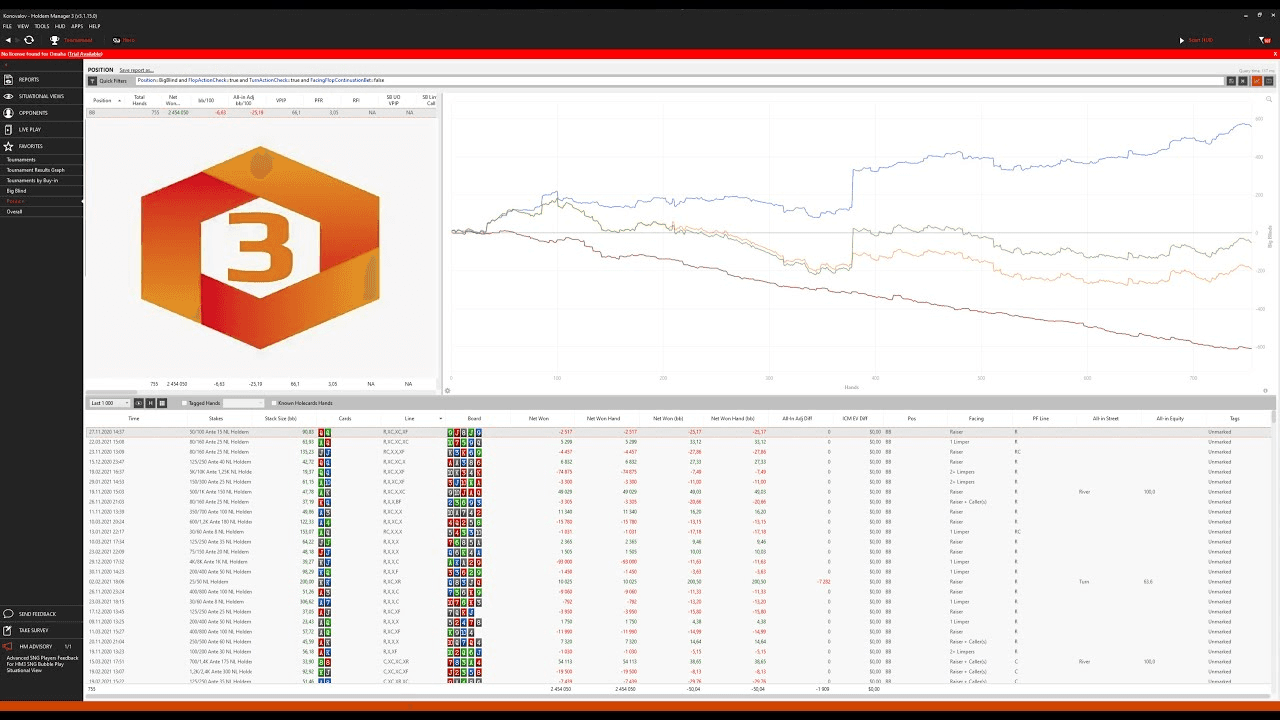
The Holdem Manager 3 interface
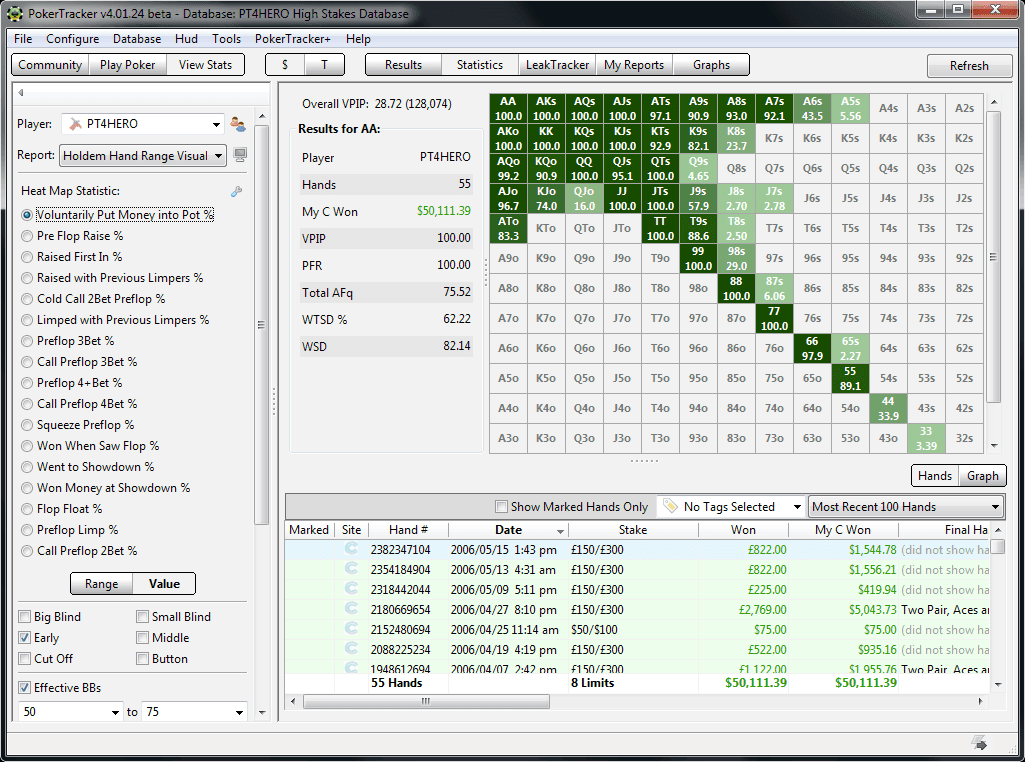
The PokerTracker 4 interface
They automatically import the history of hands and tournaments played, building a database on the basis of which key metrics, including ABI, are calculated.
In the context of ABI, these programs let you:
see the average buy-in (Avg Buy-In / Avg Total Buy-In) for any period
track the dynamics of how ABI changes
analyze results at different stakes
compare ABI with ROI, EVbb/100, and other metrics
This provides an important advantage: the player begins to see not individual tournaments, but the structure of their play.
For example, you can discover that the ABI rose unconsciously — because of adding a few expensive tournaments. Or, conversely, that the average buy-in is too low relative to your current level of play.
Thus, trackers turn ABI from a formula into a tool for control and analysis.
2. SharkScope is an online service that collects statistics on tournament players.
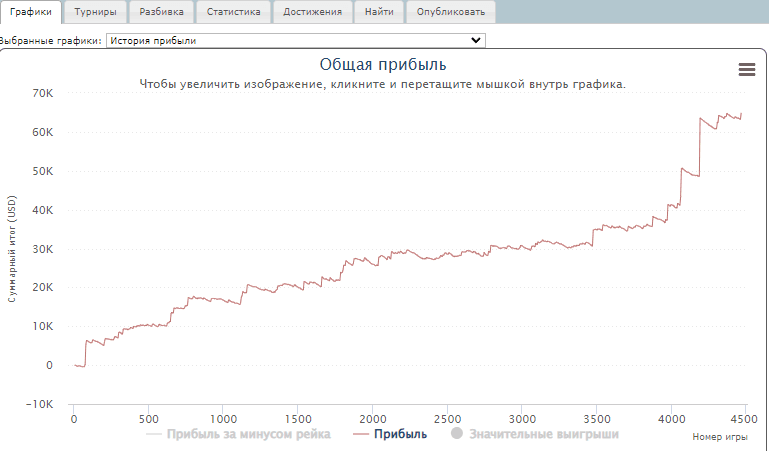
The SharkScope interface
Unlike trackers, it doesn't require installation and can be used to analyze both your own play and that of your opponents.
In the context of ABI, SharkScope shows:
the player's average buy-in
ROI and profit over the long run
the dynamics of results
the distribution of tournaments across stakes
This is especially useful in two cases:
Self-analysis. You can quickly assess whether your current ABI matches your results and bankroll.
Assessing opponents. An opponent's ABI gives an idea of their level and experience. A player with a high ABI usually plays a stronger field and has a more stable strategy.
Conclusion
Calculating ABI in poker is the foundation of a systematic approach to tournament play. It's the ability to control the level of risk, build stable play over the long run, and make decisions that don't destroy the bankroll.
Over the long run, it's precisely this approach that ensures steady growth and allows you to move up to higher stakes without critical downswings.
If you want to work on your game within a system and earn over the long run, apply to FunFarm.

Free course · FF Start
Master tournament poker
Understand tournament structure, stages of play, stack sizes and the key decisions.
Frequently asked questions
Read next

Call, 3-bet or fold after a raise: how to make decisions

Float in Poker: How to Use Position to Steal Pots
How to play against very aggressive players in poker