Four of a Kind in Poker: How to Make It and Play It Right
Let's discuss what four of a kind is in poker and how to play it correctly.

Ilya is a Liga 2 player with six years of experience in online MTTs. He graduated from the Faculty of Journalism at RSUH and writes about poker for beginners, explaining complex things in simple, clear language. In his texts, Ilya combines his personal playing experience with his professional journalism skills to help newcomers confidently get into the game.
Most hands in hold'em are won by weak combinations. High cards and top pairs regularly take down pots. Sets, straights, and flushes come far less often. The strongest poker hands players see only once every few months. Playing them often causes difficulties. Let's discuss what quads are in poker and how to play them correctly.

New breakdowns in your inbox
Subscribe to the FunFarm newsletter: fresh Poker ABC articles and material that helps you grow as a player.
Key facts about quads:
A combination of four cards of the same rank. For example, the starting hand 5♣️ 5♠️ on the flop 5♦️5♥️3♣️ makes quad fives.
Beats: high card, pair, two pair, set, straight, flush, and full house.
Loses to a straight flush and a royal flush.
If two players make the combination, the pot goes to the one with the higher rank. Quads 8♣️8♦️8♠️8♥️ beat 7♣️7♦️7♠️7♥️ because an eight is higher than a seven.
The probability of quads in poker depends on the player's starting hand. A pocket pair hits the combination on the flop 0.25% of the time. With an unpaired holding, quads come 0.01% of the time.
Some rooms pay out a jackpot for wins and losses with quads.
What are quads
Quads in poker are a combination of four cards of the same rank. For example, the hand 9♣️9♦️ on the board T♠️9♠️9♥️ makes quad nines.
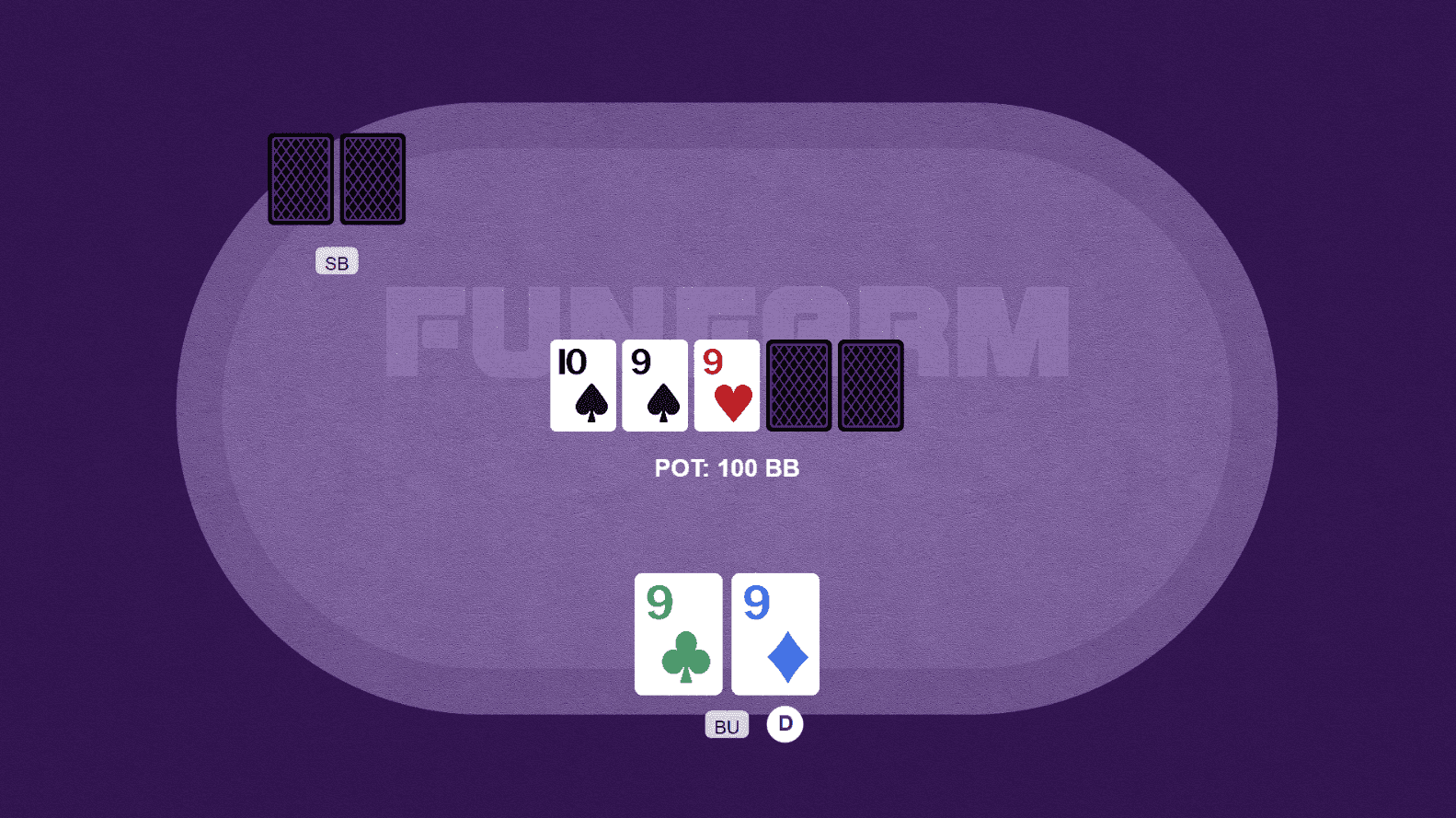
In most hands, four matching cards guarantee the win
There are three ways to make the combination:
Pocket pair + 2 of the same on the board. For example, J♠️J♥️ on the flop J♣️J♦️5♦️.
One card from an unpaired hand + 3 of the same on the board. For example, A♠️K♠️ on the board Q♠️K♣️K♥️2♦️K♦️.
Four cards of the same rank on the board. For example, A♥️J♠️ on the board 8♣️8♦️8♠️8♥️3♣️. The rarest scenario.
In the hand rankings, quads rank third, after the royal flush and the straight flush. They beat: high card, pair, two pair, set, straight, flush, and full house. The combination can be made in: no-limit hold'em, Omaha, short deck, seven-card stud, draw poker, and pineapple.
Which quads are higher — comparison rules
In "quads vs. quads" hands it's easy to determine the winner. The pot goes to the player with the higher combination. For example, Liv entered the hand with pocket A♣️A♥️. Igor called with the pair T♠️T♦️. The full board looks like T♣️T♥️A♠️6♥️A♦️. The opponents made combinations of the same type, but Liv wins the hand. A♣️A♥️A♠️A♦️ outranks T♠️T♦️T♣️T♥️.
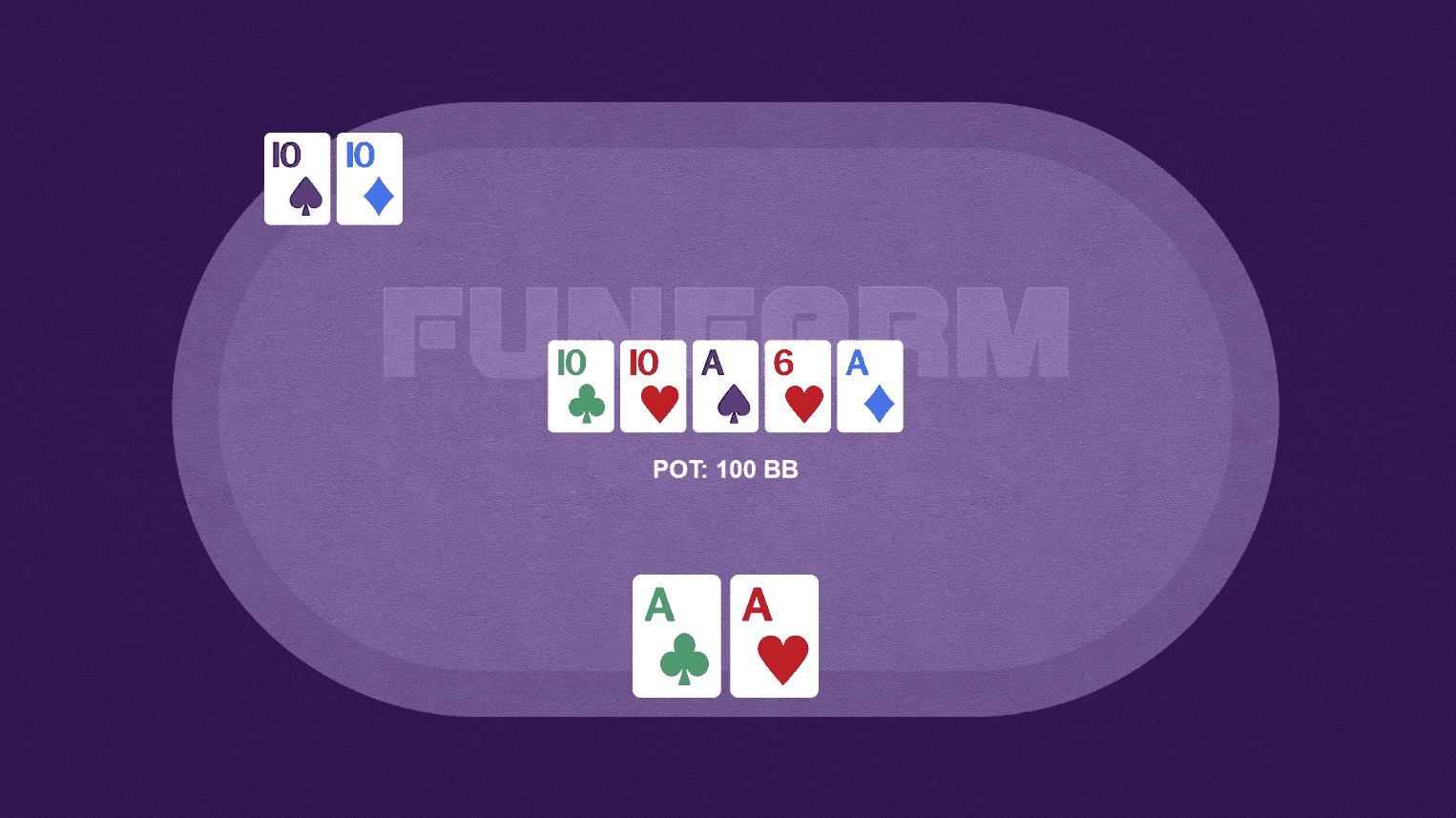
If both players make quads, the card rank determines the winner
In most quads situations, the fifth card of the combination doesn't matter. The exception is hands where 4 of the same rank land on the shared board. For example, Liv raised with K♣️J♥️ and Igor came along with J♠️T♦️. The board came 3♠️3♦️3♣️3♥️7♦️. Liv and Igor got the same quads, 3♠️3♦️3♣️3♥️. Do we declare a tie and split the pot? No, the pot goes to Liv because she has the higher kicker. The combination 3♠️3♦️3♣️3♥️K♣️ beats 3♠️3♦️3♣️3♥️J♠️. Not all poker players know how the rules work with quads on the board. Opponents often think they'll split the pot and call any bet. Don't hesitate to extract value if you caught an ace as your kicker.
Learning at FunFarm, from any level
The probability of making quads
The rarer the combination, the higher its value. The chance of hitting quads depends on the player's starting hand. A pocket pair will hit two of the same on the flop 0.24% of the time. If the player got an unpaired hand, the probability drops to 0.01%. With a set on the flop, quads will come by the river 4.3% of the time. The chance of hitting your single out on one street is 2%. Let's summarize the information on probabilities for a set in a table:
Stage of the hand | How we count | Probability of improvement |
From flop to turn | Divide 1 out by 47 cards in the deck | 2.13% |
From turn to river | Divide 1 out by 46 cards in the deck | 2.17% |
From flop to river | Divide 2 outs by 47 cards in the deck | 4.26% |
Calculations across 2 streets use a more complex formula that subtracts outs, but in the table we simplified it to 2 : 47.
In Omaha, players start the hand with a four-card hand, which raises the probability of making quads. With a pocket pair in the starting hand, the player will hit the combination on the flop 0.27% of the time. Two pair preflop raises the chances to 0.53%. The probability of hitting quads with a set also rises minimally. The increase comes from the two other cards of the starting hand. For example, a player entered the pot with 4♠️4♦️K♣️J♥️ and got the board Q♠️7♦️4♣️. We subtract K♣️J♥️ from the deck and the chances of making quads rise slightly.
How to play quads
With quads, the player will almost always win the hand. There's no point in protecting the hand against other quads or a straight flush. That probability can be ignored. However, the winnings often won't exceed a few blinds. The problem is the paired board. A flop with two of the same rank suggests trips. So the player won't put much money in the pot. At the same time, quads zero out the chance of trips for the opponent, which makes his range even weaker.
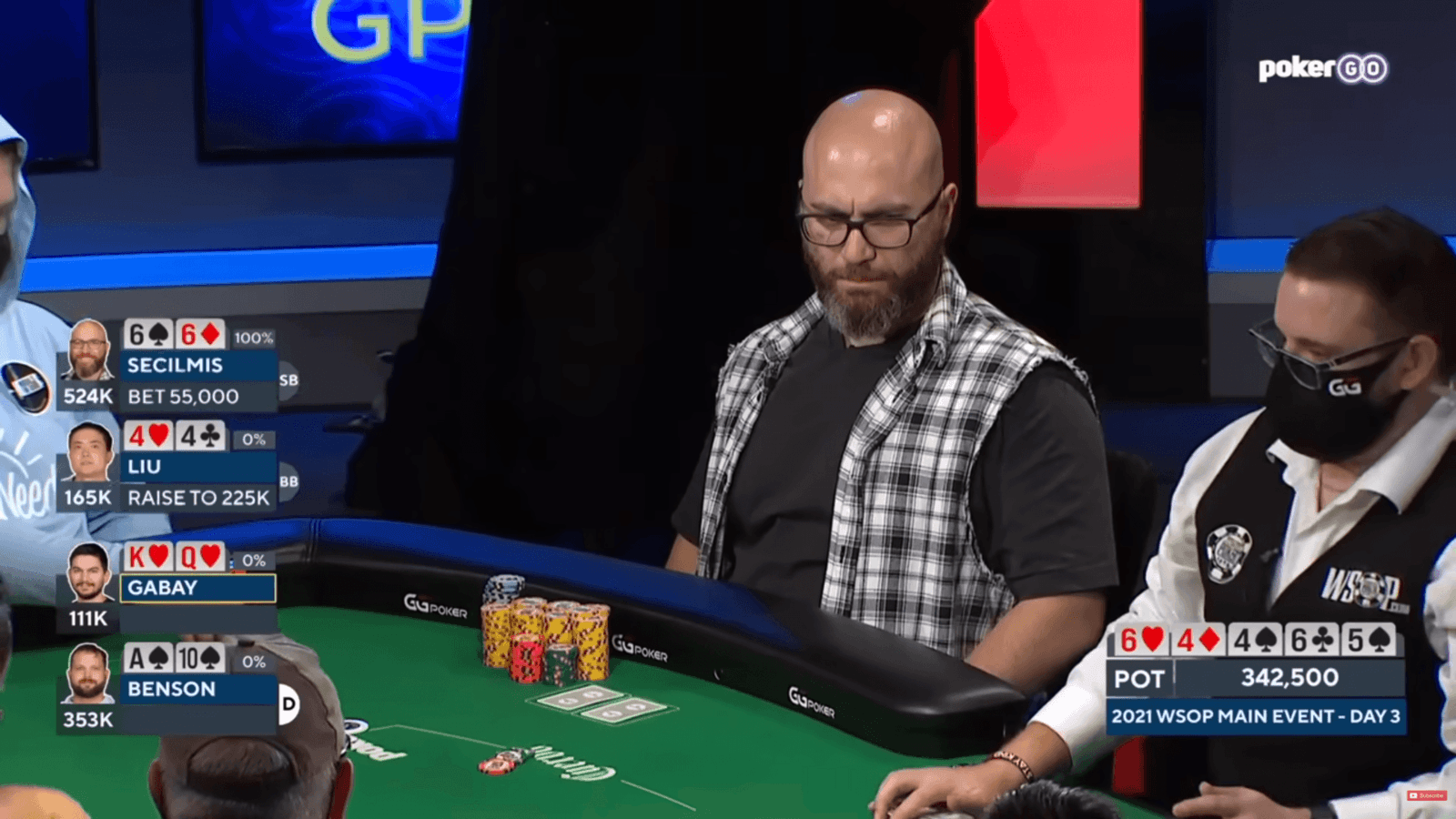
The most famous quads-vs-quads hand was played at the 2021 WSOP Main Event. Back then, Ozgur Secilmis's sixes beat Chang Liu's fours
The only chance to win a solid pot with quads is to give the opponent a chance to hit a decent combination. On the flop we choose to slowplay. If the opponent shows aggression, we respond with a call.
Against loose-passive opponents we make small value bets. Let's show with an example. Suppose the player got 6♠️6♦️ preflop and raised. A "calling station" on the big blind called. The flop came J♦️6♣️6♥️. The opponent's range has a lot of top pairs, hands with an ace, and overcards. So we'll often get a check-call of a 1/3–1/4 pot bet. On the turn we increase the sizing to 3/4 of the pot to extract value from top pairs and the draws that have formed. We repeat the heavy bet on the river too. The opponent will often fold, but sometimes we'll see calls from top pairs too.
Stats from a tracker can suggest the best decision. Does the opponent rarely fold to continuation bets and like to bluff? We make a modest continuation bet on the flop and let the opponent show aggression. Does the opponent play by the cards and fold in a disciplined way? We choose a passive line and give him the chance to hit a worthwhile combination.

Which rooms reward quads
Some platforms run Bad Beat Jackpot promotions. To get a payout, a player must win or lose with quads. Usually the promotion conditions look like this:
make a premium combination;
use both hole cards in the combination;
reach showdown.
Rooms specify the minimum qualifying combinations in the promotion rules. For example, on POKEROK it's enough to lose with a full house A-A-A-T-T or better. The largest BBJ is run by POKEROK. As of the end of April 2026, the jackpot exceeded $2,205,000. Players regularly receive a share of the BBJ. For example, on April 26, 2026, a user with the nickname "V Kostrub" lost with quad kings at an Omaha table. His opponent showed a heart royal flush and took the pot. The bad luck brought the player $127,442.
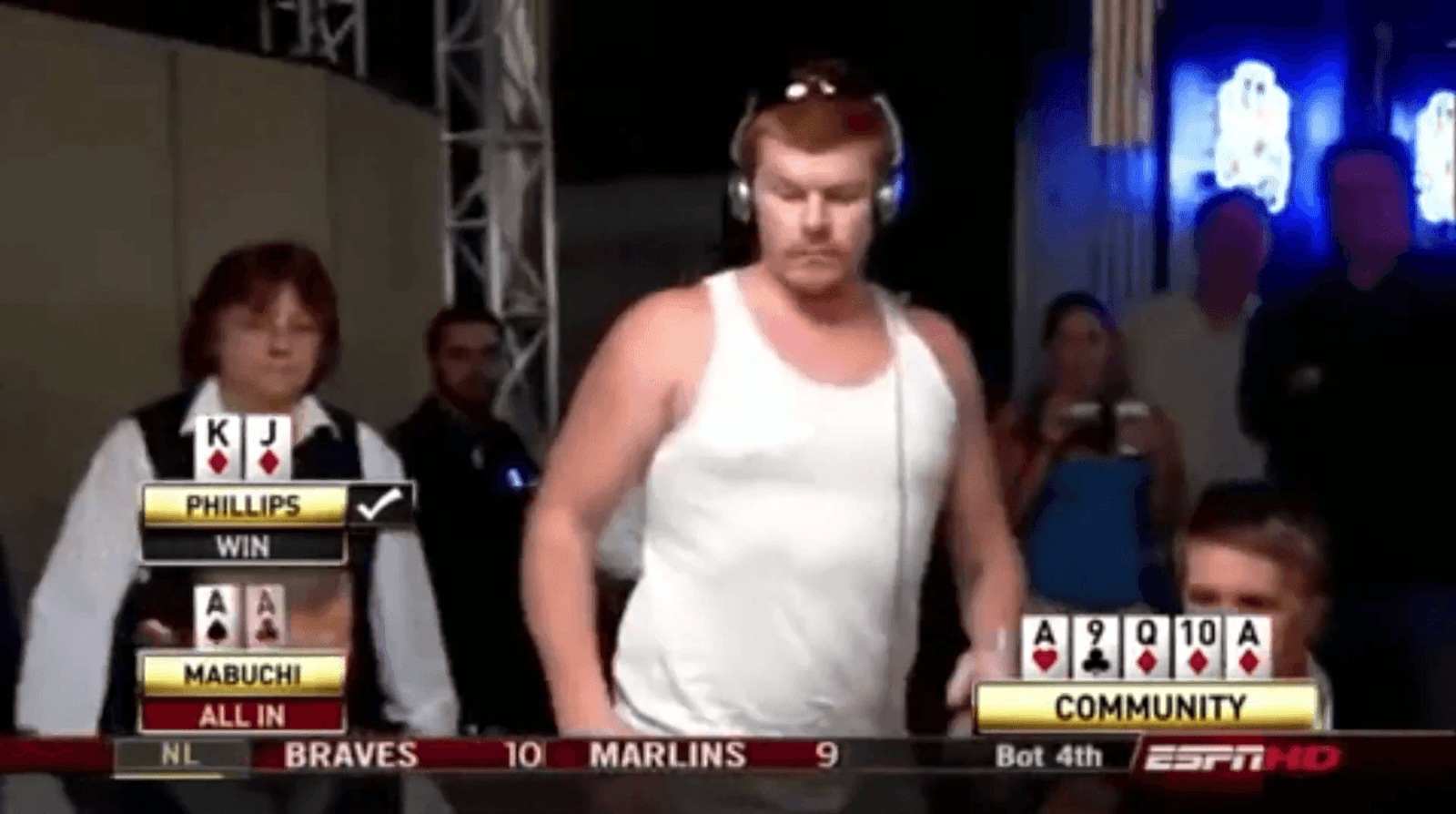
Losses with premium combinations usually reward cash players. Busting with quad aces at the WSOP is priceless. But the hand stayed in poker history forever
Bad Beat Jackpot promotions are run by: POKEROK, Pokerdom, TigerGaming, Stake Poker, 1Win Poker, and Pinco Poker.
How to learn to play poker
To win a hand with quads, you don't need to know GTO perfectly or see right through your opponent. A powerful combination leaves opponents no chance. However, a good player will take the opponent's stack with it, while a bad one will take a few blinds. To get the maximum out of every situation, a player must regularly work on their game. You can raise your level in various ways: watching videos, reading books, analyzing hands in software, working with a coach.
Building a study process on your own is hard. Which materials to study? How much time to spend on theory? How to retain the conclusions from analyzed hands in memory for a long time? Some players grope for the right approach for years. If you want to systematize your learning process, join FunFarm. For beginners, we recommend taking the FF Start course.

Graduates of the program for beginners are invited to the advanced course
It includes 30 lessons on: the rules of poker, math, adapting to different opponent types, and strategy for the late stages of MTTs. For experienced players, the advanced program FF Player Path is a good fit. It will let you beat the microstakes and reach an average monthly income of $1,200 and up.

Free course · FF Start
Your first hands, with a clear plan
Learn to read the table, compare hands and understand the order of action.