Poker solver: what it is and whether beginners need one
How it works, which one to choose and at what stakes you should start playing with a solver.


One of our first coaches: on the team since the very founding of the project. He prioritizes simple and practical training with an emphasis on real game situations and decision-making over the long run. Val doesn't just "beat the games" as a player, but also instills a systematic approach to the game and discipline in his students.
Practically every player who starts seriously studying poker sooner or later runs into the advice: “It's time to work in a solver.” From the outside, it can seem like this programme knows the correct answer to any hand and can instantly turn an ordinary player into a strong regular. In practice, it's all far more complicated.
*A regular (shortened to “reg”) is a player who systematically plays poker, putting in a significant volume over the long run in their chosen discipline.
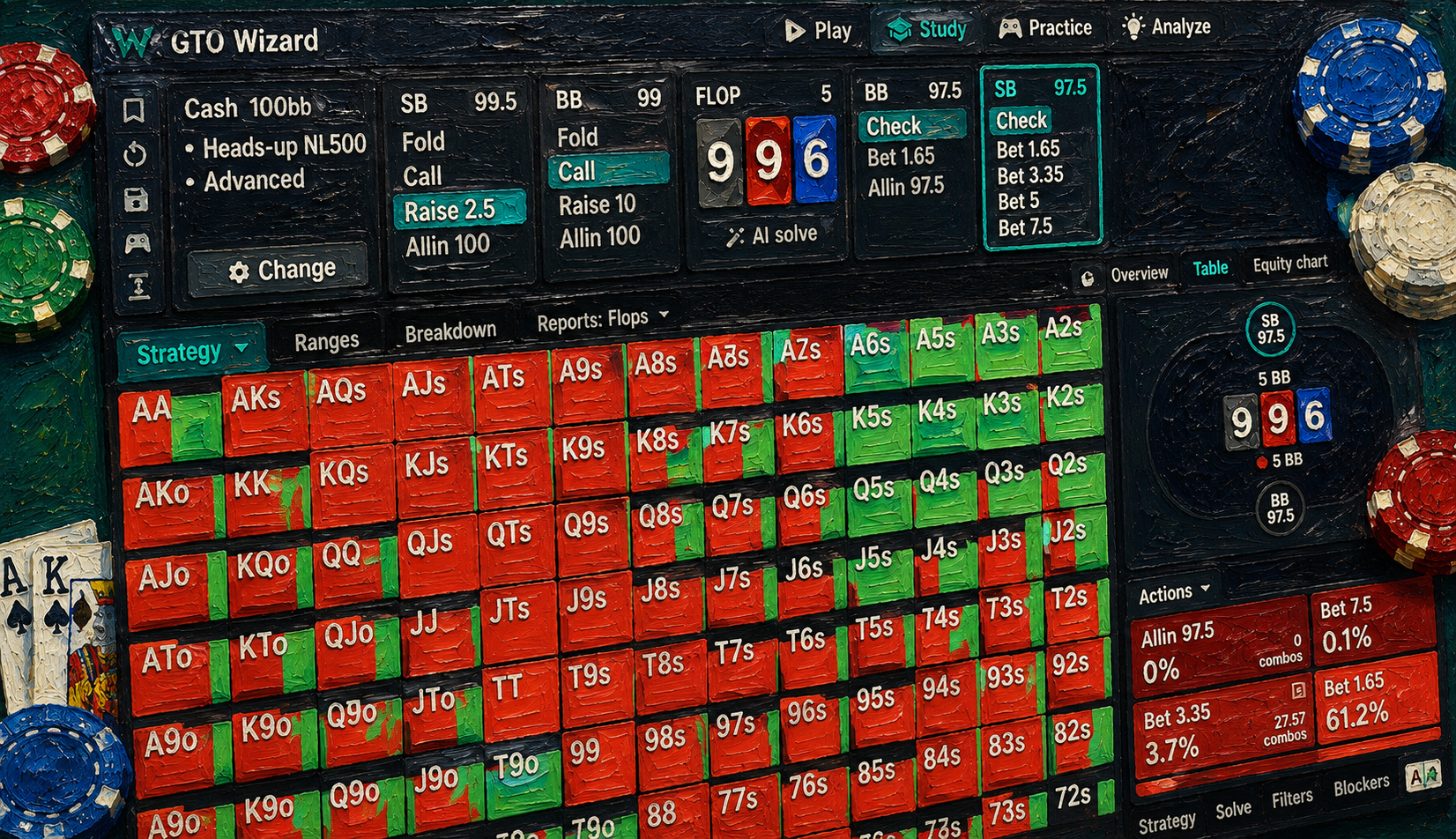
After the first launch, most beginner players see dozens of colourful tables, percentage ratios and confusing graphs. Instead of a clear answer of “bet or check”, the programme suggests using several different actions at a certain frequency. A natural question arises: what is such a tool for, and how do you even use it?
In this article, we'll break down what a poker solver is, how it works, and whether a beginner poker player should really spend time studying it.

New breakdowns in your inbox
Subscribe to the FunFarm newsletter: fresh Poker ABC articles and material that helps you grow as a player.
What is a poker solver
A poker solver is a programme that calculates the optimal strategy for a specific in-game situation from the standpoint of game theory — Game Theory Optimal.
*GTO (Game Theory Optimal) is a strategy that cannot be exploited. This means an opponent cannot profit from our deviations from the strategy, because there are none.
We covered this strategy in more detail in this article. Go and read it.
Unlike poker calculators or trackers, a solver doesn't evaluate a hand that has already been played and doesn't show opponent statistics. Its job is to determine which actions will be the most profitable under the given conditions.
To do this, the user sets the hand's parameters: players' positions, stack sizes, hand ranges, board structure, pot size, and available bet sizes.
The programme then calculates a huge number of possible scenarios and suggests a strategy that is practically impossible to exploit over the long run.
It's important to understand that the solver doesn't guess the opponent's cards and doesn't predict how a specific hand will play out. It considers hand ranges and calculates which actions will be optimal against the opponent's entire assumed spectrum.
How a poker solver works
Despite the complex maths, the general principle behind how a solver works can be explained fairly simply.
Imagine that a computer is able to replay the same hand millions of times. After each simulation, the programme compares different action options and evaluates which one would have brought in more profit. The calculation is then repeated again and again, gradually reducing the number of inefficient decisions.
Over time, the strategy becomes so balanced that it's practically impossible to improve it any further. This is exactly the kind of result the solver produces.
Most modern programmes are based on the Counterfactual Regret Minimisation (CFR) algorithm. Without going into the mathematical details, its job is to sequentially reduce “regret” over incorrect decisions. After millions of iterations, the programme arrives at a strategy close to Nash equilibrium.
Some programmes also use other calculation methods, such as Monte Carlo, which doesn't calculate every possible way the hand could play out, but rather a large random sample of them. This approach slightly reduces accuracy but allows the calculations to be significantly sped up.
What data does a solver receive
The solver itself knows nothing about a specific hand. All calculations are built on the information entered by the user. Typically, the programme needs to be given the players' preflop ranges, the effective stack, the pot size, the participants' positions, the cards on the board, possible bet sizes, and additional parameters such as rake or the ICM model for tournaments.
*ICM (Independent Chip Model) is a mathematical model used in poker tournaments to estimate the monetary value of a player's stack.
You can read more about how the ICM concept works in this article. Go and build up your understanding of the game.
The more accurately the initial data is set, the more useful the final calculation will be. That's exactly why experienced players pay a great deal of attention to building correct ranges. If the opponent's range is set incorrectly, the programme will still find the optimal solution — but for the wrong problem.
Once the calculation is complete, the solver displays a whole strategy. It usually includes:
the frequency of each action
expected value (EV)
the distribution of hands across different lines
optimal bet sizes
how the strategy changes on subsequent streets.
For example, the programme may recommend playing the same hand in several different ways. Say, on a flop with a top pair, the optimal strategy looks like this:
60% — a small-sized bet
25% — a large bet
15% — check
To a human, such recommendations may seem illogical. We're used to looking for a single correct decision. However, the solver's task isn't to simplify the game as much as possible, but to make it mathematically balanced. That's exactly why it often uses mixed strategies and different bet sizes with the same hand.
What GTO is and why you can't understand a solver without it
GTO is a mathematically balanced strategy that cannot be systematically exploited. If two players use such a strategy without mistakes, neither of them will be able to gain an advantage simply by changing their own play.
The foundation of this idea is considered to be the Nash equilibrium, formulated by the American mathematician John Nash. Applied to poker, it describes a situation in which it's not beneficial for any player to unilaterally change their strategy, because doing so would only worsen their result.
For example, if your opponent folds 80% of hands to every continuation bet, mathematically it becomes far more profitable to bluff much more often than GTO recommends. In other words, against a specific weak opponent, an exploit strategy will generate more profit.
*An exploit is a deliberate strategy in which a player consciously takes advantage of weaknesses, mistakes, or predictable patterns in the play of a specific opponent or group of players in order to gain an advantage over them and extract maximum profit.
By understanding what balanced play looks like, it becomes much easier to spot opponents' mistakes and to understand in which situations it can be profitable to deviate from the optimal strategy. That's exactly why professional players use solvers not to blindly copy every recommendation the program gives, but to understand the logic behind the decisions being made.
Learning at FunFarm, from any level
How solvers have changed modern poker
Just 15–20 years ago, most strong players made decisions based on experience, intuition, and the results of hands played. Many strategies were considered correct simply because successful professionals used them. The emergence of solvers significantly changed this approach.
Instead of relying on assumptions, players gained the ability to check almost any situation using a mathematical model. It turned out that many established ideas about poker were inaccurate, and some were completely wrong. That's exactly why modern poker looks noticeably different from the game of a decade ago.
1. Small continuation bets started being used much more often
One of the most notable discoveries concerned the size of the continuation bet. Previously, most players preferred to bet large — around 70–80% of the pot. It was believed that this made it easier to protect the hand and extract more value.
*Value — the profit you expect to get from your bet when you believe you have the best hand. A value bet is a bet made with the goal of getting paid by worse hands.
Solvers showed that on many dry boards, a small continuation bet of around 20–33% of the pot turns out to be just as effective. Today, small continuation bets have become the standard on many boards precisely thanks to solver-based research.
2. Overbets stopped being seen as an exotic play
Just a few years ago, a bet larger than the size of the pot was viewed as a rare technique. Solvers showed that on certain textures, an overbet is in fact the most effective option. Such bets are especially common on the turn, aimed at maximising equity realisation right here and now.
We covered in more detail how to play hands on the turn in this article. Follow the link and give it a read.
3. Big blind defence became significantly wider
Another important change concerns play from the big blind. Before solvers appeared, many players folded a large number of hands against standard opens.
Calculations showed that, thanks to the mandatory blind already invested, a significantly wider range needs to be defended.
As a result, modern charts contain far more calls with hands that were once considered obvious folds. Of course, the exact range depends on the opponent's position, stack sizes, and bet sizes, but the concept itself has changed substantially precisely thanks to the work of solvers.
4. Strategies have become more varied
Many beginning players try to find a single universal sizing for every situation. For example, always betting a third of the pot, always using 75%, always playing for half the pot.
Solvers showed that this kind of approach oversimplifies the strategy. In practice, optimal play often involves using several bet sizes at the same time.
For example, part of the range bets small, another part bets big, and some hands prefer to check altogether. This kind of distribution makes the strategy significantly harder to exploit.
That's exactly why working with a solver gradually changes the way of thinking itself. The player starts thinking not in terms of a specific hand, but in terms of what their entire range looks like in a given situation.
Popular poker solvers
In recent years, a huge number of programs for calculating GTO strategies have appeared. They differ in price, functionality, processing speed and computer requirements. Some are designed for professional players who build their own game trees and run complex calculations, while others are aimed at those who want to quickly study ready-made solutions. Let's look at the most popular options.
PioSolver
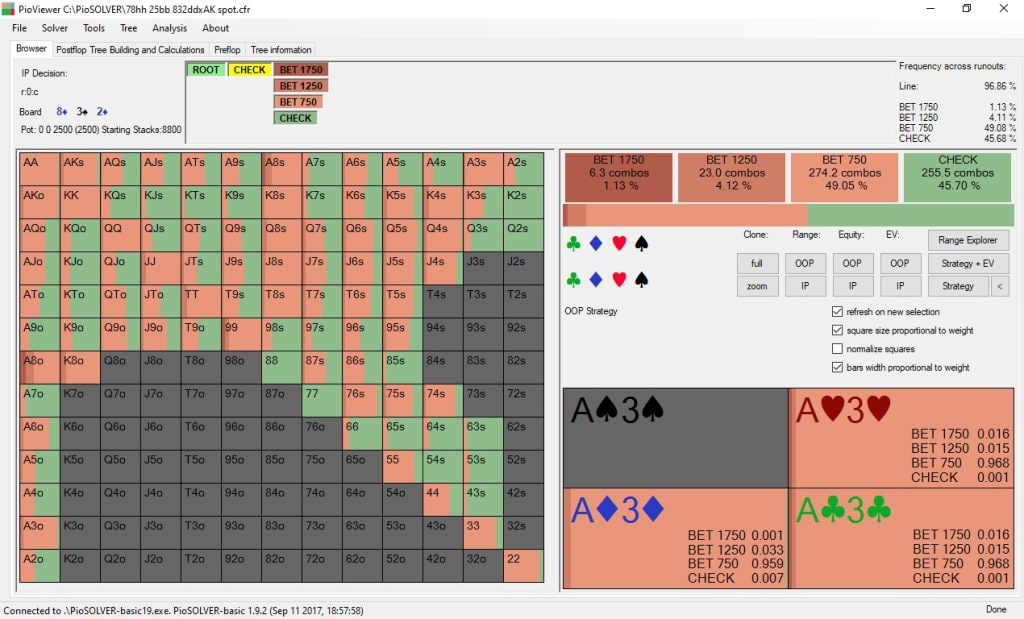
One of the first solvers to become widely used among professional players. It was with its appearance that working with GTO became available not only to game theory researchers, but also to the poker community.
The program allows you to set almost any hand parameters yourself:
player ranges
stack sizes
board structure
bet sizes
possible lines of play.
After that, PioSolver calculates the optimal strategy for each situation.
The main advantage of the program is flexibility. The user has full control over the calculation process and can model almost any game scenario. However, there are also drawbacks.
To work effectively with PioSolver, you need to have a good understanding of the principles of building game trees and correctly setting input parameters. In addition, complex calculations require a fairly powerful computer and a large amount of RAM. That's why PioSolver is now more often used by experienced players and coaches.
GTO Wizard
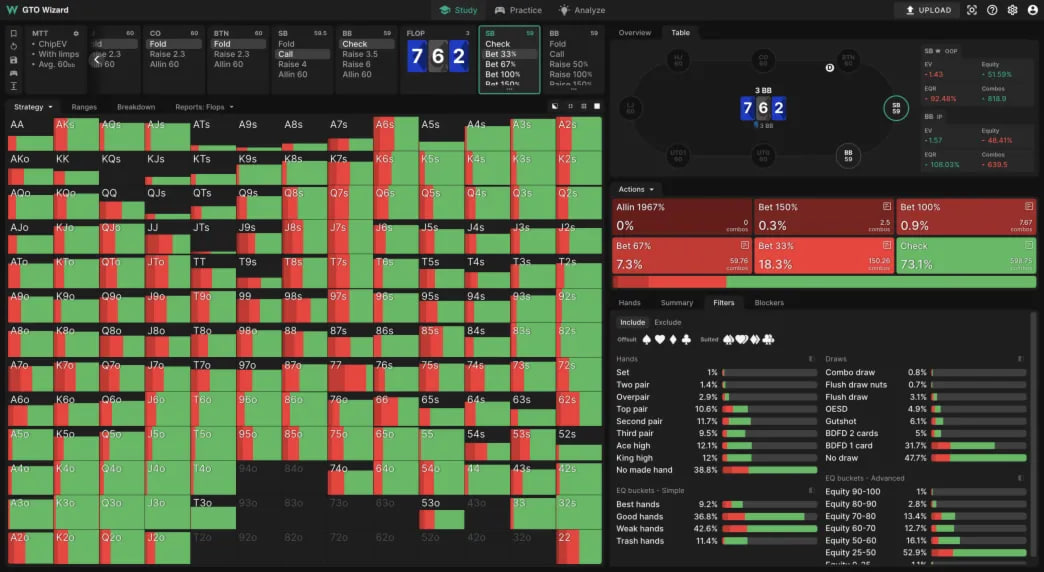
In recent years, it is GTO Wizard that has become the most popular tool for studying GTO. The main difference of the service is that most of the calculations have already been performed in advance.
The player doesn't need to wait several hours for the program to calculate the tree. It's enough to select the situation of interest, and the ready-made solution opens almost instantly.
In addition to viewing solutions, the service offers many additional features:
interactive drills
strategy knowledge tests
comparing your own play with GTO
training for specific game situations
ready-made preflop charts
Thanks to this, GTO Wizard is suitable not only for professionals, but also for mid-level players who are just starting to get acquainted with the solver approach.

Simple Postflop
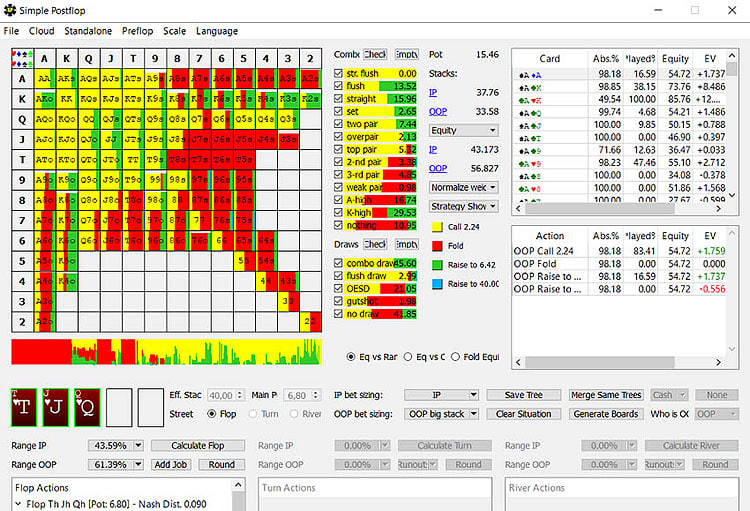
Simple Postflop occupies an intermediate position between PioSolver and modern cloud services. The program has extensive customization options and a high calculation speed.
It also allows you to build game trees yourself and model various scenarios, however, the interface is considered more user-friendly by many users.
Simple Postflop is actively used both by professional players and poker schools when preparing training materials.
How to work with a solver correctly
One of the most common mistakes made by beginner players is opening a random hand, plugging it into the solver, and memorising the ready-made solution. This approach rarely brings any benefit.
Firstly, it's impossible to remember every possible situation. Secondly, without understanding the reasons, recommendations are quickly forgotten and hardly help during play. It's much more effective to use the solver as a tool for finding patterns.
Step 1. Choose a specific hand
It's best to start with situations that genuinely caused difficulties during play. The more specific the problem, the more useful the analysis will be.
Step 2. Try to make the decision yourself
Don't look at the program's recommendations right away. First, ask yourself a few questions:
Who has the range advantage?
Who has more strong combinations?
What bet size would I play?
Which hands would I choose to check with?
This kind of analysis forces you to think for yourself rather than mechanically copying answers.
Step 3. Compare your conclusions with the calculation
Only after that should you open the solver. Pay attention not only to which action turned out to be optimal, but also to the reasons behind such a choice. For example:
why the program preferred a small bet
why some strong hands went into the check range
which hands are used as bluffs
which combinations protect the checking range
It's precisely these patterns that represent the greatest value.
Step 4. Look for recurring principles
Don't try to memorise thousands of individual solutions. Instead, pay attention to the general ideas. For example:
on which textures small continuation bets are used more often
when overbets appear
why on some boards the solver almost never uses large bets
how strategy changes depending on stack depth
Gradually, such patterns start to carry over into new game situations. This is exactly how genuine learning is built.
Which solver to choose
The choice depends primarily on your goals. If your aim is to understand the basic principles of GTO and regularly study ready-made solutions, GTO Wizard or similar online services will be enough for most players.
If you want to independently explore new game situations, build your own models and dive deep into theory, it's worth taking a look at PioSolver or Simple Postflop.
That said, it's important to remember that even the most expensive solver won't replace an understanding of poker. The programme only calculates the optimal strategy — interpreting the results is still up to the player.
Apply to FunFarm to learn how to work with solvers and level up your game skills.

Free course · FF Start
Learn poker systematically
From the first rules to strategy, math and a clear development plan.