MTT Poker Strategy: Early, Mid & Late Stage Guide
MTT is a multi-table format of tournament poker. Like any other variety of poker, it has its own specifics that you need to know to play successfully.

One of our first coaches: on the team since the very founding of the project. He prioritizes simple and practical training with an emphasis on real game situations and decision-making over the long run. Val doesn't just "beat the games" as a player, but also instills a systematic approach to the game and discipline in his students.
In short, this is a format where conditions change faster than we can get used to them: blinds grow, effective stacks shrink, the goals of hands change, and as we approach the payouts and the final table, chips become more valuable.
That's why the same hand and the same spot can have different value at different moments in the tournament.
In this article we'll cover:
which MTT stages are useful to distinguish and how to understand which stage we're in right now
why tournaments have two game models (ChipEV and ICM), and how they change ranges and aggression
how position and stack depth define our preflop strategy
how to build our game in the early, middle, and late stages
how to survive the bubble and play the final table without chaos — through simple principles and clear rules.
Our goal is to put together a clear system, so that at every stage we have a logic by which we choose our line and don't lose EV because of the wrong context.
* EV (Expected Value) is the mathematical expectation: how many chips or how much money you will on average win or lose over the long run by making a specific action in a specific situation.
What an MTT is and why a single strategy doesn't exist
MTTs are multi-table tournaments, where we start the game with identical starting stacks and conditions, but over the long run we get a constantly changing environment:
blinds grow → we need to use every possible situation to enter a hand
opening and defending the blinds starts to bring a noticeable expectation
in key stages the cost of busting out of the tournament rises sharply.
In tournaments we need a scheme: what to focus on in this segment and which risks are justified, based on the stage and the stacks.
* A 3-bet in poker is the third aggressive action in a hand. It's also called a reraise.
* A 4-bet in poker is a reraise of a 3-bet, that is, the fourth aggressive action in a hand.
You can learn more about 3-bets in poker in this article, and more about 4-bets — in this one.
ChipEV and ICM — and why it's important for us to distinguish them
These are the names of the two main game models used in MTTs. Let's explain in simple terms.
1. ChipEV is a model where we evaluate decisions through the expected profit in chips. Roughly: if a call/raise brings +X chips over the long run, we make it regardless of how the result looks over the short horizon.
ChipEV logic dominates in the early stage and through most of the middle stage — until the pressure of the payouts becomes decisive.
The practical consequence of ChipEV: we don't avoid +EV all-ins because of the risk of busting, if the big payouts are far off and the value of a chip is roughly linear.
2. ICM (Independent Chip Model) is a model where chips don't equal money directly. Losing part of your stack can cost more than an equivalent gain, because we pay not only with chips — we pay with our chance to finish in a higher place.
ICM shows up most strongly: on the bubble/pre-bubble, in the pre-final stage, and at the final table.
* ICM in poker is a mathematical model that determines the value of a player's stack in money at different stages of the tournament.
The practical consequence of ICM — ranges become more asymmetric. All-in calls need to be made less often and more thoughtfully, especially against stacks bigger than ours. The chip leader's aggression becomes more profitable, because the field tends to over-fold.
How do we apply this without formulas? We aren't obliged to count ICM in every hand. But we are obliged to understand three markers:
1. How close are the significant pay jumps?
2. Who covers whom in stack?
3. What is the state of the field — are the players at the table playing aggressively or tightening up?
Learning at FunFarm, from any level
The five stages of an MTT: a handy model for decision-making

For the strategy to be practical, we need a clear map of the tournament. We can use a model of five stages:
1. Early stage — from the start until the end of late registration — or until the average stack is around 50 BB, if there's no late registration.
2. Middle stage — after the end of late registration until the bubble.
3. Bubble — the zone right before ITM — reaching the prize zone.
4. Late stage (ITM) — after the money until the final table.
5. Final table — a separate game with maximum ICM pressure.
Next — a breakdown of each stage so that we can apply the concepts at the tables.
Early stage
In the early stage we have a resource that's rare in tournaments — a deep effective stack. This doesn't mean we're obliged to play more hands "because we can." It means something else: we can create situations where weak players will have to make many decisions postflop, and therefore make mistakes more often.
In MTTs, this is exactly the most sustainable way to accumulate chips at the start of the tournament — not by forcing events, but through the systematic selection of profitable hands.
For this we need to:
be in position against weak ranges more often
choose hands that realize equity well, that is, not only have chances to improve but are also capable of winning large pots
play for value against players who tend to overpay
If we keep this goal in mind, the early stage stops being a "warm-up" and becomes the phase where we lay the foundation of our future stack.
* Equity is the share of the pot that mathematically belongs to you at a given moment in the hand, based on the probability of winning.
What is characteristic of the early stage?
1. Deep stacks (100–300 BB). Depth sharply increases the importance of two factors:
position: in position it's easier to control the size of the pot and realize equity
combination: hands with good postflop playability become more valuable, while marginal hands without a plan become more costly in mistakes.
* Marginal hands are medium-strength hands that sit on the edge between a profitable and an unprofitable decision.
2. Cheap blinds. The cost of one round of betting is small. But in the early stage we more often lose not because of the blinds, but because of large pots with vulnerable hands. That's why our priority is not the frequency of participation, but the quality of entering a hand.
3. More weak players. In this stage we more often than in others see limps, unbalanced calls of 3-bets, overvaluing of hands, and opponents' desire to see the board run out to the end.
* A limp is entering a hand by calling the big blind.
Preflop play in the early stage
In the early stage we play deep, so preflop decisions directly affect the complexity of postflop decisions. Our task is to enter pots in a way that lands us in clear and profitable situations more often.
1. Early positions — careful ranges
Opening from UTG/MP is an investment in a pot where we'll often be out of position. That's why the requirements for a hand are higher.
In practice this means:
we more often open hands that hold domination: broadways, strong suited Ax, pocket pairs
we less often play weak connectivity "for the sake of the flop"
we avoid spots where after calling we don't understand the plan for several streets.
Too wide a range from early positions leads to many difficult and -EV decisions on the flop and turn.
* A hand range is the set of all possible starting hands a player can have in a hand, based on their actions and position.
2. Late positions — we widen through playability
In position we can play wider, because:
we realize equity better
we more often control the size of the pot
it's easier to continue aggression after a c-bet
But the widening should be structural. We add hands capable of making strong combinations: suited connectors, suited broadways, Axs — with good potential and backdoors.
* A continuation bet (c-bet) is a bet made by the player who showed aggression on the previous street.
We covered positions in poker in more detail in this article.
3. Isolating limps
A limp in the early stage often means a weak or unstructured range.
By isolating the limper in position, we:
play heads-up against a weak range
get more value from the opponent's mistakes
more often make better decisions postflop.
4. We use 3-bets more often against weak ranges
In the early stage many players fold poorly to a 3-bet and continue with dominated hands.
This gives us the opportunity to:
3-bet for value more often
build pots against weak ranges
apply pressure on opponents who play 3-bet pots poorly.
The main thing is to choose hands with good structure and to understand the plan for continuing, rather than 3-betting automatically.
* Value is the play of getting paid off by an opponent's weaker hands.
Middle stage
This is a transitional phase between comfortable depth and the zone of increased pressure. We still mostly play by the ChipEV model, but at the same time we must understand: time begins to work against a passive strategy. While in the early stage we could afford a waiting game, now each round of blinds has a more noticeable impact on the stack.
Our task in this stage is not just to survive until the bubble, but to actively grow our stack, using the advantage of position, the dynamics of the table, and the mistakes of opponents.
The middle stage is characterized by several systemic changes.
1. The cost of a round grows. The antes and increased blinds make every missed spot more expensive. Passivity starts to "eat" the stack faster than it seems. If we fold too often in late positions or don't defend the blinds, our stack gradually drains away without resistance.
2. The average stack in the tournament is 40-80 BB, and short stacks appear. This is the range in which decisions become more sensitive. We're no longer playing a depth of 150 BB, but we're also not in the push/fold zone. A mistake here can cost a significant part of the stack, while competent aggression can give a steady increase in chips.
3. Steals and blind defense become a full-fledged source of EV. While in the early stage winning 1.5–2 BB didn't matter much, now it's a systematic tool for accumulating chips.
* A steal is an attempt to steal the blinds from a late position before the flop.
4. The frequency of 3-bets and resteals increases. Players start to defend their ranges more often, and the battle in late positions becomes more aggressive.
* A resteal is a reraise — usually a 3-bet or a push — against a player who's trying to steal.
* A push is a bet for everything, that is, an all-in.
Bubble

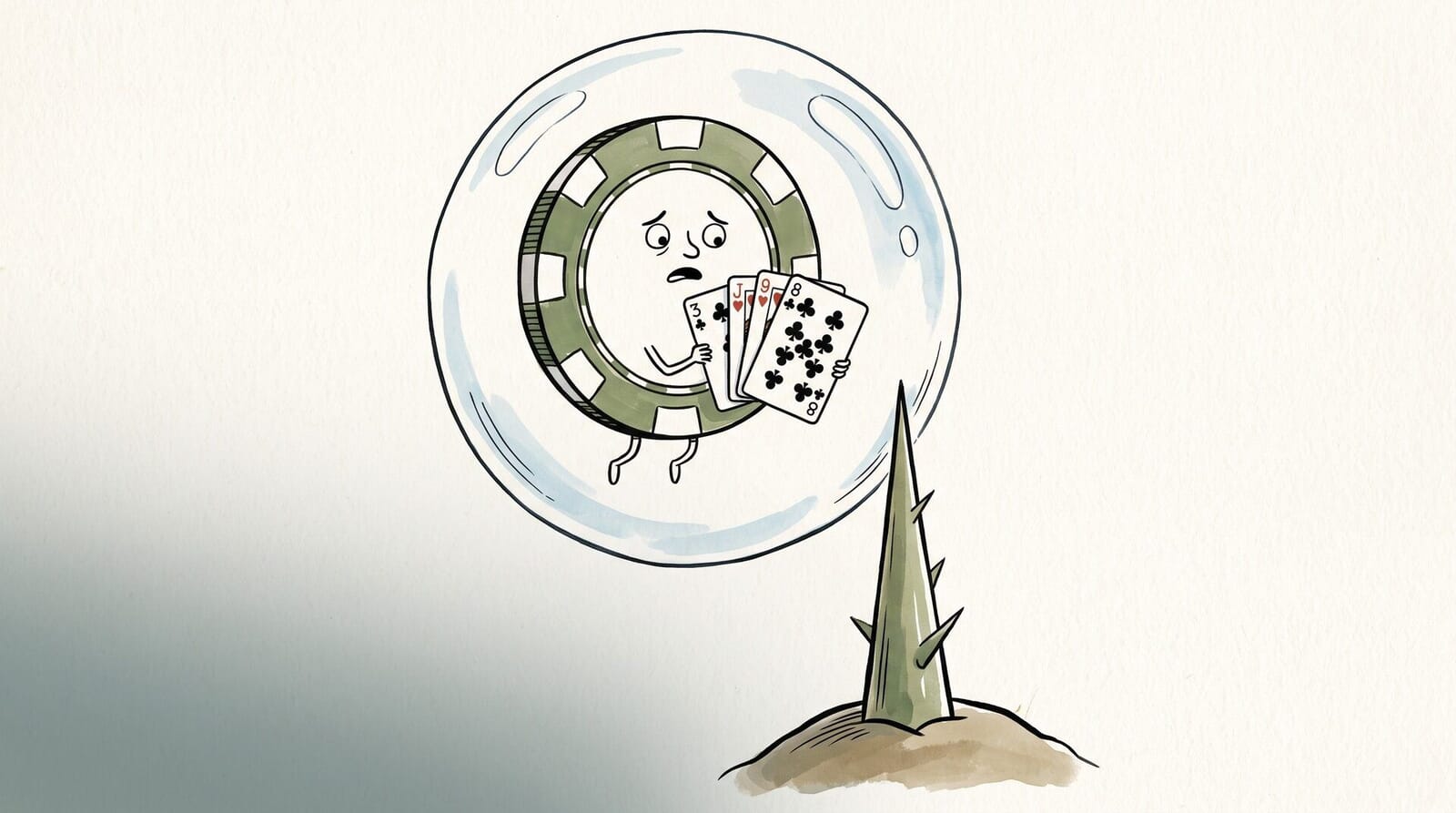
The bubble is the stage right before ITM — reaching the prize zone — when the elimination of several players is rewarded with money. At this moment pressure kicks in: people are afraid to make a mistake that will deprive them of a guaranteed prize.
Our goal on the bubble is to exploit the field's mistakes. And the strategy depends heavily on our stack.
1. We're the chip leaders
We can apply pressure, because opponents don't want to bust out, calls against us become less profitable, and our risk is relatively smaller.
But the pressure must be smart: we open wider against those who don't cover us, avoid big clashes with those who cover us, and more often give up to 3-bets if we opened wider.
* A chip leader is the player who has the largest chip stack in the tournament at the given moment.
2. We have a medium stack
The working line — we attack the short stacks and those who've started playing fold more often, avoid aggressive play against big stacks, and narrow our all-in call ranges, especially when we're covered.
3. We have a short stack
A short stack often wins on the bubble not by "waiting," but by choosing the right pushes — by position and against opponents who will fold.
At the same time we understand: the closer to ITM, the tighter the calls against our pushes, and therefore fold equity grows, and this improves the quality of the push strategy.
* Fold equity is the probability that the opponent will fold their hand in response to your bet or raise.
We wrote more about fold equity in this article.
Late stage
After reaching the money, the ICM pressure drops sharply, because we've recouped our investment in the tournament, while the stage in which each player's elimination will cost substantial money is still far off. That's why in this stage we play close to ChipEV.
It's worth noting that the pressure grows as we approach the final table: the closer we are, the more rapidly we transition from ChipEV to ICM strategy. The most significant pressure occurs on the final table bubble, when 10-12 players are left in the tournament.
As a rule, in tournament poker 9 players play at the final table, and busting one step away from the home stretch is not so much frustrating as it is dangerous for our monetary expectation over the long run. That's why we need to be extremely attentive when playing two stages of the tournament: the ITM bubble and the final table bubble.
But let's return to the late stage. At this point of the game we can accumulate a stack through discipline, correct all-in calls, and targeted pressure on vulnerable stacks.
We choose decisions taking into account the size of the pay jumps, the distribution of stacks at the table and in the tournament, and our position relative to the chip leaders and the short stacks.
1. Big stack
A big stack in the ITM is an opportunity to collect EV through pressure, but it doesn't mean you should play every pot. The most profitable model for the chip leader: medium stacks under pressure are the best source.
That's exactly why against medium stacks the best-working tools are frequent opens in late positions, 3-bets against those who open and then fold too much, c-bets on textures where we have a range advantage, and sizings that create "expensive decisions" without the need to go all-in.
It's important — not to apply pressure on short stacks without reason and not to inflate pots against stacks that cover us. In fact, if there's a stack that covers ours, then it's us who becomes vulnerable
A practical formula for the big stack:
collect the blinds and small pots through frequency
avoid big all-ins without a strong advantage
attack those who are forced to play cautiously because we cover them.
2. Medium stack
This is the most difficult stack to manage, because we're squeezed at the same time by chip leaders and short stacks, who start pushing and create difficult calls + the payout structure, which gradually makes mistakes more expensive.
It's important — to open and steal the blinds from the short stacks. We must be able to steal and collect the blinds, because a medium stack "melts" the fastest.
It's important — we aren't obliged to defend every blind. Blind defense in the ITM should take into account not only the pot odds, but also how well we'll be able to realize equity postflop.
3. Short stack
A short stack in the ITM is a mode where every decision must be as clean as possible in EV — either push or fold.
Where do the mistakes arise?
— Pushing "because it's time." The player starts going all-in "on a timer" rather than on the spot. This leads to pushes in bad positions, into players who call wide, or in situations where there's a risk of isolation behind us.
— Ignoring who exactly is calling. In the ITM, call ranges depend on the stack and psychology. A big stack can call wider, because knocking out a short stack is a profitable investment. A medium stack often calls tighter, because it's afraid of losing and becoming short.
How do we choose push spots correctly?
position: late position = more fold equity, early = less
type of blinds: who tends to play fold more often, and who calls wide
stack interactions: if there's a player behind us who can isolate wide, our push loses EV.
Final table

This is exactly where ICM reaches its maximum concentration. And very often the winner is not the one who is technically stronger postflop, but the one who more accurately understands the payout structure and correctly distributes risk.
At the final table we're interested not only in what our hand is, but also in what context that hand is being played.
A mistake of 15–20 big blinds in the early stage can be unpleasant, but survivable. A mistake of the same scale at the final table can cost tens of percent of tournament expectation.
What do we register before making big decisions?
1. The stack structure. We determine who is the chip leader, how many short stacks are at the table, whether there's a pronounced gap between the top 3 and the rest, and how close the medium stacks are to each other.
For example, if there are two ultra-short stacks (5–10 BB) at the table and we have 25–30 BB, our task is often to survive their elimination, rather than to enter hands with equal stacks. But if there are no short stacks and the stack distribution is tight, the value of accumulating chips increases.
2. Stack coverage. The key question — who can knock us out?
If one chip leader covers us, while the other players have smaller stacks, our strategy will differ substantially from a situation where two or three players cover us.
Example: we're second in stack, but the chip leader is significantly ahead. A conflict with him is a risk of busting in 9th place instead of fighting for the top 3. In this configuration we avoid marginal all-ins against him and shift the pressure onto players whom we cover ourselves.
3. Pay jumps. We assess how steep the payout steps are, where the critical "tipping" points are, and whether it makes sense to wait out one elimination or whether it's more profitable to fight for the chip lead.
* A pay jump is the increase in prize payouts when moving up to the next place in the tournament.
4. Player types. We ask ourselves the questions:
who will play fold more often against pressure?
who will call too wide?
who is capable of aggressive resteals?
who is afraid of busting against us?
If a player clearly plays for survival, he becomes our target for pressure. If an opponent is aggressive and understands ICM, against him we act more carefully and choose cleaner spots.
Strategy by stack type at the final table
1. Big stack. We attack the medium stacks that are afraid of busting, open wider in positions against those whom we cover, and avoid unnecessary conflicts against stacks equal in strength, if the risk isn't justified by ICM.
2. Medium stack. The most vulnerable category at the final table. We press the short stacks if we can knock them out, avoid marginal pots against the chip leader, and choose situations where our risk is minimal and the pressure is maximum.
3. Short stack. Here discipline is especially important. We choose pushes where there's fold equity, take into account who will call wide because of coverage, and understand that sometimes waiting for another short stack to bust is already a plus to our monetary EV.
But at the same time we don't fall into the extreme of "waiting forever." If the stack becomes critical, our window of fold equity closes quickly.
Conclusion
If you want to understand the specifics of play in each of the stages of tournament poker even better, apply to FunFarm — we've been teaching players to consistently earn money with poker for over 10 years.

Free course · FF Start
Understand the logic of MTTs
Study the early stage, the bubble, short stacks and the final table as one system.