What Is a 3-bet in Poker: A Complete Guide for Beginners
The 3-bet is one of the most important elements of modern poker strategy. A player who understands how and why to use it gains an edge in hands — taking down pots before the flop, controlling the structure of the game, and increasing their expected value.


Lera conducts interviews with players and coaches, provides commentary on events, hosts news broadcasts, and helps build dialogue between the players and the team. Lera's arsenal includes dozens of reviews, practical sessions, and training videos. More than 50 training sessions have been released on the fund's channels — from final-table reviews to advanced decision-making concepts.
Beginners are often intimidated by not understanding how to use this element of the game — when to 3-bet, which hands are suitable, what happens if my 3-bet gets called, and so on.
In this article, we'll break it all down in simple terms — from definitions and ranges to typical mistakes and correct sizings.
You'll learn:
what a 3-bet is and how it differs from an ordinary raise
why a 3-bet is needed in tournaments
which hands to 3-bet for value and as a bluff
what linear and polarized ranges are
how to choose sizing in the early and late stages
What a 3-bet is in simple terms
A 3-bet is the third sizing increase in a hand. The betting begins with forced bets — the small and big blinds. In No-Limit Texas Hold'em, it's the blinds that form the starting pot before anyone has seen their cards. In other words, the first bet is the forced bet from the BB position.
The second bet is a raise from any of the positions. For example, an opponent enters the hand with a bet of 2bb. And if a player raises this second bet — making what's called a re-raise — then that action is called a 3-bet.
It's important to understand that a 3-bet does not mean "a bet of 3 bb" and does not mean "3 times larger."
It's a term describing the order of actions, not the size of the bet.
Why is a 3-bet needed?
Every 3-bet has one of two goals:
1. Increase profit with value
You make a 3-bet with strong hands to play a big pot against a weak range or to get more chips when you're ahead.
2. Deny the opponent's equity
This play can be classed in the 3-bet-as-a-bluff category. It works when the opponent folds to a re-raise frequently.
Our goal is to take the pot before the flop, deny the opponent the chance to play out their best hands, and improve your EV over the long run.
We'll show how the range changes depending on the goal of the 3-bet using the example of a single position.
3. Isolate the opponent and protect your hand's equity
Multiway pots significantly reduce the profitability of even strong hands — the more players see the flop, the higher the chance that someone connects with the board better than you, and the postflop play becomes more difficult and less predictable.
A 3-bet allows you to:
remove players behind you who would get too good a price to call
simplify the structure of the hand: fewer players → fewer strong connections → more initiative
leave a single opponent in the hand instead of several, in order to realize your equity as effectively as possible.
Isolation is especially important against players who open too wide and easily give up to aggression.
Learning at FunFarm, from any level
How to adjust to different opponents?
We suggest examining two 3-bet ranges from the same position against players with different playing styles as an example.
We explained how to use poker charts in this article.
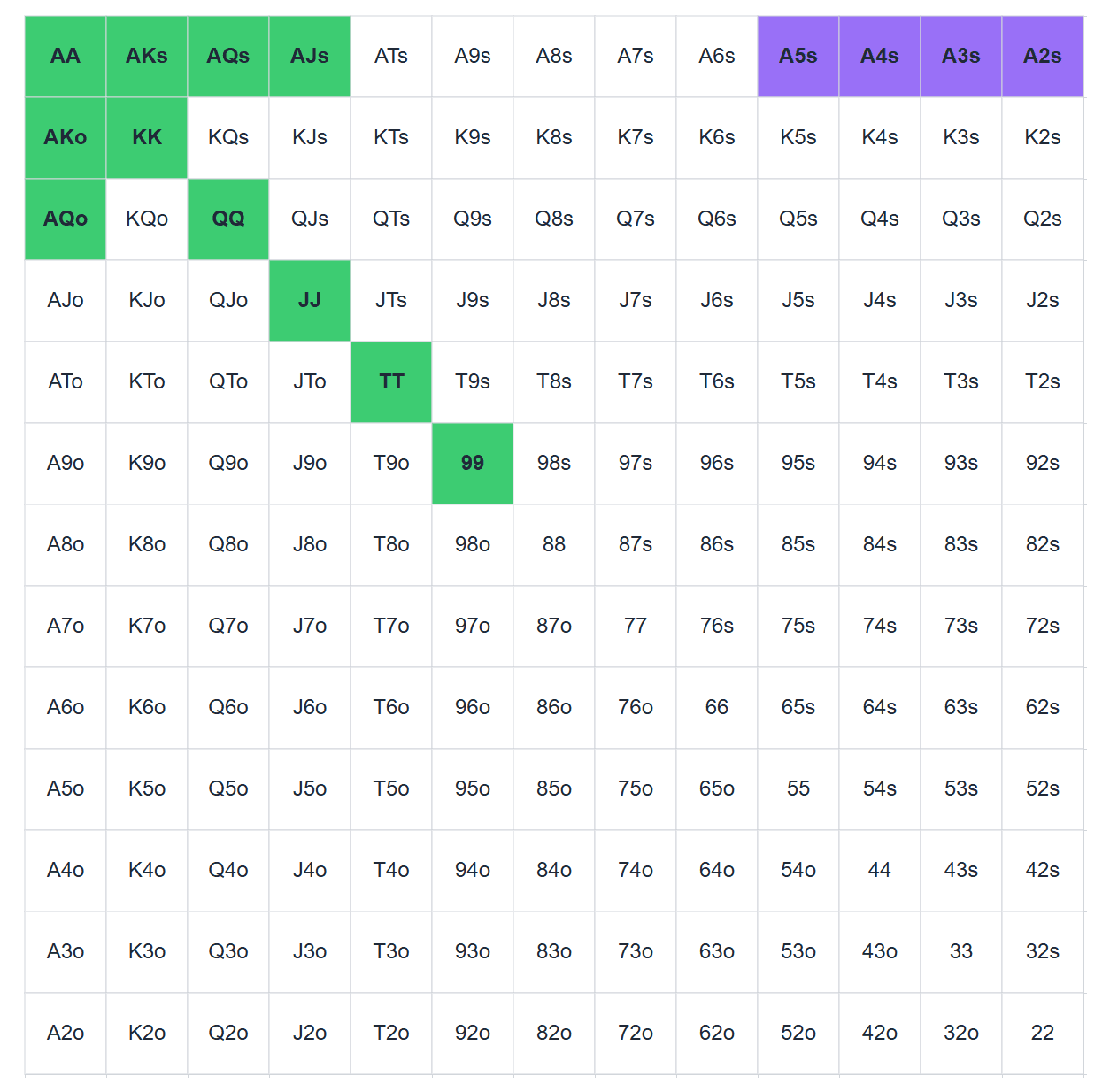
BTN vs CO value range
We're on the button (BTN) — the most profitable position in poker. The opponent opened behind us — from the cutoff position (CO). We're up against a fairly skilled opponent with a balanced playing strategy.
Knowing his opening range, which is fairly wide — from 28% to 35% of all hands — we can build our own value-hand range. On the chart they're marked in green.
We play these hands via a 3-bet in order to build the pot and take more chips on subsequent streets in case the opponent calls or 4-bets.
In purple we've marked the hands that can be kept as a bluff range — for strategy balance.
Why these specifically? After our 3-bet, the opponent may fold hands with a stronger kicker — for example, A6o–A8o. We spare ourselves from a postflop situation in which we'd be dominated. On top of that, having an ace in our hand reduces the number of potential aces in the opponent's range, which means we'll get a fold more often. Against responsive aggression from the opponent, we easily fold, having lost fewer chips than we could have on the flop, turn, and river.
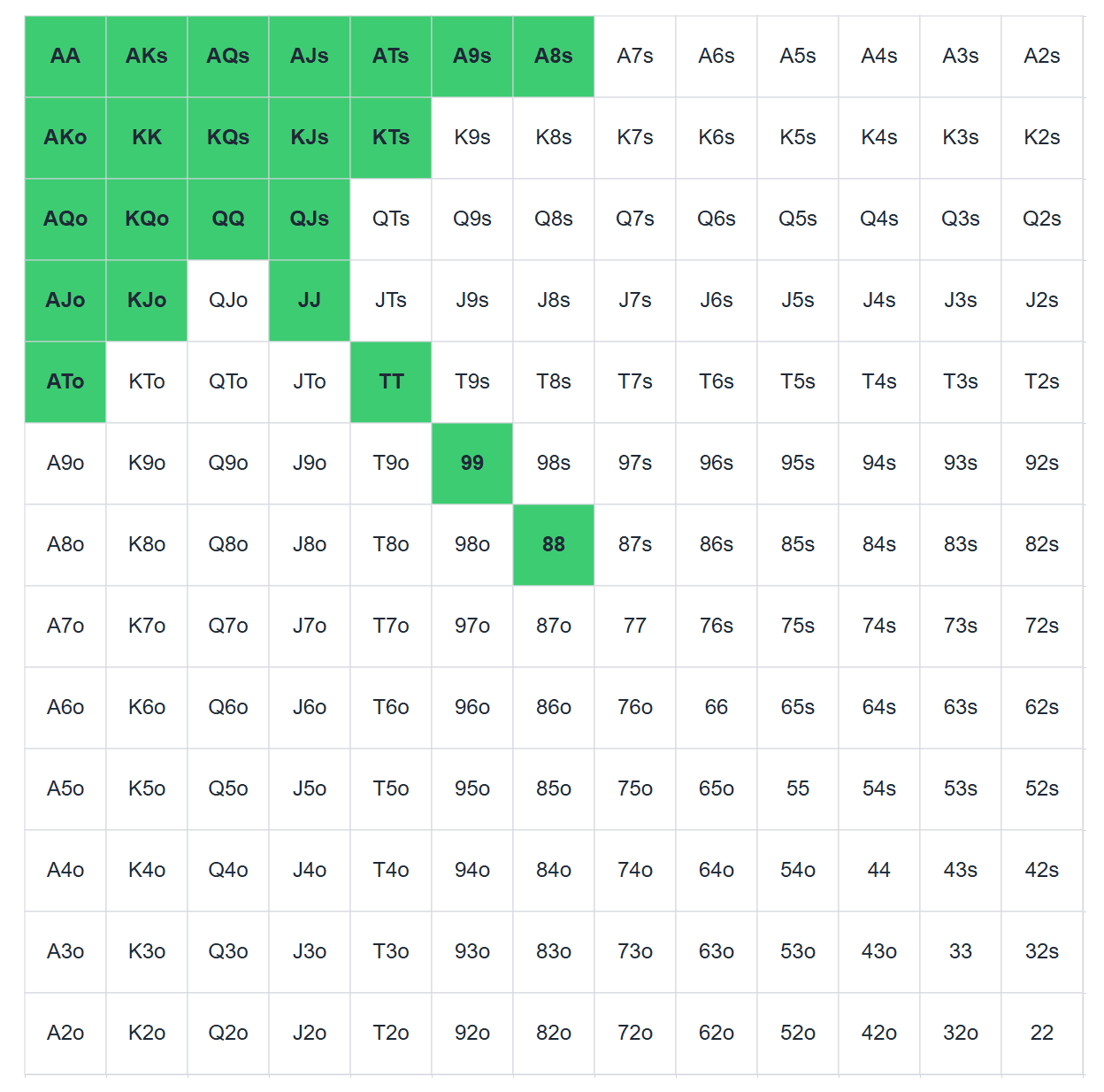
BTN vs CO isolate range
The same situation — only this time we're up against an amateur who prefers and is willing to pay off our 3-bets with weak hands.
In this case, we want to widen our 3-bet range in order to:
isolate the opponent and reach the postflop in a 1-on-1 situation
get calls from weaker hands
Which hands to 3-bet?
To build a 3-bet range correctly, you need to understand two types of ranges.
1. Linear range
Includes only strong hands from the top of the spectrum. We use a linear 3-bet pursuing one of two goals:
We want to play in position against an amateur and isolate him with hands that have a chance to make a strong combination.
We want to grow the pot preflop in order to win more chips.
2. Polarized range
Contains strong value and the bottom of the spectrum — hands for bluffing. Suitable against opponents with a high percentage of folds to a 3-bet.
That is, the opponent folds frequently, which means it's profitable for us to take the pot from him preflop without resistance. But sometimes he doesn't give up and calls — and for such cases we have value in our range to win big pots.
3-bet size: which bet size to choose
The size depends on position and stack depth. As a rule, the standard bet size is:
3x the raise size in position and 4x out of position in deep stacks (when the effective stack in the hand is 50-100bb, against a 2bb open we choose a 3-bet size of 6bb in position and 8bb out of position)
2.3–2.5x in position and 2.7–3x out of position in medium and short stacks (when the effective stack is 25-50bb, we can play a 3-bet of 5.5bb in position and 6bb out of position)
Note that each case is individual. Our recommendations are general in nature and form the foundation of a playing strategy.
If you want to better understand the nuances of poker mastery, submit an application to FunFarm. We train systematically, sequentially, and based on real data.

Free course · FF Start
Break the game down street by street
Learn to plan a hand from preflop to river and understand the purpose of every action.
Frequently asked questions
Read next
Call, 3-bet or fold after a raise: how to make decisions

Float in Poker: How to Use Position to Steal Pots
How to play against very aggressive players in poker