4-bet for beginners: when, against whom, and what for?
A 4-bet is the action that brings players in poker to the most expensive hands. The pot suddenly becomes large, ranges become narrow, and the cost of a mistake is noticeably higher.


One of our first coaches: on the team since the very founding of the project. He prioritizes simple and practical training with an emphasis on real game situations and decision-making over the long run. Val doesn't just "beat the games" as a player, but also instills a systematic approach to the game and discipline in his students.
Beginning players often go with one of two scenarios — "I don't play 4-bets at all — it's too complicated and risky" or "I play 4-bets only with the strongest hands."
In this article, we want to walk you through the basic principles of building 4-bet ranges so it becomes easier for you to understand this play and start using it in your own game without taking on big risks.

New breakdowns in your inbox
Subscribe to the FunFarm newsletter: fresh Poker ABC articles and material that helps you grow as a player.
You'll learn:
what a 4-bet is
what goals a 4-bet accomplishes
why position matters more than it seems
how to choose your 4-bet sizing
which hands make sense to 4-bet against different types of players;
how to react when someone 4-bets you.
What a 4-bet is, in simple terms
To avoid getting confused by the terminology, picture this chain of actions:
there are the blind bets — they're already in the common pot
a player makes an open-raise
a player after them re-raises, i.e. plays a 3-bet
the next re-raise on top of that is the 4-bet.
The key point: a 4-bet is about the order of raises, not the size of the bet. Not "4 times," not "4 blinds," not "made a big bet" — but specifically the bet that comes after a 3-bet.
Why you need a 4-bet
1. For value — to build the pot when you're ahead
The simplest example — you have AA in your hand. This is the strongest hand in poker, i.e. any hand in your opponent's range is weaker than yours before the flop, turn, and river come out.
In this situation you want to:
get a call from worse hands
provoke your opponent into playing a 5-bet/push
play a big pot where you have the edge.
Your goal is to squeeze the maximum out of a hand in which the math is on your side.
2. As a bluff — to deny equity and take the pot before the flop
If your opponent 3-bets often, then they have bluff 3-bets, and they easily give up against a 4-bet. You have a chance to take the pot right here and now.
For such a play you need:
fold equity — when the opponent really should be capable of folding
you need blockers — A and K are the most valuable
your hand should have the potential to make the nuts if you get called.
That's why professional players often choose weak suited aces as their bluff range.
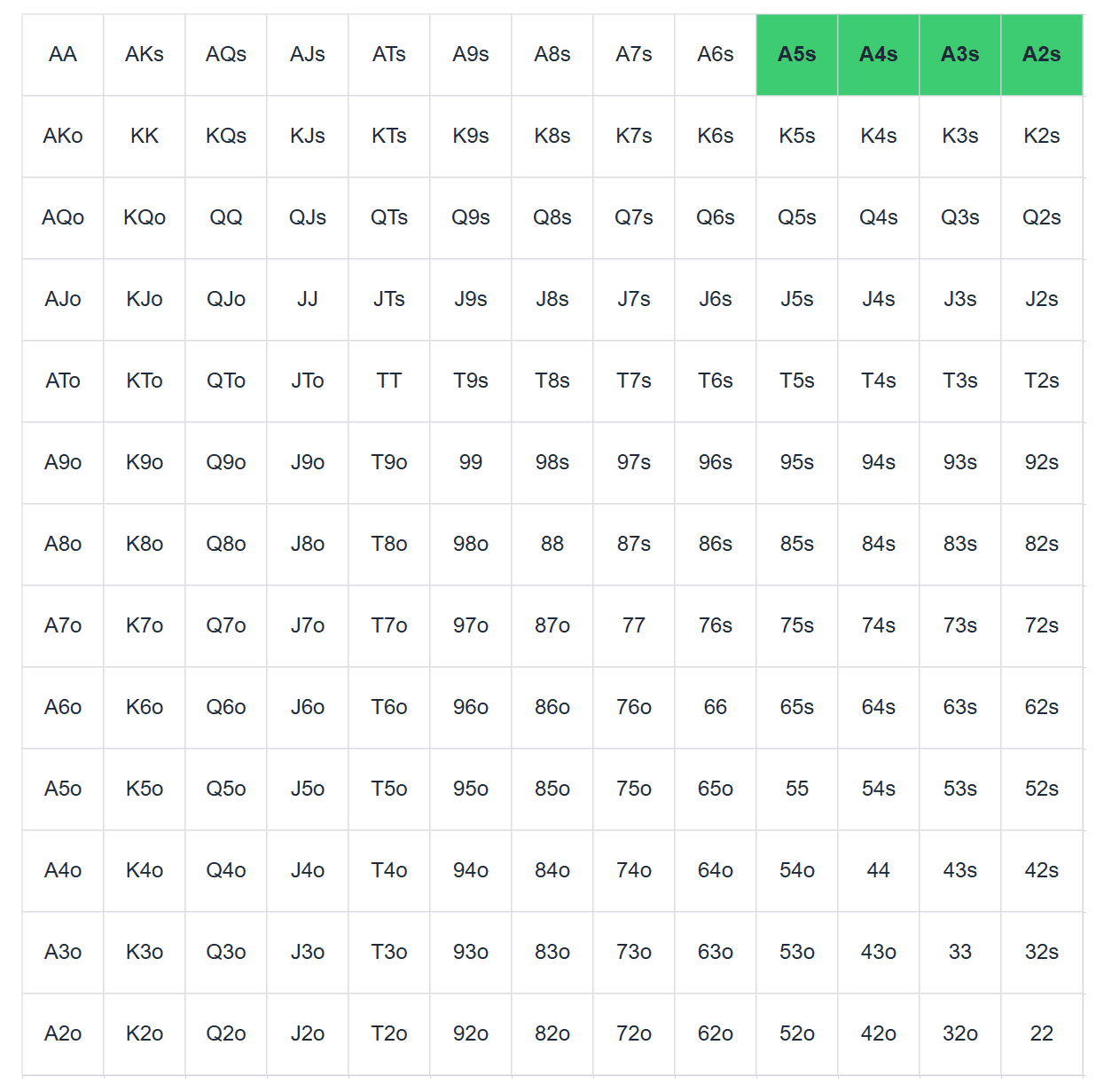
The most profitable hands for a 4-bet bluff
The range from A5s down to A2s fits two criteria:
There's a blocker to a strong hand in the form of the ace. This lowers the probability of strong aces in your opponent's range.
There's a chance to make the nut flush or straight when playing the hand postflop.
What a player should ask themselves before a 4-bet
When making this play, it's important to ask yourself two questions:
1. What does the opponent 3-bet with?
This depends on position and player type. A 3-bet against UTG and a 3-bet against BTN are two different universes.
2. What does he continue with against a 4-bet?
That is — what he'll fold, what he'll call, and what he'll go 5-bet/push with.
Learning at FunFarm, from any level
The importance of position
To understand the importance of position when it comes to 4-betting, start by orienting yourself around these two situations:
Against early positions, ranges are usually tight → your 4-bet should also be disciplined.
CO/BTN vs SB/BB — the opposite: there's more width, more dynamics, more air → room for bluffing appears.
That's exactly why there's no universal 4-bet range. But you can have clear reference points.
What 4-bet sizing to choose
One of the typical mistakes beginning players make is using different sizes for value and bluffs. This approach makes your strategy readable. How do you fix it?
4-bet in position — about 2–2.5x the size of the 3-bet;
4-bet out of position — about 2.5–3x the size of the 3-bet.
Example: you opened to 3bb, got a 3-bet to 10bb, an adequate 4-bet in this case is about 20–24bb.
Another important point: if your 4-bet ends up being about a third of your stack, it's often simpler and more logical to consider a push — especially with short stacks — so you don't leave yourself an awkward SPR postflop.
*SPR (Stack-to-Pot Ratio) is the ratio of the effective stack to the pot size in a specific hand.

Example hands
Example #1: 4-betting for value against a loose-aggressive player
Situation: we're on the CO with JJ. On the BTN, a loose-aggressive opponent plays a 3-bet against us.
In this case jacks turn into a hand that often has a value 4-bet, because his continuing range includes worse hands — including lower pocket pairs and broadway hands that can outdraw our hand postflop.
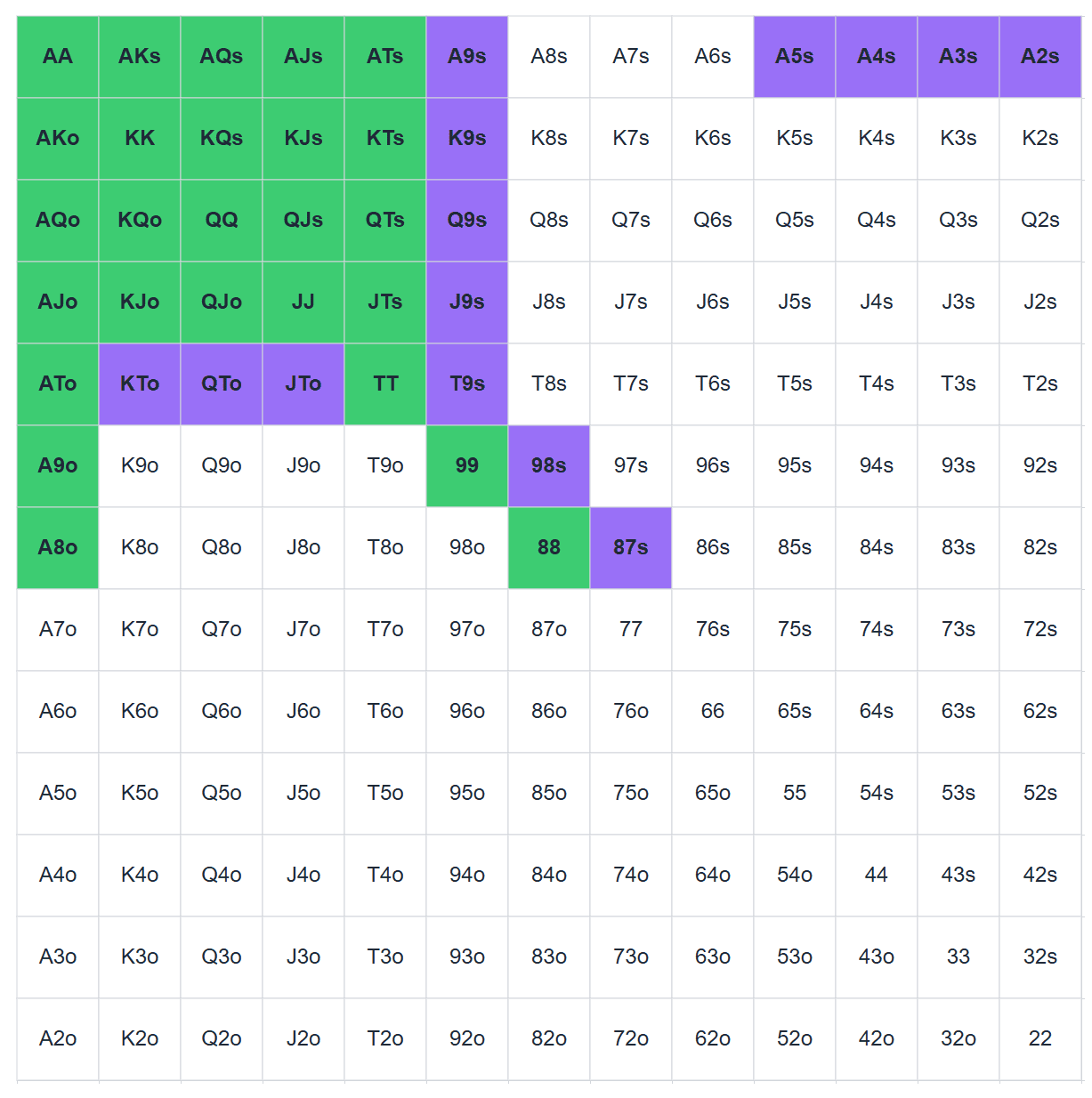
An approximate 3-bet range of a loose-aggressive player on the BTN against the CO
The best play in this case is to make a 4-bet, in order to:
get a chance to avoid playing a tough spot out of position
get paid by weaker hands preflop
Example #2: 4-betting as a bluff against a player with a high fold to 4-bet
Situation: we open from the HJ and get a 3-bet from a player in the SB.
We have A5s in our hand — and this hand is a great fit for a 4-bet bluff, because:
the ace in our hand reduces the number of combinations of AA, AK and other strong Ax in our opponent's range
the hand can make a nut combination if we happen to get called
we don't mind turning it into a bluff — unlike AQ, which is often better to call
The optimal play — we 4-bet with the same size as for value — in this case we're in position, so 2–2.5x will be enough.
With this play we can get the stronger aces and strong broadways out of the way and take the pot without a fight.
Let's give two specific situations as examples:
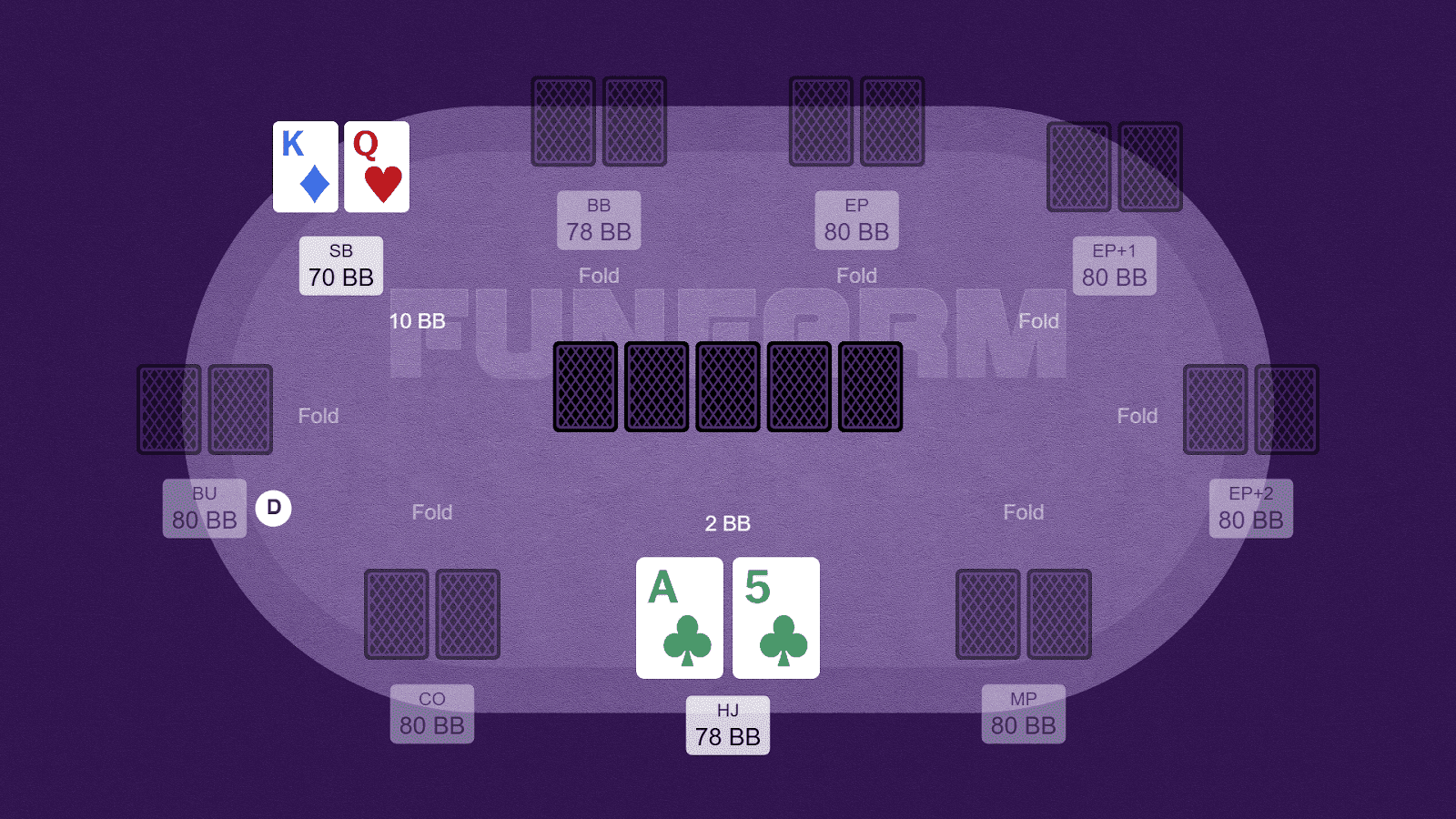
A player in the SB — especially a skilled one — will often choose to play offsuit strong broadways via a 3-bet with the aim of pushing out the opponent's weak aces.
By playing a 4-bet, we can take the pot without a fight and without tough decisions postflop — even if the opponent's hand is weaker than ours by the math.
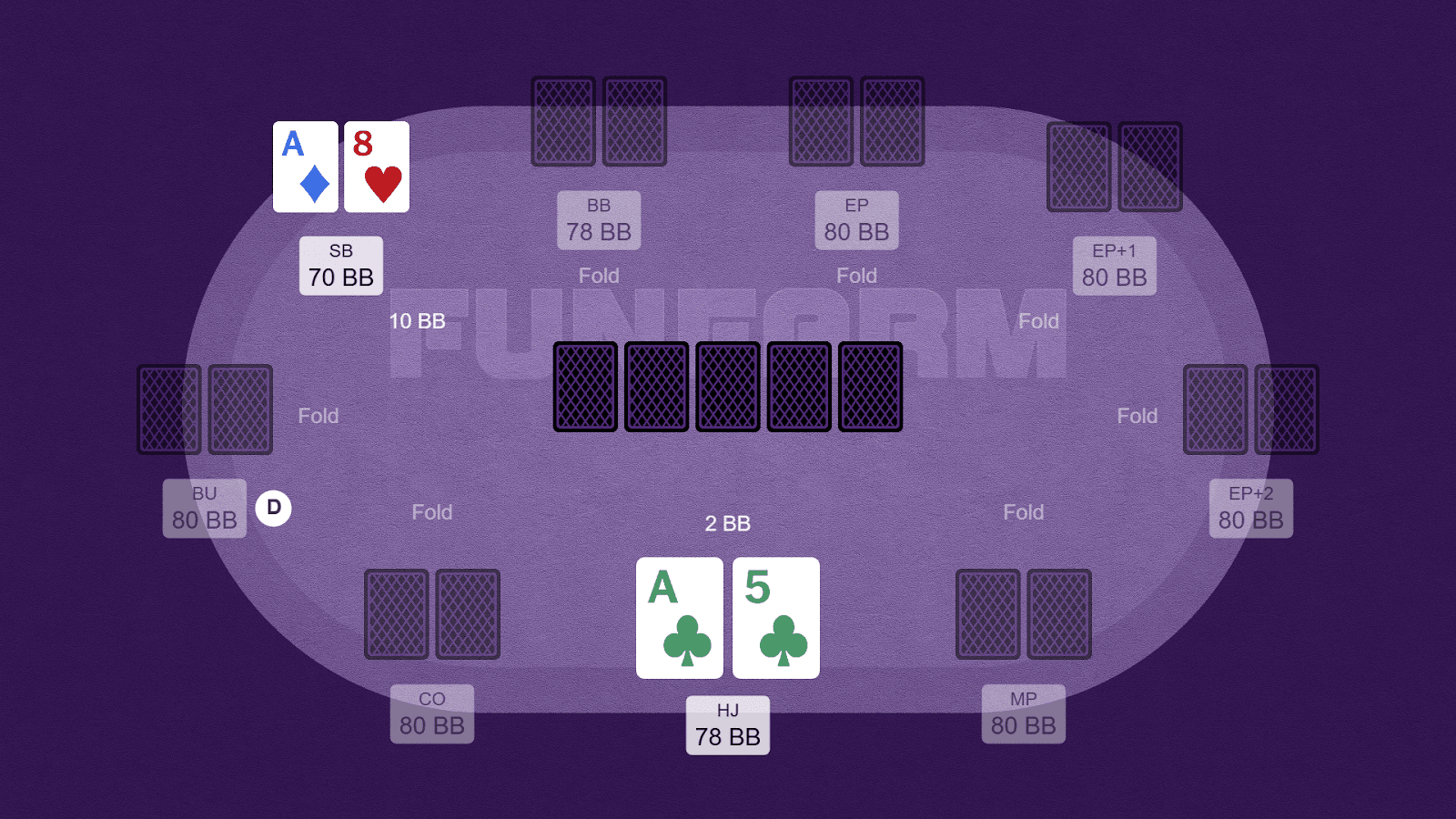
In this case the hand of the opponent who played a 3-bet in the SB is stronger than ours. It's part of the bluff range against the HJ position.
By playing a 4-bet, we won't just achieve taking the pot without a fight, but also push out a stronger hand.
Conclusion
If you want to learn how to build a preflop strategy so that 4-bets make money over the long run — submit an application to FunFarm.
We help players build a system — ranges, sizings, adjustments to opponent types, and confident play in 3-bet/4-bet pots — so that decisions are predictable and profitable.

Free course · FF Start
Fix costly beginner mistakes
Learn when to bet, call or fold — and when putting pressure on an opponent pays off.
Frequently asked questions
Read next
Call, 3-bet or fold after a raise: how to make decisions

Float in Poker: How to Use Position to Steal Pots
How to play against very aggressive players in poker