Early-Stage MTT Strategy
In this article, we'll explain how the early stage of MTT poker differs from deeper stages, which hands you should open from various positions, and which strategies to follow after we've entered a hand.

One of our first coaches: on the team since the very founding of the project. He prioritizes simple and practical training with an emphasis on real game situations and decision-making over the long run. Val doesn't just "beat the games" as a player, but also instills a systematic approach to the game and discipline in his students.
The early stage of an MTT often feels like the calmest part of the tournament. The stack is deep, the money is far away, and there's none of the pressure at the table that shows up on the bubble or at the final table. Because of this, many players treat the first levels as a warm-up and start playing too loosely.
*The bubble is the stage of a poker tournament when only one or a few players remain to be eliminated before reaching the money (ITM — in the money).
This is a mistake. The player thinks that a deep stack lets them enter a large number of pots, see flops with questionable hands, and try their luck, unlike play in deeper stages. But the early stage — like any stage of a poker tournament — has its own playing nuances that generate profit over the long run.
This is the stage where we lay the foundation of our future stack: we choose good starting hands, use position, play against weak opponents, and avoid creating tough decisions for ourselves with hands that have poor potential for postflop play.
*Postflop refers to all betting rounds that take place after the flop (flop, turn, and river).
In this article, we'll explain how the early stage in MTT poker differs from deeper ones, which hands you should open from various positions, and what strategies to follow once we've entered a hand.

New breakdowns in your inbox
Subscribe to the FunFarm newsletter: fresh Poker ABC articles and material that helps you grow as a player.
What the early stage in an MTT is
The early stage of an MTT is the first levels of the tournament, when players still have deep stacks and the forced bets make up a small portion of the total chips. Usually this is the first 7–10 levels of the tournament, depending on the structure.
The main feature of the early stage is the low cost of a single blind in chips. The average stack at the tables is deep, all players typically have 100+ BB, which means there's no serious reason to urgently fight for every pot. There's an opportunity to wait for good situations, play postflop, use position, and pick opponents.
An equally important feature is the composition of the field. In the early stage there are usually many weak and passive players at the tables. They often limp, call raises wide, overvalue top pairs, and don't know when to stop with medium-strength hands. It's precisely against such opponents that we can earn the most.
*A limp in poker is an action by a player preflop in which they call the big blind (the forced bet) instead of raising (increasing the bet).
Early-stage strategy differs from the middle and late stages. Here there's almost no ICM pressure, so decisions are more like playing for chips than fighting to preserve tournament life. But that doesn't mean you can play in a relaxed way, without a plan and discipline.
*ICM (Independent Chip Model) is a mathematical model in poker that allows you to estimate the monetary value of a tournament stack, taking into account the payout structure and the number of chips each player has.
You can read more about tournament stages in the general guide to MTT strategies on our site.
Basic principles of early-stage MTT play
It's often said that a tournament can't be won on the first hand, but it can be lost. This phrase doesn't mean you should fear every pot. It means something else: in the early stage there's no need to force things if the situation doesn't give us a clear advantage.
If a hand is profitable in chips, declining it just out of fear of busting is wrong. But seeking out borderline all-ins at 100 big blinds without a serious reason isn't necessary either. At the start of the tournament, weak players will give you plenty of opportunities to earn chips in more straightforward situations.
The basic playing style is tight-aggressive. This means we don't enter the pot with everything, but when we do choose a hand to play, we act aggressively.
*Tight-aggressive style in poker is a strategy that combines selectiveness in choosing starting hands with aggressive behavior in the betting.
The basic logic is simple: from early positions we play tighter, because many players act after us. From late positions we can open more hands, because we'll more often be making decisions last and will realize equity better.
*Equity is your share of the pot, corresponding to your chances of winning at the given moment.
In the early stage it's especially important to play against weak opponents. If there's a player at the table who often limps and calls too wide, we can isolate them with a raise. This way we create a pot against a wide range and more often end up in a situation where we make more accurate decisions.
We covered isolation in poker and playing against limpers in more detail in this article.
Against passive players you need to bet more for value. If a player doesn't like to fold pairs and draws, there's no point in coming up with elaborate bluffs.
Against aggressive opponents the logic is different. We're not obligated to fight them in every pot. It's often more profitable to narrow our range, let them do the betting themselves, and take big pots when we really have a strong hand.
Starting-hand charts for the early stage of an MTT
We'll note right away that a chart shouldn't be treated as something set in stone, but the hands listed in the table show positive values over the long run.
This is a basic reference. Real decisions depend on the composition of the table, stack depths, position, the activity of the players seated behind us, and the presence of weak opponents in the blinds.
Below we'll show several hand charts from different positions — early, middle, and late.
In order to understand how to use poker charts, read our article on this topic.
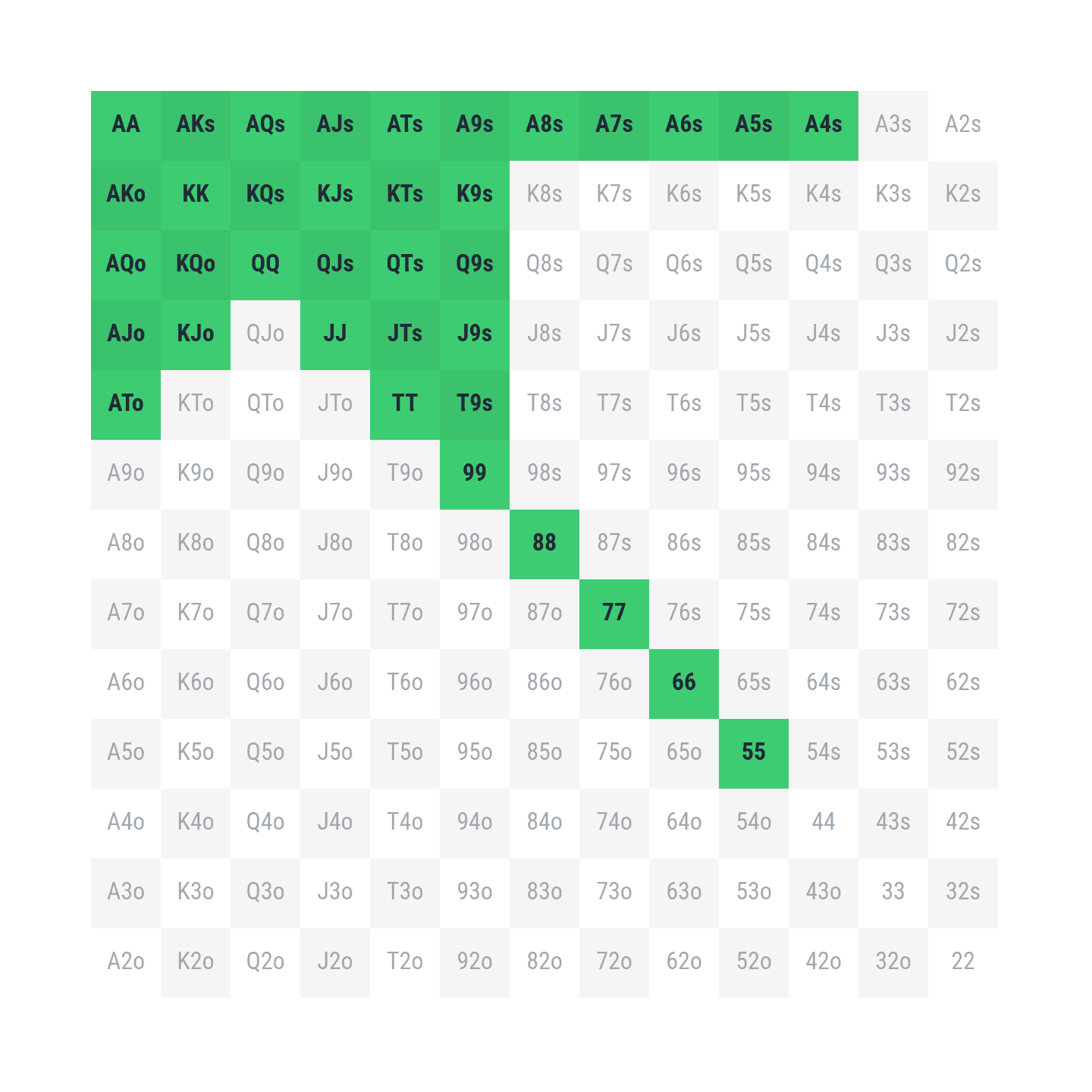
Opening from EP
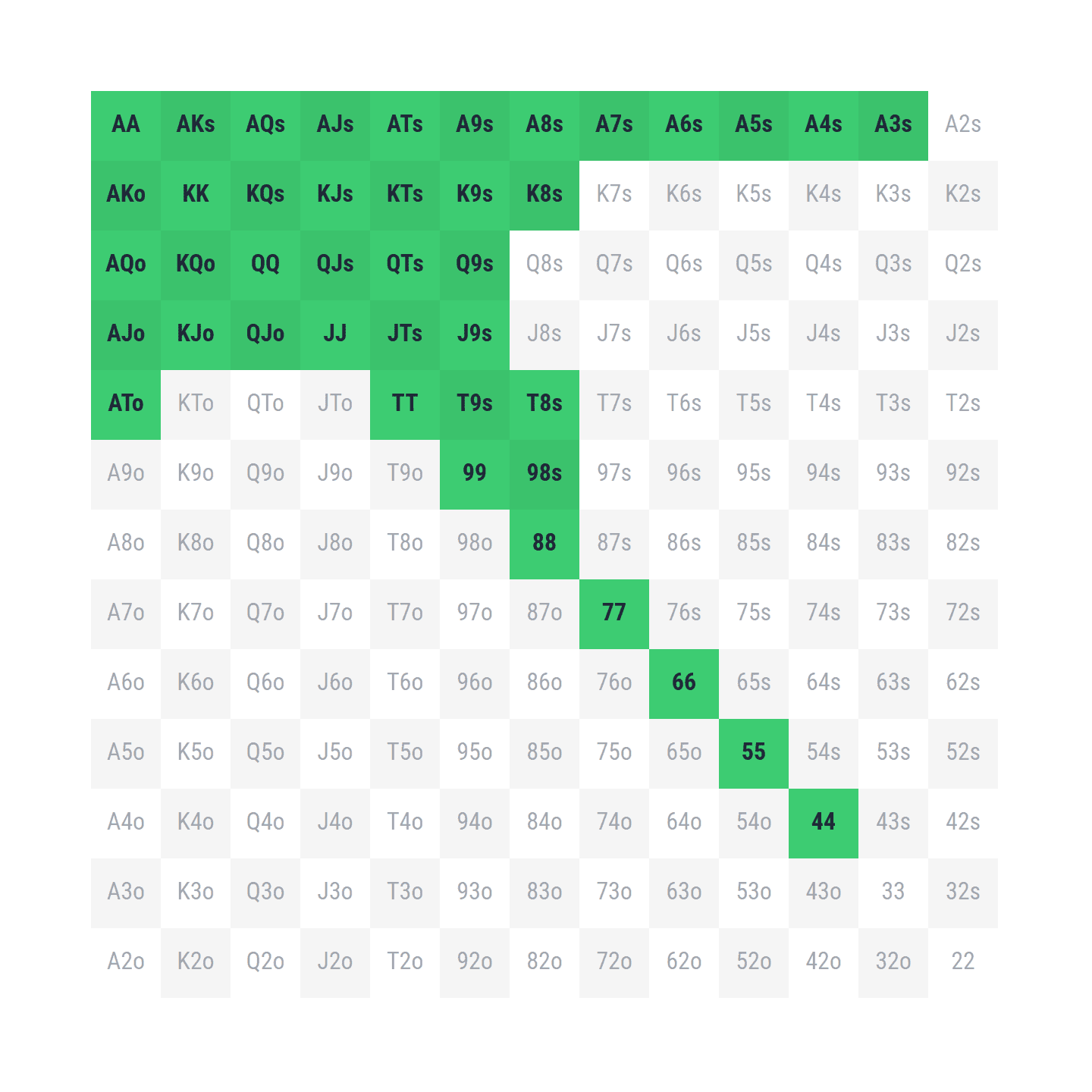
Opening from EP+1
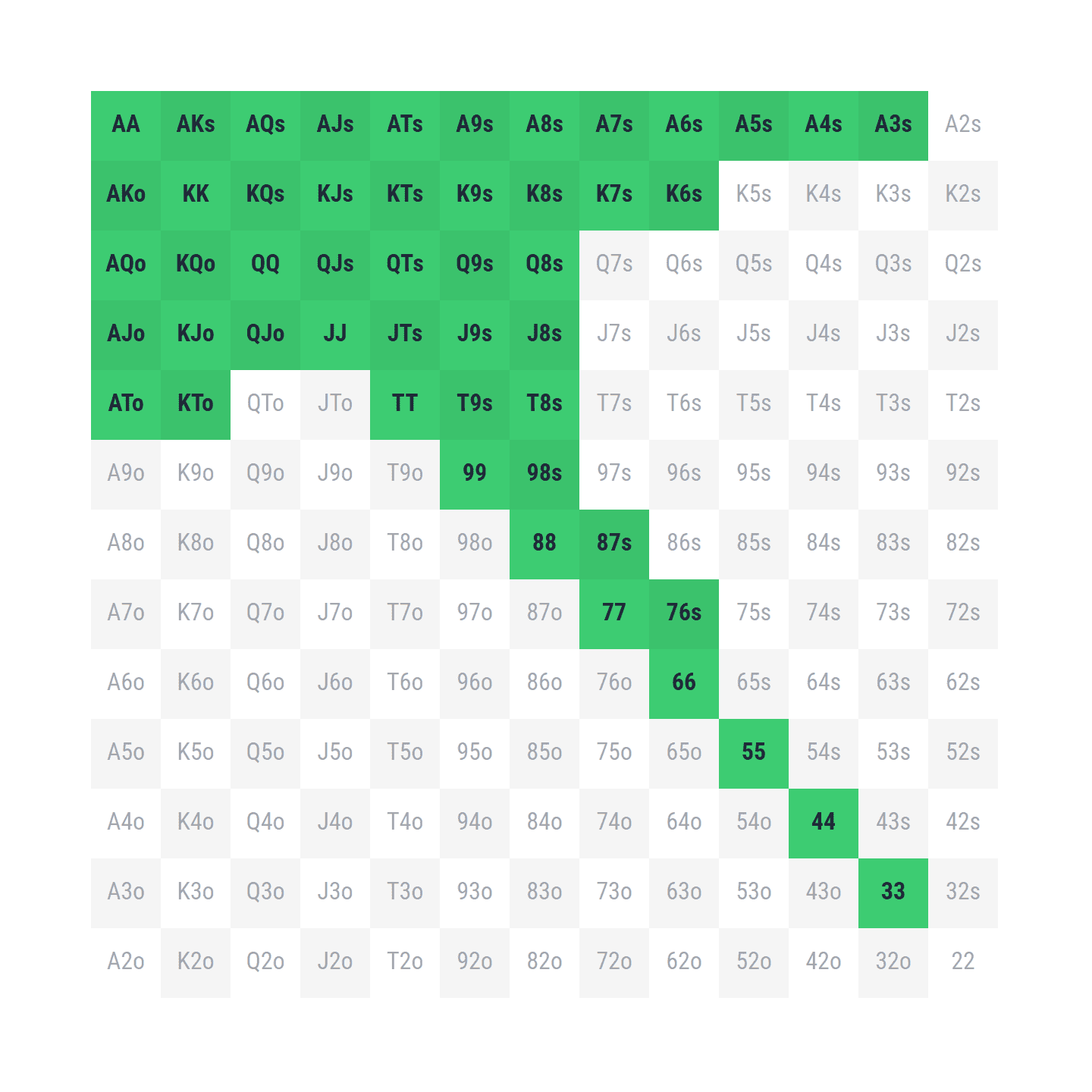
Opening from MP
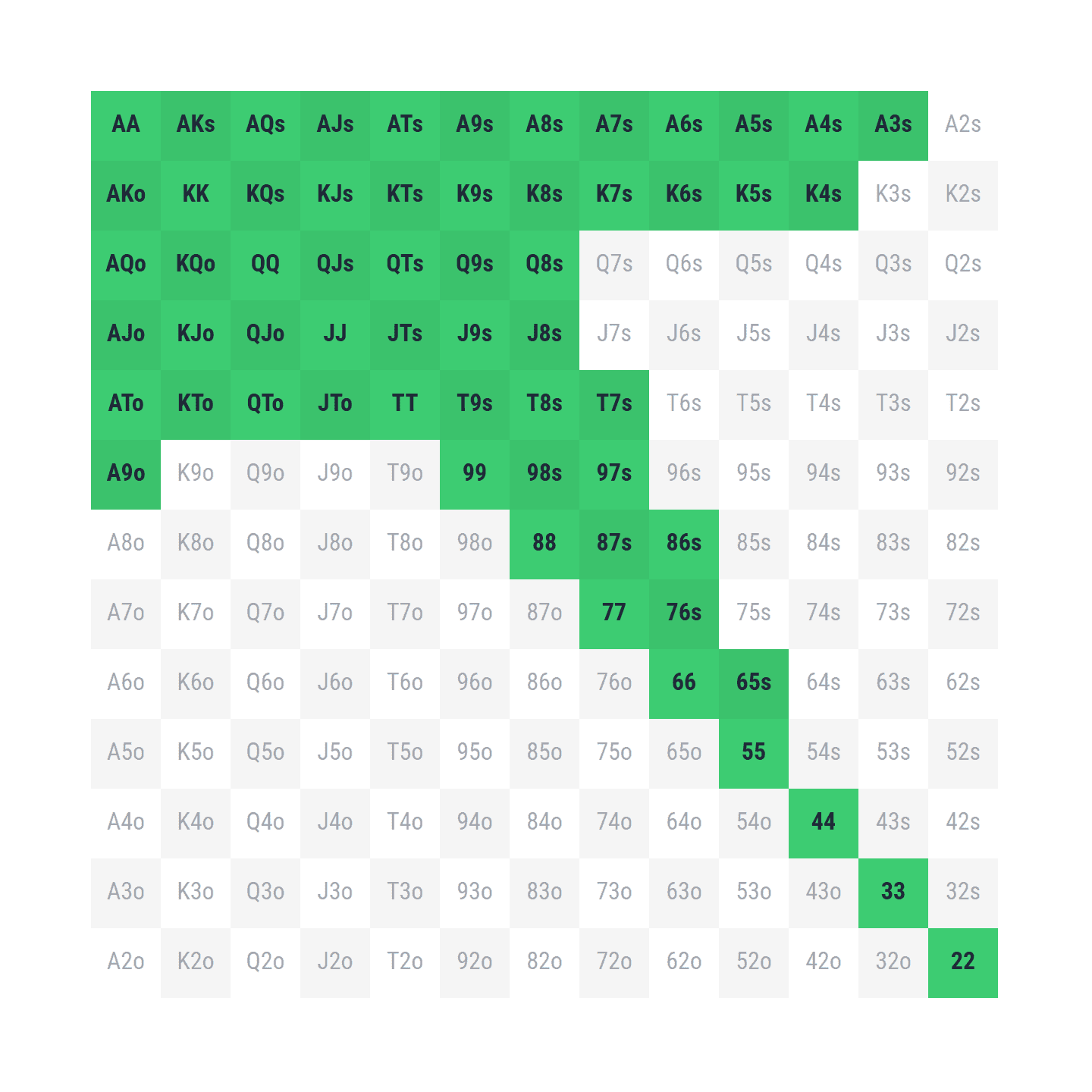
Opening from HJ
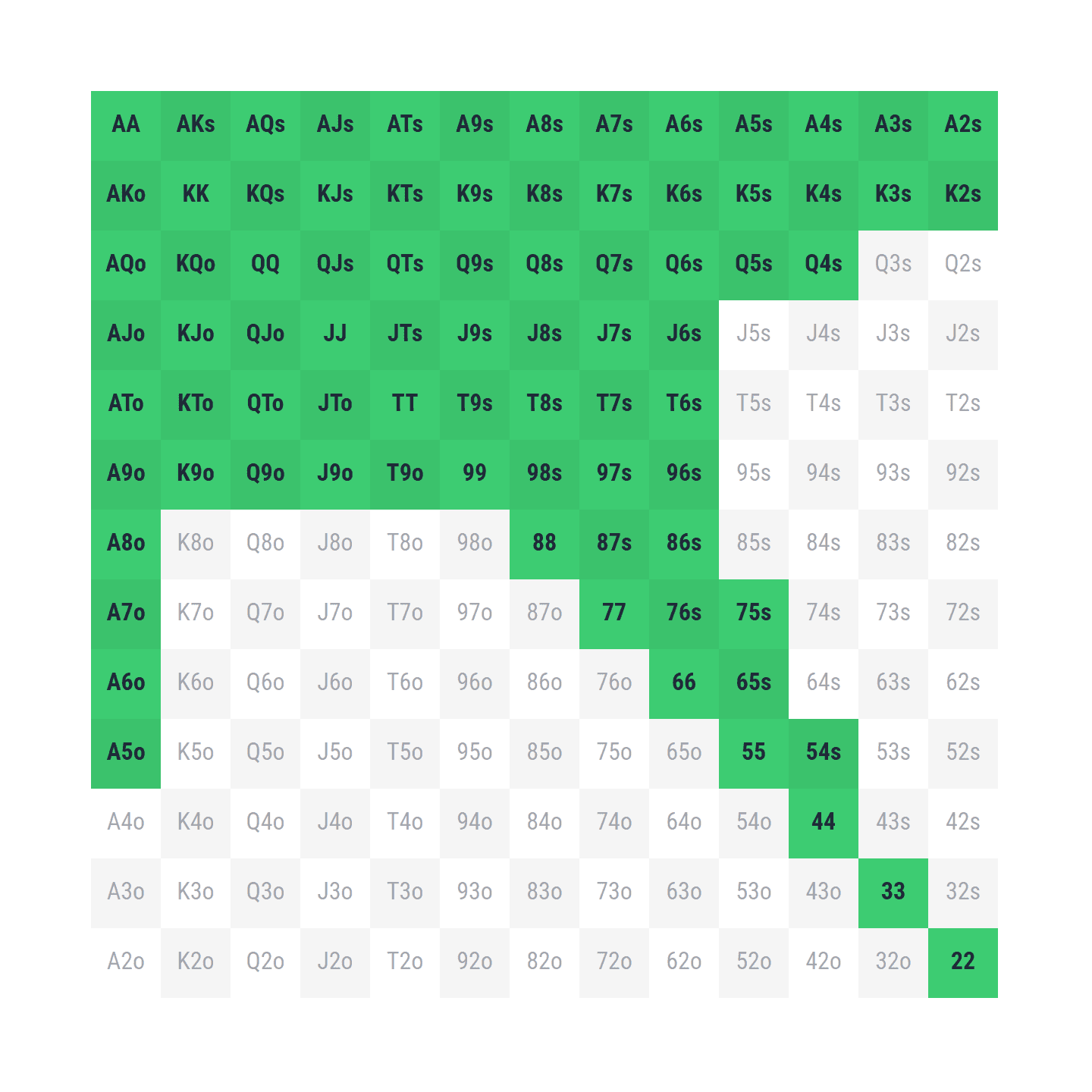
Opening from CO
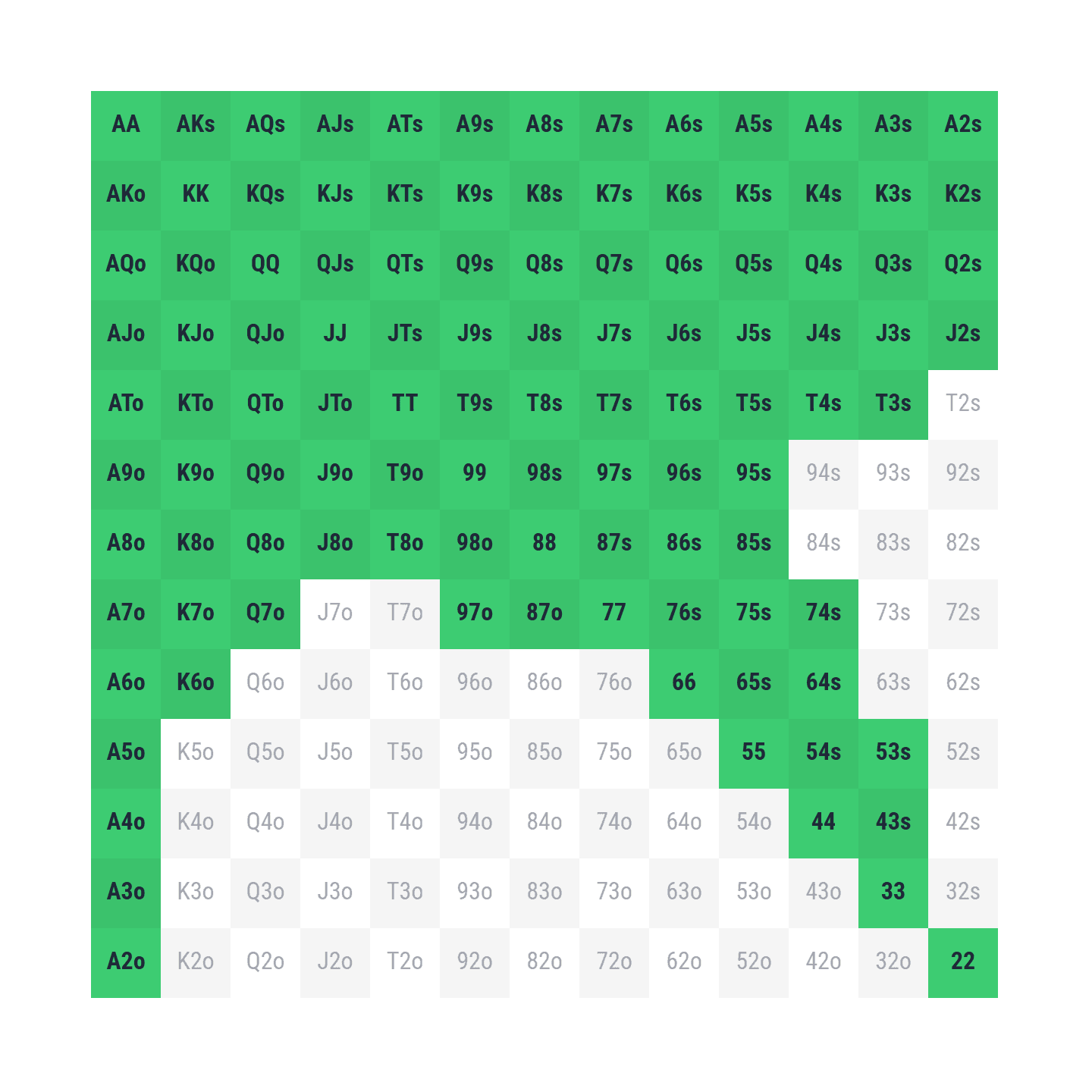
Opening from BU
If you don't understand what positions in poker are, we recommend reading our article on this topic right here.
Learning at FunFarm, from any level
Playing against limpers
A limp in the early stage often just shows the opponent's weakness. Against such players we can make an isolation raise. Its purpose isn't just to grow the pot, but to leave one weak opponent in the hand and gain the initiative.
If there's one limper in front of us, the standard raise can be increased to 3.5 big blinds. If there are several limpers, you need to increase the size by 1 blind for each limper, i.e. with two limpers it's 4.5 blinds, with three it's 5.5 blinds, and so on.
Postflop play in the early stage of a poker tournament
In the early stage, postflop play plays a decisive role. Deep stacks mean that a hand rarely ends on a single bet. Players often dig in and reach deeper streets — the turn and the river.
The main task postflop isn't to play every strong hand to the max, but to understand which ranges interact with the board.
On dry boards a continuation bet often works better. For example, if we opened from the button and got a call from the big blind, and the flop comes A-7-2 with no flush draw, a small bet of 25–33% of the pot will be profitable. Such a board fits our range better, and the opponent often gives up because they have nothing to continue with.
On coordinated boards you need to be more careful. If the flop comes J-9-8 with a flush draw, the opponent's calling range gets a lot of continuations: pairs, straight draws, flush draws. Betting without a plan here quickly leads to tough decisions on the turn.
Against players who call too wide, the strategy should be straightforward: more value bets, fewer bluffs. You can bluff in the early stage, but selectively. Good conditions for a bluff: position, a dry board, a single opponent who gives up on later streets, and a logical telling of our line. Bad conditions: a multiway pot, sticky opponents, and playing without a plan.

The most common player mistakes in the early stage of an MTT
1. Limping instead of raising
A limp seems like a cheap way to see a flop. The player enters with a medium-strength hand, gets several opponents, and doesn't know what to do after the flop. The best thing is to remember a simple rule for any poker player: never limp.
2. Chasing an early double-up
Many players try to find an all-in for their whole stack as early as the first levels. The problem is that a deep stack doesn't need to take risks without a serious advantage: chips in the early stage are cheap.
3. Calling 3-bets out of position with dominated hands
Hands like QJ, KJ, A9 look quite pretty, but against a strong 3-bet they often end up dominated. Without position such hands are especially problematic: we often make the second-best combination and lose a big pot.
4. Passivity against weak players
Some beginner players are afraid to bet even with a strong hand. They give opponents free cards, fail to extract value from top pairs, and let draws realize their equity. If the opponent is willing to pay — you need to bet for value.
*Value is the profit a player gets from a strong combination of cards by making opponents put money into the pot with weaker hands.
5. Ignoring opponents' styles
You can't play the same way against everyone. Against a tight player a bluff can be profitable. Against a sticky one, that same bluff will burn chips.
Conclusion
Early-stage MTT strategy isn't built around fear of busting or around an attempt to double up quickly. The main task is to make decisions that consistently bring in chips over the long run.
The better a player understands which pots to enter, the less they depend on random hands. This is exactly what distinguishes a systematic MTT strategy from playing on a "gut feeling."
If you want to learn to break down tournaments more deeply — through ranges, stack structure, and the quality of postflop decisions — apply to FunFarm. We help players build a professional approach to the game.

Free course · FF Start
Make decisions with more confidence
A structured course for beginners who want to understand the logic behind every hand.