What a straight is in poker and how to play it
Let's break down the straight in poker and its place in the hand rankings.

Ilya is a Liga 2 player with six years of experience in online MTTs. He graduated from the Faculty of Journalism at RSUH and writes about poker for beginners, explaining complex things in simple, clear language. In his texts, Ilya combines his personal playing experience with his professional journalism skills to help newcomers confidently get into the game.
To play poker, you need to learn the rules. Beginners start with the ranking of hands. In hold'em there are 10 winning combinations: from high card to royal flush. Let's discuss the straight in poker and its place in the hierarchy of hands.

New breakdowns in your inbox
Subscribe to the FunFarm newsletter: fresh Poker ABC articles and material that helps you grow as a player.
Key facts about the straight
A straight is a hand of five consecutive cards of different suits.
A straight beats 5 hands: high card, pair, two pair, set and trips.
A straight loses to: flush, full house, quads, straight flush and royal flush.
The strongest version of the hand includes A-K-Q-J-T, the weakest — A-2-3-4-5.
An open-ended straight draw is helped by 8 outs, a gutshot — by 4.
The "rule of 2 and 4" lets you quickly calculate your odds of improving.
The straight in poker
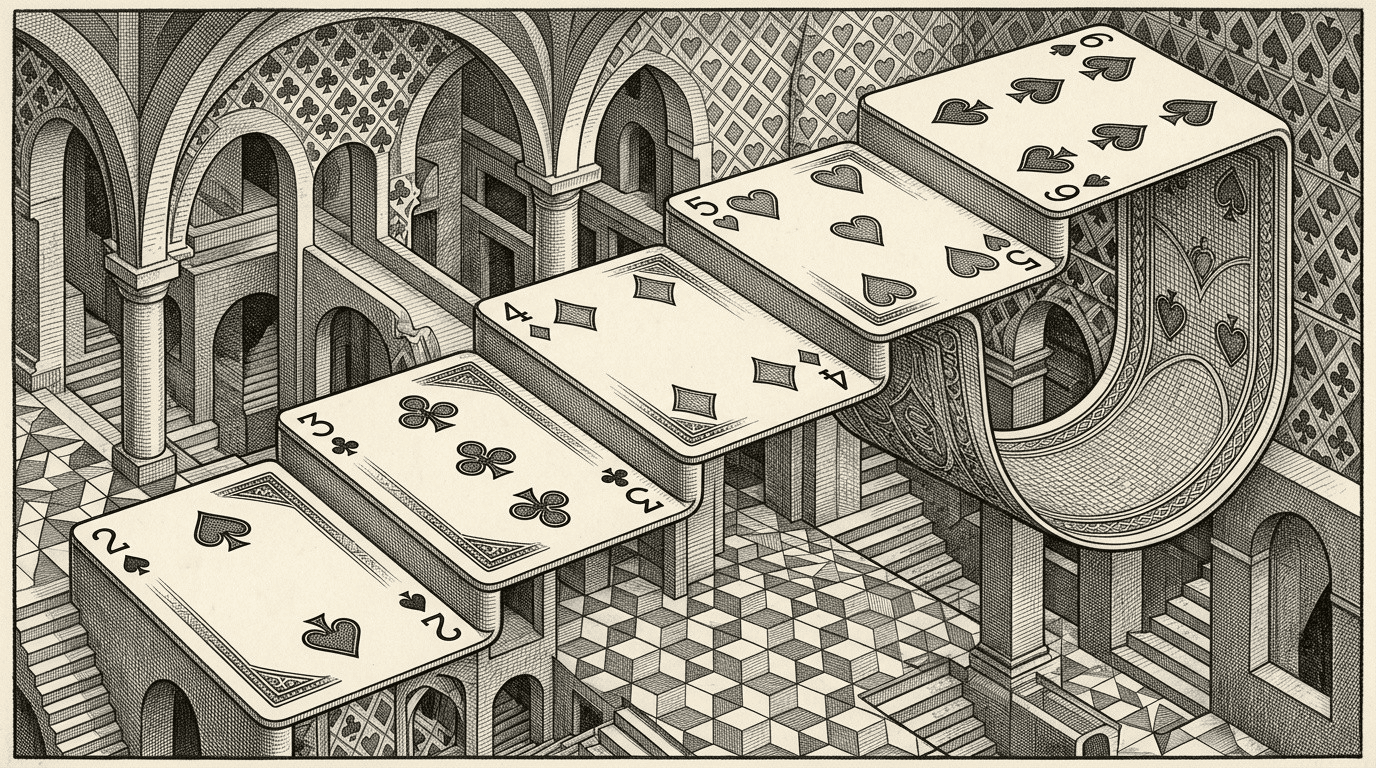
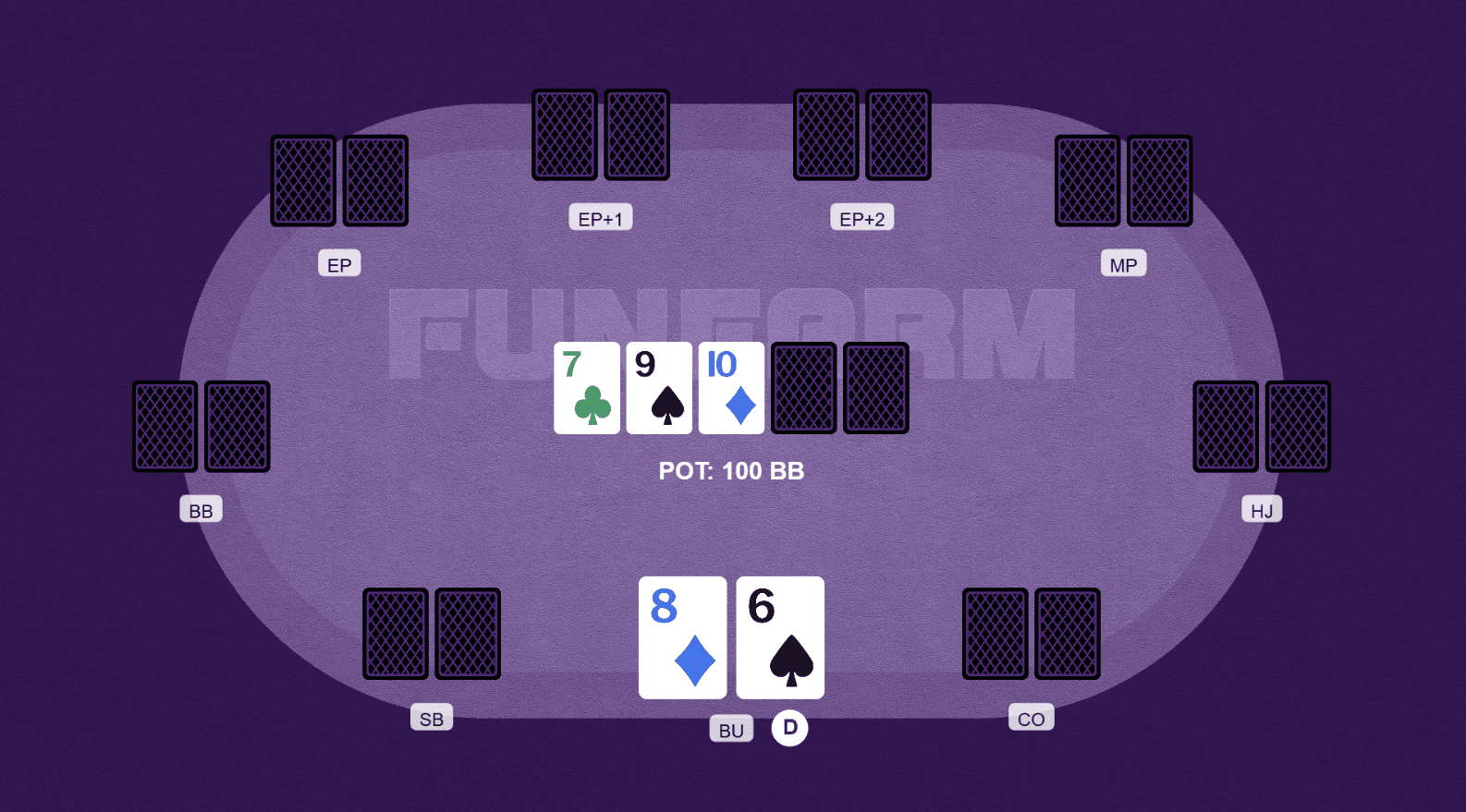
The straight is one of the winning hands in poker. The combination consists of 5 consecutive ranks of different colors. For example: 8d6s on a 7c9sTd board makes the straight T-9-8-7-6. A straight with an ace in poker can be made in two ways: A-K-Q-J-T and A-2-3-4-5.
In hold'em the straight is considered a strong hand. In most cases it takes the pot
If a player has 5 cards in a row of the same suit, they have a straight flush. It's the second-strongest hand in no-limit hold'em, pot-limit Omaha, seven-card stud and draw poker. A straight of suited A-K-Q-J-T forms the strongest hand in poker — the royal flush.
In the classic hierarchy of hands, the straight ranks fifth in strength. It beats: high card, pair, two pair, set. It loses to: flush, full house, quads, straight flush, royal flush. In PLO8 and other games with a low, the strength of the hand depends on the specific ranks. A-2-3-4-5 lets you contend for both halves of the pot. The hand A-K-Q-J-T can win only the high half of the pot. That's why A-2-3-4-5 is valued more highly than higher sequences in "hi-lo" games.
Types of straights and special cases
The highest and lowest straights have their own names:
A-K-Q-J-T is sometimes called the "Broadway." The cards in the hand are often called "Broadway cards."
A-2-3-4-5 is nicknamed the "wheel." In the lowest hand the ace acts as the weakest rank, in the highest — as the strongest.
The other straights were not given names.
Some beginning players overrate the ace's versatility. They mistakenly believe that hands like K-A-2-3-4 or J-Q-K-A-2 also make a straight. The classic rules of poker don't allow combining elements of the highest and lowest straight in a single hand.
Learning at FunFarm, from any level
How to determine the winner when there are two straights
In hold'em and Omaha, situations often arise where several players make a straight at the same time. For example, Liv was dealt QJ preflop, Igor — 76. A shared board of 892TA came down. Both opponents got straights. Liv's final hand looks like Q-J-T-9-8. Igor showed T-9-8-7-6 at showdown. Formally their hands are equal, but Liv will take the pot. Her hand is stronger thanks to the higher ranks. The queen beats the ten — Liv wins the hand.
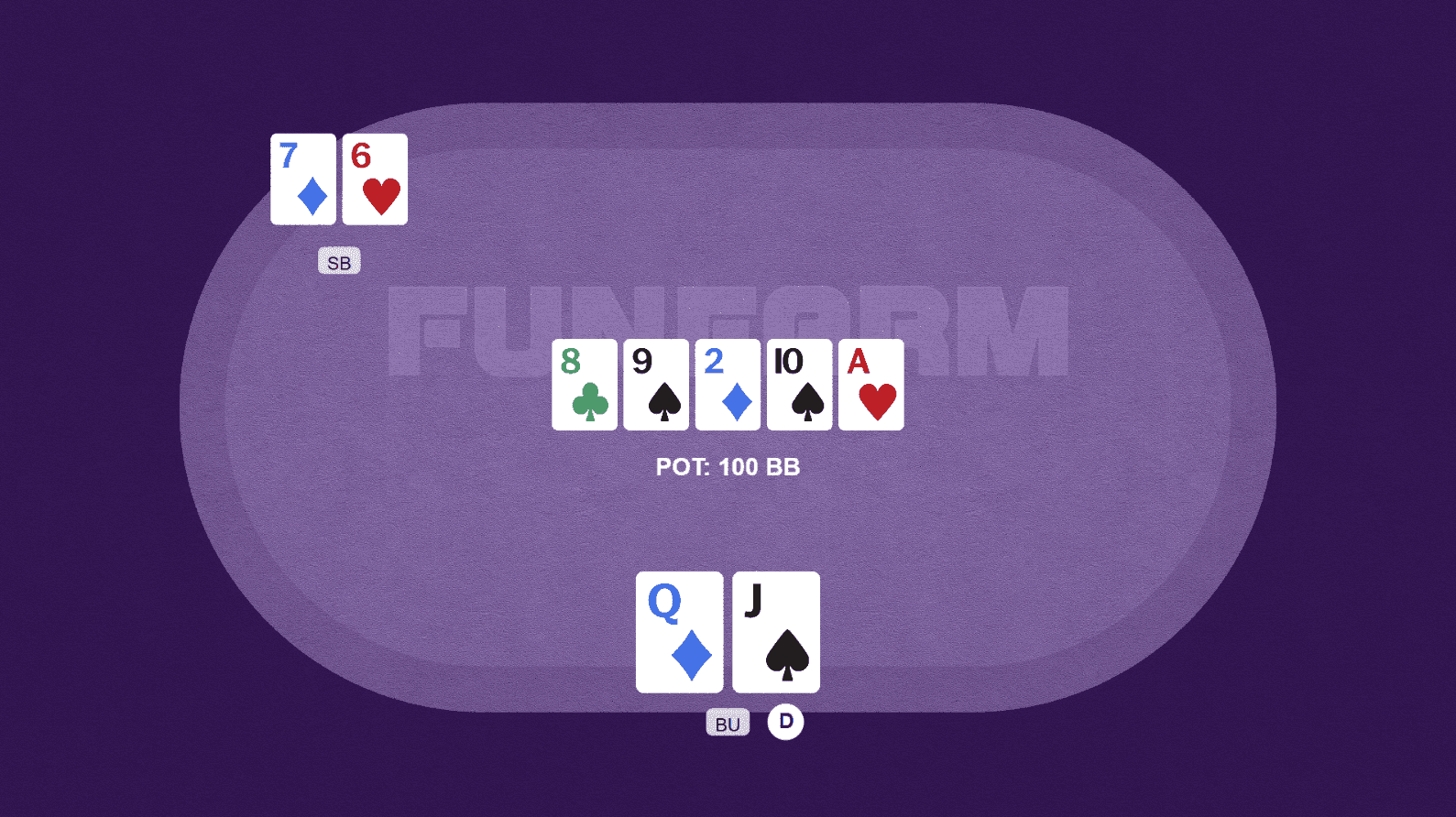
In NL Holdem players make their final hands from the board cards and their starting hands. That's why opponents often show identical hands at showdown
Let's change Igor's starting hand and the board cards. Suppose he was dealt Q7 preflop. Liv entered the pot with QJ. The table showed 89T2J. Now the opponents will split the pot, because they made equal-strength straights Q-J-T-9-8.
In no-limit Texas hold'em you can make a hand exclusively from the board cards. For example, Liv was dealt AA preflop, Igor — KK, and the board came T9678. The opponents will split the pot, because the strongest hand of both players looks like T-9-8-7-6.
Straight draw — how to count the odds
A straight draw is a situation where a player has lined up a sequence of four cards in a row and is one rank short of a made hand. For example, KQ on a JT2 board. To complete the hand, you need to catch an A or a 9 on the following streets.
There are two types of straight draws in poker:
Open-ended draw or Open-Ended Straight Draw. 8 outs let you complete the hand. Example: 98 on a JT4 flop. Any Q or 7 will give the player a made hand. There are four queens and four sevens in the deck.
Gutshot. 4 outs let you complete the hand. For example, AK on a JT7 board will improve to a straight only with the 4 queens.
Let's also single out a special variant of the open-ended draw — the Double Belly Buster. Its main difference from the OESD is two "gaps" inside the hand. For example: a player entered the pot with 87 and got a J95 board. To build a made strong hand, the player needs a ten or a six. The Double Belly Buster has the same 8 outs as the Open-Ended Straight Draw, but the hand is harder to recognize.
Experienced players also pay attention to backdoor straight draws. Let's explain with an example. Suppose a player entered the pot with KJ. The flop came Q26. If a T comes on the turn and an A or 9 on the river, the player makes a straight. The chance of catching two needed cards in a row is modest — about 4%. Usually a backdoor draw gives one additional out to improve.
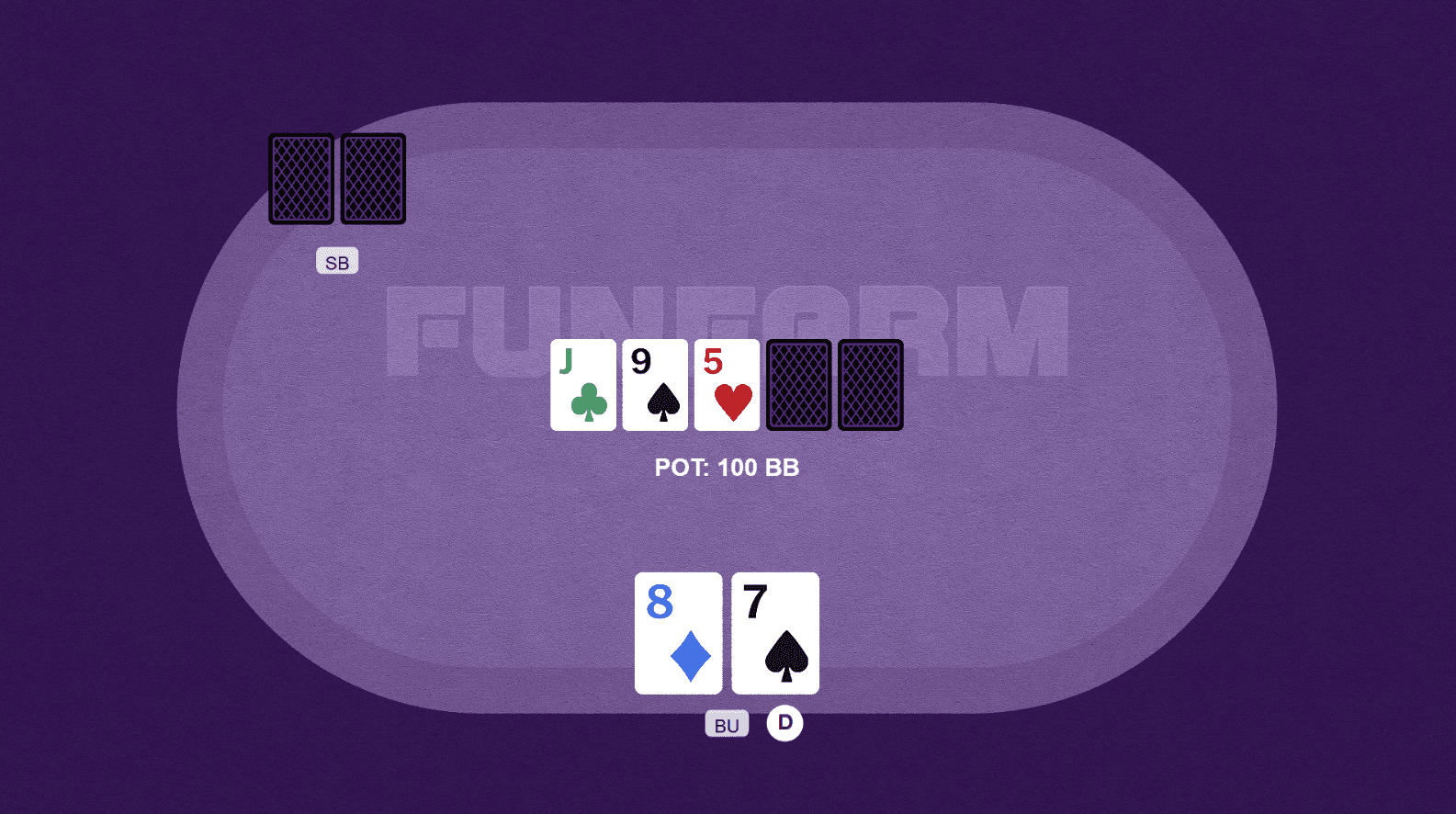
Reading a double gutshot is harder than reading an open-ended straight draw
The "rule of 2 and 4" lets you quickly count your odds of improving. On the flop, multiply the number of outs by 4 to get the approximate chance of improving by the river. The calculations look like this:
OESD. 8 x 4 = 32%.
Gutshot. 4 x 4 = 16%.
If you need to calculate the odds for one street, multiply the number of outs by 2. An OESD becomes a straight 16% of the time, a gutshot — 8%. The topics of outs, pot odds and implied odds were covered by Roy Rounder in the book "Easy Poker Math". The 30-page guide is easy to find in the public domain.
Let's also mention combo draws. A player can simultaneously have chances to complete a straight or a flush. The best combo draws have 15 outs to improve: 9 — for the flush, 6 — for the straight. There's also the variant with a flush draw and a gutshot. It's improved by 12 cards. High chances of catching outs let you play very aggressively with combo draws.
How to play a straight on different streets
No-limit hold'em has modest requirements for winning hands. Often top pairs win pots. Sometimes a high card is enough for the winner. That's why the straight falls into the category of strong hands. However, you still need to make sound decisions with it. Let's break down the tactics of play on different streets.
Flop. With a made straight on the flop, you need to build the pot. Don't invent elaborate traps. Bet yourself or raise against the opponent's aggression. Example: a player with JT caught a made hand on a 987 flop. On such a board the opponent could have: two pair, a set, a weaker straight, a pair + draw. Each hand will pay off a big bet. Be careful on suited boards. For example, with the spade QJ on a heart T98 flop. The straight is probably the strongest hand in the pot right now. However, the opponents have many draws. On the flop we recommend making a good value bet, but after that control the size of the pot.
Turn. The greatest danger is created by a repeated board card and a third suited rank. In the first case the opponent can get a full house or quads, in the second — a flush. For example, another seven comes on the turn to 987. As a result all sets and some two pairs surpass the straight. If the turn brought an unpleasant card, it's wiser to make a modest bet or check.
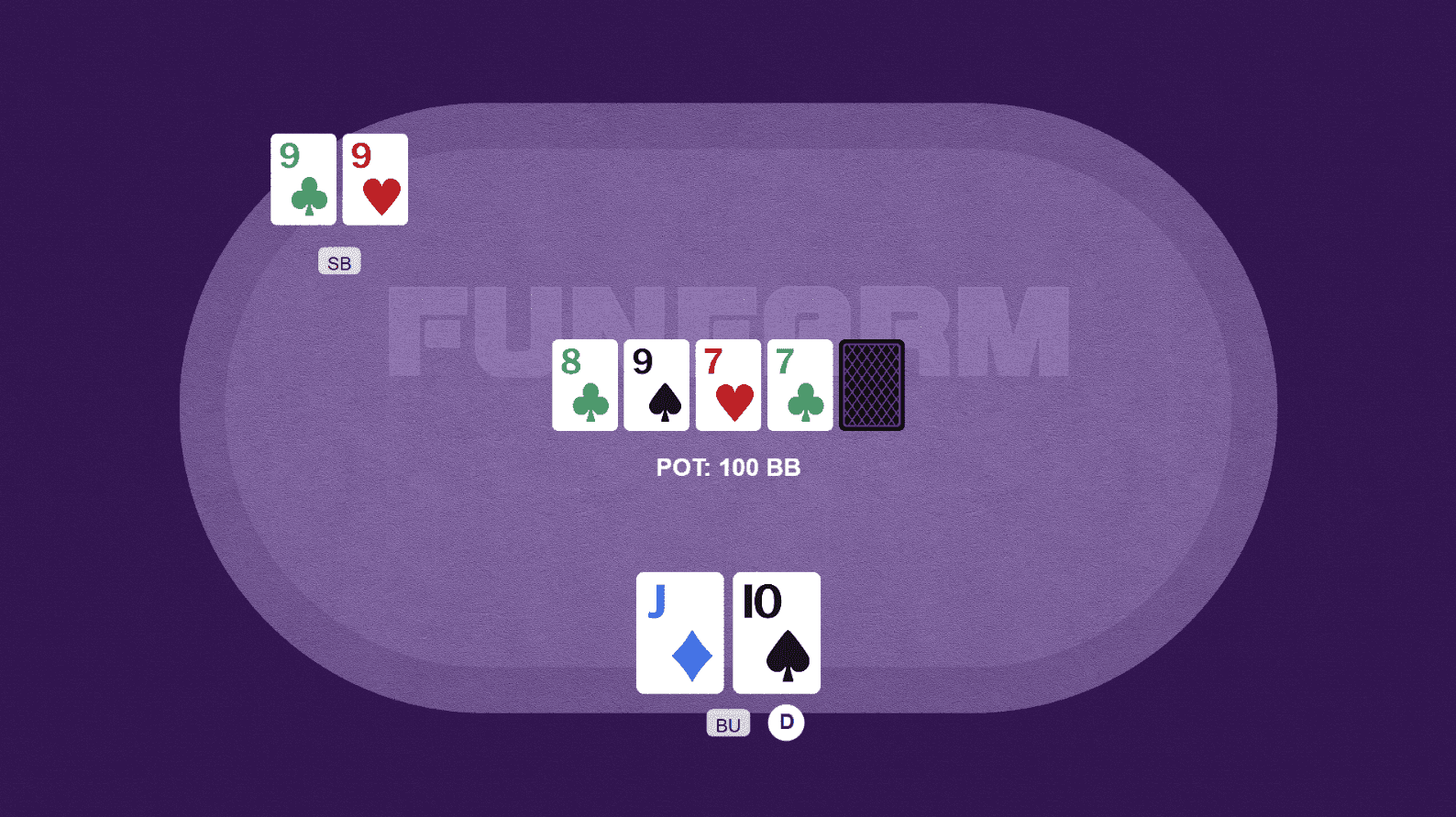
In poker, scary cards are the ones that can give the opponent a better hand. The seven on the turn improved the opponent to a full house and deprived the straight of any chance to win
River. If the turn and river didn't bring scary cards, we keep extracting value. Some opponents may overrate the strength of their hand. Others — may start catching opponents' bluffs. With potential flushes, full houses and quads on the board, we recommend acting more carefully. The opponent could have caught the needed card, so it's important not to lose additional money.
The straight is a strong but vulnerable hand. In most situations slowplay won't bring additional profit. The opponent will either cheaply catch their out, or won't invest money in the pot with a weak hand. Start collecting opponents' chips from the flop.

Typical mistakes with the straight
To outplay the world's top players, you need the highest level of skill and a lot of experience. In low buy-in tournaments, eliminating gross mistakes is enough for success. Here are the slip-ups players make:
They ignore pot odds. The slogans "never give up" and "go all the way" are motivating in life, but in poker it's useful to compare decisions with the math. Calling an opponent's large bets with a gutshot is always bad play. Calls with an OESD often lead to losses too. Advanced players justify their actions with implied odds. The thing is, an opponent rarely pays off the obvious extraction with a completed straight.
They don't fold in losing situations. The best hand on the flop can become garbage by the river. For example, a player caught a straight on the flop, but by the river 4 suited cards were on the board. The opponent very likely has a flush. However, some players don't admit defeat and lose additional money. Cards on later streets regularly flip hands around. Act flexibly and don't give away too much.
They use slowplay. In most cases straightforward extraction works better than elaborate traps. Slowplay creates additional risks. If the opponent prefers to check, we give them a free card. A dangerous turn or river will create a tricky situation. Giving up slowplay frees you from variance-laden decisions.
Some players overrate the strength of their hand. For example, a player with KQ on a suited JT9 board got a straight.
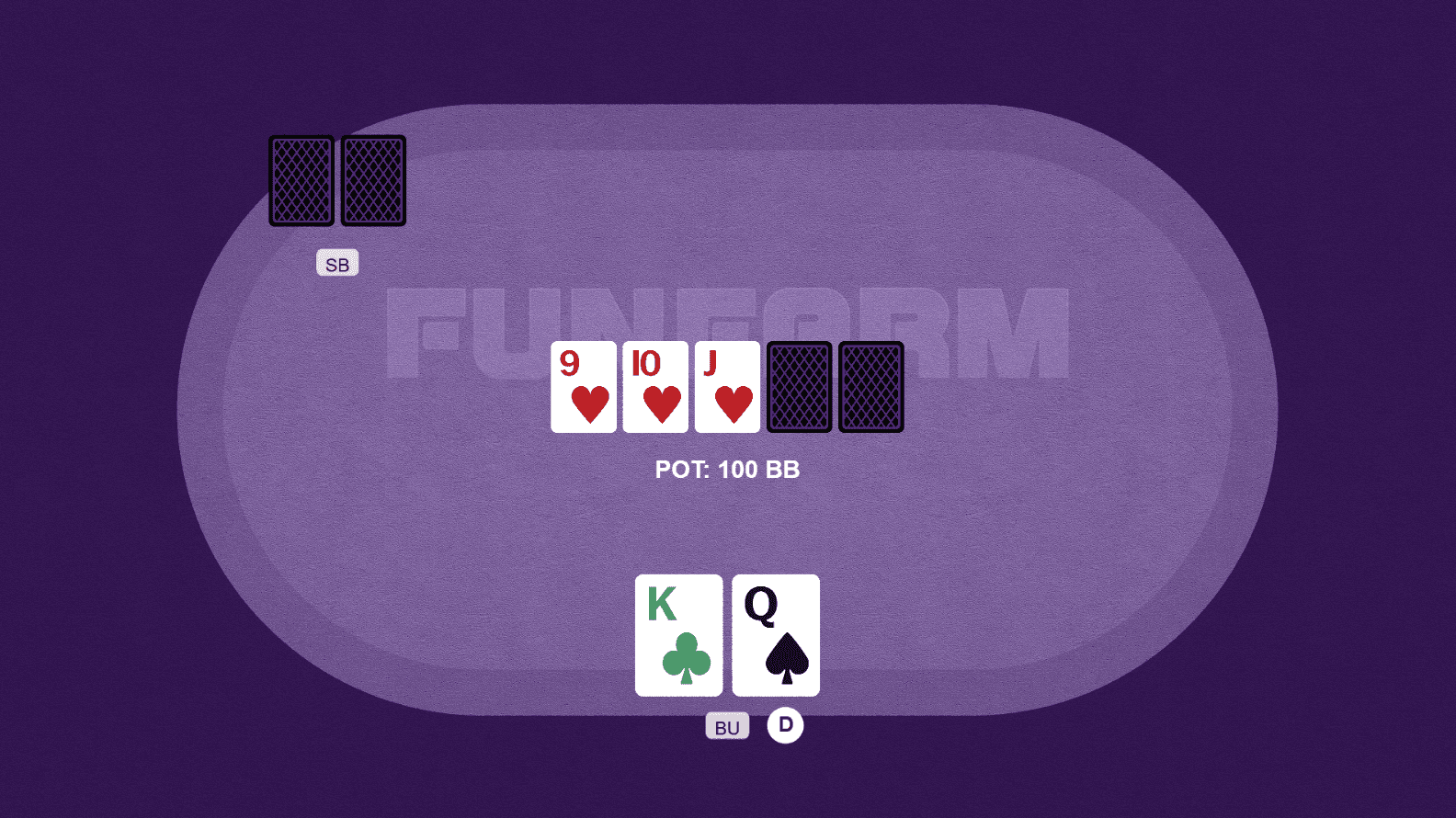
On a suited flop it's important to remember the unlikely but possible flush
The opponent could have caught a flush or a straight flush. An inexperienced player will ignore the chance of a better hand and try to invest all their chips in the pot as fast as possible. A pro will also choose an aggressive line, but will leave room for a fold.
How to learn to play poker
Most beginners start by getting acquainted with hands. In the next stages they study positions and the course of betting. Once a beginning player has mastered the basics, they can go in any direction. At their disposal: thousands of training videos and articles, hundreds of books, dozens of special programs.
The variety of learning materials isn't always beneficial. A chaotic approach slows progress. As a result the player loses time and motivation. If you're looking for a structured learning system, take a look at the FF Start program. It gives basic knowledge about poker and lets you lay the foundation. In the course we cover: the rules, types of opponents, final-table strategy and push/fold. A trainer will help reinforce the theory. We invite graduates of the program to the next level — FF Player Path

Free course · FF Start
Your first hands, with a clear plan
Learn to read the table, compare hands and understand the order of action.