What is a squeeze in poker
In this article, we'll break down what a squeeze is in poker, in which situations it works, which hands are suitable for it, how to choose the right bet size, and how to avoid turning this play into a source of losses.

One of our first coaches: on the team since the very founding of the project. He prioritizes simple and practical training with an emphasis on real game situations and decision-making over the long run. Val doesn't just "beat the games" as a player, but also instills a systematic approach to the game and discipline in his students.
We often find ourselves in this situation: preflop, one player opens with a raise, then one or two opponents simply call. The pot has already grown, "dead money"* has appeared in it, and we hold a good — but not necessarily premium — hand. And then the question arises: should we call to see the flop, or raise and try to take it all down right now?
*Dead money is the amount in the pot contributed by players who are no longer in the hand (who have folded). These funds are considered "dead" because their original owner has lost the chance to win the pot, even though the money stays in the pot and can be played for by the remaining participants.
Most beginning players choose to call. They're afraid to take risks, unsure of their hand, and hoping for luck on the postflop. As a result, they end up in a multiway pot against several opponents, where even a strong hand loses part of its equity.
*A multiway pot is a hand in which three or more players reach the flop (and subsequent streets).
The professional approach in this situation is to play a squeeze. An aggressive 3-bet that takes the pot down before the flop or leaves us heads-up against a single opponent.
In this article we'll break down what a squeeze is in poker, in which situations it works, which hands are suitable for it, how to choose the right bet size, and how to keep this move from becoming a source of losses. We'll also look at how to respond to a squeeze aimed at us and what mistakes beginning players make when trying to use this tactic.

New breakdowns in your inbox
Subscribe to the FunFarm newsletter: fresh Poker ABC articles and material that helps you grow as a player.
What a squeeze is in poker
A squeeze is a 3-bet in a situation where one player has open-raised before us and at least one opponent has called after them. We make a large raise, applying pressure on all the participants in the hand at once.
*An open-raise is the first raise in a hand preflop.
A classic squeeze situation: UTG opens to 3 big blinds, CO calls 3 big blinds, and we on the button squeeze to 12 big blinds. Before our action, the pot is already about 8 big blinds, counting the small and big blinds, and we're attacking that dead money.
You can learn more about positions in poker and which hands to play from each of them in this article. Go check it out.
The main difference between a squeeze and a regular 3-bet is the presence of cold-callers. This is a player who calls the bet without showing aggression preflop. Their range doesn't contain the strongest hands — AA, KK, QQ — because with those hands they would most likely have 3-bet themselves.
The caller's range consists of medium-strength hands: medium pocket pairs (77–TT), suited connectors (76s–98s), suited broadways (AJs, ATs), sometimes strong offsuit hands (KQo, AJo).
Why is this called a "squeeze"? Because we literally "squeeze" opponents out of the pot, creating pressure from two sides: on the raiser, who has already put money in and doesn't want to lose it, and on the callers, who were hoping to see the flop cheaply and complete their draws.
It's important to understand that a squeeze isn't necessarily a bluff and isn't necessarily a value bet. It's first and foremost the use of dead money and the weakness of ranges. We can squeeze both with strong hands (AA, KK) and with bluffs (A5s, 76s). The key is understanding why we're doing it in a particular situation.
Why a squeeze works
The success of a squeeze is based on several factors. Let's break down each of them in detail.
1. Dead money
When players simply call an open-raise, they've already put chips into the pot but haven't shown strength. That money no longer belongs to them, but they can't take it back without continuing in the hand. Our task is to make a bet of a size that makes continuing unprofitable for them mathematically and too expensive in terms of risk.
The more callers there are, the more dead money there is in the pot, and the more attractive the squeeze becomes. If one player has opened and two have called, the pot already holds 9–10 big blinds at the start. A squeeze to 15–16 big blinds risks 15 to win 10. The required fold equity is 60%. Against three opponents this is quite achievable.
2. The weakness of callers' ranges
This is the key point you need to understand once and for all. Players generally don't call with AA, KK, or QQ — they 3-bet. With AK they also 3-bet more often than they call. The caller's range consists of hands that are good for a multiway pot but handle pressure poorly: medium pairs, suited connectors, suited broadways.
And you can learn more about 3-bet strategy in this article. Go check it out.
When we make a large squeeze, the caller ends up in an awkward spot. They have no position, their hand isn't strong enough to continue, and the pot odds they're getting often don't justify a call.
3. Pressure on the raiser
The original raiser isn't thrilled about the squeeze either. They opened with a certain range, and now they're being asked to call a large bet. The top of their range (AA, KK, QQ, AK) will continue with a 4-bet or call. But the middle and bottom of it (medium pairs, weak aces, broadway hands) will fold with high probability.
It's important to understand that the raiser folds not because their hand is weak in absolute terms. They fold because their hand is weak relative to our actions. Open-raising 55 from UTG is fine. But calling a squeeze with 88 out of position against an aggressor is already bad.
Learning at FunFarm, from any level
What to squeeze with
The squeeze range should be balanced. It contains hands for value and hands for bluffing. Without balance, opponents will quickly adapt and start exploiting our strategy.
Value hands for squeezing
These are strong starting hands that we're willing to play a large pot with even if called. AA, KK, QQ, JJ, AKs, AKo. You can also add AQs and KQs here, especially in position and against wide ranges.
Why are these hands good for squeezing? They have high equity against most continuing ranges. AA and KK are monsters that win 80% of the time against a single hand. AKs and AKo have around 60–65% equity against a calling range. Even if the opponent doesn't fold, we remain in a profitable spot.
Bluff hands for squeezing
We can't squeeze only with strong hands. If we 3-bet only with AA, KK, QQ, and AK, opponents will quickly notice. To every raise of ours, they'll simply fold all weak hands and continue only with premiums.
We need bluffing hands that satisfy at least one of two conditions: holding blockers to the opponent's strong hands, and postflop potential.
*Blockers in poker are cards that are already in a player's hand and reduce the probability of those cards being in the opponents' hands.
The best candidates for a bluff squeeze are low suited aces.
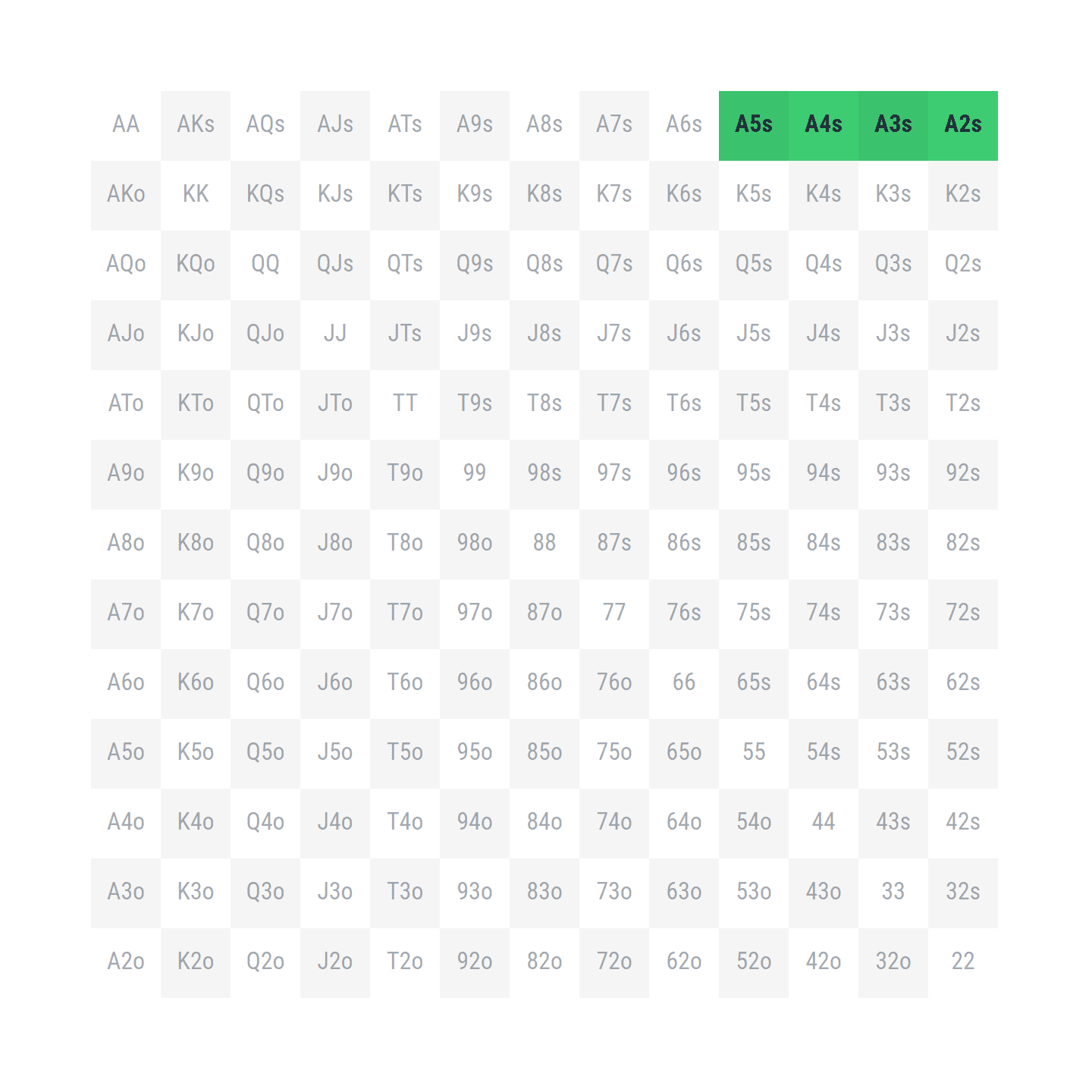
Why are they so good?
1. The ace blocks AA and AK — the main hands the opponent can continue with. The probability that the raiser has AA or AK is cut in half, because one ace is already in our hand.
2. These hands have flush potential. Postflop with A5s you can make the nut flush, which gives us additional equity when called.
3. These hands are easy to fold to a 4-bet — we don't lose much, because we haven't invested too much.
The second tier is suited connectors.
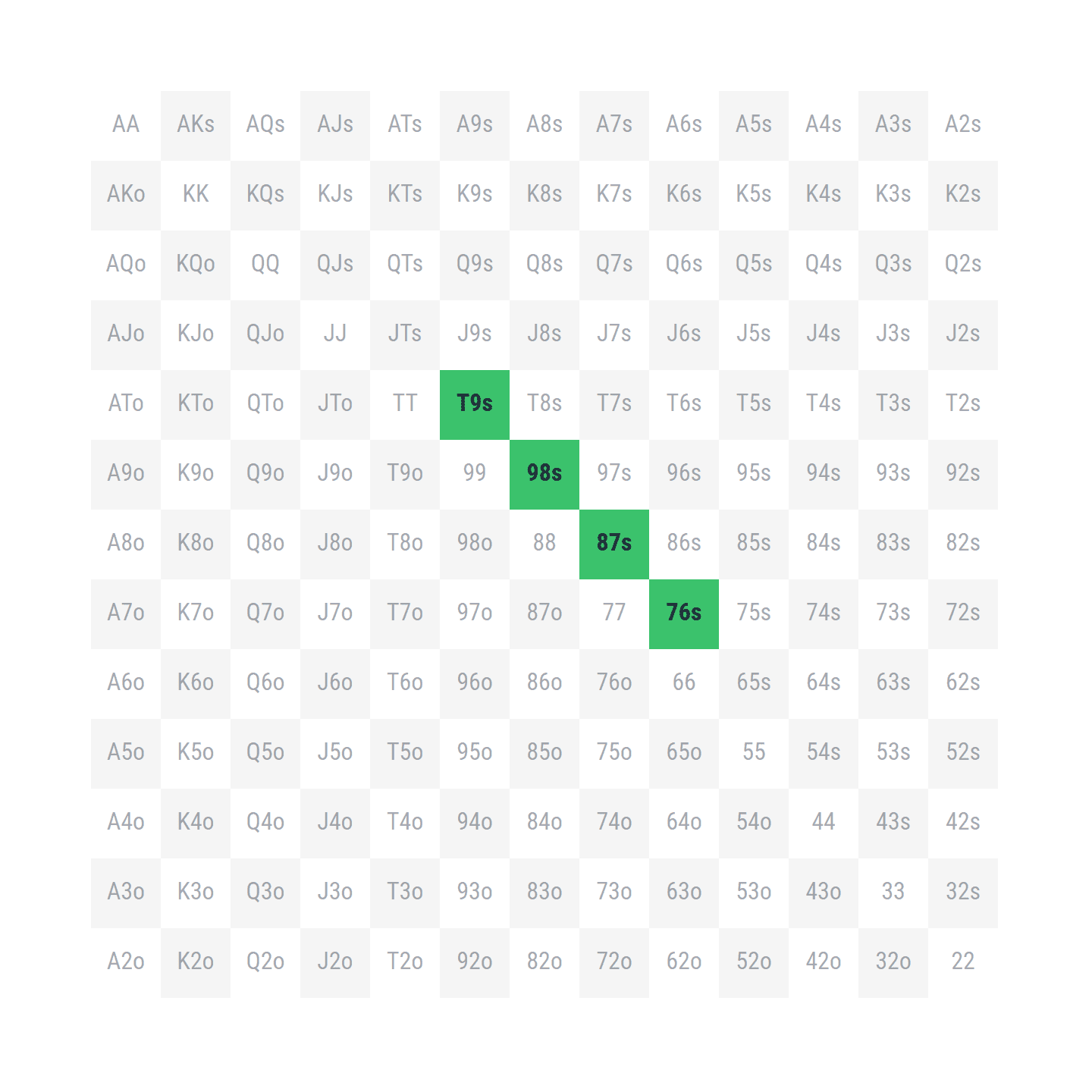
They have no blockers, but they have excellent postflop potential. From hands like these you can make a straight or a flush, and on dry textures they're good for a semi-bluff. And even if opponents fire back with aggression, we won't mind parting with these hands.
The third tier is suited broadways
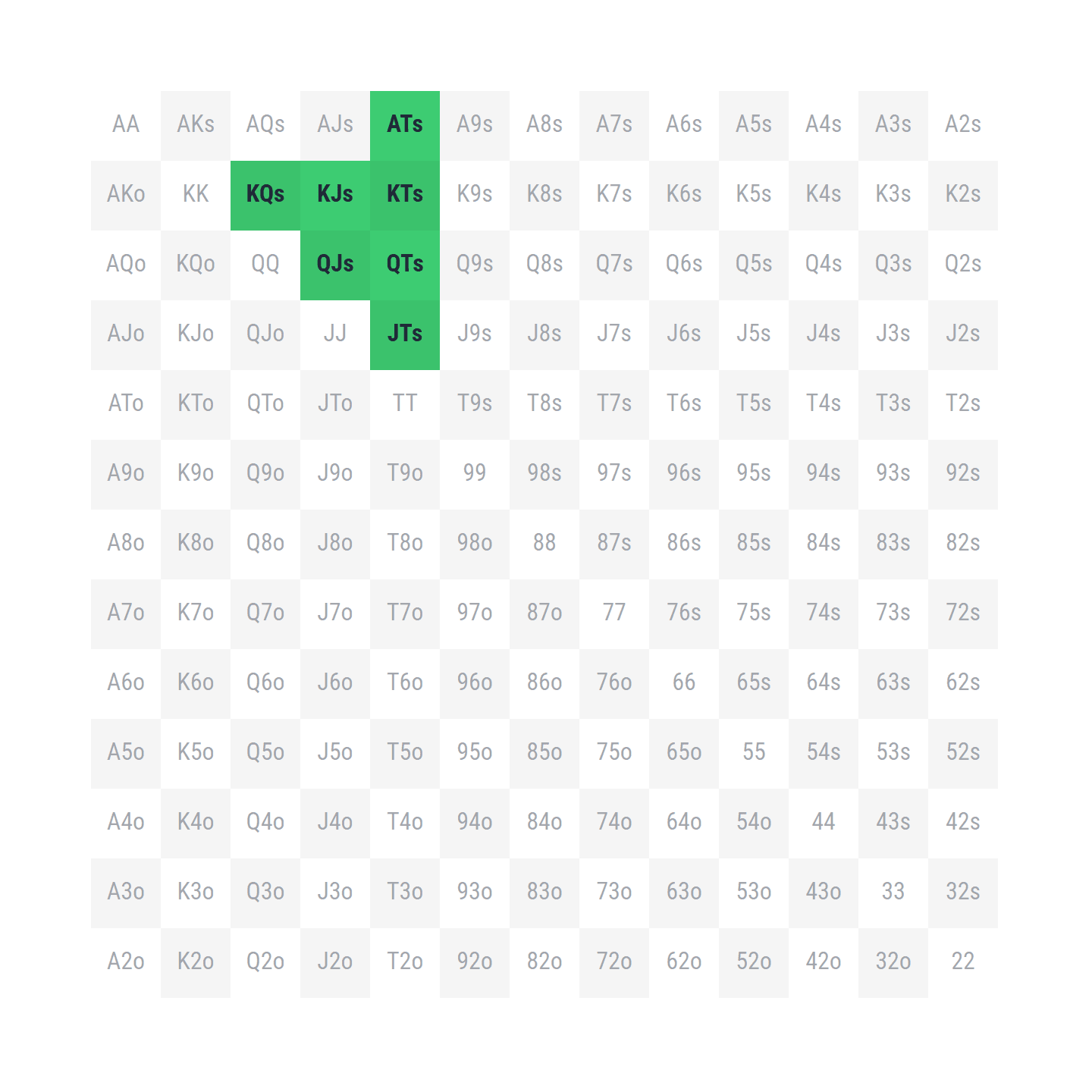
They have blockers (ATs blocks AA, AK, AQ; KJs blocks KK, KQ) and good postflop potential. They can be used in position against players who fold well.
Squeeze size
Squeeze size is one of the most important parameters. Too small a squeeze won't create pressure, and opponents will call with any draws. Too large a squeeze forces us to risk too many chips.
The standard formula. For a squeeze against one raiser and one caller, the optimal sizing is 3.5–4x the size of the open-raise. If they opened to 3 BB, we squeeze to 11–12 BB. That's enough to create pressure without overloading the bet.
Against one raiser and two callers, the pot is already bigger, which means the pressure should be stronger too. We play a squeeze of 4.5–5x the open-raise — to 14–15 BB.
With three callers you can squeeze 5–6x. The more dead money there is, the larger the squeeze should be in order to deny opponents pot odds.
What factors are important to keep in mind?
Positions. From the button or cutoff we can squeeze a bit smaller, because position will help us postflop. From the small blind or the big blind — larger, to compensate for the lack of position.
Stack depth. If stacks are short (30–40 BB), the squeeze can be smaller, because opponents will be more cautious. If stacks are deep (100+ BB), the squeeze should be larger to create real pressure.
When not to squeeze
The squeeze is a powerful move, but it doesn't always work. There are situations where it's better to pass on it. Ignoring these warnings will turn the squeeze from a weapon into a source of losses.
1. No blockers and no postflop potential
If we have J3o or T8o, the squeeze becomes a waste of chips. Such hands don't block opponents' strong ranges and have no chance to improve postflop. When called, we'll be playing a large pot with a hand that has almost no equity.
2. The opponent rarely folds
If we're playing against a not-very-aggressive player, their open-raise means a very strong hand — QQ+, AK. They won't fold to our squeeze, and we'll end up in a large pot with a hand that's very likely dominated. Against such players we don't squeeze as a bluff. Only value, and only with very strong hands.
3. No position and many callers
If we're in the small blind and someone has opened in front of us with three callers, the squeeze becomes dangerous. Without position against several opponents postflop, we'll be making difficult decisions. Every bet of ours will reveal information, and opponents will see our actions before their decisions. In spots like these it's better to fold marginal hands and squeeze only with premiums.
*Marginal (borderline) hands are starting combinations that are neither obviously strong nor clearly unsuitable for entering the hand.

How to respond to a squeeze aimed at you

It's important to understand how to play correctly against a squeeze. A mistake here can cost a lot of money.
1. 4-bet for value
With AA, KK, AKs we can and should 4-bet. These are the best hands in poker, and we're ready to play for stacks. Especially if we're in position. The 4-bet size is around 2.5–3x the squeeze. With a 12 BB squeeze, our 4-bet will be 28–32 BB.
2. 4-bet as a bluff
With A2s–A5s you can sometimes 4-bet as a bluff. These hands block AA and AK, which means the opponent is less likely to have a hand to continue with. But such a move requires confidence and isn't suitable for all stakes. At low stakes, where players rarely fold to a 4-bet, it's better to refrain. The size of a bluff 4-bet should be the same as a value 4-bet, so as not to give the opponent information.
3. Call
With hands like QQ, JJ, AQs in position you can simply call the squeeze. These hands are strong enough to play postflop, especially if we have position. We don't want to inflate the pot to 50 BB preflop, but we're ready to play postflop with pot control. When calling, it's important to have a postflop plan.
If we call with QQ and the flop comes A-9-2, we should be ready to fold to aggression. If the flop comes 8-6-9, we can continue.
Common squeeze mistakes
Squeeze mistakes happen for two reasons: incorrect assessment of the situation and incorrect hand selection. Let's break down the most common ones.
1. Squeezing with trash hands
A player sees that the opponent opened wide and decides to play a squeeze with Q4s just because the hand is suited. This is a mistake. Q4s has no blockers, and its postflop potential is minimal. When called, we'll find ourselves in a dominated position. Squeezes like these quickly destroy a bankroll.
2. Too small a squeeze
A player squeezes 9 BB against a 3 BB open-raise and one call. That's not enough. Opponents get good pot odds and call with any draws. As a result, we end up in a multiway pot with a hand that has no advantage. The squeeze size should create real pressure.
3. Too large a squeeze
A player squeezes 20 BB against a 3 BB open-raise and one call. That's overkill. We risk too many chips. Postflop with a short stack is hard to play — especially without position. A large squeeze only makes sense with short stacks, where we're ready to play for stacks.
4. Squeezing without accounting for opponents' playing style
Before squeezing, we always assess who's sitting at the table. Against tight players the squeeze is dangerous. Against loose ones it's profitable.
*A tight player is a participant in the hand who chooses to enter the game only with the strongest hole cards. A loose player is the opposite: they like to play aggressively, apply pressure, and open a wide range of hands.
5. Squeezing without a postflop plan
A player makes a squeeze, the opponent calls. What next? If we don't have an answer to this question, the squeeze was a mistake. We should always have a plan: which flop we want to see, how we'll act when we hit and when we miss, what bet size we'll use. Without a plan, the squeeze turns into a lottery.
Conclusion
The ability to use a tool like the squeeze in your game is the mark of a confident player who understands poker math and isn't afraid of aggression. But confidence is based on calculation, not luck.
If you want to build a systematic preflop strategy, learn to use 3-bets and squeezes correctly, and understand when aggression brings profit and when it leads to losses — submit an application to FunFarm.
Free course · FF Start
Make decisions with more confidence
A structured course for beginners who want to understand the logic behind every hand.