Push/Fold in Poker: Short-Stack Strategy and Nash Charts
In tournament poker, almost every player goes through the same stage. At the start of the event, the stack is deep, the blinds are small, and that means we have room to maneuver. But as the blinds grow, the tournament structure changes. A stack that seemed comfortable just a moment ago suddenly turns into a short one.

One of our first coaches: on the team since the very founding of the project. He prioritizes simple and practical training with an emphasis on real game situations and decision-making over the long run. Val doesn't just "beat the games" as a player, but also instills a systematic approach to the game and discipline in his students.
It's at this very moment that the game stops resembling the usual postflop poker. When we're left with 10–15 big blinds, we can no longer afford a wide range of decisions. Every mistake starts to cost too much, and any unsuccessful investment of chips sharply reduces our chances of survival and of advancing further through the tournament. This is where the push/fold strategy comes in.
In this article, we'll break down what push/fold is in poker, why the 13–15 BB threshold is considered key, how Nash charts work, why ICM changes ranges on the bubble and final tables, and also how the strategy changes by position — from early position to the small blind.

New breakdowns in your inbox
Subscribe to the FunFarm newsletter: fresh Poker ABC articles and material that helps you grow as a player.
What push/fold is in poker
This is a strategy in which, preflop, we either go all-in immediately or fold. Between these two actions, in most cases there's no room left for a limp, a call, or a raise.
The reason is simple: with a short stack, any intermediate decisions start losing in efficiency.
If we have 10–12 BB left, then even a small raise already invests a substantial portion of the stack into the pot. After that, we often find ourselves in an awkward situation: on the one hand, we've already invested too much to fold; on the other, we have too few chips left to comfortably play postflop.
That's precisely why the push/fold strategy simplifies the decision tree. We either realize fold equity through an all-in, or we preserve our stack. This lets us avoid situations where we give away part of our chips without applying enough pressure on the opponent.
Why exactly are 13–15 BB considered the threshold zone? Because at roughly this depth the stack is already not large enough for full-fledged postflop play, yet still noticeable enough that a push creates pressure on opponents' calling ranges.
What an effective stack is and why it matters
The effective stack is the smallest stack among the players involved in the hand. It's precisely this that determines how many chips the participants are actually risking.
Let's imagine a situation: we have 150 BB, the opponent has 20 BB. If we go all-in and he calls, then only his 20 BB and our 20 BB are involved in the hand. The remaining 130 BB don't come into actual play. That means the effective stack in this hand is 20 BB.
For push/fold this is a critically important parameter. There may be several players at the table with different stacks, and theoretically our stack might be comfortable. But if a player with a short stack is in the hand, the strategy adjusts specifically to his size. In some spots we play as if against 25 BB, in others as if against 8 BB, even though our own stack hasn't changed.
This is especially important on the bubble and in the late stages of tournaments, where the table often has short, medium, and big stacks all at once. Ignoring the effective stack means making decisions divorced from the real structure of the hand.
Why a min-raise and a limp with a short stack are mistakes
One of the most common problems beginners have in push/fold stacks is trying to play "as usual." It seems to the player that an all-in is too risky an action, so they choose something intermediate: a limp, a small raise, or a call. In practice, this is exactly what becomes a source of EV loss.
1. We lose fold equity
The main strength of a push lies not only in the fact that we can double up at showdown, but also in the fact that opponents often simply throw their hands away. That's fold equity: the probability that the opponent will give up under the pressure of an all-in.
When we make a min-raise with a short stack, we reduce the pressure. The opponent gets a good price to call, can connect with the board, and can realize equity with hands that they would have folded against a push. As a result, we invest part of our stack but don't achieve the main goal — we don't force the opponent's range to fold as often as we need.
We discussed this topic in more detail in this article.
2. We create a situation with difficult decisions postflop
If we have 12 BB and we open with a min-raise, then after the opponent calls there will already be a significant portion of our stack in the pot. On the flop we often face an unpleasant choice: continue the aggression almost on autopilot, or give up after we've already invested a noticeable amount of chips. This is the typical short-stack trap: half the stack is already spent, while the hand is still far from finished.
3. We let the opponent realize equity
A short stack can't allow opponents to see the flop cheaply. If they have connectors, suited hands, or simply two live cards, then over the long run it's profitable for them to get the chance to see the board for a small price. A push cuts off that chance and forces them to pay the full price to continue.
*Equity is the mathematical probability that a hand will win the pot by showdown, taking into account all possible cards and opponents' ranges.
*A connector is a starting hand consisting of two consecutive cards whose ranks differ by one. These cards can be adjacent, for example 7 and 8, or separated by one card, for example 10 and 8.
Learning at FunFarm, from any level
Starting-hand charts in push/fold
To make decisions in push/fold stacks, players use starting-hand charts, or push/fold tables. These are matrix ranges that show which hands we can profitably push depending on position, stack, ante, and other parameters.
The main value of such tables is that they remove the illusion of intuitive play. In push/fold it's very easy to overvalue a hand. For example, weak offsuit aces often seem like convenient push candidates simply because an ace looks strong. But in practice such hands can turn out to be dominated within the calling range and bring less EV than connected suited Broadways.
*A Broadway is a high-ranking card from ten to ace. Combinations consisting of such cards, for example KQ or AJ, are called Broadway hands.
We covered how to read charts in more detail in this article. Head over to study the matter more deeply.
How push/fold is calculated by position
One of the most important patterns of push/fold is how ranges change by position. The idea here is very simple: the fewer players remain behind us, the less often we encounter a strong calling range and the wider we can push.
1. Early positions
From early position our range should be the tightest. The reason isn't that the hands themselves become weaker, but that there are too many opponents left behind us. Even if each of them defends relatively tightly, the cumulative probability of getting a call rises sharply.
We offer you several push/fold ranges for a 10 BB and a 15 BB stack — so you can get a feel for the difference.
In green we'll mark a confident push, and in purple a marginally profitable one. Don't take the ranges we'll show you literally — we put them together to demonstrate the logic of push/fold depending on positions and stacks.
In addition, the discussion below will be about positions in poker. To navigate the topic better, we advise reading our article about positions.
*A range is the assumed set of hands with which a player can perform a certain action: open, call, bet, or bluff.
And now to the charts.
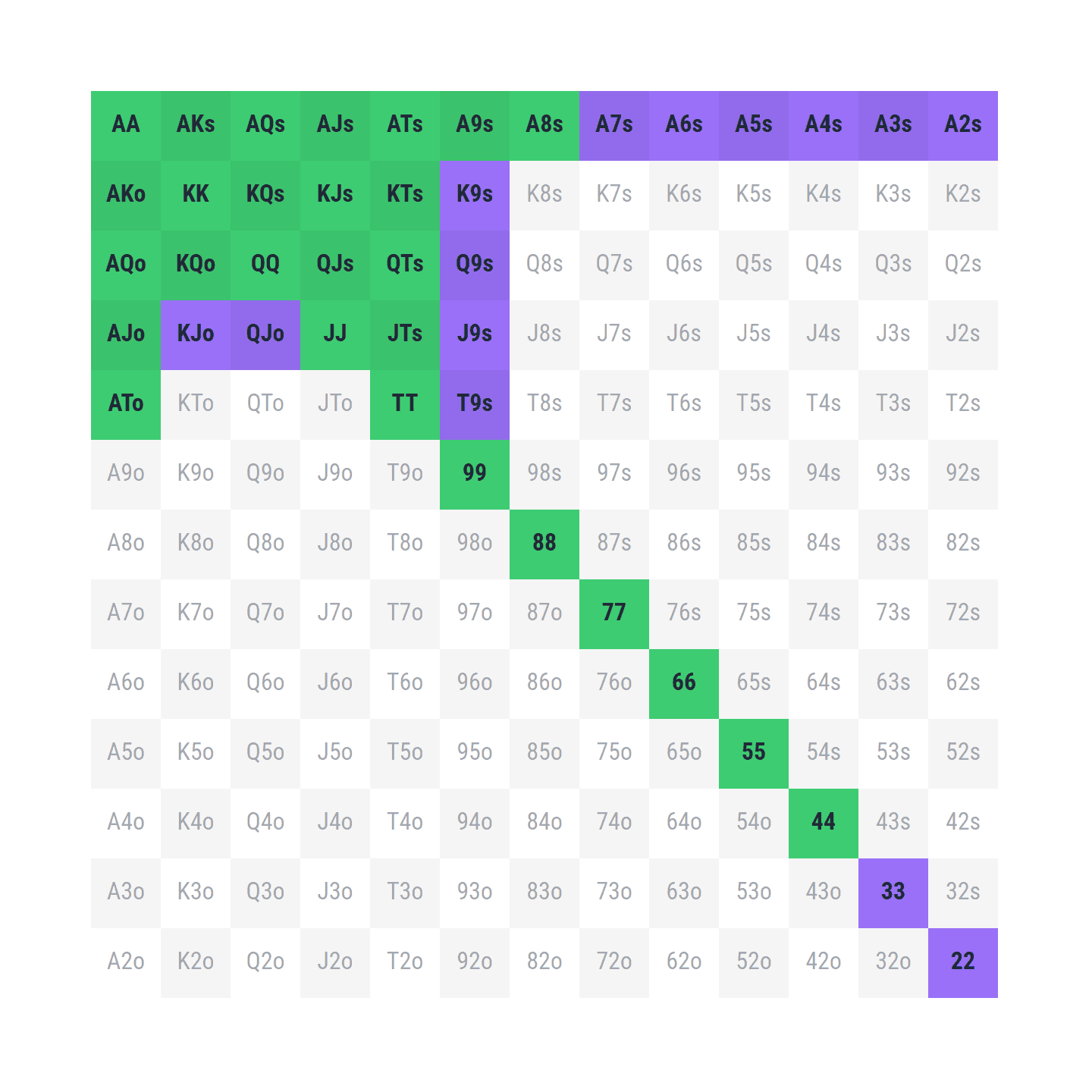
UTG and UTG+1 with a 10 BB stack
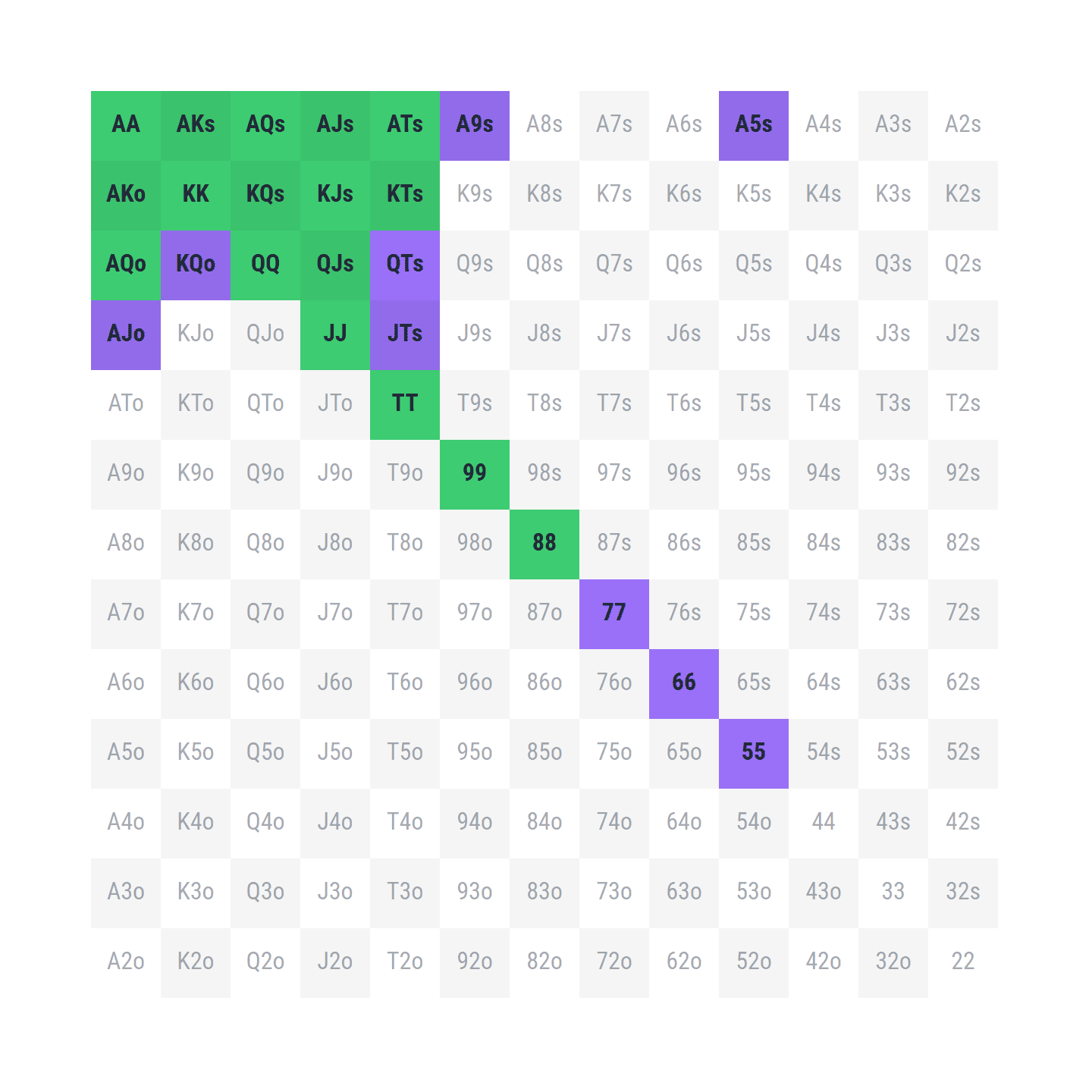
UTG and UTG+1 with a 15 BB stack
2. Middle positions
As we move away from the early positions, the range starts to gradually widen. There are already fewer players behind us, which means our fold equity becomes higher.
Here more borderline hands start being added to the range, especially if the players behind aren't the most aggressive opponents.
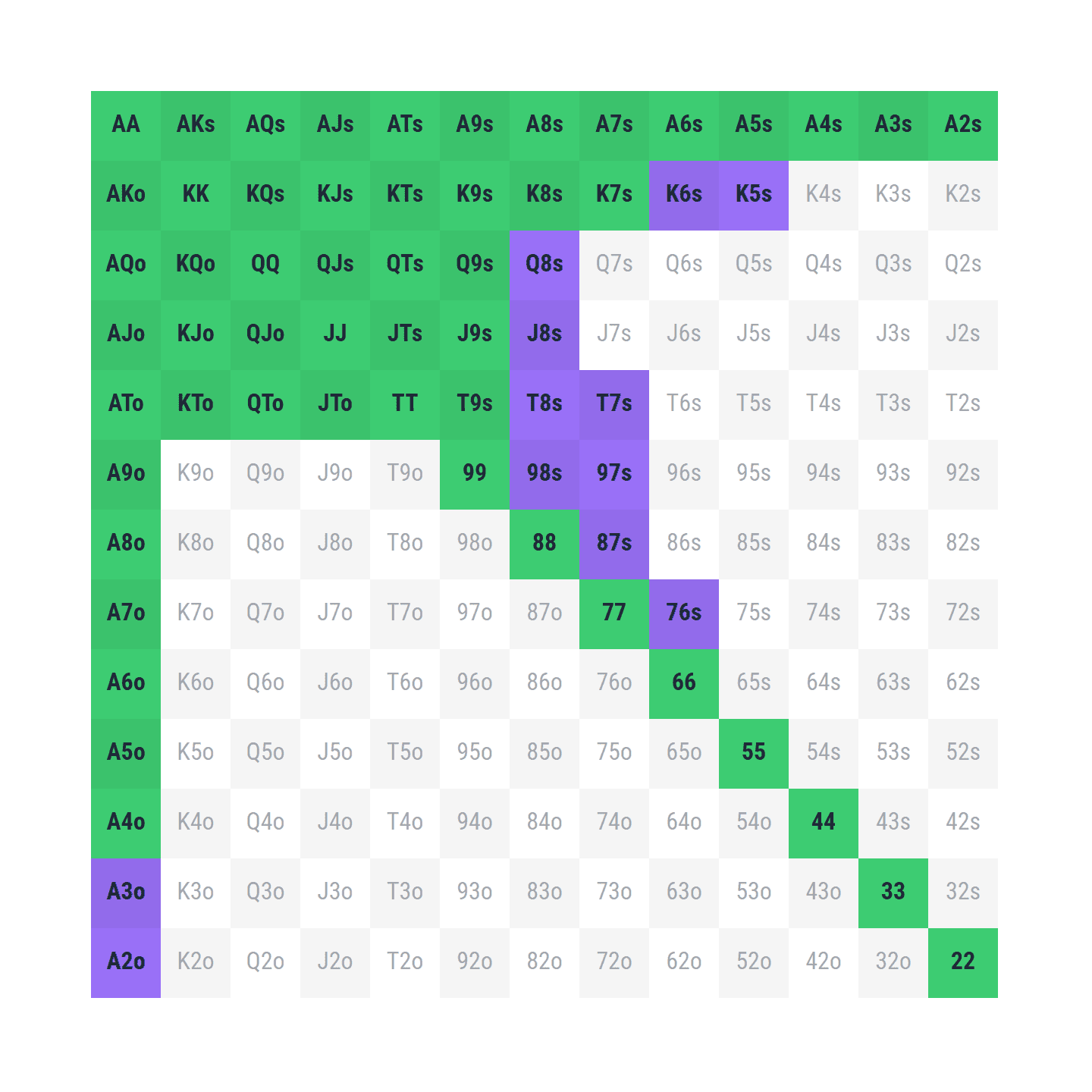
MP and HJ with a 10 BB stack
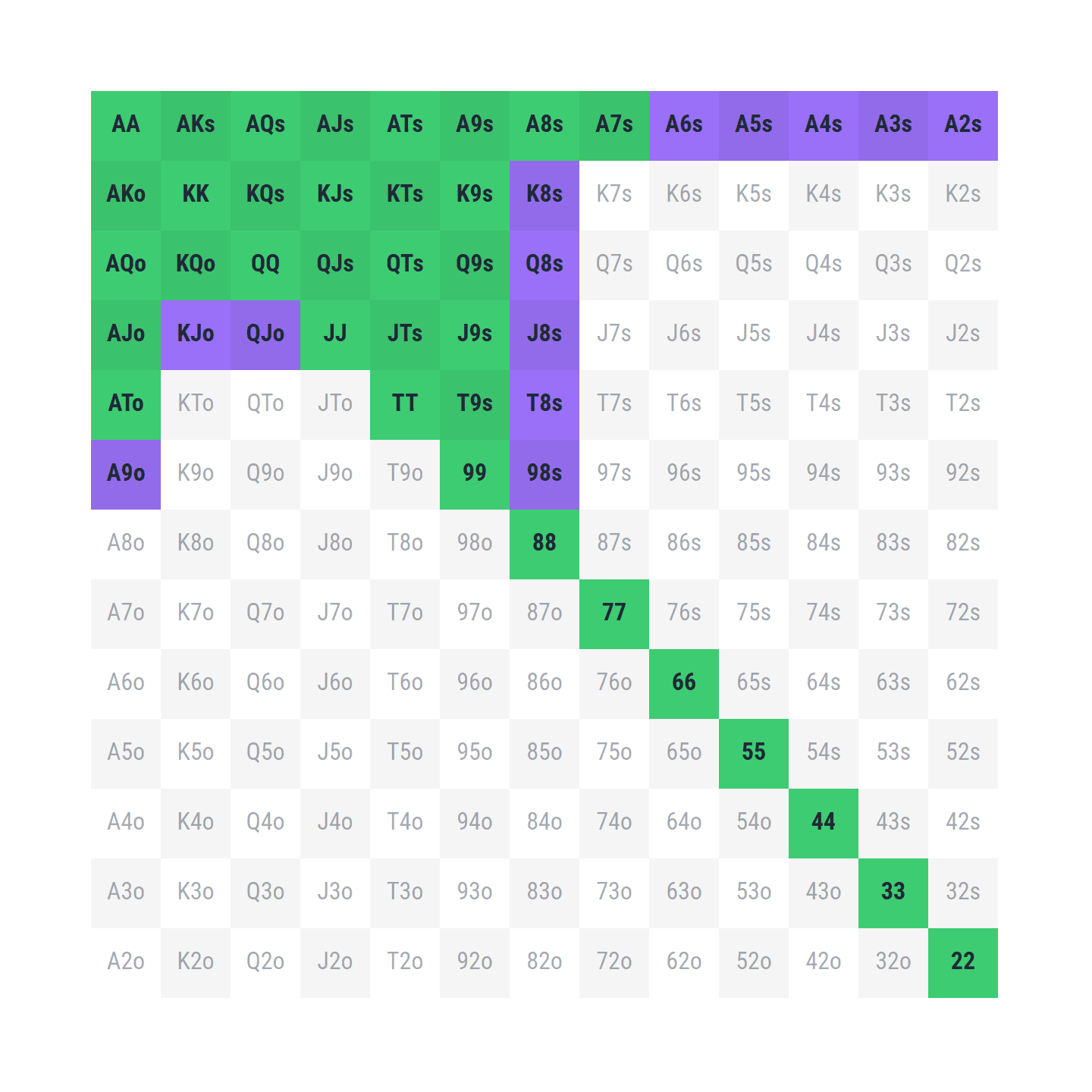
MP and HJ with a 15 BB stack
3. Late positions
It's precisely in late positions that push/fold reveals itself most fully. On the CO and especially on the BTN we get the chance to put pressure on the blinds, which are forced to defend fairly disciplined.
The later the position, the wider our push range — and this is one of the most important ideas for the entire short-stack strategy.
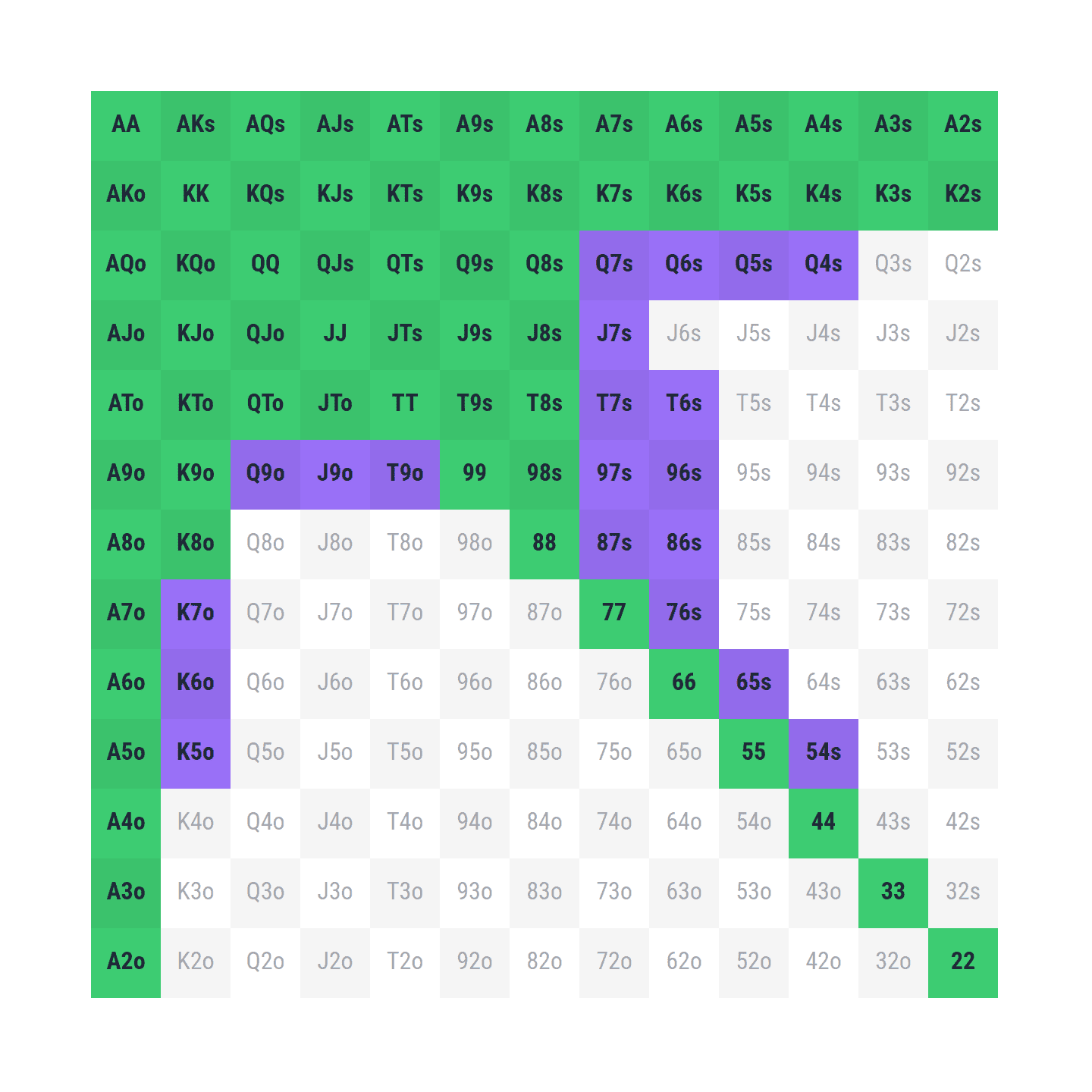
CO and BTN with a 10 BB stack
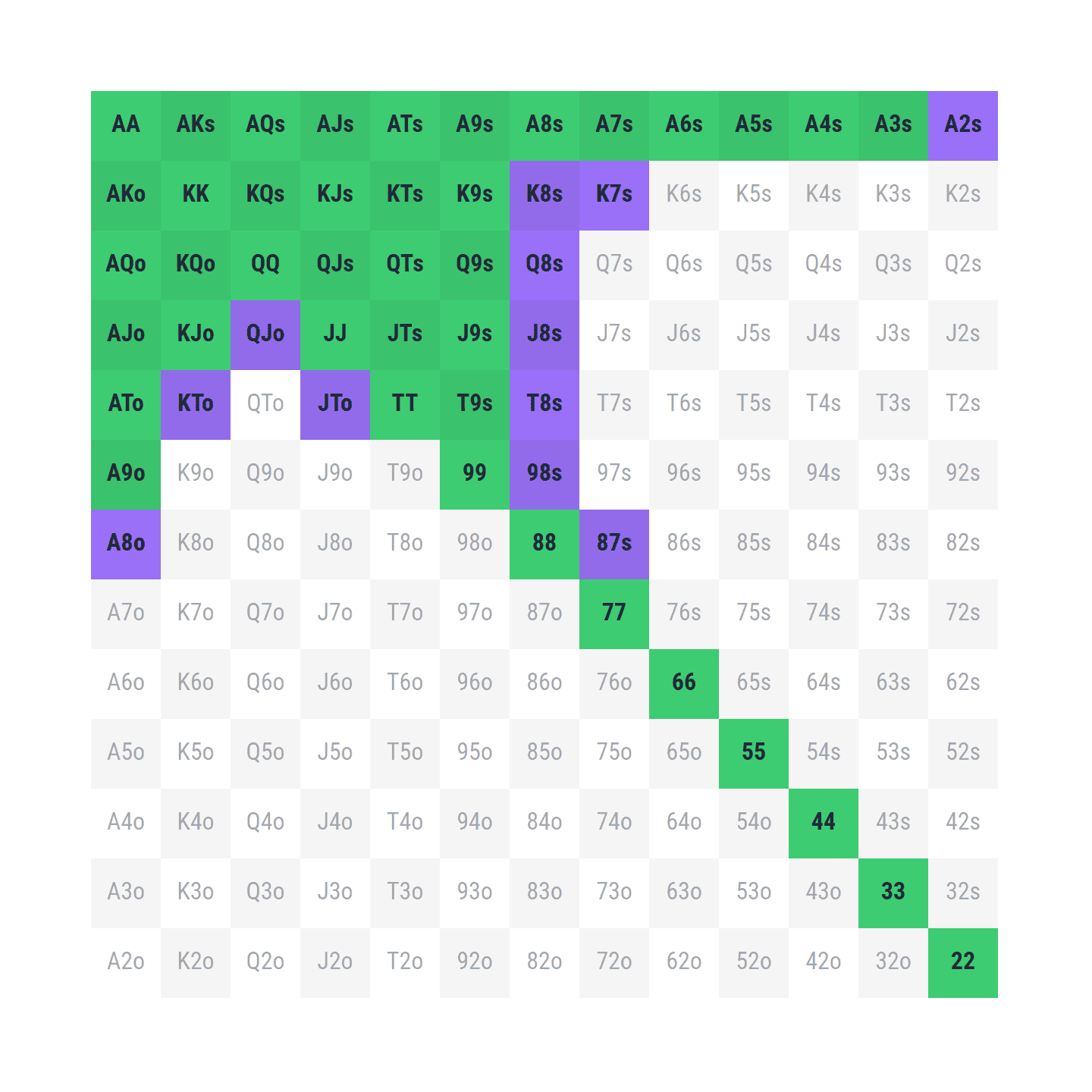
CO and BTN with a 15 BB stack
4. Small blind against big blind
The SB vs BB situation is special. Here only one player remains behind us, so the push ranges become very wide. If the opponent on the big blind calls too tightly, our push earns extra chipEV with a huge number of hands from the range.
That's exactly why many borderline hands become profitable in SB vs BB. But this is also where a trap lies: if the big blind defends wider than the field does on average, our range needs to be adjusted.
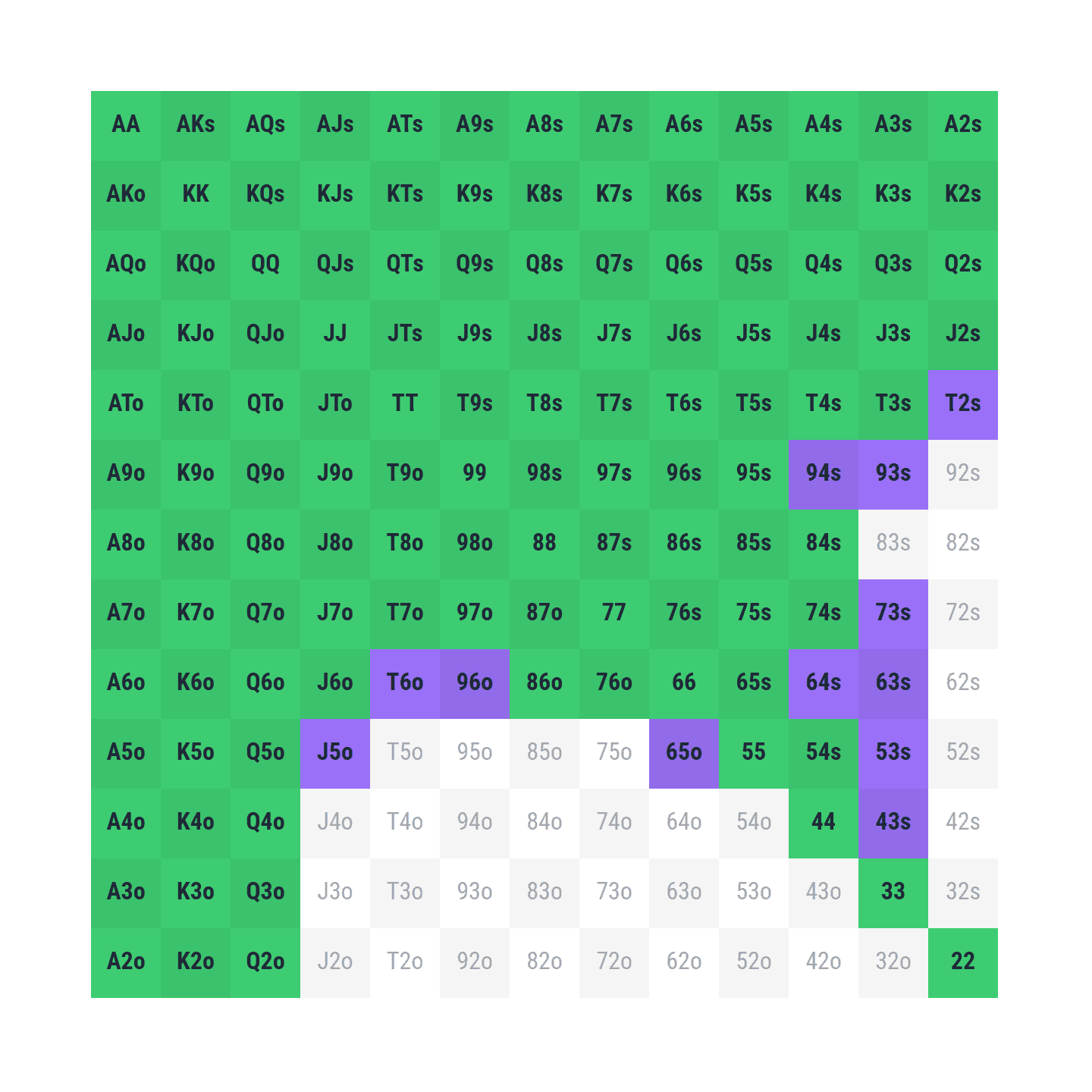
SB vs BB with a 10 BB stack
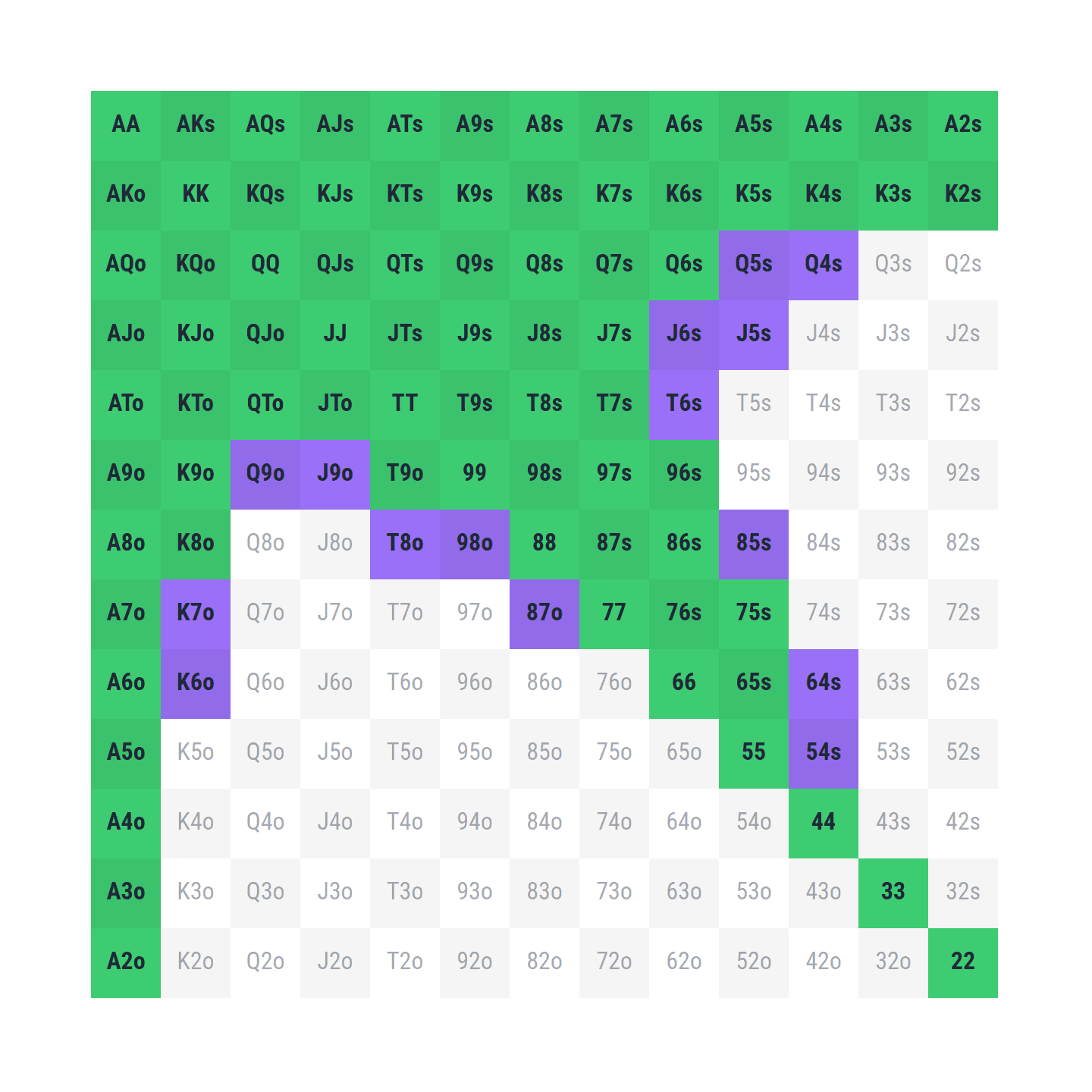
SB vs BB with a 15 BB stack
What ICM is and how it affects push/fold
When we study the push/fold strategy, it's very easy to fall into the trap of oversimplification. It seems to us that it's enough to open a table, look at the stack in blinds, find our position, and mechanically make a decision. In the early stages of a tournament such an approach can still work relatively close to optimal. But the closer we get to the money, the bubble, or the final table, the more dangerous it becomes to blindly follow the basic charts.
This is exactly where ICM (Independent Chip Model) comes in — a model that shows that in tournaments the value of chips doesn't equal their face value.
We covered the influence of ICM on poker decisions and the difference between chipEV and ICM in more detail in this article. Head over and read it.
This is one of the most important shifts in a tournament player's thinking. As long as we evaluate a stack only as a number of chips, we can make actions that seem logical at first glance but are losing over the long run. ICM forces us to look at the stack differently: not as an abstract resource, but as a tool tied to the current stage of the tournament, pay jumps, and the probability of being knocked out.
*A pay jump is an increase in the payout when moving up to a higher place in the tournament.
For push/fold this means several very important things.
1. On the bubble, ranges change
On the bubble, players can no longer think only in terms of chipEV. This affects calling ranges especially strongly. A push in such a situation can still be profitable, because opponents don't want to risk busting before the money. A call against a push, on the other hand, requires much more caution.
*The bubble is the stage of a tournament when one or several players still have to be eliminated before reaching the money.
2. On the final table, medium stacks are under pressure
This is one of the most underestimated aspects of ICM. It seems that a medium stack is a comfortable zone: the player still has room to maneuver, yet at the same time isn't on the brink of elimination. In practice, it's precisely medium stacks that most often end up in the most vulnerable position.
They can't apply pressure as freely as the chip leader, because the risk of losing a big pot is too great. But they also can't wait indefinitely, because the blinds keep growing. Because of this, their push/fold strategy becomes much more restrained than in the chipEV model.
When we say that ICM poker changes push/fold, we're essentially talking about a shift from "table-based" play to contextual play. It's no longer enough for us to simply find a hand in a chart. We need to take into account:
how many players are left before the money
how big the difference between payouts is
what our stack is relative to the other participants
whom we cover and who covers us
how costly being knocked out would be right now
That's exactly why the same hand can be a standard push in the middle of a tournament, a borderline action on the bubble, and a clear fold at the final table. Not because the hand changed, but because the cost of a mistake changed.

What programs help build ranges
When we start to dig deeper into the push/fold strategy, it quickly becomes clear — basic tables alone aren't enough. They're useful as a foundation, but they poorly convey the real structure of a tournament.
We need a tool that lets us evaluate specific spots, take into account the stack, ante, positions, and tournament context. This is exactly what players use specialized software for, and one of the most well-known tools is ICMIZER.
Information about other ICM calculators you can find in that same article about ICM in poker that we mentioned in the previous block.
The main value of ICMIZER is that it helps move from the abstract assumption "this hand seems to be a push" to the concrete question — exactly how much EV are we gaining or losing with this action?
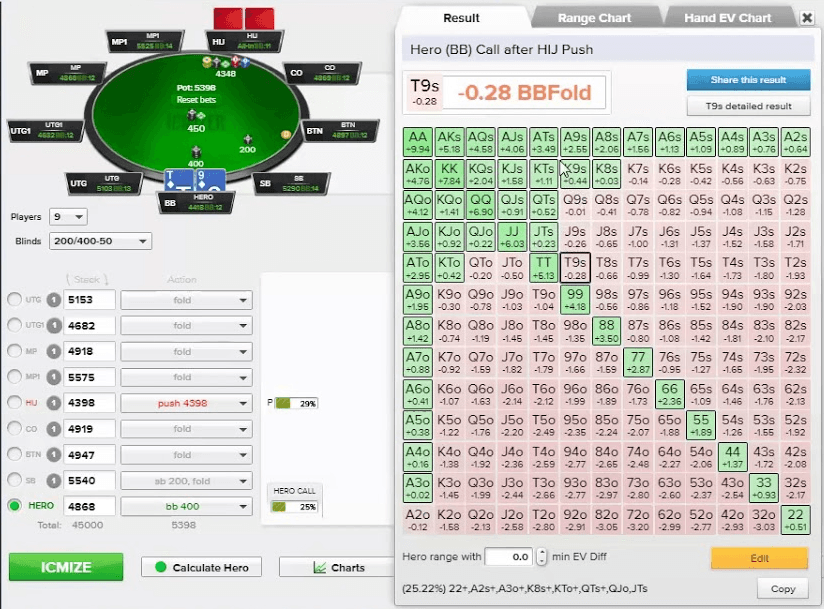
The program's interface
The program takes into account:
the size of the effective stack
the presence of an ante
the number of players at the table
positions
the assumed push and call ranges
the tournament payout structure, if we're working in ICM mode
This makes it possible to analyze not abstract push/fold poker, but a real tournament situation.
For example, we can see that a hand with a small but stable chipEV plus becomes a minus in an ICM scenario. Or the other way around: a borderline push against opponents who are too tight unexpectedly starts bringing more EV than the basic tables suggested.
Another popular tool for analyzing push/fold situations is Holdem Resources Calculator (HRC). It's one of the most well-known tournament poker calculators, used by many professional players to build ranges and analyze hands.
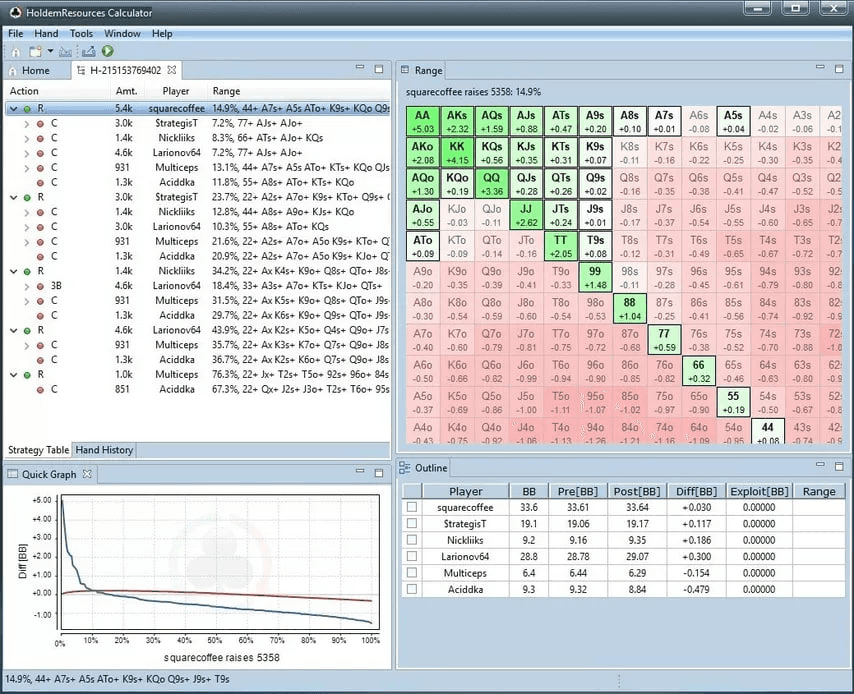
The program's interface
If ICMIZER is more often used for quick analysis of individual spots, then HRC is especially valued as a tool for deep analysis of tournament situations and finding leaks in strategy. The program lets you model various hand scenarios and see which decisions will be optimal from the standpoint of expected value.
The program's interface lets you create specific game scenarios and analyze them from different points of view.
The program analyzes a multitude of parameters that directly affect the profitability of a push or a call:
the size of the effective stack
the number of players at the table
the participants' positions
the push and call ranges
the prize payout structure
the distribution of stacks among players
A particularly useful feature of HRC is the ability to import real hands and analyze them after the game. This turns the program into a tool for finding strategic mistakes: the software shows where a push was a plus, where it was worth folding, and where the range could have been widened.
The advantages and disadvantages of a push
When we talk about a push, it's important to understand: it really does have strong sides, and that's exactly why the push/fold strategy exists at all as a separate section of tournament poker. But this action also has limitations. If you use it without an understanding of the stack, position, calling ranges, and tournament structure, the advantage quickly turns into a source of EV leakage.
Advantages of a push:
1. A push creates maximum pressure
If an ordinary raise can be perceived as an intermediate action, then an all-in requires the opponent to decide immediately — whether they're ready to risk a significant portion of their stack or their entire tournament.
That's precisely why a push works as the strongest form of pressure. It's not enough for the opponent to simply see one more card or call out of curiosity. They must either continue at a very high price, or fold.
2. A push lets us steal the blinds
When the stack is short, we no longer need to wait exclusively for premium hands to keep our tournament life going. On the contrary, part of the profit comes from regularly stealing the blinds.
In short stacks this is critical: sometimes one successful push without a showdown means almost a whole additional orbit at the table for us.
3. A push simplifies short-stack play
When the stack drops into the 10–15 BB zone, complex postflop play almost always becomes not an advantage, but a source of mistakes.
A push removes this problem. We immediately move the hand into the most rigid format — we remove from it the decisions that, with a short stack, more often turn out to be losing.
4. A push protects strong hands and strong draws
A push is useful not only as a tool of pressure, but also as a means of protection. If we have a strong but vulnerable hand, we don't always want to let the opponent cheaply realize equity. The same goes for strong draws: sometimes an all-in turns out to be the best line precisely because it gives us two paths to a win — the opponent folding, or winning at showdown.
Disadvantages of a push:
1. A push is always associated with the risk of losing your stack
Even if the decision is profitable over the long run, in the short horizon it remains risky. We can get it in ahead and still lose. We need to understand how justified this risk is right now and specifically in this context.
2. A push becomes predictable with templated use
If a player uses a push too often as a universal answer to all difficult situations, their strategy quickly becomes transparent. Opponents start noticing patterns: from which positions we apply pressure wider, with which hands we get it in too often, how we ourselves react to pressure.
A good push is an action that relies on the range, the stack, and table dynamics. A bad push is simply the habit of resolving a hand immediately, when a player doesn't want to work through the nuances.
3. A push loses effectiveness against big stacks and wide calling ranges
If the opponent has a big stack, they can afford to defend noticeably wider. For them the price of a call is lower not in absolute chips, but in a strategic sense. They don't fear being knocked out as strongly as a medium or short stack.
The same goes for opponents who simply call too wide. We can no longer count on the standard amount of fold equity and must shift toward a stronger push range.
4. A push amplifies ICM risks on the bubble and the final table
This applies especially to medium stacks. They most often find themselves under maximum ICM pressure and can't afford marginal shoves. So a push that would be routine in the middle of a tournament can become a clear overreach in the late stage.
Conclusion
A good player doesn't perceive push/fold as a boring survival mode. On the contrary, they understand that it's precisely here that a big edge over the field can be gained.
Most beginning players either push too tightly and lose their stack, or, on the contrary, overvalue individual hands and get it in too wide. Knowledge of Nash charts, an understanding of ICM poker, and the ability to adjust ranges to the real tendencies of the field turn push/fold from a mechanical scheme into a working tool for growing EV.
If you want to understand starting-hand charts more deeply, better understand position in poker and work more confidently with spots like all-in in poker, it's important to study this topic not as a set of tables, but as part of the entire tournament system. It's precisely this approach to learning and understanding the game that we build at FunFarm.

Free course · FF Start
Strong play starts before the flop
Master starting hands, position, bet sizes and the core preflop scenarios.