MTT Late-Stage Strategy
So the late stage of an MTT isn't just a continuation of the middle stage. It's a transition to a game where every decision must be evaluated not only through chip EV, but also through its impact on the final monetary result.


One of our first coaches: on the team since the very founding of the project. He prioritizes simple and practical training with an emphasis on real game situations and decision-making over the long run. Val doesn't just "beat the games" as a player, but also instills a systematic approach to the game and discipline in his students.
If in the early stage of the tournament we learned to preserve our stack and avoid unnecessary variance, and in the middle stage we actively built it up by stealing blinds and applying pressure on our opponents, then the late stage sets a completely different task before the player.

Now it's not just the number of chips that matters — it's important to understand how much those chips are worth in money.
It's precisely in the late stage that many players make the most expensive mistakes of the tournament. They keep thinking in terms of stacks and big blinds, even though the tournament long ago stopped being a competition purely for chips.
At this stage, one wrong decision can cost more than dozens of small mistakes made at the start of the tournament. The reason is simple — the payout structure begins to directly affect strategy.
That's why the late stage of an MTT isn't just a continuation of the middle stage. It's a transition to a game where every decision must be evaluated not only through chip EV, but also through its impact on the final monetary result.
In this article we'll break down what the late stage of a tournament is, how the Independent Chip Model (ICM) works, why identical decisions can have different monetary value, how strategy changes on the bubble and after reaching the money, and we'll also look at the specifics of playing with a big, medium, and short stack.

New breakdowns in your inbox
Subscribe to the FunFarm newsletter: fresh Poker ABC articles and material that helps you grow as a player.
When the late stage of a tournament begins
There's no exact boundary. The late stage usually covers several key phases:
the start of the pre-final-table zone (about 10–20% of the field)
the pre-final-table zone (when 2 tables are left, i.e. 16–18 players in the tournament)
the final table bubble
the final table
*The final table bubble in poker is a situation in a multi-table tournament (MTT) when one or several eliminations remain before the final table is formed.
This is exactly why the late stage can't be seen as a single segment of the tournament. The strategy constantly changes along with the distribution of stacks and the prize pool.
It's important to understand that the pressure at these phases differs. For example, on the bubble players are afraid of busting without reaching the final table, where the pay jump significantly exceeds the previous ones.
*A pay jump is the move from one tier of prize payouts to the next, higher one.
Why the late stage differs from the middle stage
In the middle stage we mostly made decisions based on the stack. If an aggressive play brought in more chips over the long run, then it was correct.
In the late stage this is no longer enough. Now the Independent Chip Model — ICM — comes into play. Its core idea is that each subsequent chip becomes less valuable than the previous one.
For example, doubling your stack doesn't always double your monetary expectation in the tournament. At the same time, losing a large part of your stack can sharply reduce your potential winnings. Because of this, many decisions change.
Calling an all-in that was profitable in the middle stage can become a mistake on the final table bubble. And vice versa — some aggressive actions become significantly more profitable because opponents start avoiding risk.
The main feature of the late stage is that we begin to play not only against cards and ranges, but also against opponents' fear of losing their tournament life.
What ICM is in simple terms

ICM is a model that helps evaluate the monetary value of a tournament stack. In the early stage, additional chips are almost always useful. In the late stage, the situation changes. Imagine two players. The first has 20 big blinds, the second has 40. If the second player doubles up to 80 big blinds, his potential winnings don't increase twofold. But if he loses his stack and busts, he loses the chance to fight for the big payouts.
That's why losing chips becomes more expensive than gaining them. This very effect explains many of the players' actions in the late stages. We start to see more cautious calls, tighter all-in ranges, and a large number of folds in situations that previously looked like a mandatory continuation.
We covered the ICM model in more detail in this article. If the topic interests you, follow the link and read on.
The bubble: how to use pressure correctly
The bubble is one of the most specific phases of any tournament. If we have a comfortable stack, we can attack players whose goal is to reach the money more actively. They start defending their blinds less often, treat all-ins more cautiously, and fold borderline hands more frequently.
But it's important to understand the difference between pressure and recklessness. We shouldn't play every hand just because the bubble has arrived.
Aggression remains profitable only when it's directed against players who are under maximum pressure. That's exactly why stack sizes become more important than the strength of individual hands.
Learning at FunFarm, from any level
Pay jumps and their impact on decisions
A pay jump is the transition between payout tiers. The closer we are to the final table, the stronger the impact of pay jumps becomes. For example, the difference between 120th and 119th place might be a few dollars. The difference between ninth and eighth place might be several times larger. Because of this, some all-ins lose their appeal.
Even if a call looks profitable in chips, it can be unprofitable in money. This happens especially often in the pre-final-table stage and at the final table.
Strong tournament players always take the payout structure into account before making big decisions. They understand that the goal isn't to win every hand. The goal is to maximize monetary expectation over the long run.
Playing with a big stack
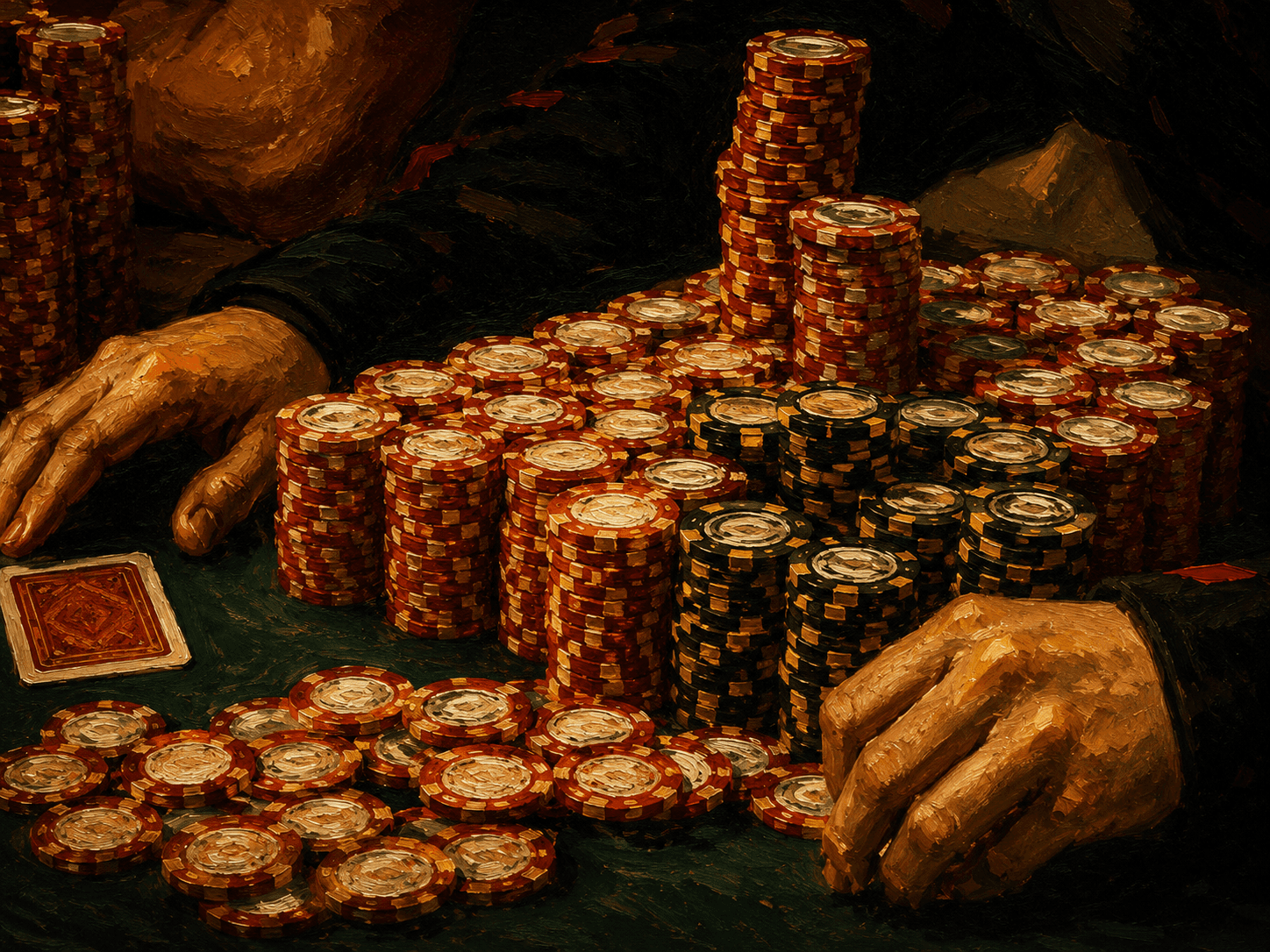
A big stack in the late stage provides a huge advantage. But many players use it incorrectly. A common mistake is that the chip leader starts getting involved in too many big pots. In reality, the main profit of a big stack comes not through all-ins, but through pressure. Chip leaders often make the opposite mistake too — they don't apply pressure, sit with a large number of chips, and wait for a good hand, when they should be playing more aggressively.
The most vulnerable targets are the medium stacks. They don't want to bust, but at the same time they can no longer wait endlessly for premium hands. That's why the following work especially well against them:
frequent opens from late positions
aggressive 3-bets
pressure on the blinds
bets on favorable textures and pressure on subsequent streets
At the same time, there's no need to bloat pots against stacks that cover us. If there's a larger stack at the table, then we become the target of pressure.
The chip leader's main task is to regularly collect small and medium pots without excessive risk.
Playing with a medium stack
The medium stack is considered the hardest to manage. On one hand, we're attacked by the big stacks. On the other, the short stacks start shoving all-in more often.
Additional pressure is created by the payout structure and the approaching pay jumps.
The main mistake of players with a medium stack is that they try to play like chip leaders. In practice, this leads to expensive clashes with the big stacks.
It's far more effective to focus on safer sources of profit:
steal the blinds
apply pressure on the short stacks
avoid marginal all-ins against players who cover us.
*A steal is a play in which a player in late position (cutoff, button, or small blind) makes a raise in order to "steal" the blinds (the opponents' mandatory bets) already on the preflop.
A medium stack requires discipline. Every big pot lost sharply increases the likelihood of ending up in the push/fold zone.
Playing with a short stack
When the stack becomes short, the room for complex plays gradually disappears. The push/fold strategy comes to the forefront.
But here many players make a serious mistake. They start shoving not because they found a good spot, but because it seems to them that their stack is already too small.
A correct shove depends on several factors:
position
opponents' stack sizes
the probability of getting a fold
For example, a shove from the button against two tight blinds can be profitable even with a relatively weak hand. The same shove from early position often turns out to be a mistake.
A short stack doesn't mean automatic aggression. It requires the most precise selection of situations.

Push/fold strategy in the late stage
With stacks of up to 10–15 big blinds, many standard opens lose their effectiveness.
If we open with a min-raise and then are forced to fold to an all-in, we lose a significant part of our stack too often. That's why part of the range starts being played through a direct all-in.
The main advantage of such a decision lies in fold equity. We can win the pot without a showdown and at the same time avoid difficult decisions on the postflop. At the same time, it's important to understand that universal push/fold ranges don't exist.
Charts are a starting point, not a ready-made answer for every situation.
If you want to get acquainted with the early stage charts in order to roughly understand opening ranges and adapt them to the late stage, we recommend turning to this article.
Typical mistakes in the late stage of an MTT
1. Ignoring ICM
The most expensive mistake of the late stage. The player keeps making decisions as if the tournament had only just begun. As a result, he calls all-ins too widely and underestimates the cost of busting.
2. Overestimating hand strength
Even a strong hand doesn't always mean a mandatory call. In the late stages, it's not only the cards that matter, but also the consequences of losing.
3. Conflicts with the stack that covers us
Many players are ready to risk their entire stack against the chip leader without good reason. Such situations often lead to the loss of a large amount of monetary expectation.
4. Playing too tight with a short stack
Waiting for a premium hand rarely helps you get back into the game. The smaller the stack, the more important it is to use fold equity in a timely manner.
5. Ignoring the payout structure
A decision two tables before the final table and a decision on the final table bubble may look identical in chips, but have completely different monetary value.
Conclusion
The late stage of an MTT is the phase at which the tournament definitively stops being a competition for chips alone. If in the early stage we built the foundation, and in the middle stage we actively built up the stack, then now the main task becomes the proper management of risk and monetary expectation.
Understanding ICM, the payout structure, stack pressure, and pay jumps allows you to make decisions that bring profit over the long run. It's precisely here that the difference is determined between regularly reaching the money and truly deep runs that form the bulk of tournament income.
If you want to learn to play confidently in the pre-final-table stage of tournaments and at final tables, FunFarm coaches will help you build a systematic approach and figure out situations where most players lose a significant part of their expectation.
1. What is ICM in poker?
ICM is a model for evaluating the monetary value of a tournament stack. It helps you understand how the distribution of chips affects potential prize payouts. Thanks to ICM, players can make decisions taking into account not only the probability of winning a hand, but also the cost of a possible bust.
2. Why do players often play too cautiously on the bubble?
Many participants strive to guarantee themselves a spot in the money and avoid situations involving the risk of busting. This makes them more vulnerable to pressure from players with big stacks.
3. How to play against short stacks in the late stage?
Against short stacks it's important to consider their all-in ranges and the payout structure. You shouldn't automatically call every all-in just because your hand looks strong. In the late stages, the cost of losing chips is often higher than the potential gain.
5. How does playing at the final table differ from other stages of the tournament?
At the final table, every place in the payout structure can be worth significant money, so the opening, calling, and all-in ranges become noticeably tighter than in the previous stages of the tournament.
6. What is a pay jump?
A pay jump is the move to the next payout tier. Every player elimination increases the guaranteed winnings of the remaining participants. The closer the tournament is to finishing, the greater the impact pay jumps have on strategy.
7. Why do strong players pay so much attention to stack sizes?
The stack size determines not only the number of available chips, but also the level of pressure a player can apply to opponents or experience themselves. In the late stage, understanding stack interactions becomes one of the key factors of successful play.

Free course · FF Start
Make decisions with more confidence
A structured course for beginners who want to understand the logic behind every hand.