A gutshot in poker
In this article, we'll break down what a gutshot is in poker, how it differs from an open-ended straight draw, how to calculate its probabilities, and when playing it is actually justified.
Ilya is a Liga 2 player with six years of experience in online MTTs. He graduated from the Faculty of Journalism at RSUH and writes about poker for beginners, explaining complex things in simple, clear language. In his texts, Ilya combines his personal playing experience with his professional journalism skills to help newcomers confidently get into the game.
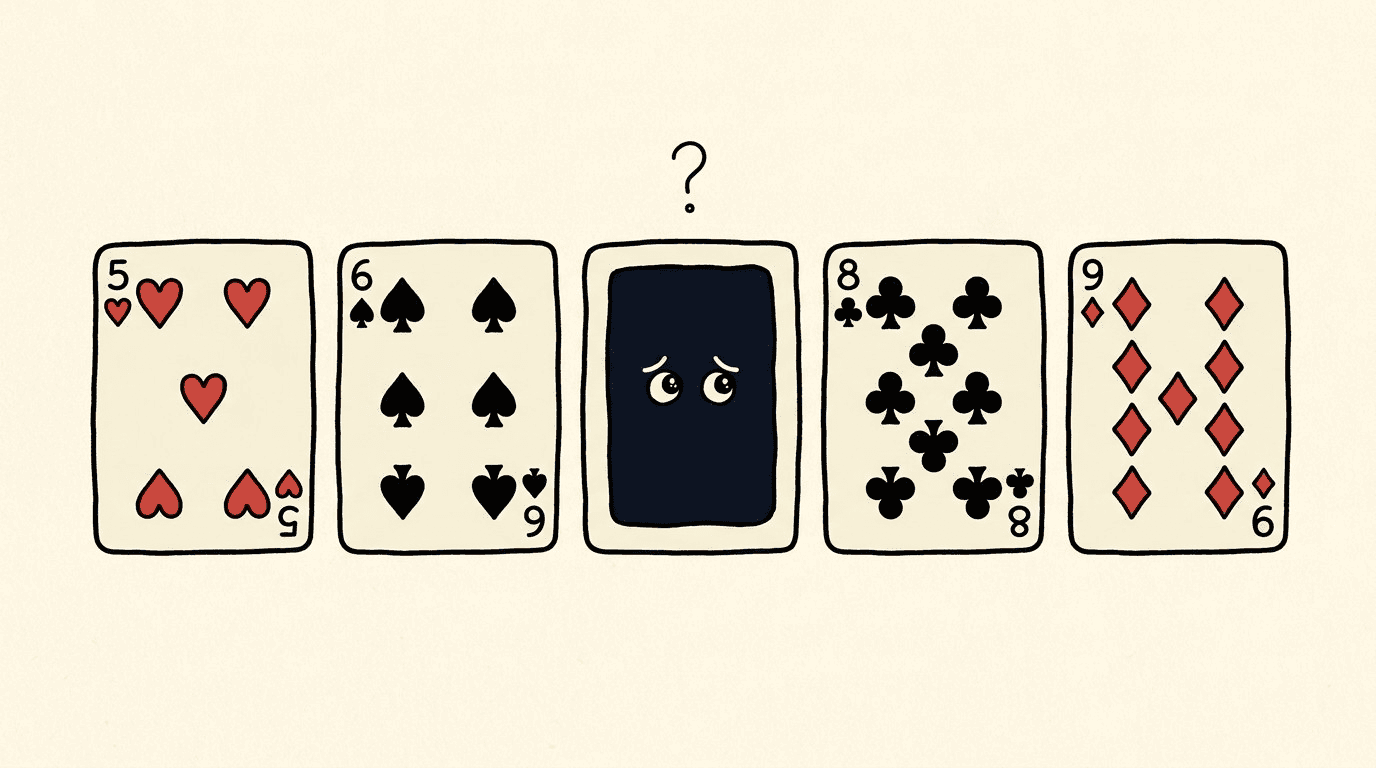
We often see players at the tables who spot a chance to make a straight and start believing in a miracle. On the flop they have, for example, 5-6-8-9, and it seems to them that the straight is within arm's reach. They only need one card — a seven. They call big bets hoping to get lucky, and over the long run they lose money. The problem isn't a lack of luck. The problem is that they don't understand the nature of a gutshot.
A gutshot is the most treacherous draw in poker. It has only four outs, and the probability of improving is half that of an open-ended straight draw. Yet it looks attractive: it seems like you're "just a little bit" short. It's precisely this illusion of being close to the goal that makes players overestimate their chances and make losing decisions.
In this article we'll break down what a gutshot is in poker, how it differs from an open-ended straight draw, how to calculate its probabilities, and when playing it is actually justified. We'll also look at situations where a gutshot can be used as a semi-bluff, and when it's better to give up on it.

New breakdowns in your inbox
Subscribe to the FunFarm newsletter: fresh Poker ABC articles and material that helps you grow as a player.
What a gutshot is in poker
A gutshot is a type of straight draw in which you're missing one card to make a straight, and that card is located inside the sequence. Hence the name: gutshot — a "shot to the gut," an "inside straight."
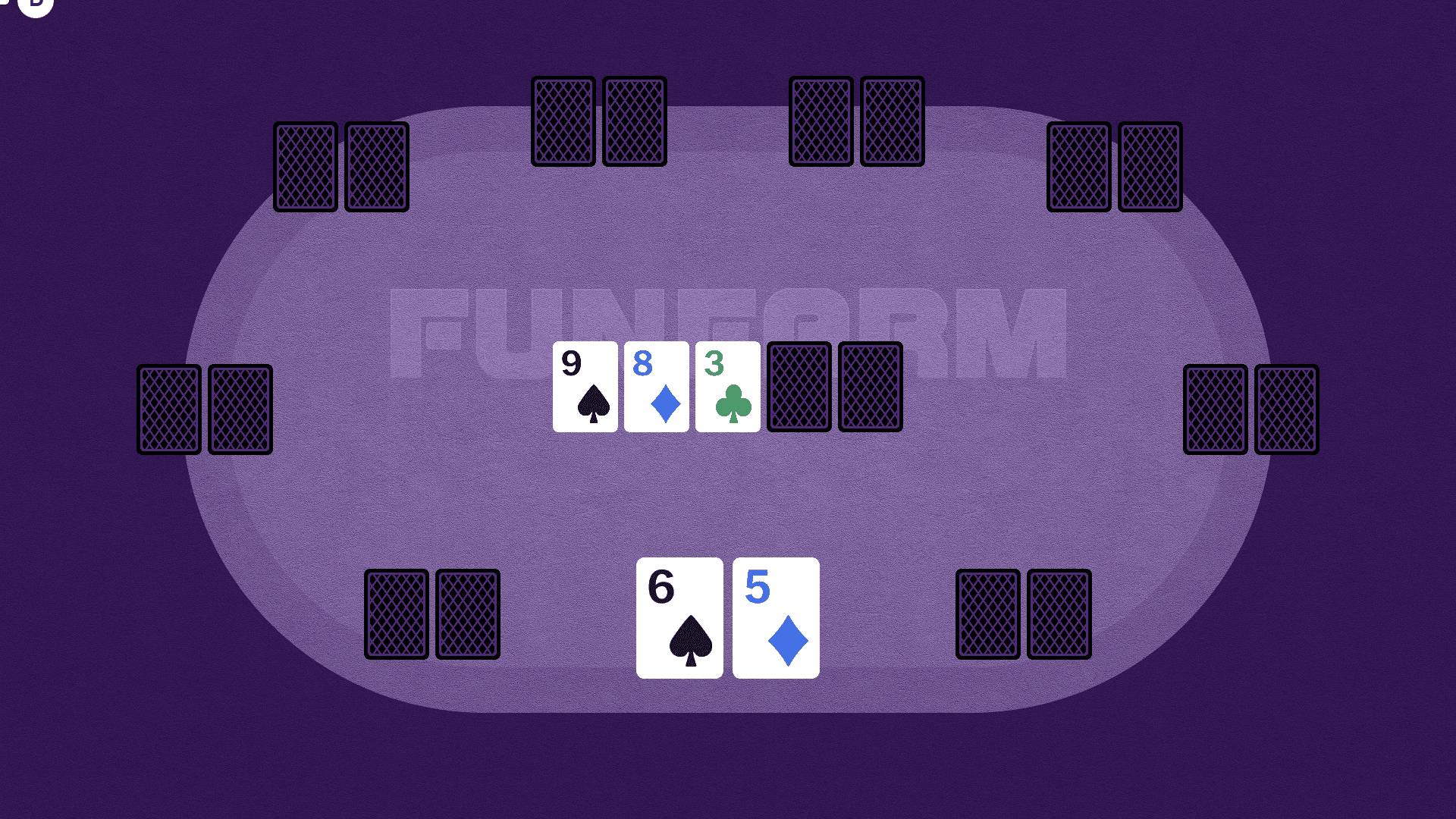
A classic example: you hold 6♠️ 5♦️, and on the board there are 8♦️ 9♠️. We're missing one card to complete the straight — a seven. It's important to understand: a gutshot is a particular case of a straight draw, but not every straight draw is a gutshot.
If two cards work from both ends (for example, 5-6-7-8, where you need a 4 or a 9), that's an open-ended straight draw (OESD), which has eight outs.
*OESD (Open Ended Straight Draw) in poker translates as "open-ended straight draw."
Gutshot vs open-ended straight draw
The difference between these two types of draws is fundamental. It affects every decision — from the size of a call to the frequency of a semi-bluff.
With an open-ended straight draw (OESD), we have four consecutive cards and can complete the straight from either end. There are 8 of our outs. The probability of completing an OESD from the flop to the river is about 31.5%. It's a strong draw that can be played aggressively.
In the case of a gutshot, we don't have four consecutive cards. The probability of completing a gutshot from the flop to the river is about 16.5%. That's half as much as an OESD.
Why does this matter? Because with an OESD we can call bets up to 75% of the pot, and it will be mathematically justified. With a gutshot, a call is profitable only against bets of 25–33% of the pot. A player who doesn't distinguish between these two types of draws will overpay for a gutshot and lose money over the long run.
The probability of a gutshot
Let's calculate the exact probabilities. There are 52 cards in the deck. On the flop we see our 2 cards and 3 board cards. That leaves 47 unknown cards. Of those, 4 are our outs.
The probability of completing a gutshot on the turn. We need one card out of 47. Probability = 4/47 ≈ 8.51%. This means that in roughly one hand out of 12 we'll complete the gutshot on the turn.
The probability of completing a gutshot on the river (if it didn't complete on the turn). By the river there are 46 unknown cards left. Probability = 4/46 ≈ 8.70%.
The probability of completing a gutshot from the flop to the river. We calculate it through the inverse probability: not completing on the turn (43/47) and not completing on the river (42/46). The probability of not completing at all = (43/47) × (42/46) ≈ 0.835. So the probability of completing = 1 - 0.835 = 0.165, that is 16.5%.
These numbers need to be memorized. They'll help us quickly assess whether a call is profitable.
Learning at FunFarm, from any level
When to call with a gutshot
A straight call with a gutshot is rarely profitable. Let's work through an example.
The situation. There are 1,000 chips in the pot. The opponent bets 500 chips (50% of the pot). We need to put in 500 chips. The pot odds are as follows:
500 / (1000 + 500 + 500) = 500 / 2000 = 25%
We need 25% equity for a break-even call.
A gutshot has 16.5% equity from the flop to the river. That's less than 25%.
The call is mathematically losing.
When does the call become profitable? Only against bets of 33% of the pot or less. If the opponent bets 330 chips into a pot of 1,000, the pot odds are as follows:
330 / (1000 + 330 + 330) = 330 / 1660 ≈ 20%
With a bet of 25% of the pot (250 chips), the pot odds are as follows:
250 / (1000 + 250 + 250) = 250 / 1500 ≈ 16.7%
That's already close to our 16.5%. The call becomes roughly break-even.
If the topic of poker math has caught your interest, follow this link and read our article in which we covered this question in more detail.
Conclusion: a gutshot is worth calling only against very small bets — up to 30% of the pot. In all other cases, folding is mathematically more correct.
It's worth mentioning the "nuttiness" of a gutshot. If our gutshot completes to the nut straight (for example, KQ on a board of AJ, needing a ten), we can call a bit wider. Because when it completes, we almost always win the pot.
An ordinary gutshot may complete to a straight that's beaten by a higher straight.
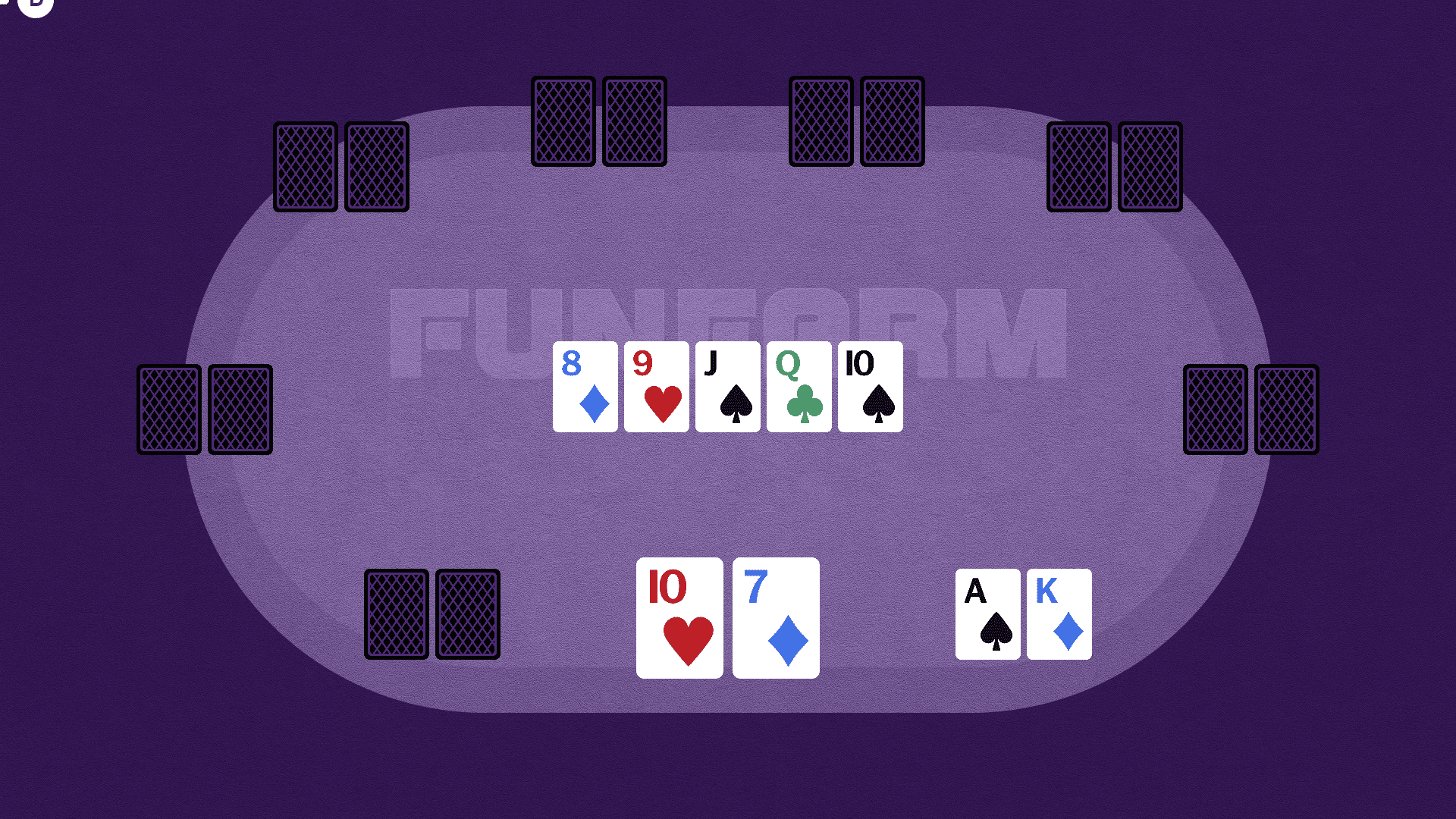
For example, with T-7 on a board of 8-9-J we've made a straight, but the opponent may complete a higher straight on later streets — from ace to ten — i.e., even a nut situation on the flop doesn't guarantee us the win.
We covered the topic of nuts in poker in more detail in this article. Go and read it.
The gutshot as a semi-bluff
Despite the weak chances of improving, a gutshot can be used for a semi-bluff. We bet or raise, counting on two outcomes: the opponent folds now, or we complete the draw on subsequent streets.
When a semi-bluff with a gutshot works.
The opponent often folds to bets. If we're playing against a tight player who doesn't like to continue without a strong hand, our bet may win the pot right now.
*A tight player is a participant in the hand who chooses to enter the game only with the strongest hole cards.
The board offers an opportunity for aggression. On coordinated boards (for example, 8-9-J) our bet looks convincing. The opponent doesn't know we have a gutshot — he sees that the board is dangerous and may fold even a medium pair.
We have position. In position we can control the size of the pot and make our decision after the opponent's actions. Out of position, a semi-bluff with a gutshot is dangerous — if we get called, on the turn we'll face a difficult choice.
When a semi-bluff with a gutshot doesn't work

1. Against stubborn opponents. If a player never folds, our bet isn't justified. We're just bloating the pot with a hand that has a 16% chance of improving.
2. On dry boards. On a board like A-7-2, our bet with a gutshot looks suspicious. What strong hands can we represent? The opponent will easily call with any pair.
3. Against aggressive opponents. If we can get re-raised, the semi-bluff turns into a loss of chips. With a gutshot we have no comfortable response to a raise.

Typical mistakes when playing a gutshot
Mistake 1 — overestimating the probability of completing
The player sees that he's "missing just one card" and thinks the odds are high. In reality, 16.5% is about 1 time out of 6. In 5 out of 6 cases the gutshot won't complete. Over the long run, calling big bets with a gutshot is a sure way to lose money.
Mistake 2 — calling without accounting for implied odds
The player calls a bet because "if it completes, I'll win a lot." But he doesn't assess whether the opponent will actually pay. Against tight players who fold on dangerous boards, implied odds are close to zero. Against short stacks — also.
*Implied odds is a concept in poker that takes into account not only the current pot odds, but also the potential future winnings if the player's hand improves. This allows you to justify calling a bet that at first glance seems mathematically losing due to insufficient pot odds.
Mistake 3 — ignoring nuttiness
The player rejoices at a completed straight without noticing that the opponent may have a higher straight. Before playing a completed gutshot aggressively, we check whether it's beaten by a higher straight.
Mistake 4 — calling with a gutshot on the turn without accounting for the remaining streets
On the turn we have one card to the river. The probability of completing the gutshot is 8.7%. Against a bet of 50% of the pot (25% pot odds), the call is losing. Players who call a gutshot on the turn are simply throwing away money.
Conclusion
If you want to systematically master poker math, learn to assess odds in real time, and make correct decisions with any draws — apply to FunFarm.

Free course · FF Start
Build your foundation in one course
Hand rankings, terminology and the logic of a hand — without scattered tips or complicated explanations.