Dead Man's Hand (AA88) in Poker: History and Rules
What is the "Dead Man's Hand" (AA88)? The story of Wild Bill Hickok, who died holding this combination. We also break down what a "Dead Hand" means and how to avoid falling into the trap of having zero outs.

Ilya is a Liga 2 player with six years of experience in online MTTs. He graduated from the Faculty of Journalism at RSUH and writes about poker for beginners, explaining complex things in simple, clear language. In his texts, Ilya combines his personal playing experience with his professional journalism skills to help newcomers confidently get into the game.
The modern version of poker was invented in the early 19th century. Over two hundred years, the card game has developed its own language. Gutshot, chip leader, draws, bubble, tilt — these are just a small part of the poker vocabulary. Some terms come with interesting stories. Let's discuss what the "dead man's hand" is.
What the dead man's hand is
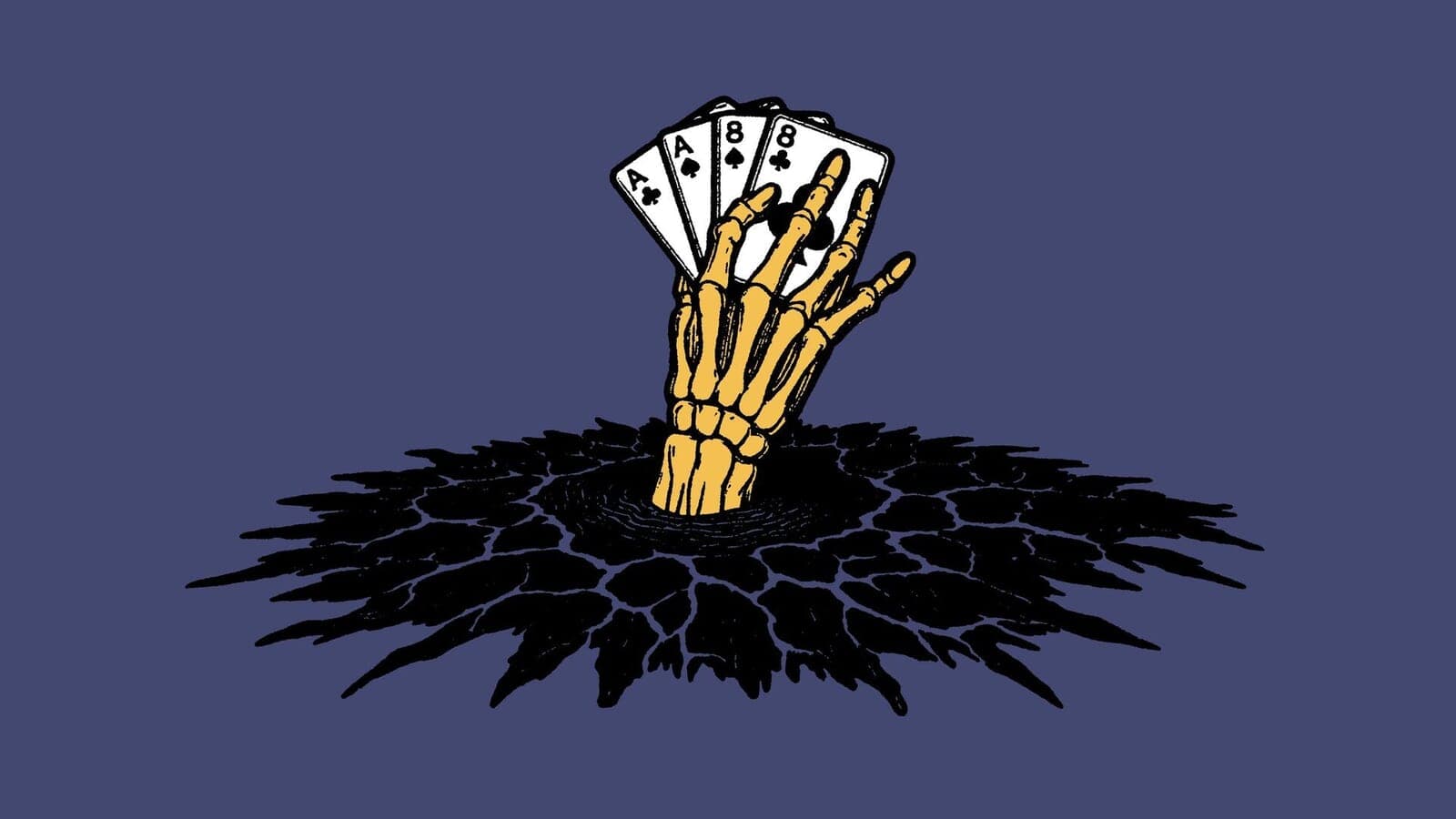
In poker, the dead man's hand refers to the AA88 combination. James Butler Hickok died holding these two pairs.
Worldwide, this hero of the American Civil War became famous as "Wild Bill." After the Northern victory, Hickok worked as a marshal, and in his free time he played poker. He was playing on August 2, 1876, in a saloon in the town of Deadwood. Here is what is known about the death of "Wild Bill":
Hickok could have avoided death. When he came into the saloon, all the seats at the table were taken. The marshal decided to wait.
The opponents were playing five-card draw poker.
"Wild Bill" was sitting with his back to the entrance.
Hickok's killer was named Jack McCall. He walked into the saloon, recognized "Wild Bill," came right up to him, and shot him in the back of the head.
Just before the fatal shot, Hickok was exchanging his fifth card to catch a full house.
There is no precise information about Jack McCall's motives. Sources from those years offer several versions. The most popular one — revenge for his brother. "Wild Bill" worked as a marshal, and the law enforcement of that time was not known for being gentle. Hickok's hot temper and love of violence only increased the number of his enemies. There is also an alternative version: "Wild Bill" had publicly humiliated McCall the day before, and Jack settled the score. The jury acquitted the killer, but the decision was later overturned, the case was re-examined, and McCall was executed.
The "dead man's hand" combination regularly appears in films. It's often dealt in Westerns. Usually it hints at a player's death. For example, in "The Ballad of Buster Scruggs," the main character receives AA88 and a few minutes later is shot in the forehead and killed.
In modern poker, the "dead man's hand" refers not only to the AA88 combination in the dark suits, but also to any combination of an ace and an eight. In Omaha, the "dead man's hand" can be dealt preflop.
What a dead hand is
Let's show the essence of a "dead hand" with an example. Suppose two players are in a pot: Nikita and Isaac. Nikita got As3s preflop and raised. Isaac was dealt KTs and called. On the flop, the dealer put down Ah8s5s. Both players caught spade flush draws. Nikita made a continuation bet, and Isaac called it. On the turn came a club deuce, which stripped Isaac of his outs. If a spade comes on the river, he loses to the better flush. Kings and tens won't help either, because Nikita has the top pair of aces. Isaac's hand is dead, but he doesn't know it.
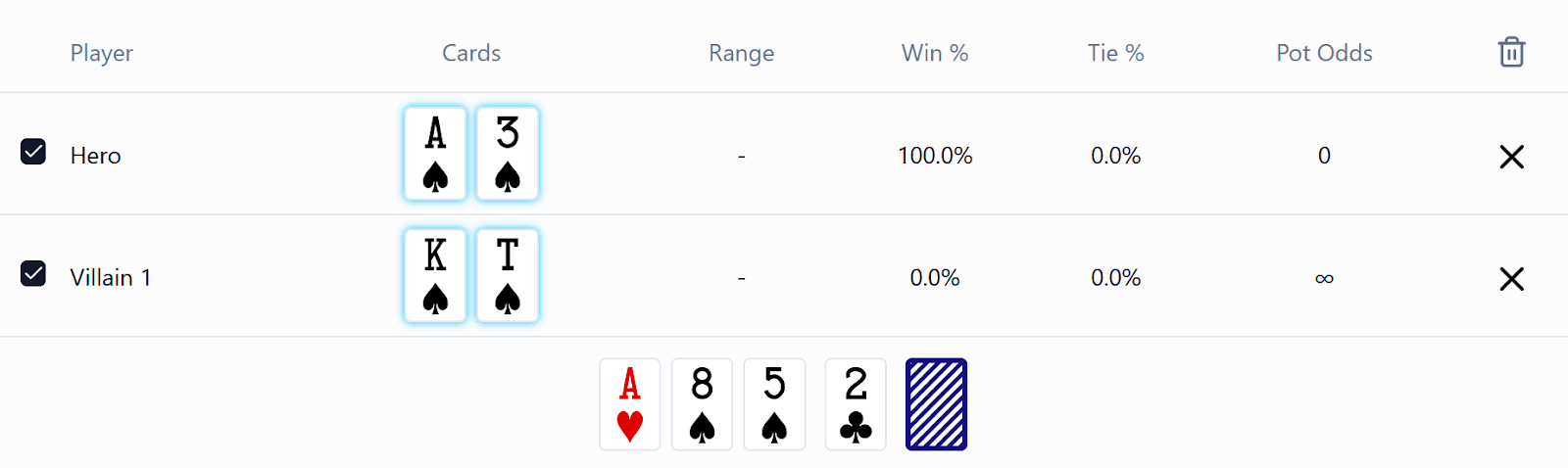
The holder of a dead hand will never win at showdown. However, there is a chance to take the pot with a bluff
A dead hand is a situation where a poker player keeps playing expecting to improve, but in reality has no outs. A zero chance of catching the better combination doesn't mean losing 100% of the time. Take the hand from the example. If the opponents reached the river and the last community card didn't complete the flush, then Isaac can pull off a bluff and take the pot.
Sometimes in poker you hear the phrase "drawing dead." It means trying to complete a combination when a player has no outs. Let's give another example. Suppose Nikita opened pocket 22. Isaac called with QhJh. The shared board brought 2h2dTh. Nikita decided not to bet, and Isaac also checked. On the turn came the king of spades. Isaac might decide he has 9 outs to the flush and 6 to the straight. In reality, neither the flush nor the straight beats Nikita's combination. Yet Isaac may keep "drawing dead."
How to stop losing with dead hands
Frequent losses with second-best flushes, lower straights, and dominated top pairs point to poor preflop play. To get into questionable situations less often, review your starting-hand charts. Remove low connectors and weak ace hands from your range. A poor choice of starting cards isn't the only potential problem. To make better decisions, we recommend reading "The Top 6 Preflop Mistakes That Cost You Money."
Professionals rarely end up in "dead hand" situations. It's all thanks to a high level of hand reading. A classy player matches the opponent's range with their actions, so they always foresee potential danger. The hand-reading skill is not an innate talent, but the result of systematic work in poker software. To start thinking in ranges, regularly analyze hands in calculators and solvers. We've told you more about useful tools in "The Complete Guide to the Programs Professionals Use".
Free course · FF Start
Choose your tools wisely
Find out which software a beginner really needs and at what stage it starts to pay off.