How to End a Poker Session Properly
In poker, there's a lot of talk about how to start a session — warming up, getting in the right mindset, concentration, your A-game. But there's one stage that players systematically underestimate — ending the session.

Tatiana develops mental support courses and leads a team of psychologists and mental coaches. Thanks to her attentiveness and professional approach, the school and fund have a mental care department that helps players maintain balance and stay resilient and motivated.
Meanwhile, it's precisely how you exit the game that directly affects the quality of your sleep, the recovery of your attention, your emotional state the next day, and ultimately — the stability of your game over the long run.
Properly ending a session is the basic "hygiene" of a professional player, without which any strategy will sooner or later start to sag.
In this article you'll learn:
why the brain can't switch itself off after a long session
which post-session mistakes amplify fatigue and burnout
what elements an effective ending ritual should consist of
how to close game cycles
why professionals treat the end of a session as seriously as its beginning
Why properly ending a session matters at all
Professional poker is one of the most cognitively demanding activities there is. During a session the brain works like an air-traffic controller: it simultaneously tracks ranges, stack sizes, table dynamics, bet sizes, and the psychology of opponents — and all of this across many tables at once.
The peculiarity of tournament poker is that a session has no clear finish line. You don't know whether it will all be over in five minutes or whether there are still three more hours of intense play ahead. Because of this, the brain doesn't close out the task — it constantly keeps a "tail of attention" in anticipation of a continuation.
And here a paradox arises. When the tournament finally ends — especially late at night — the body is already exhausted: you want to lie down, your reactions are slowed, your energy is at zero. But the brain, on the contrary, is still revved up. It keeps replaying hands, alternative lines, missed opportunities.
It's like a situation where a car's engine is still running at high RPM while you've already slammed on the brakes. From the standpoint of psychology and neurophysiology, this creates several risks at once:
1. Background stress
Even without vivid emotions, the sympathetic nervous system remains active. The tension isn't released — it's "preserved."
2. Cognitive overload
Unclosed thought cycles reduce the quality of the nervous system's recovery
3. Risk of burnout
Not because of a single tough session, but because of a systematic absence of the transition into recovery mode.
That's why properly ending a session isn't about a single evening. It's an investment in your game for weeks, months, and years to come.
What you shouldn't do after a session ends

Some scenarios seem natural but work against you over the long run. Let's look at the most common ones:
1. Going straight to sleep
During play, the system of goal-directed thinking is active: analysis, control, evaluation. If you go to bed without a "cooldown" stage, the brain keeps processing the information in your sleep — but now without rational control.
As a result:
memories get distorted
focus shifts toward mistakes
sleep becomes shallow rather than deep
in the morning you're left with a feeling of heaviness or dissatisfaction with yourself
2. Diving straight into deep analysis
After a session lasting many hours, cognitive flexibility declines. Analysis in this state often turns into either harsh self-criticism or defensive justifications.
Both of these reduce the quality of your work on your game and increase emotional strain.
3. Continuing any activity at the computer
The screen, the keyboard, the same posture — these are powerful conditioned signals. For the brain it's still work mode, even if you're watching entertainment content.
As a result, no switching takes place, and fatigue accumulates.
Learning at FunFarm, from any level
What a switching ritual should consist of
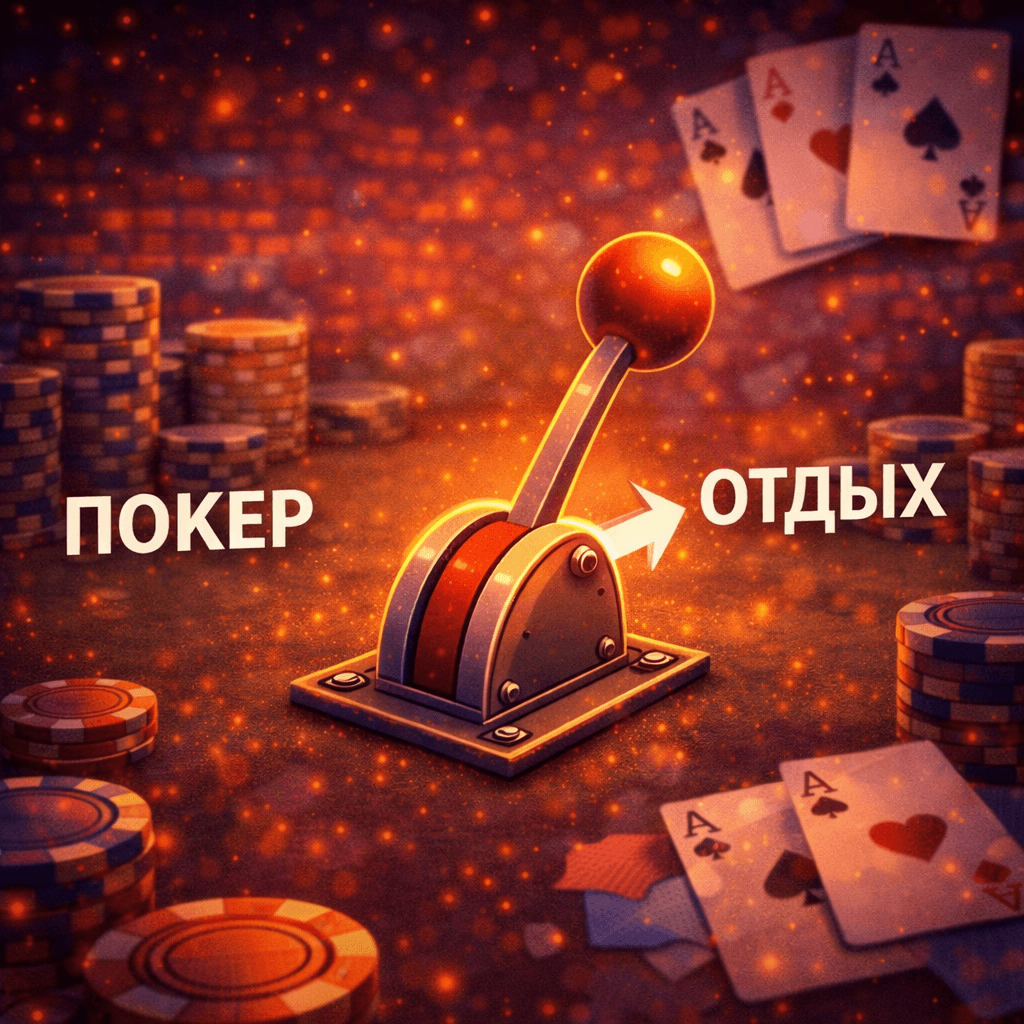
The key principle is repeatability. The brain learns through stable sequences. When the ritual is the same every time, it becomes an automatic marker — the session is over, you can come down from the tension.
Let's list the techniques that can help you:
1. Verbalizing your impressions of the session
It's important to briefly put two points into words: your impressions of the result and your impressions of the quality of your play.
For example: "The result is a loss, unpleasant; the quality of play is generally good, there were two debatable decisions in the late stage."
This is a critically important step. First, verbalization activates the prefrontal cortex, which lowers emotional intensity. Second, you separate what was within your control from what wasn't.
If you don't do this, the brain will fuse everything into one global assessment — and that will directly hit your self-esteem and self-confidence.
2. Noting key moments for future analysis
Here it's important to note them, not to analyze. You can settle on the following points: questions, debatable hands, and topics to review in any format — notes, a checklist, a voice message.
This gives the brain a signal — we'll come back to this later — and it will stop running these thoughts around in circles.
3. Physically exiting stress activation
During play the sympathetic nervous system is active — tense breathing, tightness in the shoulders, heightened muscle tone.
To exit this state, you need a bodily signal of safety:
slow breathing with an extended exhale
movement of the shoulders and the thoracic region
light stretching
This switches the body into recovery mode.
4. A ritual of transitioning from work mode to everyday mode
Simple physical markers work surprisingly effectively:
change your t-shirt
wash your face
change the lighting
go for a short walk
The brain understands such signals perfectly. They clearly separate "I was playing" from "I'm getting on with my life" — without any need to prove anything to yourself.
The main takeaway
Properly ending a session is not weakness and not excessive caution. It's a sign of a professional attitude toward the game.
A player who knows how to close game cycles recovers faster, sleeps more deeply, and plays more consistently over the long run.
If you want to build a systematic approach to poker and stop treating poker as an exercise for training willpower, submit an application to FunFarm.
We teach not only how to show high-quality play at the tables, but also how to live with poker in a way that doesn't burn out your resources.
Free course · FF Start
Turn hands into experience
Learn to keep a journal, spot recurring mistakes and plan the next stage of your learning.
Frequently asked questions
Read next
A, B, C game: how to stop giving away blinds to your own inner monkey
Poker Without Burnout: How to Balance Playing with Work, Study and Family
A cooler in poker