Five Card Draw: The Wild West Poker Rules
Poker is an umbrella term for various card games. It brings together Hold'em, Omaha, Stud, Razz, Badugi, Short Deck, and other game variations. Each of them has spawned its own offshoots. The brightest example is Omaha, with its Pot-Limit, five-card, six-card, and Hi-Lo versions. Draw poker is also included among them. Let's discuss the rules of the game from the Westerns.

Ilya is a Liga 2 player with six years of experience in online MTTs. He graduated from the Faculty of Journalism at RSUH and writes about poker for beginners, explaining complex things in simple, clear language. In his texts, Ilya combines his personal playing experience with his professional journalism skills to help newcomers confidently get into the game.
What is draw poker
Five Card Draw (5 Card Draw) is a game where the participants in a hand are dealt starting hands of 5 cards and allowed to exchange them during the hand. It's sometimes called "Draw Poker."
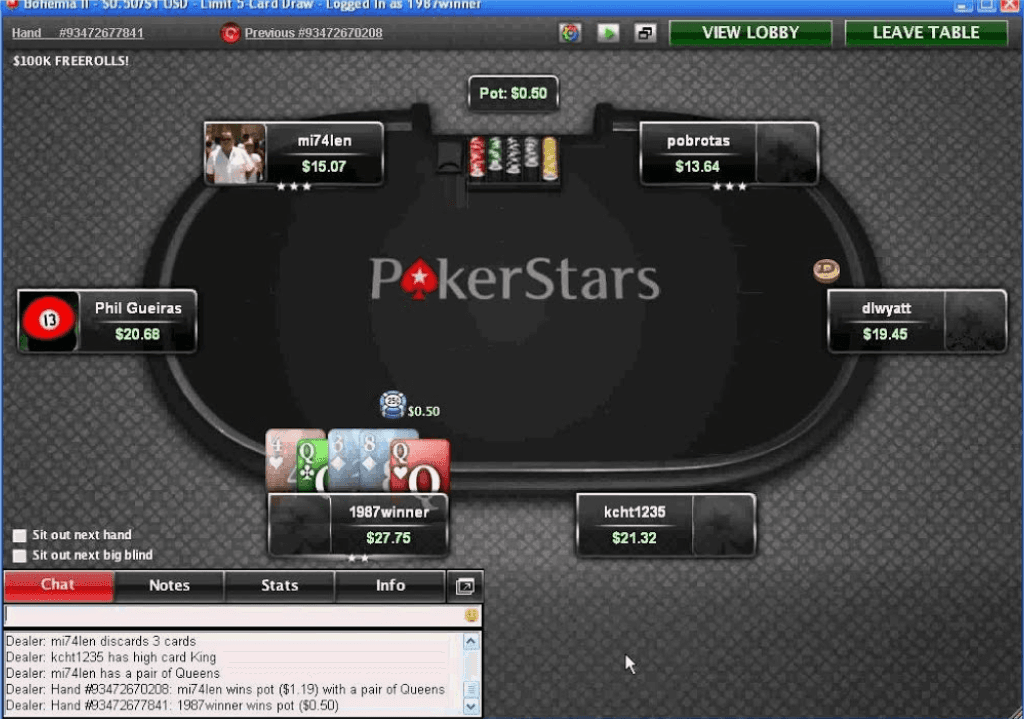
Online, draw poker was actively promoted by PokerStars
Before the rise of no-limit Texas Hold'em, it was draw poker that held the spot of the most popular card game. 5 Card Draw is firmly tied to the days of the Wild West and cowboys. The legendary Wild Bill spent the final moments of his life playing five-card poker. Draw poker also pops up in most westerns. For example, in the film "Maverick" with Mel Gibson.
Alongside the standard version of five-card draw poker, there are others. Among them:
Lowball. Each player is dealt 5 cards and can exchange them during the hand. What distinguishes lowball from 5 Card Draw is the goal of the game. In it, the pot is taken by the holder of the worst combination. In five-card poker the strongest combination is a royal flush, in lowball it's 23457.
2-7 Triple Draw. A variety of lowball. The main feature is that players are given the chance to exchange cards three times.
2-7 Single Draw. A variety of lowball. Opponents can exchange cards once.
Depending on the betting rules, 5 Card Draw is divided into:
No-limit. A player can go all-in at any moment.
Pot-limit. A player's bet cannot exceed the size of the pot.
Limit. At any moment of the hand, a poker player can make a fixed bet.
In recent years draw poker has been confused with variants of Omaha. The confusion is caused by the same number of cards in the starting hand — 5. Five-card Omaha and Courchevel have no other overlap with draw poker. Sometimes search engines respond to the query "draw poker" with information about flush draws, straight draws, and other drawing combinations. In Hold'em and Omaha, a "drawing hand" means a holding with the prospect of completing a strong combination. For example, 4 cards of one suit allow you to complete a flush on the following streets.
What the hand rankings look like in five-card poker
In draw poker you can take the pot in two ways: 1) show the best holding at showdown; 2) force opponents to fold their cards. The hierarchy of combinations in 5 Card Draw is the same as in NL Holdem or PLO. Let's look at it in more detail. We'll go from weakest to strongest.
High card. In the movies opponents regularly make top combinations, like quads or a royal flush. In real life the fate of the pot is often decided by the high card. Let's show it with an example. Suppose Brad and Annabel made it to showdown. Brad showed AJ894, Annabel — KQJ95. Neither opponent even made a pair, but Brad takes the pot thanks to the higher ace.
Pair. Two cards of the same rank form a pair. For example, if a player's starting hand looks like A28A4, then they have a pair of aces. When opponents show pairs at the reveal, the pot is taken by the holder of the higher one. Brad has KT993, Annabel has A6882, 99 is higher than 88, so the pot goes to Brad. When pairs are equal, the winner is determined by the kicker. The kicker is the highest rank among the cards not used in building the pair.
Two pair. A starting hand can also include a combination of two pairs. For example, AA883 gives two pair. If each opponent has made two pair, then the higher ones are compared first, then the lower ones. When the two pairs are equal, the fate of the pot depends on the kicker.
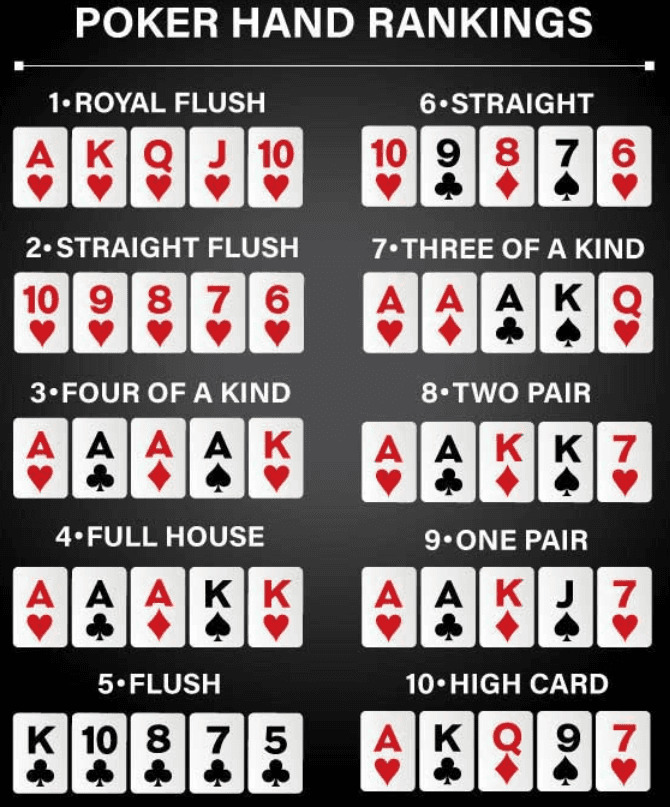
In draw poker, Texas Hold'em, Omaha and Stud the hand-ranking rules are the same
Set. Three cards of the same rank give a set. With the hand AK888 a player gets a set of eights. If opponents are equal in combination strength, the winner is determined by the rank of the set. Brad with the hand QQQ27 will take the pot from Annabel with JJJ97.
Straight. Five consecutive cards of different suits form a straight. In a situation with two straights, the fate of the hand is decided by their ranking. Suppose Brad caught JT987, while Annabel got 98765. The money goes to Brad thanks to the higher cards in the straight.
Flush. Five cards of one suit give a flush. If at showdown both opponents have a flush, then the pot goes to the holder of the higher one. For example, Brad has a spade flush with a high king, Annabel has a heart flush with a high queen. Brad wins the hand. In the rarest cases opponents may show equal flushes of different suits. Then they split the pot. In five-card poker all suits are equal in strength.
Full house. Combines a set and a pair. If each opponent has a full house, the pot is taken by the holder of the strongest set.
Quads. The combination is formed by 4 cards of the same rank.
Straight flush. Five consecutive cards of the same suit give a straight flush.
Royal flush. The combination of a suited ace, king, queen, jack and ten forms the best combination in draw poker — a royal flush.
Learning at FunFarm, from any level
How a hand plays out in five-card draw poker
Five-card poker involves from 2 to 6 people. The rejection of 9-max tables is dictated by the number of cards in the deck. Let's take a hypothetical situation with 9 players in a hand. When each of them receives a starting hand, there will be 7 cards left in the deck. Such a reserve is often not enough for a round with an exchange.
Before the hand opponents make mandatory bets. In draw poker either the blinds approach or the ante approach is used. In the first case players post the small and big blinds. They are posted by the players in the seats to the left of the dealer. Each hand the positions and the obligation to put in money move one seat clockwise. The ante variant is simpler — all players invest equal amounts and form the starting pot. Money in the pot stimulates opponents to enter the game. Otherwise everyone would wait for strong starting hands and turn poker into a sleeping pill.
Once players have made the mandatory bets, the dealer deals each one 5 cards face down. The poker players assess the prospects and decide on a raise, limp or fold. If two or more players are contesting the pot, the card exchange stage begins. Participants in the hand can replace from 1 to 5 cards. Keeping the starting hand is also allowed. Opponents see the number of cards exchanged, but don't know their ranks. After the exchange come the betting and the showdown.
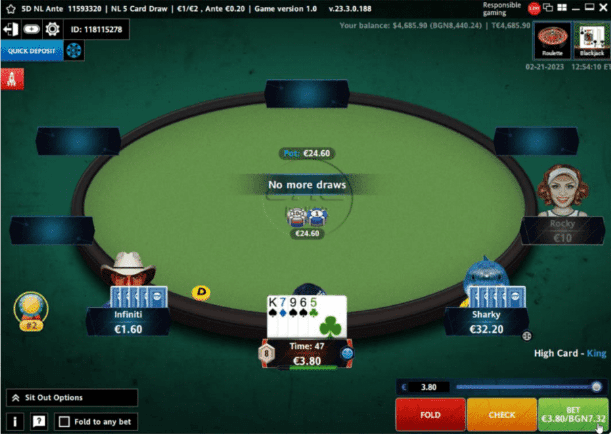
In Triple Draw players can exchange cards 3 times, in Single Draw — once
In 5 Card Draw there is no board with community cards. The strength of an opponent's hand will be hinted at by:
The number of cards exchanged. Suppose a player replaced 1 card. We can assume that they have two pair, a straight draw or a flush draw. Exchanging three cards will indicate a pair.
The size of the bets and aggression. With a strong hand a poker player wants to win a big pot. So from the start of the hand they begin to bet and raise. An additional hint is given by declining the exchange. Such a line speaks of two pair or a better combination.
The player's reputation. Observing opponents is useful in all kinds of poker. In 5 Card Draw it's important to watch opponents, because there are no other sources of information. Statistical software won't help in draw poker. A common board won't suggest a decision either. The better we've studied an opponent, the higher the chance of outplaying them.
In other varieties of five-card poker the course of a hand is different. For example, in 2-7 Triple Draw players go through the card-exchange-and-betting cycle three times.
You can take the pot not only thanks to the strongest combination at the reveal. In draw poker pots are also won by bluffing. However, there's less room to maneuver in 5 Card Draw than in NL Holdem. You can't fire a second barrel into an overcard or represent a completed flush without a common board.
Where to play poker with 5 cards in hand
The time of five-card poker has passed. In the early 2000s PokerStars offered the chance to play draw poker. Other platforms ignored the rare card game. PokerStars found a place for 5 Card Draw in cash. It ran cash games and regular tournaments. After "Black Friday" PS began cutting costs. As a result the room dropped five-card poker and other rare variations of the game. PokerStars remembers classic five-card poker during major tournament series. As part of WCOOP-2024 PS organized 3 tournaments for: $11, $109 and $1,050. Another 7 events were dedicated to different versions of lowball.
As of December 2025, you can play five-card poker only on Phenom Poker. The daily schedule offers 4 tournaments. The guarantee of the priciest — Triple Draw Mixed — reaches $1,000. Entry costs $100. Sometimes you can find opponents at cash tables too.
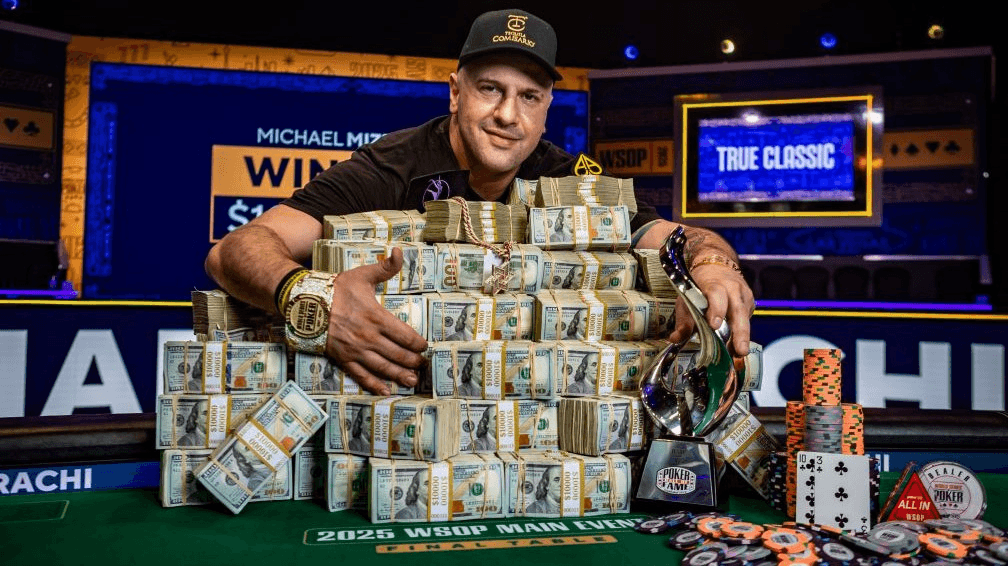
The best NL Holdem players earn far more than their counterparts from 5 Card Draw
Several draw poker tournaments are also organized at the annual World Series of Poker in Las Vegas. For example, in 2025 there were 3 lowball events. The biggest of them was won by Nick Schulman. The champion's bracelet was supplemented by $497,356.
Why no-limit Texas Hold'em is better than draw poker
No-limit Texas Hold'em has dominated poker for several decades. The game is significantly more popular than Omaha, seven-card stud, or draw poker. NL Holdem surpasses 5 Card Draw on several parameters. Here are the main ones:
Availability. No-limit Texas Hold'em is the industry standard. You can find it in any online room and land-based casino. You can play NL Holdem 24/7 in different disciplines and formats. Five-card poker is a game for enthusiasts. It's not available on most platforms. So playing 5 Card Draw is very difficult.
Prize money. Let's take as an example the most prestigious live poker festival — the WSOP. The winner of the biggest no-limit hold'em tournament in 2025 took $10,000,000. The champion of the most expensive five-card poker event was paid $497,356. A twentyfold advantage is a convincing argument in favor of NL Holdem. Online, hold'em has an absolute edge: 5 Card Draw tournaments are almost never held.
Depth of the game. In draw poker we know our own hand and the number of cards opponents are exchanging. There's little information, much depends on intuition and reading the opponent. In hold'em the common board lays the foundation of the hand. A player can compare the table's cards with opponents' hand ranges, build complex postflop strategies, use position, control the pot size, make subtle bluffs and value bets.
Opportunities for learning and growth. Thousands of books, articles and video courses have been dedicated to NL Holdem. Hundreds of training programs help raise the level of mastery in hold'em. The training materials allow you to study the game on a microscopic level. There's significantly less information about five-card poker. No books are written about the game. Developers don't create training software.
Recognition. The name of the WSOP Main Event champion is known to the whole industry. Sometimes news about victories goes beyond the poker community. The leading five-card poker players aren't known outside the circle of fans of this game. Nick Schulman won't be invited into a Katy Perry video or an X-Men film. Unlike Daniel Negreanu.
Versatility. Skills from NL Holdem will be useful in other kinds of poker too, like Omaha. Experience from 5 Card Draw won't provide additional options.
The FF Start program will help you take your first steps in no-limit Texas Hold'em. As part of the course we will:
introduce you to basic poker strategy;
examine short-stack play and adapting against different types of opponents;
break down the math and ICM.
If you pass the exam at the end of the course — you'll get a chance to join the largest online poker school, FunFarm.

Free course · FF Start
Understand the logic of MTTs
Study the early stage, the bubble, short stacks and the final table as one system.
Frequently asked questions
Read next
Chinese Poker Pineapple: rules, hands, and scoring
What sports poker is and how it works
Types of Poker: Popular Variations, Their Rules and Features