What to do if you get bored playing during a session
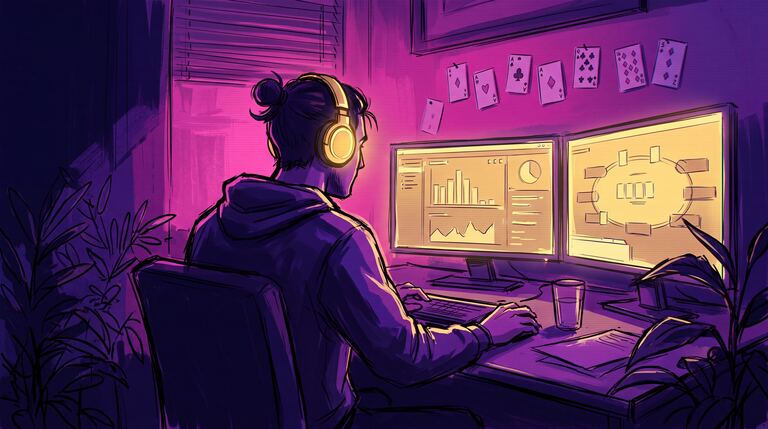
Boredom in poker rarely shows up with a direct message: "I'm not interested." More often it disguises itself as outwardly harmless things — autopilot, mechanical clicks, the urge to open YouTube "in the background," check your phone, or just keep playing "out of habit." It's at this very moment that a player starts losing money — not directly, but because of the quality of the decisions being made.

Tatiana develops mental support courses and leads a team of psychologists and mental coaches. Thanks to her attentiveness and professional approach, the school and fund have a mental care department that helps players maintain balance and stay resilient and motivated.
It's important to state right away: boredom isn't laziness, a lack of motivation, or a sign that you're tired of poker. It's a state of attention. And you can work with it just as systematically as with tilt or fatigue.
In this article you'll learn:
why boredom is a signal that conscious thinking has switched off, not a "bad mood"
why boredom is more dangerous than tilt over the long run
how to restore concentration right in the middle of a session
what simple actions help you switch your A-game back on
why professionals know how to work with boredom rather than avoid it

New breakdowns in your inbox
Subscribe to the FunFarm newsletter: fresh Poker ABC articles and material that helps you grow as a player.
Why boredom is about thinking, not emotions
To understand what happens to a player during boredom, it helps to draw on the dual-systems model of thinking.
System 1 is fast, automatic, and energy-saving. It runs on habits, templates, and past patterns.
System 2 is slow, conscious, and energy-intensive. It's what analyzes ranges, compares lines, and adjusts to opponents.
In poker this easily translates into the language of A/B/C-game:
A-game — active System 2. Awareness, attention to detail, flexible decisions.
B-game — System 1 running on memorized algorithms. Not a disaster, but without fine-tuned adjustment.
C-game — full dominance of automatic processes: clicks without analysis, playing "from memory" — without being present in the moment.
Boredom almost always means one thing: System 2 has switched off, and control has quietly passed to System 1. Not because of emotions, but because of monotony and a drop in cognitive resources.
The professional player's key task is to be able to bring themselves back into System 2 right in the middle of a session, rather than hoping concentration returns on its own.
Psychohygiene: how not to create fertile ground for boredom in advance
Working with boredom begins before you open the tables. Because most of the time it doesn't arise suddenly, but as a consequence of an accumulated state.
Before a session it's important to ask yourself a simple but honest question — "what state am I in right now?"
Lack of sleep, hunger, irritation, background anxiety — all of these reduce access to System 2. And if your resources are already at zero, your brain will inevitably switch to autopilot at the very first sign of monotony.
The second important thing is setting goals for the session, but not financial ones. Money doesn't hold your attention. Only focus-based intentions work:
tracking bet sizes
observing timings
noting opponent types
tracking your own automatic decisions.
And finally — breaks. The best thing you can do during a pause is move and drink water. The worst is to stay in your chair and keep consuming information. TV series, reels, and YouTube don't give your brain a rest — on the contrary, they accelerate the depletion of System 2.
Learning at FunFarm, from any level
Why it's impossible to show A-game all day long
One of the most toxic beliefs in poker is the expectation that you can hold maximum concentration for 8–10 hours straight.
You can't. Physiologically.
A professional's task isn't to drive themselves to exhaustion by constantly concentrating on every detail of the game, but to be able to switch their A-game on and off consciously.
Here the link between mind and body works great. Simple bodily anchors:
after a tense hand — a slow, deep exhale
before entering the next one — a deep, active inhale
This micro-regulation lets you avoid getting stuck in constant tension and avoid sinking into monotony.
How to bring attention back in the moment
When boredom has already taken hold, fighting it head-on is useless. System 1 doesn't respond to persuasion, but it copes poorly with breaking a pattern.
So the task is to create a small amount of uncertainty that automatically switches System 2 on.
Working techniques:
a short pause before acting
don't use auto-fold
enter bet sizes manually
saying your decisions out loud — "why fold here," "what do I expect," "what range calls," and so on.
Speech is a powerful tool for switching on conscious thinking, because it requires structure and logic.

Why boredom isn't an enemy but an indicator
Boredom during a session is not a weakness or a mistake. It's a signal. It shows that your attention has scattered and that control has quietly passed to automatic processes.
What sets a professional apart isn't that they never feel boredom, but that they know how to get themselves back into the game without waiting for serious losses.
The main takeaway
Boredom isn't a reason to end a session, nor an excuse to beat yourself up. It's a marker that you've stopped being a participant in the process and started playing on inertia.
If you can track this state and bring your attention back in time, you'll play more evenly, more steadily, and more professionally — precisely over the long run, not just in one lucky session.
If you want to build a systematic approach to the game — from strategy to mental resilience — and learn to manage such states rather than depend on them, apply to join FunFarm.
We help players not just know what's correct, but be able to apply it in real play.
Free course · FF Start
Learn faster, play more deliberately
Get a clear workflow: theory, practice, hand reviews and fixing mistakes.
Frequently asked questions
Read next

A, B, C game: how to stop giving away blinds to your own inner monkey
Poker Without Burnout: How to Balance Playing with Work, Study and Family
A cooler in poker