Check-Raise: A Powerful Weapon in Your Arsenal
Check-raise is one of the most controversial plays in poker. To some, it looks like a sign of strength and confidence; to others, it's a dangerous trap that you can easily set for yourself. And the truth is, a check-raise can be both.


One of our first coaches: on the team since the very founding of the project. He prioritizes simple and practical training with an emphasis on real game situations and decision-making over the long run. Val doesn't just "beat the games" as a player, but also instills a systematic approach to the game and discipline in his students.
This move can sharply build the pot, flip the dynamics of a hand, and put your opponent in an uncomfortable spot. But for that exact same reason it requires care — the cost of a mistake here is higher than with most standard lines.
The check-raise isn't a "trick" and isn't an attempt to scare your opponent. It's a tool that only works when there's logic behind it: an understanding of ranges, goals, and how the hand will develop further.
In this article you'll learn:
what tasks the check-raise should solve in your strategy — and which it shouldn't
why a check-raise without a plan almost always leads to losing EV
against which types of opponents the check-raise is especially effective
how to choose the size of your check-raise
what to do on the turn after a check-raise and why you can't continue your aggression 100% of the time

New breakdowns in your inbox
Subscribe to the FunFarm newsletter: fresh Poker ABC articles and material that helps you grow as a player.
What a check-raise is and why it changes the dynamics of a hand
A check-raise is a line in which you first check and then, after your opponent bets, raise it. Seemingly simple mechanics. But there's an important strategic idea behind it.
First, a check-raise is only possible out of position. To check first, you have to act before your opponent. And it's precisely because of being out of position that this move is so valuable: it lets you temporarily seize the initiative where, by default, you don't hold it.
Second, a check-raise sharply changes your opponent's expectations. He bets, counting on a standard development of the hand, but the check-raise forces him to reconsider everything — the strength of your hand, the structure of your range, and his further actions.
This creates pressure. And pressure is precisely the main resource of the check-raise.
What the check-raise is used for
The check-raise has two basic tasks. Let's look at them carefully with examples.
1. Extracting more value
The most obvious scenario — we have a strong hand and want to get more chips. Instead of betting right away, we let our opponent invest first — and only then build the pot.
The check-raise works especially well against players who:
fire a continuation bet automatically
have a hard time letting go of top pairs and overpairs
tend to disbelieve their opponents' bets and look for bluffs where there are none
In such situations the check-raise turns an ordinary hand into a more profitable one.
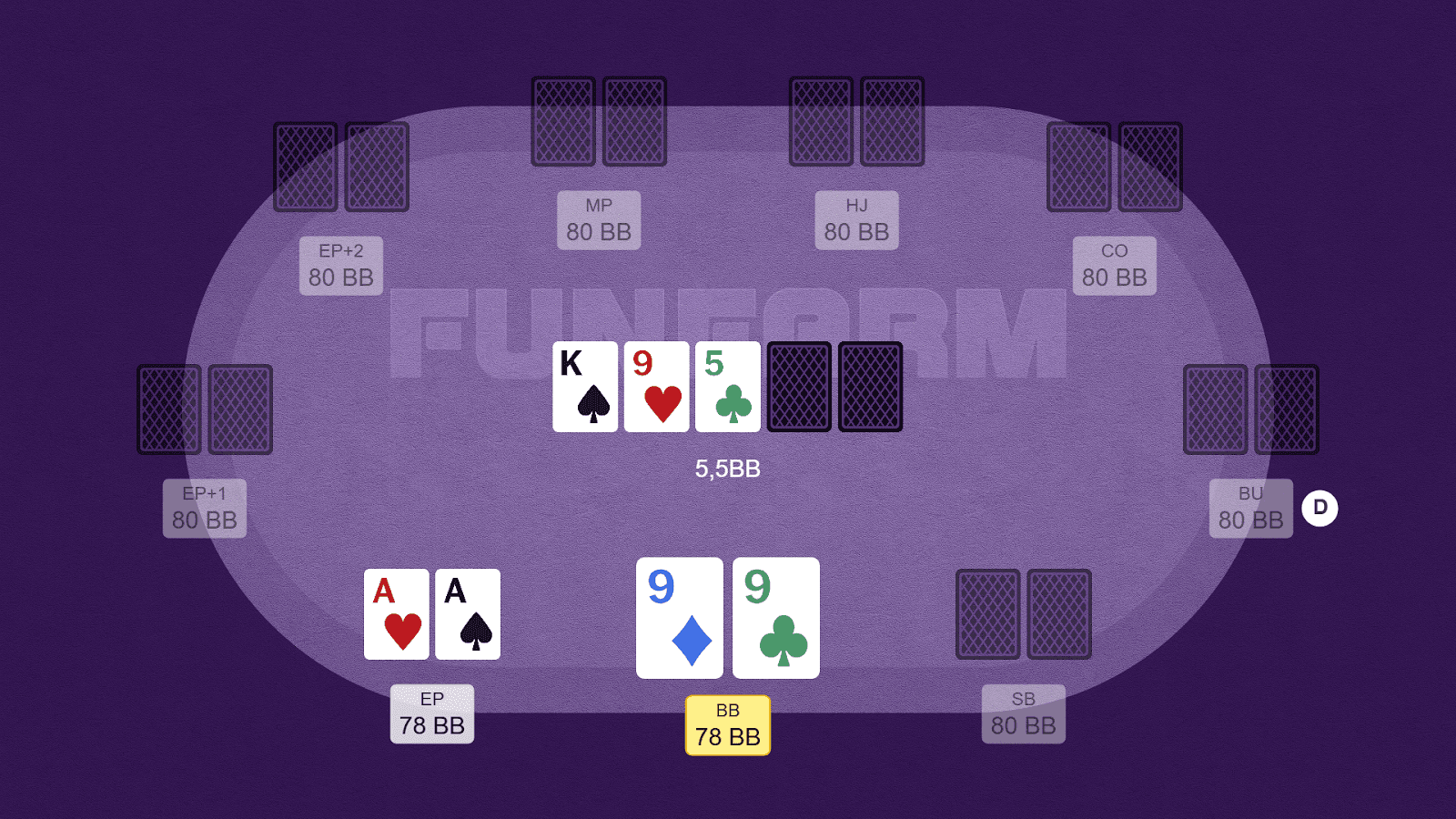
Situation: UTG opens with a standard raise, we defend the BB. Given that the opponent is opening from early position, it's more profitable to play 99 by calling rather than 3-betting — as we would do against an opponent on CO or BTN.
On the flop we hit a set. At the same time the board structure is safe — there's no flush draw, but there are potential straight draws that we can represent as bluffs in the opponent's eyes.
UTG predictably fires a continuation bet of around 30–33% of the pot. That's a standard sizing the opponent will use with almost his entire range.
Why do we want to play a check-raise rather than a call? We let the opponent invest first, which means the pot has already grown. After betting, his range contains a lot of hands ready to pay here and now — overpairs, top pairs, sometimes even two overcards ready to see the turn.
We make a moderately sized check-raise — for example, 2.5x his bet. This size doesn't look scary, leaves the opponent room to call, and preserves the possibility of extracting on the turn and river.
If the opponent calls, on the turn we continue playing straightforwardly, extracting from his range, but now in a more inflated pot. If he raises — great, the pot is building exactly the way we want it to.
Bottom line: in this case the check-raise is a way to turn a strong hand into a maximally profitable one, without scaring off the opponent's range and without missing streets of value.
2. Denying equity and taking the pot
The second goal of the check-raise is pressure. A check-raise as a bluff or semi-bluff is used to knock out hands that still have a share of the pot against you but withstand aggression poorly.
These can be overcards that missed, weak pairs, draws that it's unprofitable to pay to realize their equity.
Here it's important to understand: the check-raise isn't obligated to knock out the "best hand." It's enough to knock out the part of the range that prevents you from comfortably playing the hand further.
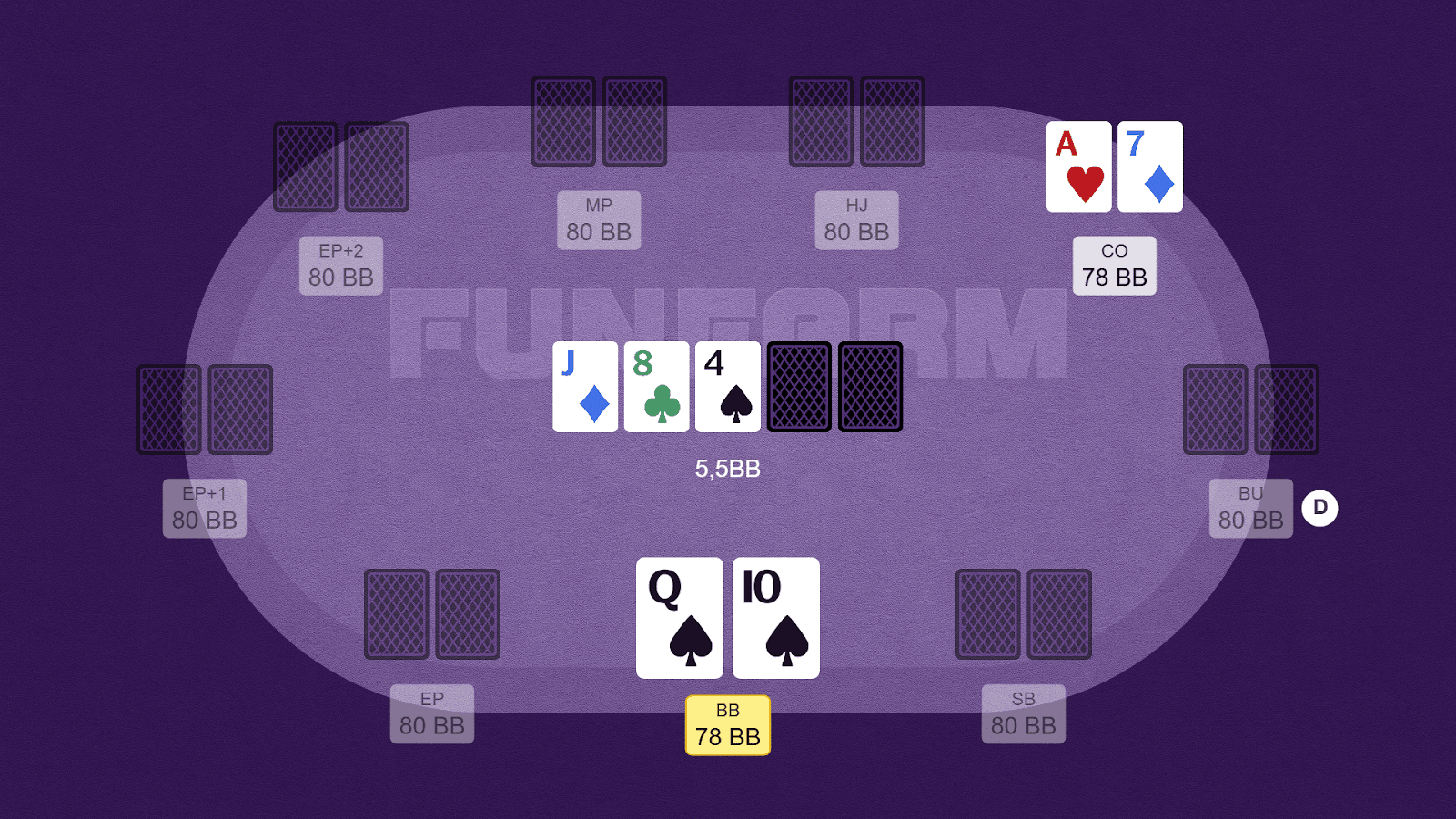
Situation: CO opens with a raise, we defend the BB. On this flop we'll most often see a continuation bet from the opponent on CO. He'll bet a small size with almost his entire range — overcards, weak hits, hands like AQ, KQ, AT.
Our hand is not a made combination, but:
we have a gutshot to the nine
there's a backdoor flush
If we just call, we let the opponent realize his equity at his price, often face pressure on the turn, and leave ourselves difficult decisions without initiative.
The check-raise in this case works as pressure. The opponent's range contains a lot of hands that are hard to resist with on future streets — an A-x that missed the board, broadway hands without a jack, low pocket pairs.
By playing a check-raise, we can immediately knock out part of the opponent's equity, deny him the chance to cheaply see the turn and river, and shift from defense to aggression.
Even if CO calls, we still have a lot of good turns to continue on — kings, nines, spade cards — and the ability to apply pressure to the opponent's middle range.
Learning at FunFarm, from any level
Why you can't use the check-raise "on autopilot"
The check-raise looks powerful, but that's exactly why it's dangerous. It builds the pot, but along with it the responsibility for every decision, and it punishes the absence of a plan.
There are two extremes players often fall into:
1. Check-raising only with monsters
In this case opponents quickly adapt — they start folding all medium value and continuing only with strong hands. As a result, tight play deprives the opponent of any opportunity to put you on a bluff.
2. Check-raising only as a bluff
Also bad — you'll start getting called and raised more often. The line will stop working.
A good check-raise is always a range that includes value, bluffs, and semi-bluffs. And most importantly — an understanding of what you'll do on the next street.
What determines check-raise frequency on the flop
1. The size of your opponent's continuation bet
Your opponent's bet sizing is the first signal of the strength of his range. If the opponent bets small — around 25%-33% of the pot — his range is most often more linear, i.e. it contains a lot of medium-strength hands.
This is a great environment for a check-raise, because you're pressuring exactly that part of the range that withstands aggression poorly.
If, however, the bet is large — 75% and up — the range more often becomes polarized, i.e. strong hands and bluffs. In such cases the check-raise should be rare, and its size more restrained.
Sometimes maximum pressure isn't what's needed, but a careful raise to put the opponent in a tough spot.
Board texture
The board determines how naturally your check-raise range is formed.
On dry boards it's harder to gather the bluffing portion. Here backdoor draws are used more often.
On drawy boards everything is easier — flush draws, gutshots, OESDs, and combo draws practically beg to be check-raised. The range comes out organic and robust.
You can learn more about board structures in our article on this topic.

The check-raise against different types of opponents

1. "Calling stations"
That's what poker calls players who love to call and hate to fold. Against them a bluff check-raise is almost always a bad idea — they don't give up often enough for this action to be profitable.
A value check-raise, on the other hand, works great. If a calling station is willing to pay — give it the chance.
2. "Maniacs"
These are aggressive players who bet a lot and often. Against them a value check-raise is sometimes even harmful — you force them to throw away their bluffs.
It's often more profitable to play strong hands through a check-call, letting the maniac keep making mistakes. Bluff check-raises, on the other hand, can work well — precisely because of their excessive aggression.
3. Regulars
Against regulars the check-raise is a tool of pressure and part of your strategy. At low stakes many regulars fold often enough, so bluff check-raises can be profitable.
But for value against a thinking opponent you need to check-raise carefully — he's capable of throwing away a weak top pair or a draw without regret.
If you want to learn more about the characteristics of opponent types, read our article on this topic.
The check-raise and the river: a common beginner mistake
It's worth separately addressing a moment where EV is regularly lost — trying to play a check-raise on the river out of position.
Beginning players often get the idea — "I'll check now, provoke a bet, and make a check-raise."
The problem is that in actual play opponents — especially at low stakes — too often won't bluff and will check back. Especially on scary runouts when draws complete and when they have medium-strength hands.
As a result, instead of extracting we get check-check and a missed street of value.
Tip: if a flush draw or straight completes on the river, the card suits your range more than the opponent's range, in such situations a donk bet is almost always more profitable than trying to come up with a check-raise.
Conclusion
The check-raise is a double-edged sword. It's a tool that either brings additional profit, or knocks out the opponent's equity and improves your EV, or can punish you for a wrong reading of the situation.
The main rule is simple: a check-raise should always have a reason — by ranges, by opponent, by board structure.
If you want to learn to use the check-raise as part of a systematic strategy rather than an impulsive decision, and to understand where it earns money and where it burns your stack, apply to FunFarm.
We help players build a professional approach to the game — from basic lines to advanced moves, including check-raises, donk bets, and working with ranges on all streets.

Free course · FF Start
Stop playing by guesswork
Get to grips with positions, bet sizing, bluffs and decisions against different opponents.
Frequently asked questions
Read next
Call, 3-bet or fold after a raise: how to make decisions

Float in Poker: How to Use Position to Steal Pots
How to play against very aggressive players in poker