Check in poker
Let's break down what a check is in poker, when it's justified, and when it turns into a loss of EV.


Ilya is a Liga 2 player with six years of experience in online MTTs. He graduated from the Faculty of Journalism at RSUH and writes about poker for beginners, explaining complex things in simple, clear language. In his texts, Ilya combines his personal playing experience with his professional journalism skills to help newcomers confidently get into the game.
We often see players at the tables who check automatically, without considering whether it's profitable in a specific situation. They check because their hand is weak, or because they're afraid to bet, or because they don't know what to do next. As a result, they either lose potential value, or let opponents cheaply realize their draws.
* Value is the worth of a hand, i.e. its ability to win the pot at showdown without bluffing.
The problem isn't the check itself. A check isn't a mistake or a sign of weakness. The mistake is a check without a plan, without understanding why we're doing it and what we'll do next.
In this article we'll break down what a check is in poker, when it's justified, and when it turns into a loss of EV. We'll also look at key techniques — check-call, check-raise, and check-behind — and learn to tell a deliberate check from a passive one.
* EV (Expected Value) is the mathematical expectation, the average result of an action over the long run. Positive EV means the action brings profit in the long term, negative means a loss.
What a check is in poker
A check is an action where we pass the turn without betting but stay in the hand. We don't put chips into the pot, but we don't fold our hand either. A check is only available if no one has bet before us in the current betting round.
If there's already been a bet before us, we can't check. In that case we have three options: call, raise, or fold. A check is always a pass of the turn, not a refusal to play.
In live poker a check is signaled by tapping the table or saying "check." In online poker there's a separate button for it. Preflop, the check is only available to the player on the big blind if no one has raised. Postflop, all players can check if there have been no bets before them.
* Preflop is the first stage of the hand before the community cards come out, when players act only on their two hole cards.
* Postflop refers to all stages of the hand after the flop comes out: flop, turn, and river. Postflop, players see the community cards and can assess how their hands connect with the board.
In this article we explained what the flop is and why this betting street is especially important in poker. If the topic interests you, head over and read it.
A check is a passive action, but it doesn't make us weak. In a balanced strategy, the checking range necessarily contains strong hands. Otherwise opponents will take pots with bluffs unpunished, knowing we never have the nuts.
* The nuts is the best possible combination on a specific board at a specific moment in the hand.
When a check is justified
A check shouldn't be the default action. It should have clear reasons. Let's look at the main situations where a check is more profitable than a bet.
1. A weak hand out of position, with which it's unprofitable to bloat the pot
In this case we check to see the next card for free or to play fold to the opponent's bet. This isn't cowardice, it's math: with a hand that has no equity, aggression makes no sense — especially when we're playing out of position and with a wide range.
Example hand:
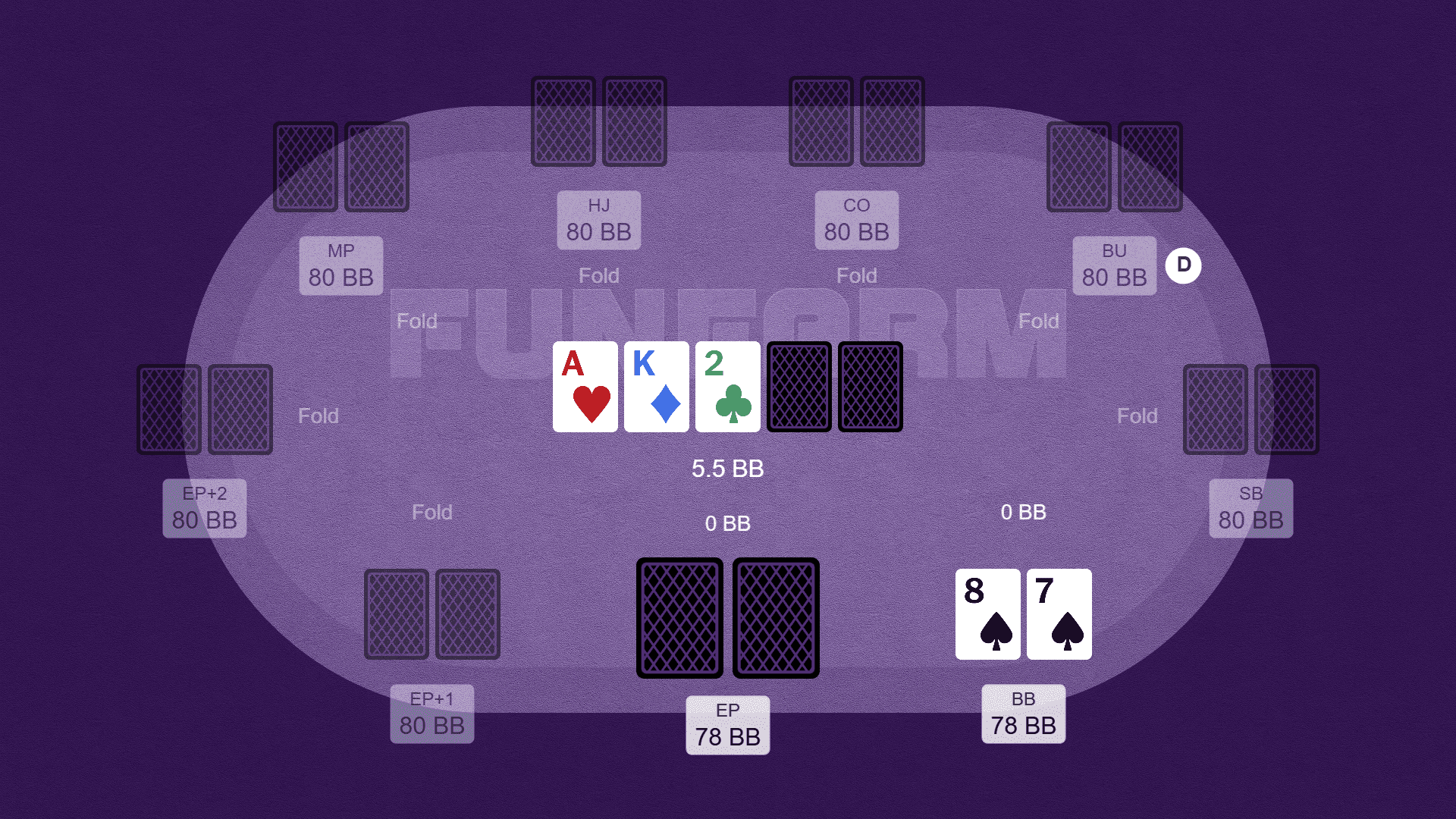
We have 8♠️ 7♠️ on the big blind. The opponent in early position open-raised, we called. We have no connection on the flop and no draw. We check first. The opponent fires a c-bet. We have no reason to continue — we comfortably fold.
2. A medium-strength hand out of position
When we have a medium-strength hand, for example second pair on a dry board, a bet often makes no sense. We'll only get a call from stronger hands, and weak ones will fold. A check lets the opponent bet with a wider range, and we'll be able to call profitably.
Example hand:
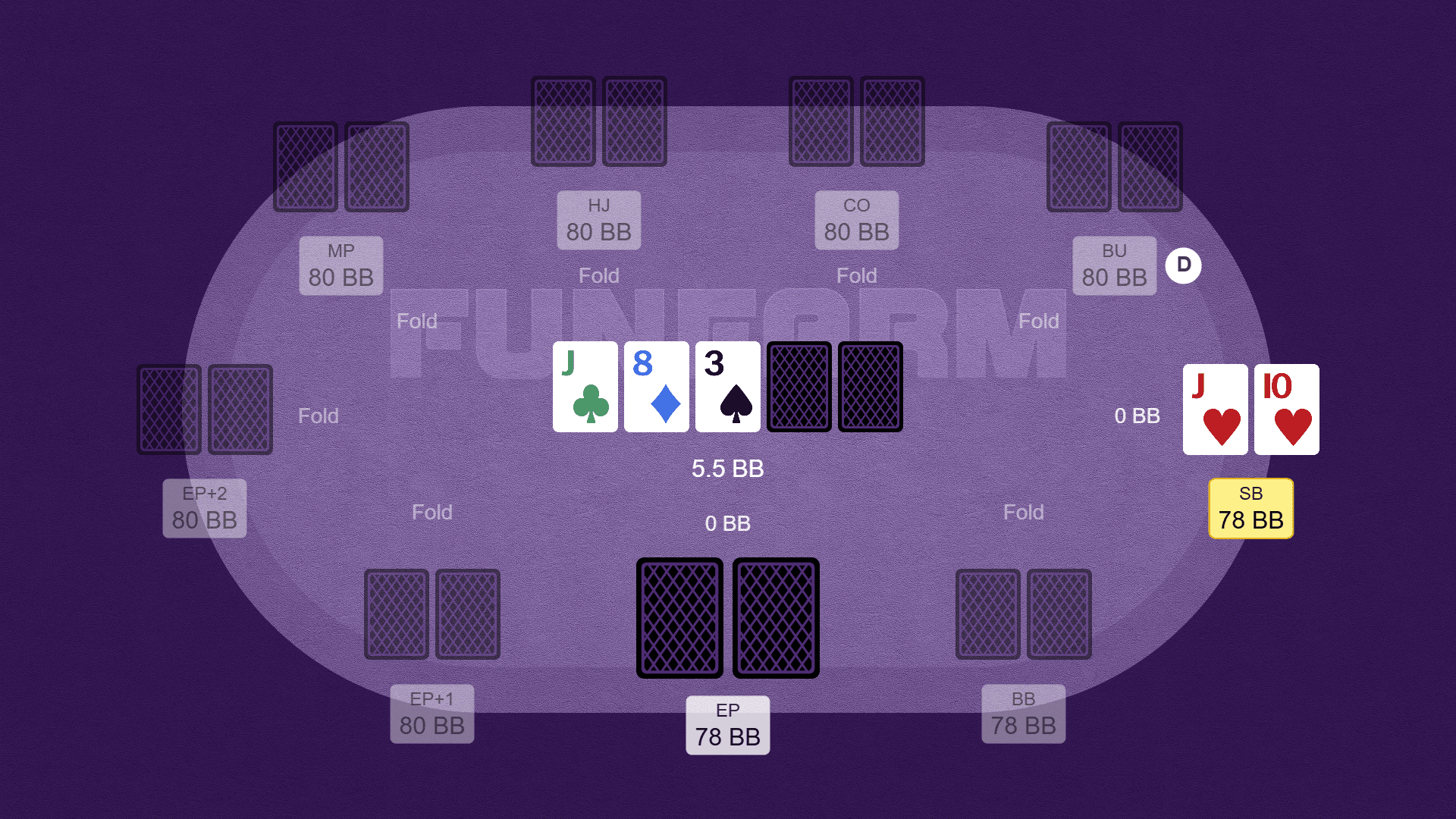
We have J♥️ T♥️ on the small blind. The opponent in early position open-raised, we called. We have top pair with a medium kicker. We check first. The opponent can bet with many hands weaker than ours — with smaller pairs, with straight draws, with two overcards. There's no point for us to play out of position with a raise, because the player will continue with all hands stronger — and often won't continue with hands weaker.
3. Setting up a check-raise
If we have a strong hand or a good draw, and the opponent is aggressive and bets often, a check is a way to apply pressure with the next action: we give him the chance to bet first, then raise. This brings more money than a direct bet.
Example hand:
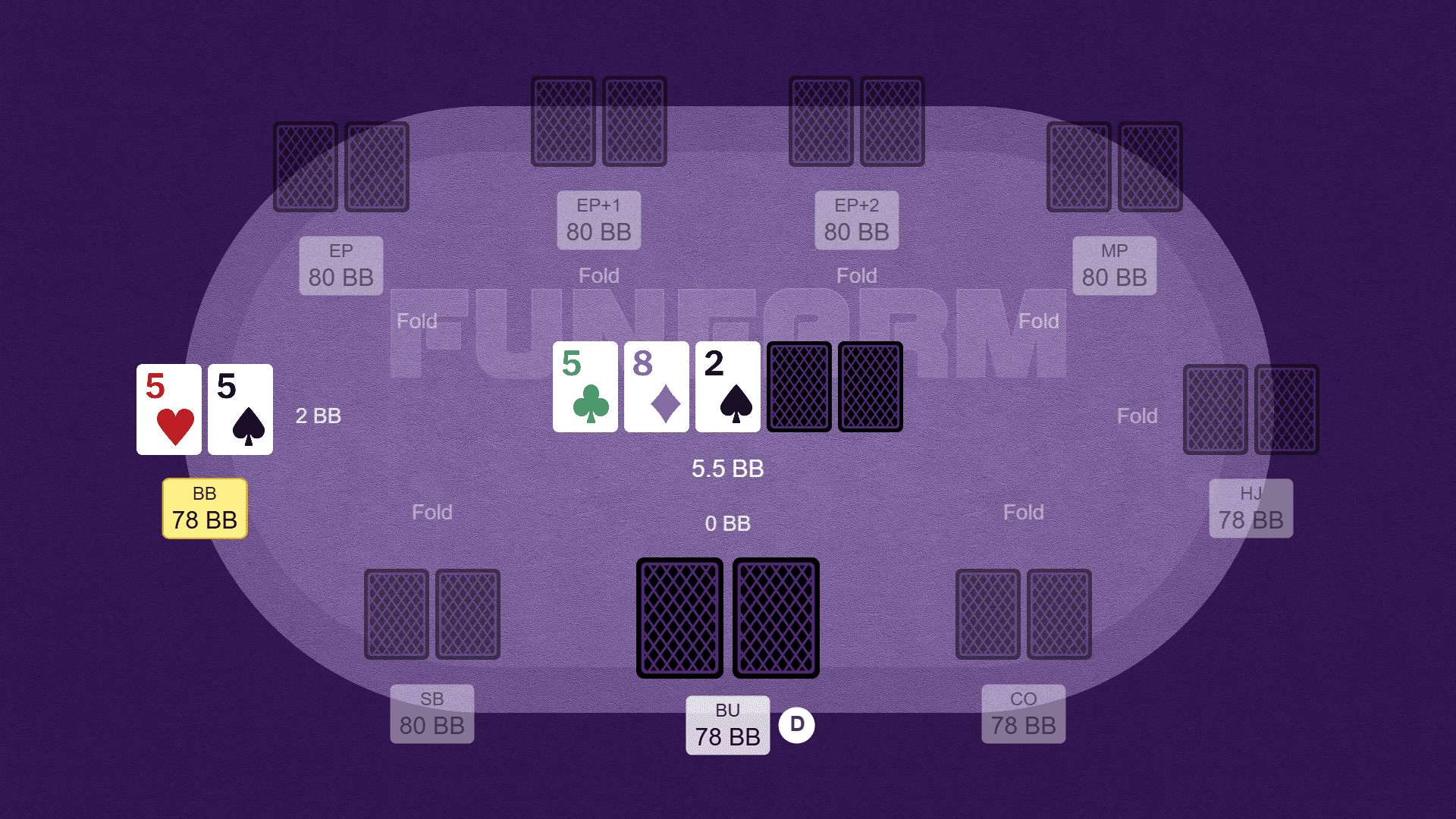
We have 5♥️5♠️ on the big blind. The opponent on the button open-raised, we called. We have a set. The opponent is aggressive and fires a c-bet almost always. We check, he bets, we check-raise. The pot is bloated, and the opponent often calls with top pair or overcards. If we had bet ourselves, he could have folded many hands.
* A c-bet is a continuation bet made by the player who showed aggression preflop.
We've left more knowledge about the concept of the "c-bet" and how to use this tool in play in this article. Head over and read it.
4. Slowplay with the nuts
Sometimes we deliberately check with a strong hand to provoke the opponent into bluffing. This works against aggressive players or on textures where the opponent has few hands to call with. Note that slowplay is more of an exception than a rule, but we'll still give an example hand.
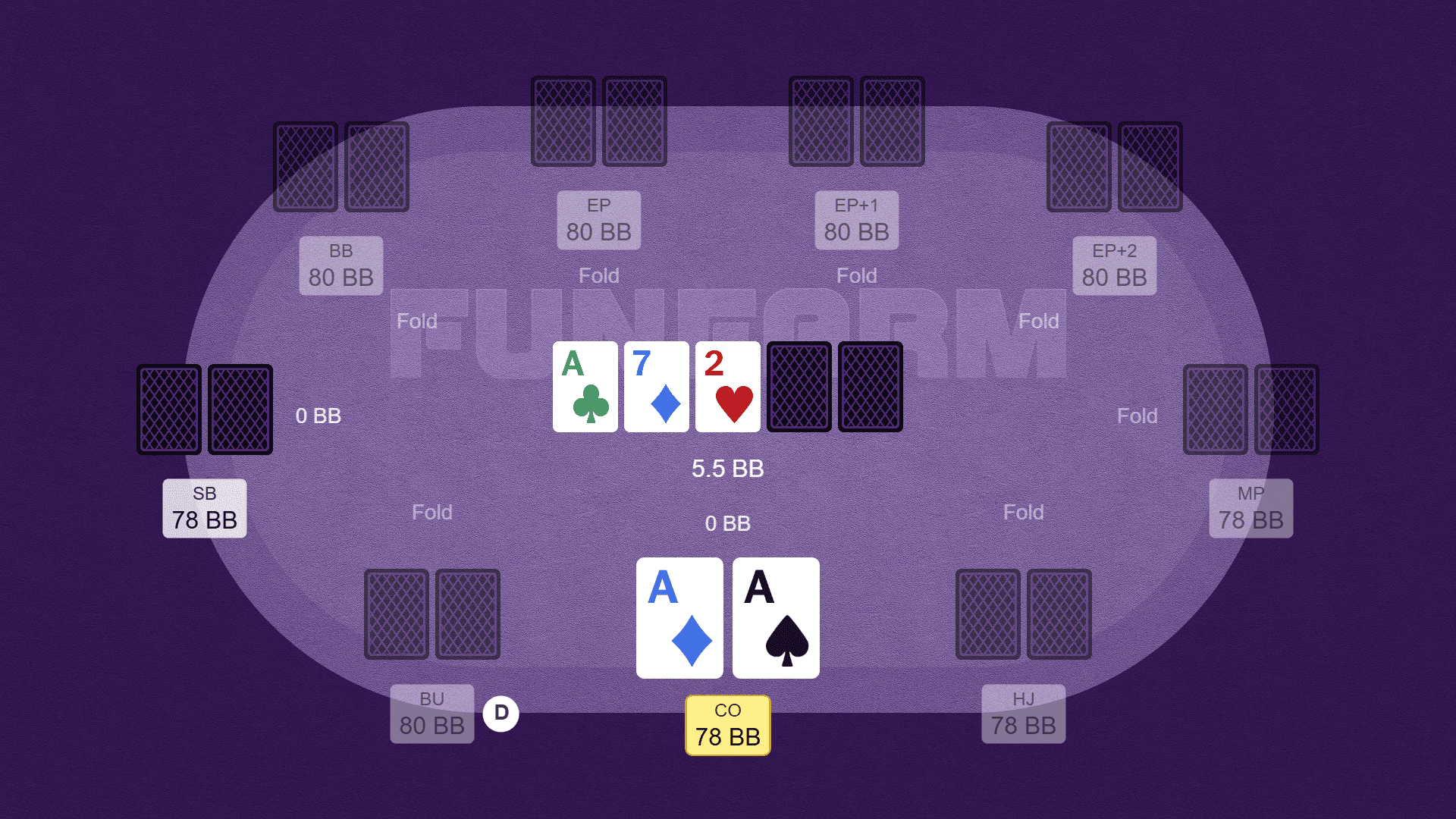
We have A♦️ A♠️ in the cutoff. We open-raised, the opponent on the small blind called. We have a set of aces. The opponent is very aggressive and likes to bet when no aggression is shown against him.
Often after a check we can get an aggressive action from an opponent who would have folded to our bet on the flop. It's worth noting that we chose an example where it's fairly hard for the opponent to improve to hands that would beat us — this factor always needs to be considered when we decide to check in position with a strong hand.
Learning at FunFarm, from any level
Checking on the flop, turn, and river
The role of the check changes depending on the street.
Flop. On the flop the check is most often defensive. We check with weak hands, with medium-strength hands, and also with part of our strong hands for balance. The flop is the street where the checking range is widest, because there's still little information about hand strength.
Turn. On the turn the check becomes more significant. A check-raise on the turn is one of the strongest actions in poker. It heavily polarizes our range: we either have a very strong hand or a bluff. It's hard for the opponent to continue without a strong combination.
River. On the river, checking with the nuts is often a missed value spot. In rare cases we can play it this way if we understand the opponent will bet as a bluff. But it's best to follow the strategy: with the nuts we bet big, and with a medium-strength hand we're ready to play a check-call with, we play exactly that way.
The mistake many players make is checking all three streets without a plan. This turns into a passive line where we just hope for luck. A check should be part of a strategy, not its absence.
Let's look at some types of checks with further continuation:
1. Check-call
A check-call is a line where we first check, then call the opponent's bet. It's one of the most common actions postflop, especially out of position.
A check-call is justified when we have a medium-strength hand that doesn't benefit from betting but is strong enough to call. For example, second pair or top pair with a weak kicker. If we bet ourselves, the opponent folds all weak hands and only calls with strong ones. If we check-call, he can bet with a wider range, including bluffs.
A check-call is also used with draws when we have no fold equity. If the opponent doesn't fold to our bets, there's no point bloating the pot with an unmade hand. We check, call a small bet, and hope to complete the draw.
The main drawback of the check-call is passivity. We don't apply pressure on the opponent, we let him cheaply realize equity, and we often face a tough choice on the next street.
2. Check-raise
A check-raise is one of the strongest techniques in poker. We check, the opponent bets, and we raise.
A check-raise serves several purposes.
With a strong hand we bloat the pot and force the opponent to pay more for the right to see the next card.
With a draw we increase fold equity and often take the pot without completing it.
With medium-strength hands we defend against the frequent c-bets of aggressive opponents.
The best situations for a check-raise are when we have the nuts or a strong draw, and the opponent is aggressive and bets often. On dry textures a check-raise is especially effective, because the opponent has few hands to continue with.
3. Check-behind
A check-behind is a check in position after the opponent has also checked. We're last to act, we see the opponent showed weakness, but we don't bet either.
Why would we check in position if we can bet? There are several reasons.
Pot control. If we have a medium-strength hand that doesn't benefit from bloating the pot, a check-behind lets us keep the pot small. For example, on the flop we have second pair, and the opponent checked. A bet would make him fold weak hands and call only with strong ones. A check lets us get to showdown cheaply.
A free card. If we have a draw, and the opponent checked, we can see the next card for free. A bet in this situation makes no sense, because fold equity is low (the opponent showed weakness, but it's not a given that he'll fold), and we can complete the draw anyway.
Slowplay. If we have a very strong hand, and the opponent checked, a check-behind can provoke him into betting on the next street. But this technique only works against aggressive opponents. Against passive ones, a check-behind with a strong hand is a loss of value.
4. Check-fold
A check-fold is a sequence where we first check, then fold our hand to the opponent's bet. It's not a technique but a statement of fact: our hand has no prospects.
A check-fold is justified when we have no equity, no draw, and the opponent bets. We don't want to put money into a hopeless situation. Better to save the chips for the next hand.
Typical mistakes when checking
1. Checking out of fear instead of checking by strategy
The player checks because he's afraid to bet, not because it's profitable. As a result he loses value with strong hands and lets opponents bluff and take pots that could potentially have been won.
2. Slowplaying to the river with the nuts
The player checks on the flop and turn with a strong hand, hoping the opponent will start betting as a bluff. On the river the opponent checks too, and the player wins a small pot instead of a big one. Slowplay only works against aggressive opponents.
3. Check-calling without a plan on the turn and river
The player calls a bet on the flop without understanding what he'll do on the next cards. On the turn he checks again and calls again, and on the river he faces a tough choice. We always need to have a plan for the entire hand, not for one street.
4. Check-raising as a bluff without outs
The player check-raises with hands that have no potential to improve. If the opponent calls, we have no plan for the next streets. A check-raise with a draw is a semi-bluff. A check-raise with hands with no potential is just a loss of chips.
Conclusion
If you want to learn to build balanced ranges postflop, correctly use check-raises and check-calls, and stop being afraid of passive lines — submit an application to FunFarm.
Free course · FF Start
From the rules to your first confident game
Work through the fundamentals in order: from hand rankings and positions to choosing starting hands.